
How to Stress Test Your Startup Pitch Before Investor Meetings
A well-crafted investor pitch is not enough; it must be rigorously pressure-tested to uncover weaknesses, anticipate difficult questions, and refine your narrative. Learn how to simulate investor scrutiny, gather actionable feedback, and leverage advanced tools to ensure your pitch is robust and compelling, setting your startup up for funding success.
By Founders360 Team
Meeting investors is a pivotal moment for any startup. It is your opportunity to articulate your vision, demonstrate your potential, and secure the capital needed to grow. However, a polished pitch deck and a confident presentation are only the beginning. The truly successful founders are those who have subjected their pitch to rigorous scrutiny, identifying every potential weakness and preparing for every challenging question. This process, known as pressure-testing, is not merely about memorizing lines; it is about deeply understanding your business from an investor's perspective and building unshakeable confidence. To further enhance your startup journey, you might also be interested in our guide on the best AI tools for startup founders.
Why Pressure-Test Your Investor Pitch?
An investor pitch is not just a presentation; it is a conversation where investors are actively looking for reasons to say yes, but are also keenly aware of potential red flags. Many founders believe that investment decisions hinge solely on the substance of their pitch, but in-person encounters are often more about asking questions, gaining clarity, and assessing personalities. A robust pitch practice builds founder confidence, surfaces questions and weaknesses, and helps iterate toward a sharp, compelling presentation that resonates with target investors. Insufficient practice, conversely, can lead to fumbled questions and reduced credibility.
Thorough preparation demonstrates respect for an investor's time, attention to detail, and the ability to communicate complex ideas clearly. These "soft skills" can be as important as business metrics when investors decide if they want to partner with you for years to come.
Understanding the Investor's Evaluation Framework
To effectively pressure-test your pitch, you must first understand what investors are truly evaluating. Venture capital decisions are structured, driven by a small set of core questions that rarely change, even if phrased differently by various firms. Investors want to know if you are operating in a large, growing market, often looking for a revenue potential of $1 billion or more. They will scrutinize the total addressable market size, market growth rate, and any structural shifts in technology or regulation. A strong startup in a small market may be a great business, but it may not be fundable from a venture capital perspective.
Key areas of investor focus include:
- Market Opportunity: Is the market large enough, and is it growing? Is there a clear need for your solution?
- Solution and Differentiation: What problem are you solving, and how is your product or service vastly better than existing alternatives? What is your unique selling proposition (USP)?
- Traction and Business Model: Have you demonstrated measurable progress, such as user growth or revenue? How do you make money, and is the business model clear and viable?
- Team: Can your team execute the vision? Investors look for a clear vision, progress, and growth, as well as the 'known-you-for' factor, which adds trust.
- Financials: Are your financial projections realistic and well-supported? Do you know your numbers inside and out?
Investors also look beyond competence; they assess character and trustworthiness. A founder lacking a specific skill can hire for it, but character is less malleable.
Simulating Tough Questions and Objections
One of the most effective ways to pressure-test your pitch is to anticipate and practice answering difficult questions. Investors will probe every aspect of your business. Common questions include:
- "What problem is your company solving?"
- "What is unique or proprietary about your product or service?"
- "How large is the market for it?"
- "What is the competitive landscape, and how is it evolving?"
- "What are the revenue and growth models?"
- "Can your team pull it off?"
- "How many users do you have, and how did you find your early customers?"
- "Why would someone use you over your competition?"
- "What segment within the gigantic total addressable market are you focusing on first?"
Practice sessions should go beyond merely reciting your deck. They should simulate the Q&A segment, which is often the highest-leverage block of the meeting. Try to rephrase questions to ensure you understand what the investor is truly asking, as sometimes there is a hidden intent behind a query.
Gathering Structured Feedback
Feedback is crucial for refinement. Do not just present your pitch; actively seek critical, constructive input. The most valuable practice partners are advisors and other founders who have fundraising experience. Even trusted friends or colleagues can provide useful perspectives. When soliciting feedback, focus on both content (which parts work, which do not) and delivery (pace, energy, clarity).
Structured feedback sessions can reveal patterns in questions that consistently emerge, indicating areas of confusion or weakness in your pitch. This feedback can help you refine your story, the flow, the wording, transitions, and timing. Aim for at least 20 practice sessions; most founders see dramatic improvement after this threshold.
Refining Your Narrative and Delivery
Your pitch is a story, not just a list of facts. It needs a compelling narrative that connects the problem, solution, and market opportunity seamlessly. Start strong with an opening that establishes who you are, what you do, and why investors should care, ideally within the first 30 seconds.
Confidence comes from competence, and practice reinforces both. Rehearse out loud, not just by reading. Record yourself and review the playback to identify areas for improvement in your delivery, such as filler words, awkward pauses, or maintaining eye contact. Time your pitch to ensure it fits within the allotted time while leaving ample room for Q&A. Focus on articulating your problem-solution fit with specific examples and presenting key metrics, such as revenue figures, growth rates, and market size, without hesitation. Remember, investors invest in people as much as ideas, so showing genuine passion and conviction is vital.
Leveraging AI for Pitch Pressure-Testing
Modern founders have powerful tools at their disposal to stress test their pitches. Founders360 offers specialized AI agents that can help you scrutinize your pitch from multiple angles, ensuring it is robust and investor-ready. For example, the Investor Memo Simulator helps you craft and pressure-test investor communications by simulating how your memo might be perceived. The AI Red Team agent can actively attack your assumptions, pushing you to defend your key decisions and identify potential vulnerabilities in your strategy and projections. This is invaluable for anticipating the tough questions investors might ask.
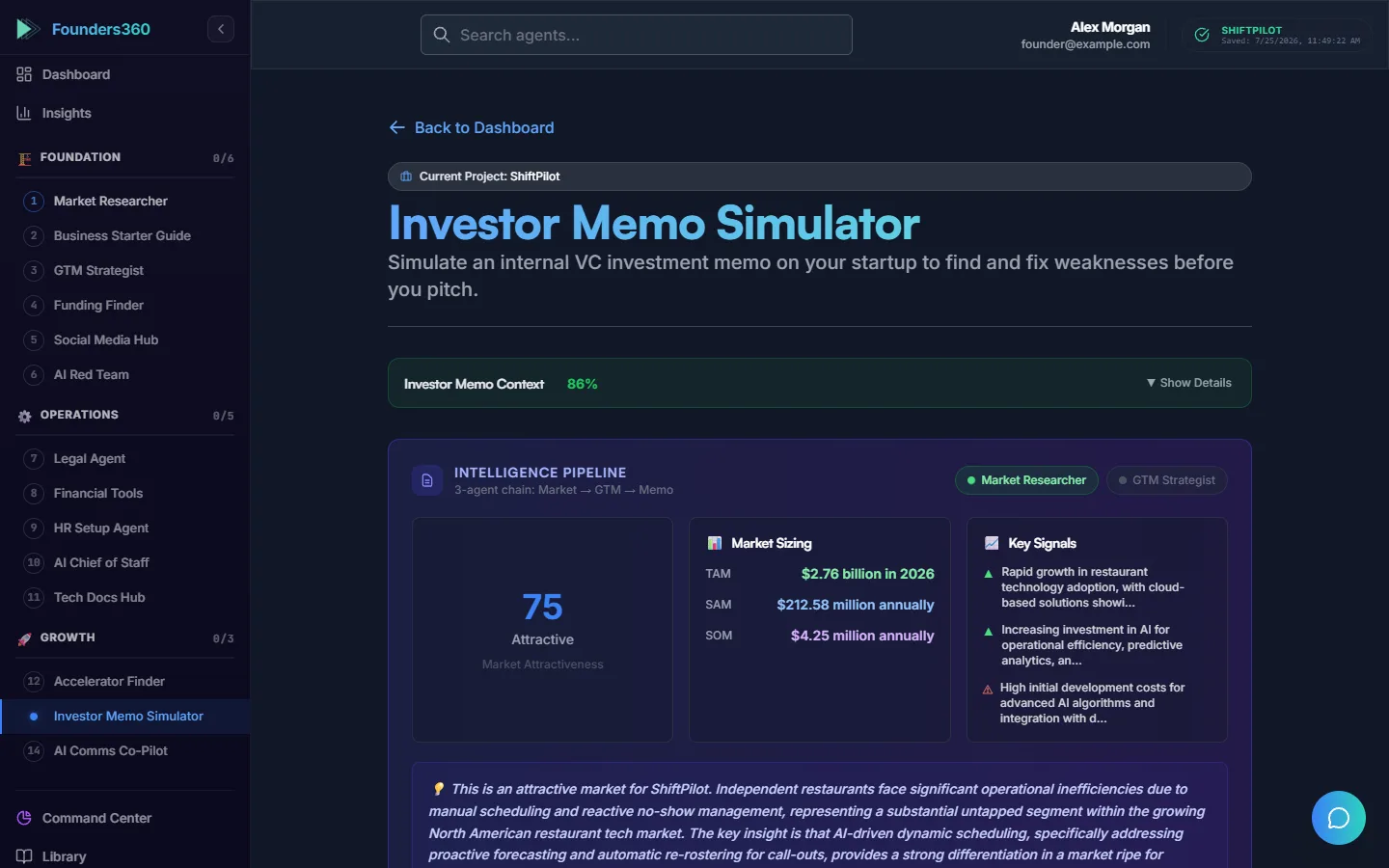
Beyond these, agents like the Market Researcher ensure your market sizing and competitive analysis are sound, while the Financial Agent helps validate your revenue models and projections. The advantage of a suite like Founders360 is its shared context; market research findings automatically inform your financial model and other outputs, eliminating copy-pasting and ensuring consistency across all your documents. You can explore these and other specialized AI agents at /agents to strengthen every aspect of your fundraising strategy. For detailed information on agent availability and access, please refer to our pricing page.
The Importance of Data and Projections
While storytelling is important, investors ultimately rely on data. Your financial projections must be realistic and well-supported, not overly optimistic or vague. Be prepared to discuss your numbers in detail, including revenue models, growth rates, and how prices fit into your revenue goals. Astute investors will quickly spot irregularities and will ask probing questions.
Additionally, your pitch should acknowledge risks and challenges, demonstrating that you have considered potential hurdles and have plans to mitigate them. Dismissing competitors or being vague about market size are common pitfalls to avoid.
Final Preparations Before the Meeting
After countless practice sessions and refinements, your pitch should feel natural, yet sharp. On the day of your meeting, focus on the logistics. Ensure your technology is working, arrive on time, and be prepared to engage in a conversation rather than just delivering a monologue. Remember to listen carefully to questions and address them directly.
Having backup materials readily available, such as detailed financial spreadsheets or customer testimonials, can be helpful, but avoid overwhelming investors with too much detail in the initial pitch. The goal is to pique their interest and move to the next stage of due diligence. Your pitch is not just about securing funding; it is about initiating a partnership. Make sure you are prepared to show you are a reliable, trustworthy, and visionary founder.
Frequently Asked Questions
How often should I practice my pitch?
Most successful founders practice their pitch 15 to 20 times before presenting, combining solo rehearsals with feedback sessions from mentors and peers. Some studies suggest significant improvement after 20 practice sessions. Consistent repetition with purpose refines both content and delivery.
What is the most common mistake founders make in pitching?
One common mistake is insufficient practice, which can lead to wooden delivery, fumbled questions, and reduced credibility. Other pitfalls include over-promising, dismissing competitors, being vague about financials or market size, and focusing too much on the product without adequate emphasis on the market or business model.
Should I have different versions of my pitch?
Yes, it is often beneficial to adapt your pitch to different audiences. For example, a venture capitalist focused on scalability might need a different emphasis than an angel investor interested in your team's background. Thorough practice allows you to make these adjustments naturally. You should also have an "elevator pitch," a condensed version of your presentation, ready in about 30 seconds.
How can I handle questions I do not know the answer to?
It is better to be honest than to guess or fabricate an answer. You can acknowledge that it is a good question and state that you will follow up with the information. Alternatively, you can reframe the question to ensure you understand its intent, buying yourself a moment to formulate a thoughtful response. Investors also value how you react to adversity, so maintaining composure is key.
Is it okay to disagree with an investor's point?
Yes, it is acceptable to respectfully disagree, especially if you have data or a well-reasoned argument to support your position. However, ensure your disagreement is grounded in facts and insights, not defensiveness. Your goal is to foster a productive dialogue, not a confrontation. Investors are looking for founders who can think critically and defend their ideas, but also listen and adapt.
Tags
Related Articles
What Accelerators Should Prioritize in Founder Tooling
Accelerators play a pivotal role in shaping the next generation of startups. Equipping founders with the right tools is not just about productivity; it is about fostering consistency, accelerating development, and ensuring investor readiness. This article explores the critical features and considerations accelerators must evaluate when selecting digital tooling for their cohorts to maximize impact and streamline operations.
9 min readPlaybooksStartup HR Checklist for Your First Hire (Every Document + Step)
Your first hire turns you into an employer overnight — with legal duties most founders discover too late. This checklist covers every document, registration, and decision before day one.
8 min readPlaybooksFinancial Projections for Startups With No Revenue (Template + Method)
Pre-revenue projections feel like fiction — but investors read them as a test of your reasoning, not your fortune-telling. Here is the assumption-driven method that passes that test.
9 min readReady to Build Smarter?
Join thousands of solopreneurs using AI agents to scale their businesses.
Get Started Free