
AI Tools for University Entrepreneurship Programs: A Director's Guide
The right AI tools for a university entrepreneurship program give every student team one shared company memory, not a pile of disconnected chatbots. This guide covers the three tool categories, what to require on integrity and guardrails, and how to license for a cohort.
By Founders360 Team
AI tools for university entrepreneurship programs should give every student team one shared company memory that carries from market research through to the pitch, rather than a list of disconnected chatbots that each start from zero. That is the selection rule. A tool that makes a student write a better business plan in isolation is a small win; a workspace where the plan, the financial model and the deck all draw on the same validated facts is the thing a program can build a curriculum on.
We license a branded portal to university programs, so we have a position here and we state it. What follows is how we would evaluate the category from the director's side of the table, including the parts where a general chatbot is the right answer.
What a university entrepreneurship program needs from AI tools
A university program needs consistency across teams, a low cost per seat, and a way for a mentor or instructor to assess the work, and it needs those three things more than it needs any particular generation feature. Student founders differ from accelerator founders in ways that change the requirement: they have no money, so a tool priced per company at accelerator rates is out; they work to a term calendar with hard deadlines; teams change composition mid-course; and the output has to be graded or reviewed by someone who was not in the room.
That last point is the one most tool evaluations miss. In an accelerator the founder is the only person who needs to trust the work. In a course, an instructor has to look at forty market analyses and tell the defended one from the invented one. A tool that produces fluent text with no record of where the numbers came from makes that job harder, not easier.
The other difference is churn. A team that forms in September and dissolves in December leaves nothing behind unless the tool kept a record the program can hand on. Most chatbot histories belong to one person's account and vanish with them.
The three categories of AI tools for student founders
There are three categories, and most programs end up with one from each.
| Category | Examples of what it does | Where it fits a program | |---|---|---| | General chatbots | Drafting, brainstorming, explaining a concept | Every student already has one; do not pay for a second | | Point-solution generators | A business plan builder, a pitch-deck tool, a financial model template | Good for one deliverable, blind to every other one | | Shared-context founder workspaces | Specialised agents that read and write one company memory | The course spine: research feeds legal, finance and the deck |
General chatbots are free and every student has one. The program does not need to buy them, but it does need a policy for them, covered under integrity below.
Point-solution generators are where most program budgets go and where most of the disappointment comes from. A business plan generator produces a plan; when the team changes its market three weeks later, the financial model built in a different tool does not know. Our roundup of AI business plan generators is the honest version of that comparison, including the cases where a single-purpose tool is the right buy.
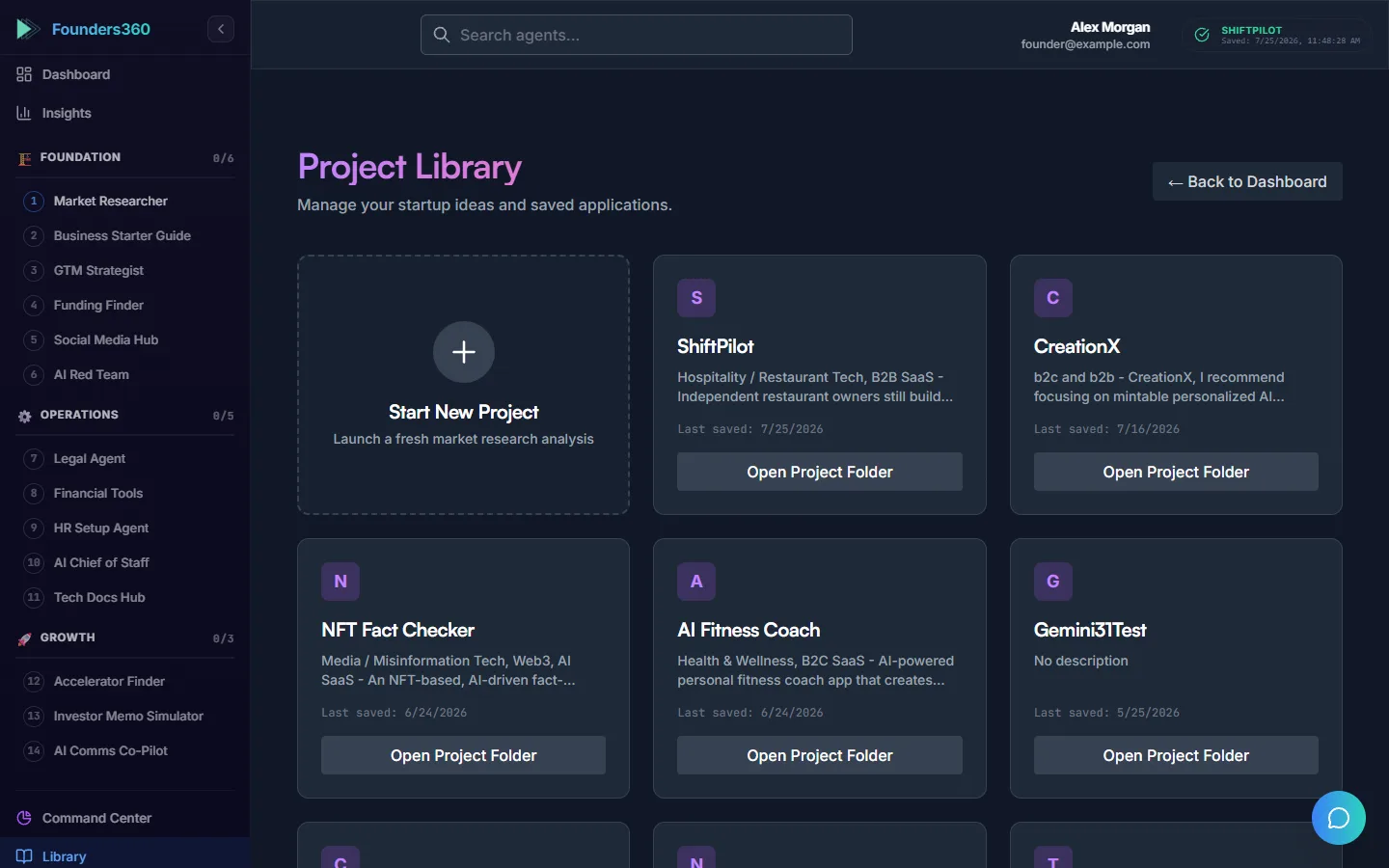
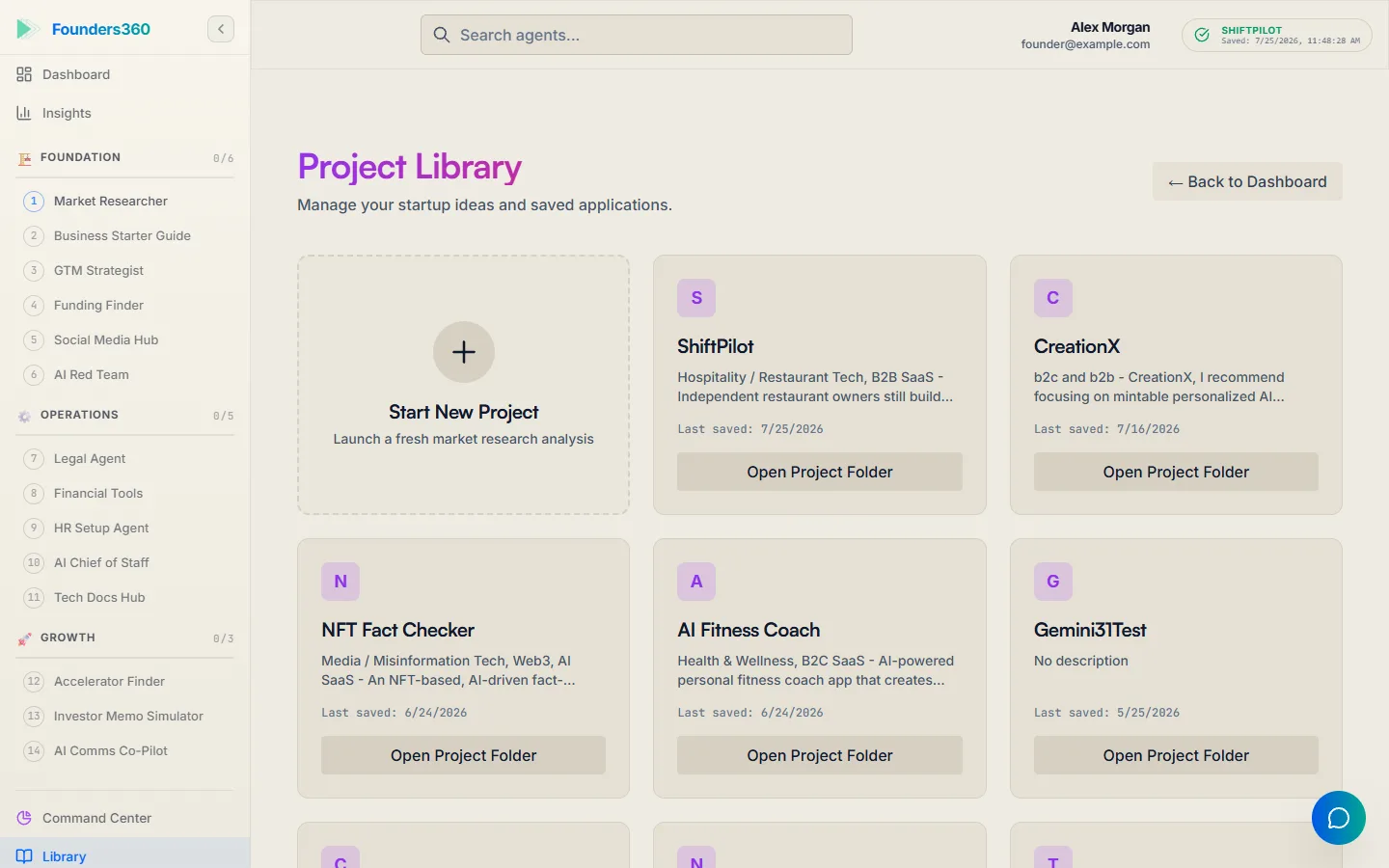
The third category is the one we build. The agents are specialised (market research, legal, financial modelling, HR, funding, go-to-market, an adversarial red team), but the point is not the count. The point is that each one writes its result into a store the others read.
Why shared memory matters more for student founders than for funded ones
Shared memory matters more in a course because a student team re-explains its company more often than any funded founder does: to a new teammate, to a mentor, to a judge, to the next tool.
In our workspace the Market Researcher writes the market size it produces into the company's Shared Context as structured facts (TAM, SAM, SOM, the sources behind each). When the same team later opens the Funding Finder, the market-size slide of the deck is filled from those facts without anyone re-typing them. When the Legal agent drafts the founder agreement, it already knows how many founders there are and what the company does. In production, roughly two thirds of every fact in that store was written by the Market Researcher: get the research right and everything downstream inherits it.
For a director, the consequence is that every team's work accumulates in one place in a consistent shape, which is what makes the program measurable; our companion piece on how to measure an accelerator program covers the scoring.
Academic integrity with AI: assess the reasoning, not the prose
Assess the reasoning and the sources, and let students use the tools openly. A ban is unenforceable and teaches the wrong lesson; every founder these students become will use these tools daily. The assessable skill is whether the team can defend the market size, explain why the pricing model was chosen and name the assumption that would break the plan.
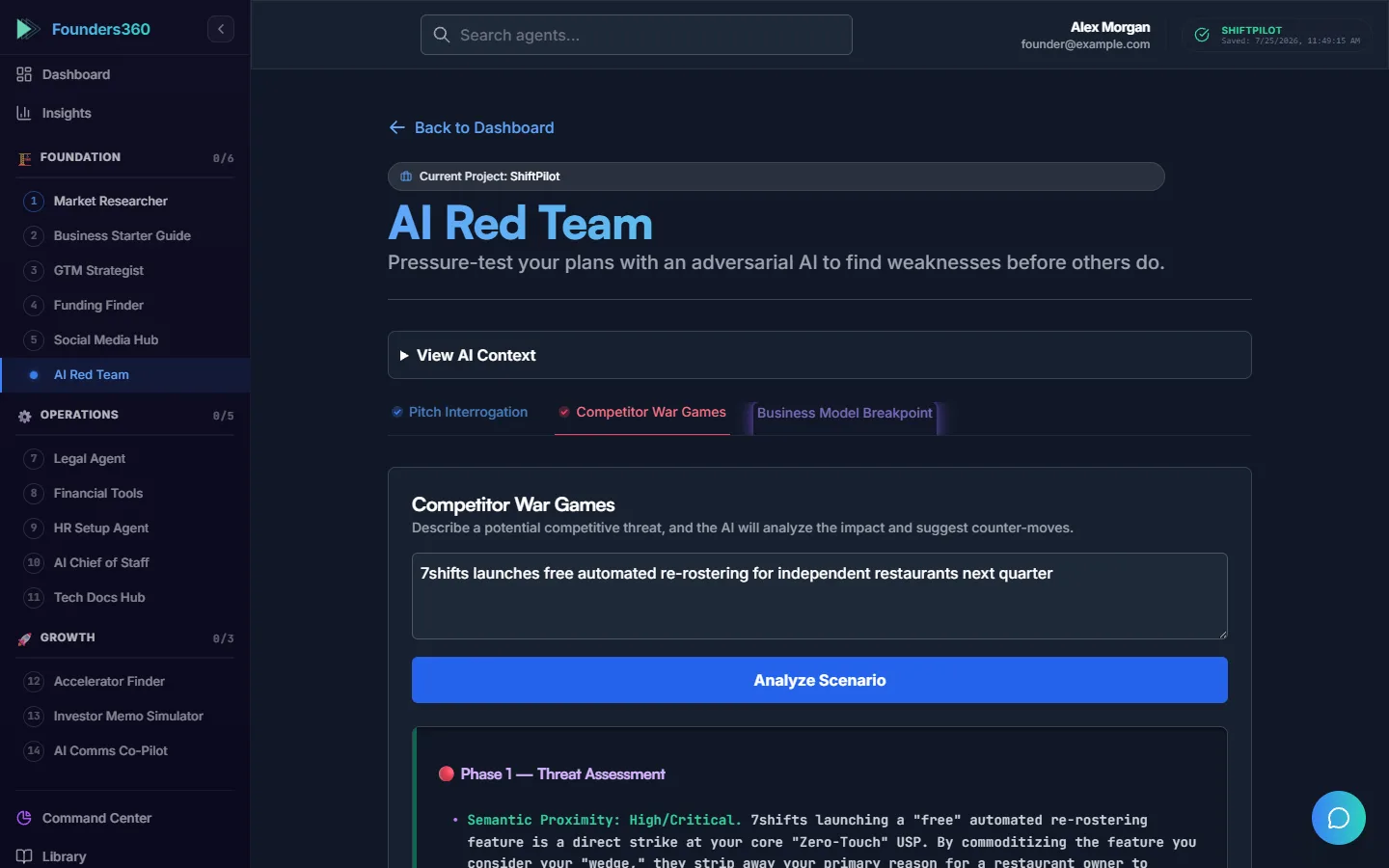
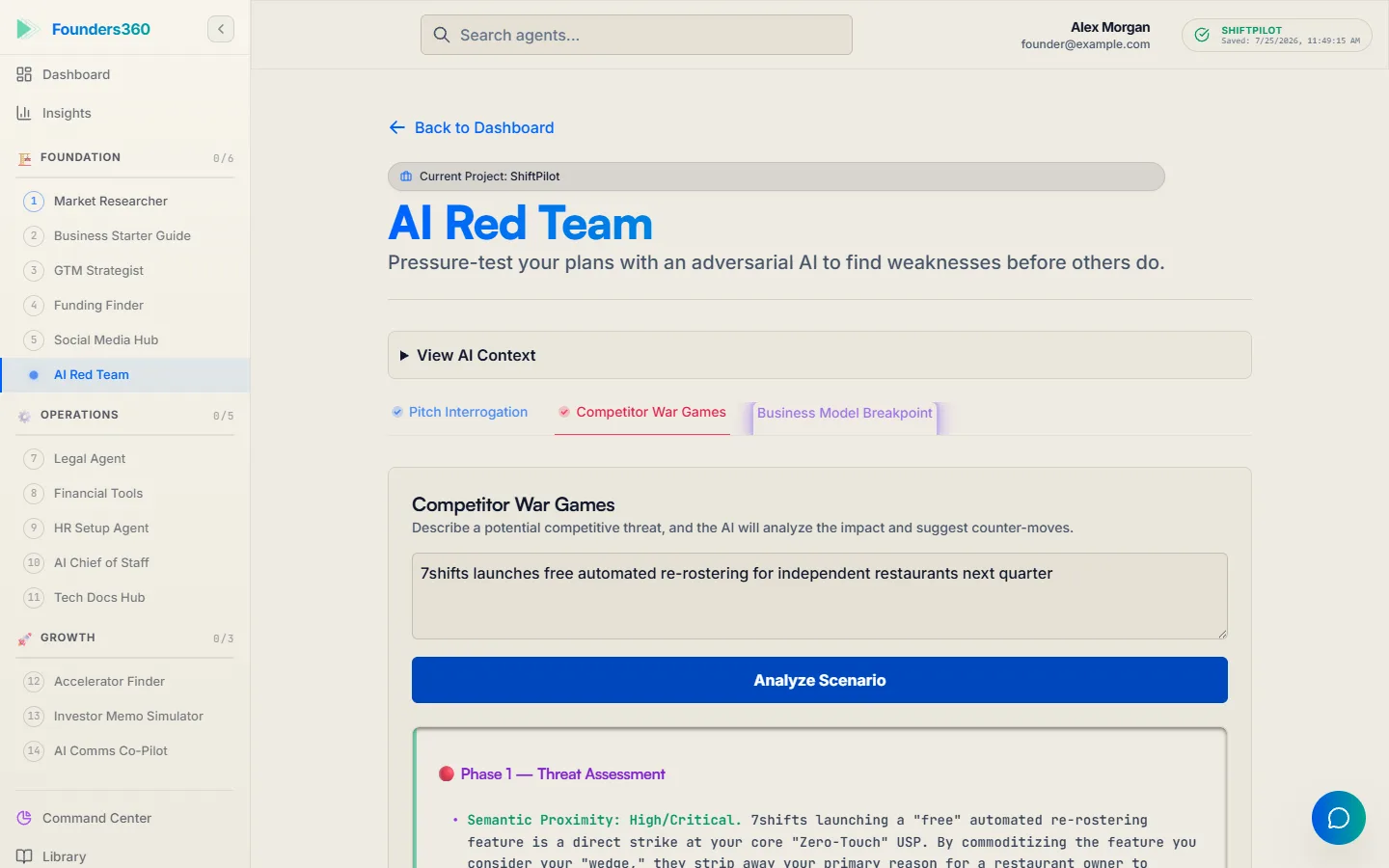
The tool can help with that directly if it is built to argue. Our AI Red Team is an agent whose only job is to find the weakest assumption in a plan and attack it. On our fictional test company (ShiftPilot, an AI scheduling idea for restaurants, and it is fictional) its first question named a real incumbent and asked what stops a restaurant from clicking that incumbent's auto-fill button instead. A team that has answered that in writing has done the thinking the course is meant to teach. We wrote about the design choice in why your AI co-founder should argue with you.
A simple assessment rule that works: every number in a submitted plan must carry a source the student has opened, and every plan must include the three hardest objections it received and the response to each. A tool that keeps that record makes the rule cheap to enforce.
What AI tools cost for a cohort of student founders
Budget per seat, not per company, and check what is free before you buy. On our platform, four agents are free forever (Command Center, Market Researcher, GTM Strategist and Business Guide), enough for a student team to size a market and draft a go-to-market plan at no cost. The paid tiers are Founder Pro at $19.99 per month and Elite at $59.99 per month, and the pricing page lists exactly which agents each unlocks.
For a program, the sensible route is a cohort license rather than forty individual subscriptions. Our branded portal for institutions licenses seats at a tier under one agreement, runs on the program's own subdomain and branding, and puts every team's company in its own scoped memory inside the same portal. Pricing scales with cohort size, and the engagement starts with a walkthrough mapped to the course. What we show in it is the Shared Context handoff, research to deck, because that is the thing a director cannot get from a chatbot; the agent list is not.
Two or three single-purpose tools at their September 2026 published rates often cost more per student than one workspace, and none of them know what the others produced.
Guardrails a program director should require from any AI vendor
Require four things in writing: a cap on model spend, a kill switch on the process that acts, scoped data per team, and evidence that the vendor tests what it claims. These are the guardrails we hold ourselves to, and each one came from a mistake.
Every model call in our system is counted, capped and cached. An organisation with no explicit budget gets a daily floor of 500 tool calls rather than unlimited, and when we add a model call we write the test that asserts its call count. Ask a vendor what happens if a student leaves an agent running in a loop overnight.
On kill switches, our lesson was expensive. Our outbound email program runs on a separate cron service with its own environment. We once set the "require human approval" flag on the API service instead of the cron service. It looked like it worked, and the cron sent a cold email to a program director who was supposed to be reviewed first. A kill switch has to live on the process that acts, and you verify it by reading it back from there. A vendor that automates anything on your students' behalf should show you where that switch lives.
On scoped data, each company's memory must be readable only by that company's team. On testing, about 1,140 backend tests run on every push to our codebase from a hook that fails closed; every production bug becomes a test before its fix ships. Ask for the equivalent.
What a program director can do this week
Pick one section of one course and run a two-week pilot with a single deliverable: a defended market size with sources, produced inside a shared workspace, submitted alongside the three hardest objections the team received. Compare the submissions against last term's. That is enough to decide whether a cohort license is worth it, and it costs nothing on the free agents.
If you want the broader field before choosing, our roundup of AI tools for university entrepreneurship programs covers the alternatives, and we will walk any program through the Shared Context demo against its own syllabus.
Frequently Asked Questions
What AI tools should a university entrepreneurship program use?
One general chatbot, which students already have, plus a shared-context founder workspace where specialised agents for market research, legal, finance, funding and go-to-market all read and write one company memory per team. Point-solution generators for a single deliverable are optional and often redundant once the workspace is in place.
How should an entrepreneurship course handle AI and academic integrity?
Allow AI openly and assess the reasoning: require a source for every number, and require each plan to include the three hardest objections it received and the responses. Tools with an adversarial agent make that record cheap to produce and cheap to grade.
How much do AI tools cost for a student founder cohort?
Several core agents are available free on our platform (Command Center, Market Researcher, GTM Strategist and Business Guide), paid individual tiers are $19.99 and $59.99 per month, and programs license seats under one cohort agreement priced by cohort size rather than buying individual subscriptions.
What is a white-label portal for a university program?
A version of the founder workspace on the program's own subdomain and branding, with seats licensed at a tier under one agreement, where every student team has its own scoped company memory inside the same portal. Our institutions page describes the onboarding and pilot process.
Why does shared context matter for student founders specifically?
Student teams re-explain their company more often than funded founders: to new teammates, mentors, judges and each new tool. A shared memory means the market research the team validated in week three is what the financial model and the deck use in week ten, and it stays with the program when the team graduates.
Tags
Related Articles
The Solo Founder Tech Stack for 2026: What to Buy, Build and Skip
The solo founder tech stack for 2026 is short: build only the product, buy everything that is not the product (payments, auth, email, hosting, the back office), and skip anything built for a team you do not have yet.
8 min readMarket TrendsHow to Measure an Accelerator Program: Metrics Beyond Demo Day
Measure an accelerator program by what each company has built and proven by the end of it, and by what happens in the 24 months after, not by the applause on demo day. This guide gives program directors the metrics, the scorecard and the instrumentation.
8 min readMarket TrendsWhy Your AI Co-Founder Should Argue With You
The default failure mode of AI isn't hallucination — it's agreement. A tool that tells you the truth beats one that flatters you, and for founders the difference is measured in wasted years. Inside: an AI that grills your pitch like a VC, walks your market size down instead of up, scores its own deck 72/100, and refuses to analyze numbers it doesn't have.
5 min readReady to Build Smarter?
Join thousands of solopreneurs using AI agents to scale their businesses.
Get Started Free