
How to Measure an Accelerator Program: Metrics Beyond Demo Day
Measure an accelerator program by what each company has built and proven by the end of it, and by what happens in the 24 months after, not by the applause on demo day. This guide gives program directors the metrics, the scorecard and the instrumentation.
By Founders360 Team
Accelerator program metrics should measure what each company has built and proven by the last week of the cohort, and what happens to it in the 24 months after. Demo day measures none of that. It measures how well ten founders present for eight minutes to a room the program filled.
We sell a branded portal to accelerators and university programs, and we hear the same complaint from directors in every conversation: the board wants a number, the only number to hand is funds raised at demo day, and everyone in the room knows it mostly measures which investors showed up. What follows is the set of metrics we would put in front of a board instead, and how to collect them without adding a reporting burden to founders.
Why demo day is the wrong finish line for an accelerator
Demo day is a marketing event for the program, and treating it as the outcome distorts everything upstream of it. When the finish line is a pitch, the cohort optimises for the pitch: the deck gets four weeks of polish, the market-size slide gets a number nobody can defend, and the work that actually decides whether the company survives (customer conversations, a financial model with real assumptions, a cap table that is not already broken) gets whatever time is left.
The second problem is timing. Money raised on demo day is committed by investors who decided weeks earlier, on the strength of intros and one-to-one meetings. It is a lagging indicator of the program's network, not a measure of what the program taught. Neither a strong cohort in a bad quarter nor a weak cohort with a well-connected director tells you what to change next year.
The third problem is that the number stops. A company that raises on demo day and dies eighteen months later counts as a win forever. If you only measure once, you only learn once.
The four accelerator metrics that predict outcomes
Four measures, taken at intake and at the end of the program, tell you more than any demo-day figure.
Time to first paying customer. Count the weeks from intake to the first invoice, and the share of the cohort that has one by graduation. This is the one number that separates a program that teaches selling from one that teaches pitching.
Foundation completeness. Does the company have a defended market size, a financial model with stated assumptions, a signed founder agreement with vesting, the legal entity in the right jurisdiction, and a hiring plan? Score each item as absent, drafted or reviewed. We cover the scoring in the next section.
Founder retention. How many founding teams are intact at graduation, and at twelve months? A co-founder split in month four is the most common quiet cause of a company that "just stopped", and it is almost always visible at intake if anyone looks at the agreement.
Capital efficiency, not capital raised. Months of runway per dollar of funding, and revenue per dollar spent. A company that raised less and needs less is a better outcome than one that raised more and is already burning it.
All four fit in one intake form and one exit form. The value is in the delta.
How to score foundation completeness across a whole cohort
Score foundation completeness by asking for the artefact, not the opinion. A founder will tell you the market size is validated; the question is whether there is a document with a top-down figure, a bottom-up figure and the sources for both.
The practical difficulty is that those artefacts live in ten different places: a market analysis in a founder's personal chatbot history, a deck in a designer's shared drive, a financial model in a spreadsheet nobody else can open. Collecting them for a cohort of twenty is a week of chasing, so most directors stop after the first cohort.
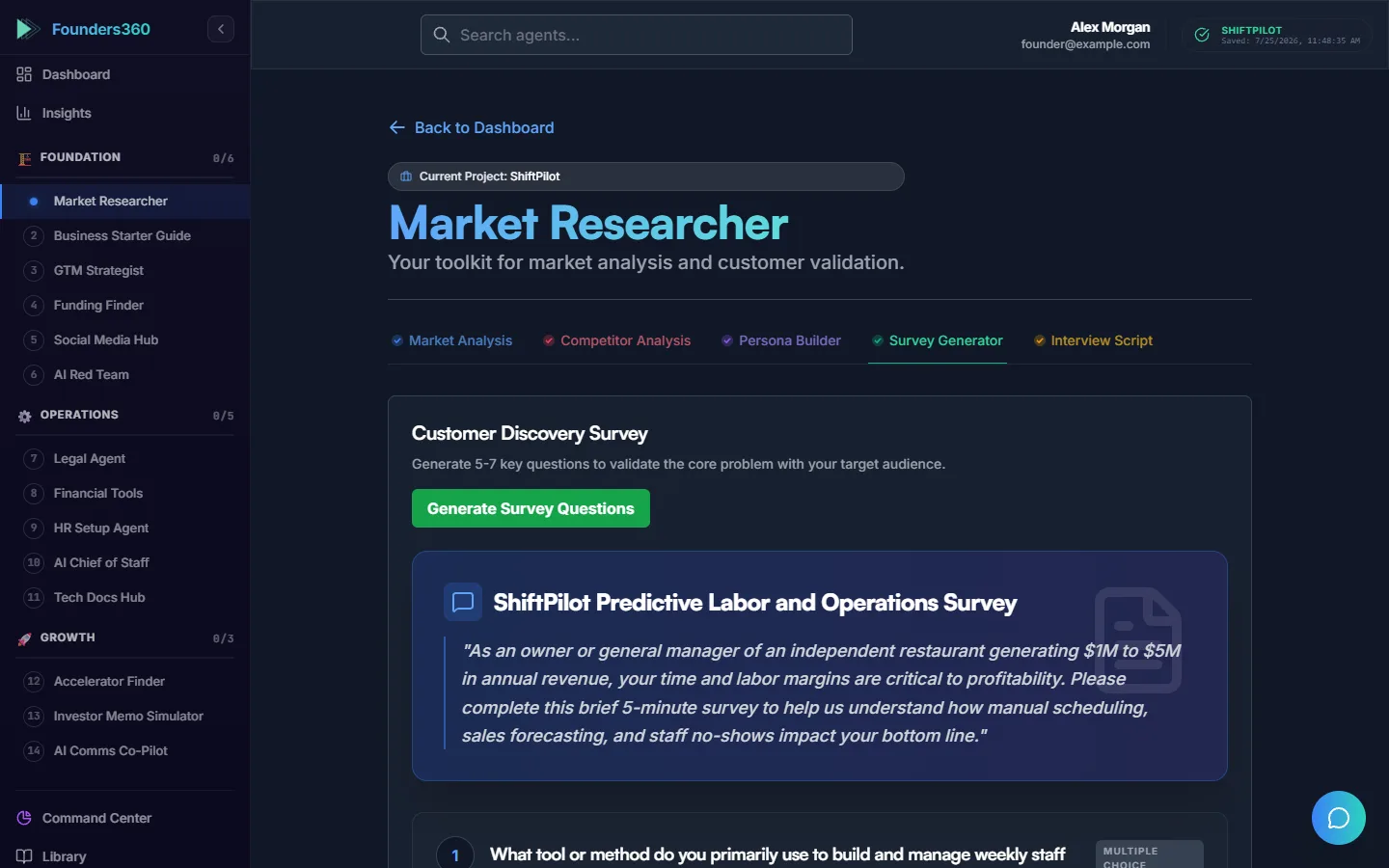
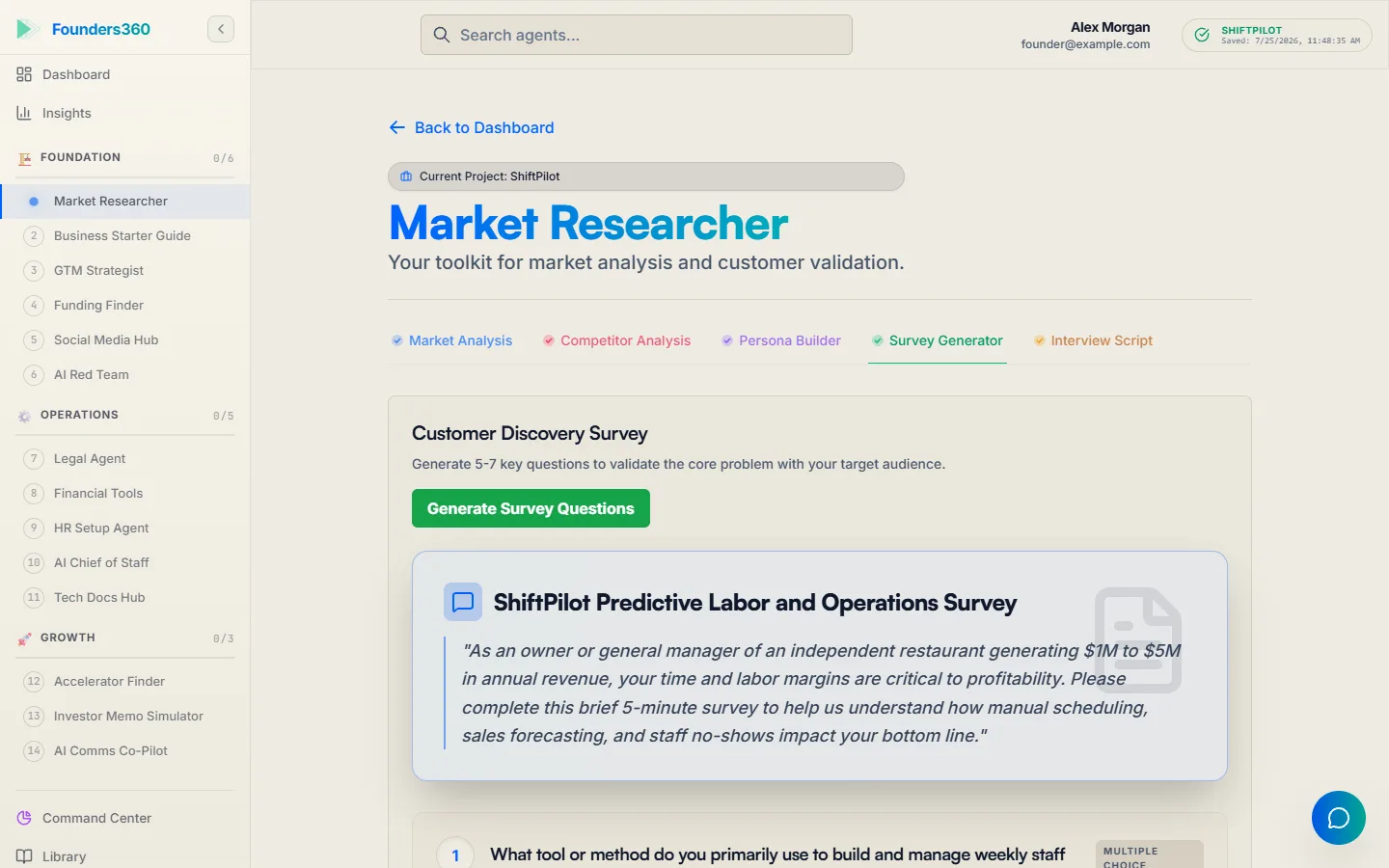
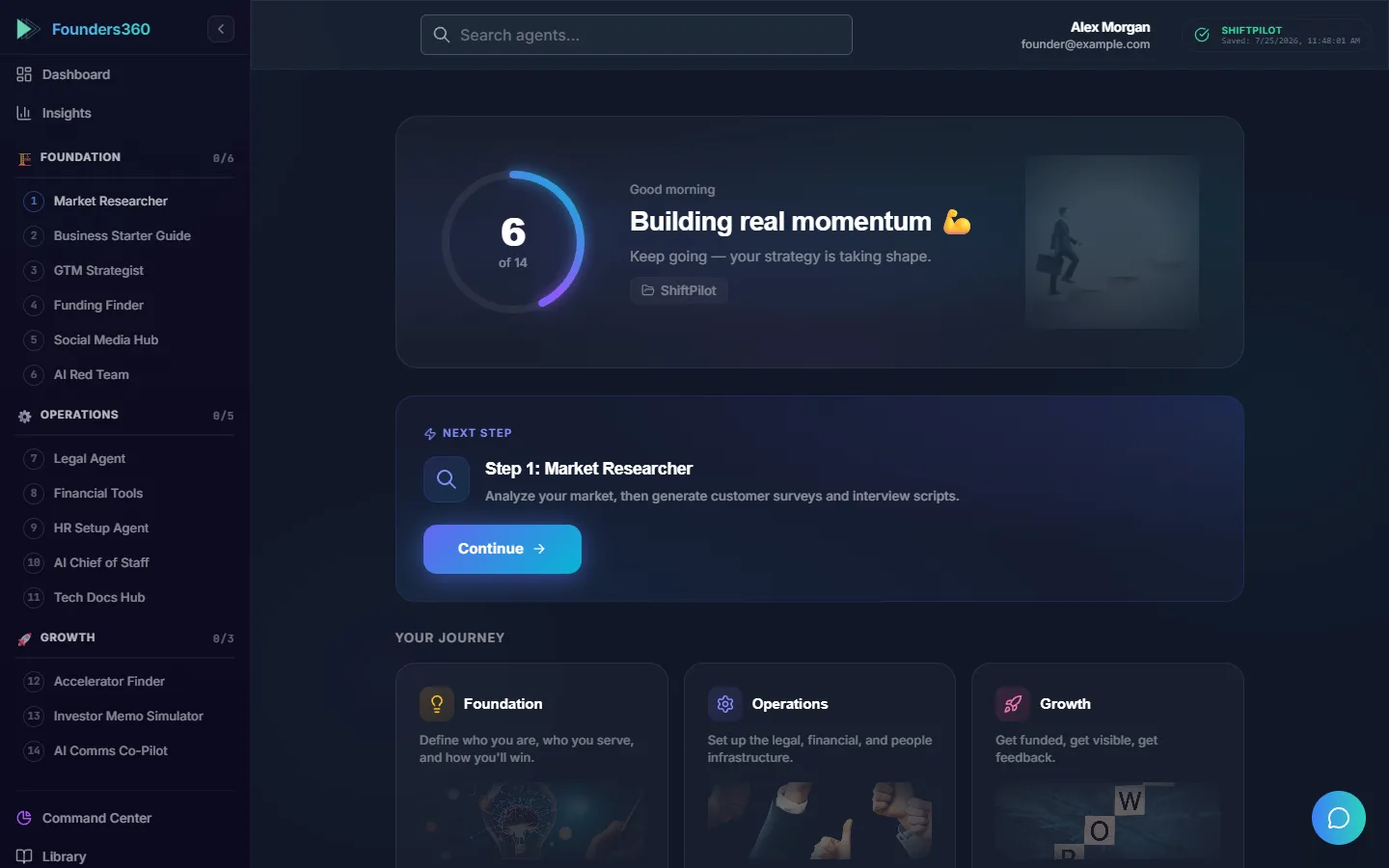
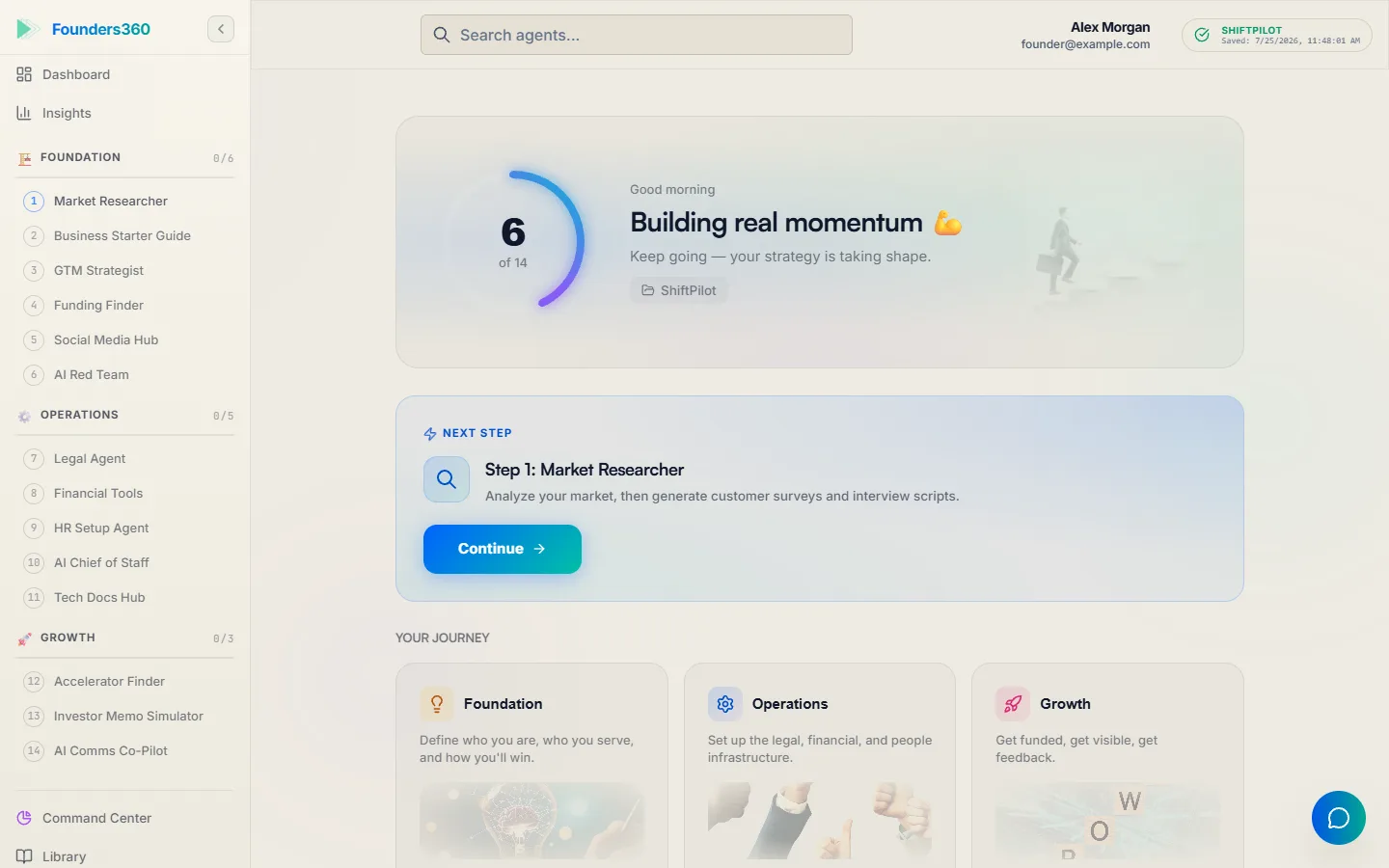
This is the problem a shared workspace solves, and it is the reason we sell programs the Shared Context demo rather than a list of agents. Inside the branded portal for institutions, every company in the cohort works in one memory. When a founder runs the Market Researcher, the TAM, SAM and SOM it produces are written into that company's Shared Context as structured facts. When the same founder later opens the Funding Finder, the market-size slide is filled from those facts without anyone re-typing them. For a director, that means the artefact exists in a consistent shape for every company, produced as a by-product of the work rather than as a reporting chore.
On our own fictional test company (ShiftPilot, an AI scheduling idea for restaurants, and it is fictional) the Market Researcher walked the market from a $2.8 billion TAM to a $212.6 million SAM and a $4.3 million obtainable slice, with the reasoning for each step. That is the artefact you want to see for every company in week three, not week twelve.
Measuring mentor hours by what changed, not how many were booked
Mentor hours are the most reported and least useful metric in the accelerator world, because the count tells you about the calendar and nothing about the company. Replace the count with two questions asked of the founder after every session: what decision did this change, and what will you do differently this week? Log the answers against the mentor.
After one cohort you will have a ranking of mentors by decisions influenced, and it will not match the ranking by hours booked. That ranking is the most valuable operating document a program director owns, and almost no program produces it.
The same logic applies to workshops. A session on financial modelling is measured by how many companies have a model with stated assumptions two weeks later, not by attendance. If the answer is two out of twenty, the session did not work, however good the feedback form looked. Our guide to financial modelling for pre-revenue startups is a reasonable checklist to score against.
Post-program tracking at 6, 12 and 24 months
Track every graduating company at 6, 12 and 24 months on four items: still operating, revenue band, headcount, and follow-on capital. Keep the form to those four; response rate is what kills every alumni survey, and a long form is how it dies.
One lesson from our own instrumentation applies directly here. Our public lead chatbot reported zero captured leads for seven weeks. We nearly concluded that visitors were not interested. The real cause was a bug: every conversation that called a tool failed on the very next turn, and pricing questions always called a tool, so the highest-intent question a visitor could ask was the one path that never worked. We were measuring the bug, not the funnel. The lesson is to re-baseline before drawing a conclusion from a number, and it applies to alumni tracking exactly: before you decide a cohort underperformed, check whether the collection worked.
An accelerator program scorecard directors can copy
The table below is the scorecard we would put in front of a board. The target values are illustrative, not a published benchmark; set your own from your first measured cohort.
| Metric | When collected | What good looks like | |---|---|---| | Foundation completeness (5 items, 0 to 2 each) | Intake, week 6, graduation | Median score rises by at least 5 points | | Share of cohort with a paying customer | Intake, graduation | Doubles between the two | | Founding teams intact | Graduation, 12 months | Above 85% at 12 months | | Mentor sessions that changed a decision | After every session | Ranking produced each cohort | | Runway months per dollar raised | Graduation | Improving cohort over cohort | | Still operating | 6, 12, 24 months | Above 60% at 24 months | | Alumni survey response rate | Each survey | Above 80%, or the row above is unreliable |
Funds raised at demo day is not a row. Record it because the board will ask, but keep it off the scorecard so it cannot become the target.
Platforms that run the program itself (applications, scheduling, reporting) are covered in our roundup of accelerator management software. Those tools run the program; a founder workspace equips the founders, and the scorecard above draws its rows from the second layer.
What a program director can do this week
Add two questions to your intake form this week: "Do you have a signed founder agreement with vesting?" and "What is your market size, and where did the number come from?" Ask for the document in both cases. Do the same at graduation, and you have your first measured delta before the next cohort starts.
Then ask three alumni from your last cohort which session changed a decision. If none did, you have found next year's curriculum change before the board has to. If you would like to see how a cohort's artefacts look when they are produced in one shared memory, we are happy to walk through the Shared Context demo for institutions against your actual program, and our companion piece on AI tools for university entrepreneurship programs covers the academic version of the same problem.
Frequently Asked Questions
What are the most important accelerator program metrics?
Time to first paying customer, foundation completeness (market size, financial model, founder agreement, legal entity, hiring plan), founding-team retention, and capital efficiency. Take each at intake and at graduation and report the change, then track survival and follow-on funding at 6, 12 and 24 months.
Should funds raised at demo day be a program KPI?
Record it, but do not make it the target. Demo-day money is committed weeks earlier on the strength of introductions, so it measures the program's network and the fundraising climate more than what the program taught. A KPI that founders can only influence through a pitch pulls cohort time toward the pitch.
How do you measure mentor quality in an accelerator?
Ask the founder after every session which decision it changed and what they will do differently this week, then log the answer against the mentor. After one cohort you have a ranking by decisions influenced, which is far more useful than a ranking by hours booked.
How long should an accelerator track alumni after the program?
At least 24 months, at 6, 12 and 24 month checkpoints, on four items only: still operating, revenue band, headcount and follow-on capital. Keep the form short so the response rate stays above 80%; a survival figure from a 30% response rate is not a survival figure.
How does a shared founder workspace help with program measurement?
It makes the artefacts exist in one consistent shape as a by-product of the work. When every company in the cohort works inside one Shared Context, the market analysis, the financial model and the deck are structured records rather than files scattered across personal tools, so foundation completeness can be scored without chasing twenty founders for documents.
Tags
Related Articles
The Solo Founder Tech Stack for 2026: What to Buy, Build and Skip
The solo founder tech stack for 2026 is short: build only the product, buy everything that is not the product (payments, auth, email, hosting, the back office), and skip anything built for a team you do not have yet.
8 min readMarket TrendsAI Tools for University Entrepreneurship Programs: A Director's Guide
The right AI tools for a university entrepreneurship program give every student team one shared company memory, not a pile of disconnected chatbots. This guide covers the three tool categories, what to require on integrity and guardrails, and how to license for a cohort.
9 min readMarket TrendsWhy Your AI Co-Founder Should Argue With You
The default failure mode of AI isn't hallucination — it's agreement. A tool that tells you the truth beats one that flatters you, and for founders the difference is measured in wasted years. Inside: an AI that grills your pitch like a VC, walks your market size down instead of up, scores its own deck 72/100, and refuses to analyze numbers it doesn't have.
5 min readReady to Build Smarter?
Join thousands of solopreneurs using AI agents to scale their businesses.
Get Started Free