
Answer Engine Optimization: How Startups Get Cited by AI Search
Search increasingly ends in an answer instead of a click. This guide covers why your rankings can hold while traffic falls, what answer engines actually reward, and how to structure a page so a model quotes you rather than a competitor.
By Founders360 Team
Answer engine optimization is the practice of structuring your content so that AI assistants and AI search results quote your company as a source. It matters now because a growing share of searches end in an answer rather than a click, and the founder who is quoted in that answer captures the demand that used to arrive as organic traffic.
This guide covers what changed, what these systems actually reward, and the specific edits that make a page quotable. It is written for founders doing their own distribution, without a content team.
Why your rankings can hold while your traffic falls
The most common and most confusing symptom is this: your position in search results has not moved, and may have improved, yet sessions are down. Nothing is broken. The click simply stopped happening.
When a search result is answered directly on the results page, or inside an assistant such as ChatGPT, Perplexity, Claude or Google AI Overviews, the user reads the answer and stops. This is the zero-click outcome. The traditional funnel assumed that ranking produced a visit and the visit produced a signup. Ranking now produces a citation, and the citation produces the visit only sometimes.
The practical consequence for a startup is that position tracking has become a lagging and partial signal. You can hold position three for your primary query and still lose the customer, because the answer above the results already recommended three tools and yours was not among them.
The second consequence is more urgent. If an assistant describes your category and names competitors, that description becomes the buyer's mental model before they ever reach your site. You are not competing for a click any more. You are competing to be part of the answer.
What answer engines actually reward
Answer engines do not read a page the way a reader does. Most operate by retrieval: they search an index, pull a handful of passages, and compose an answer grounded in those passages. The unit of value is therefore not the page. It is the passage.
This changes what good content looks like. A well written essay that develops an argument across nine paragraphs, saving the conclusion for the end, is excellent for a human reader and close to useless for a retrieval system, because no single passage contains a complete, self-sufficient answer.
Three properties make a passage quotable. It has to be extractive, meaning a model can lift two or three sentences and have them still make sense with no surrounding context. It has to be specific, because a model asked for a recommendation will prefer a passage that names things over one that gestures at them. It has to be attributable, meaning the claim is stated plainly enough that quoting it does not require the model to interpret or soften it.
Notice that none of this is a trick. The same properties make a page genuinely more useful to a hurried reader, which is why answer engine optimization and good writing have converged rather than diverged.
Write the answer first, then the argument
The single highest leverage edit is structural, and you can apply it to every page you already have.
Lead each section with a complete answer in the first one or two sentences, then follow with the reasoning, the caveats and the examples. This is the inverted pyramid that newsrooms have used for a century, and it maps almost perfectly onto how retrieval works.
Consider the difference. A section headed "Pricing" that opens with three paragraphs on the philosophy of value based pricing before naming a number gives a model nothing to extract. A section that opens with the plans and prices, then explains the reasoning, loses nothing for the human reader, who was scanning for the number anyway.
Apply the same rule to headings. A heading should be able to stand alone as a search query. "How much do startup legal documents cost" is a heading a model can match to a question. "Costs" is not. Our guide to what startup legal documents actually cost is built this way throughout, and is worth reading as a structural example.
Structure a page so a model can quote it
Beyond prose, a few structural elements do disproportionate work.
Add a frequently asked questions section with real questions as headings and a direct answer paragraph under each. This is the highest yield block on most pages, for two reasons. It produces naturally extractive passages, and it emits FAQPage schema, the structured data format that answer engines parse to identify question and answer pairs. Every article on this site ends with one, and the page template turns those headings into schema automatically.
Use structured data more broadly where it genuinely applies: Organization and Product markup for your core pages, Article markup for editorial content. Structured data does not make a weak claim strong, but it removes ambiguity about what your page is and who published it.
Keep your facts in text, not in images. A pricing table rendered as a screenshot is invisible to retrieval. So is a comparison chart, a feature matrix, or a number that only appears inside a diagram. If a fact matters enough to compete on, it belongs in selectable text on the page.
Give the model facts it can verify
Answer engines are increasingly conservative about what they will repeat, and vague marketing language is the first thing they discard.
Replace unverifiable superlatives with checkable specifics. "The leading platform for founders" is unquotable, because a model has no way to confirm it and some risk in repeating it. "Sixteen specialized AI agents that share one project context" is a fact about the product that a model can state without exposure.
The same applies to numbers. Every statistic you publish should carry a source and, where the underlying figure moves, the date you observed it. Competitor pricing is the clearest example: it changes often, so a claim about a rival's price without a date attached will be wrong eventually and may be wrong already.
This is where founders most often damage themselves without noticing. Inflated claims that a human reader discounts automatically are treated by a retrieval system as assertions to be checked, and pages full of assertions that do not survive checking are weak candidates for citation.
Build the entity, not just the page
Retrieval systems reason about entities, meaning companies, products and people as distinct things they know facts about, rather than about isolated URLs. Getting cited consistently depends on your entity being coherent.
Coherence is mostly consistency. Your company name, category description and core claims should read the same way on your own site, in your documentation, in your app store or directory listings, and anywhere else you appear. A company that describes itself three different ways across three surfaces is harder to summarise confidently, and confidence is what determines whether a model volunteers your name.
Third party mentions matter more here than they do for classic ranking, because they are how a model corroborates. A single self description is a claim. The same description echoed by a directory, a review site and a comparison article is a fact. This is unglamorous work: get listed accurately in the places your category is catalogued, and make sure each listing says the same thing.
Comparison pages deserve specific mention, because a very large share of assistant queries are comparative. Users ask which tool is better for a job, and models answer from pages that lay out real differences. An honest comparison that concedes where a competitor is stronger is more likely to be quoted than a page that claims victory on every axis, because the former reads as evidence and the latter reads as advertising.
How to tell whether it is working
Measurement is the weakest part of this discipline today, and pretending otherwise helps nobody. No mature analytics product reports your citation share across assistants the way a rank tracker reports positions.
What you can do is sample deliberately. Write down the ten to fifteen questions a buyer would actually ask before choosing in your category. Run them across the assistants your buyers use, on a fixed schedule, and record three things: whether you were mentioned, whether the description was accurate, and which sources were cited instead. That log becomes your real scoreboard.
Watch referral traffic from assistant domains, which is a real if incomplete signal. Watch branded search volume too, because assistants frequently create the intent while a search delivers the visit.
Then treat any inaccurate description you find as a content bug with a specific cause. If an assistant says your product does not do something it does, the fact is usually missing from your site in extractable form, stated only inside an image, or contradicted somewhere else you have written.
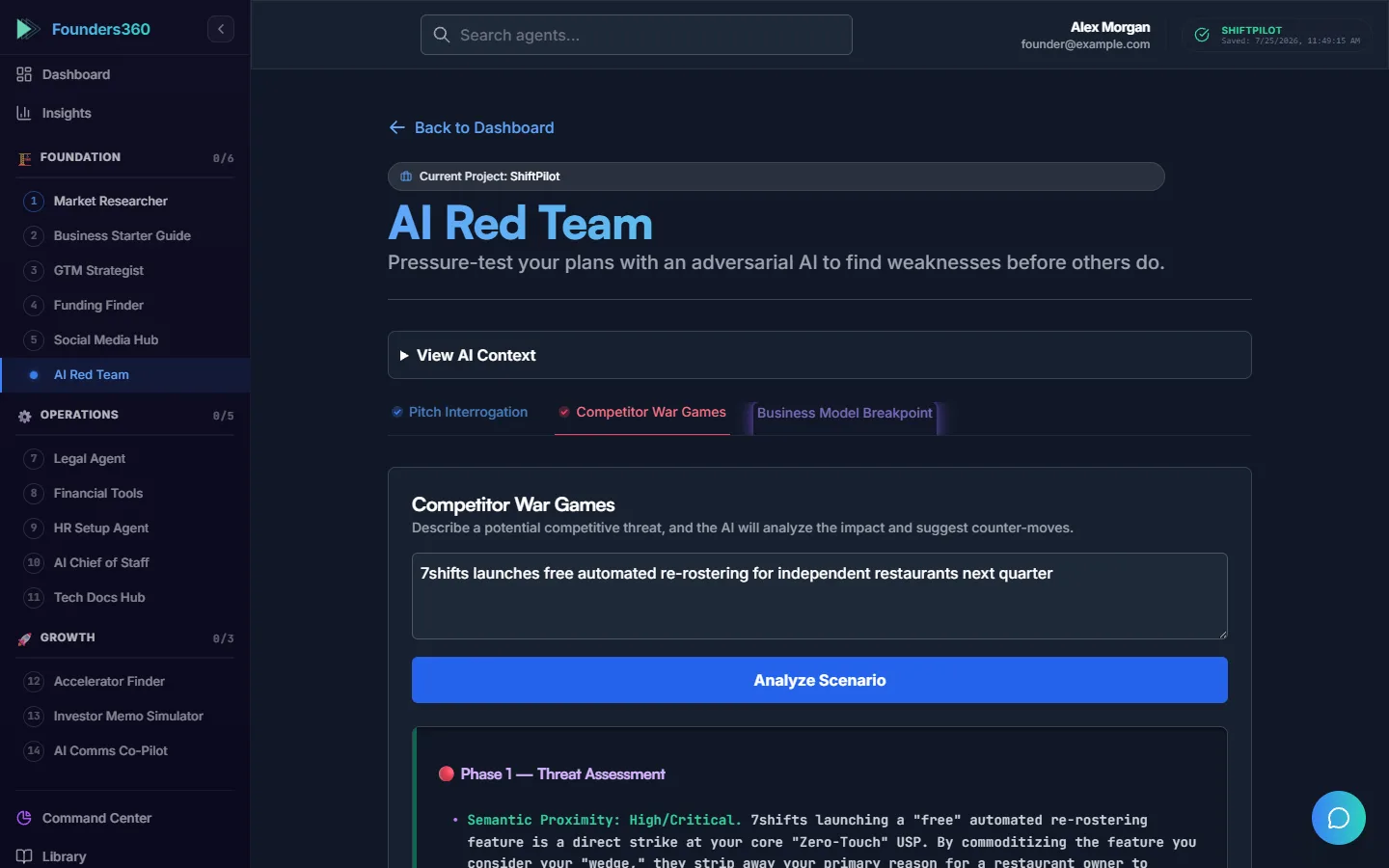
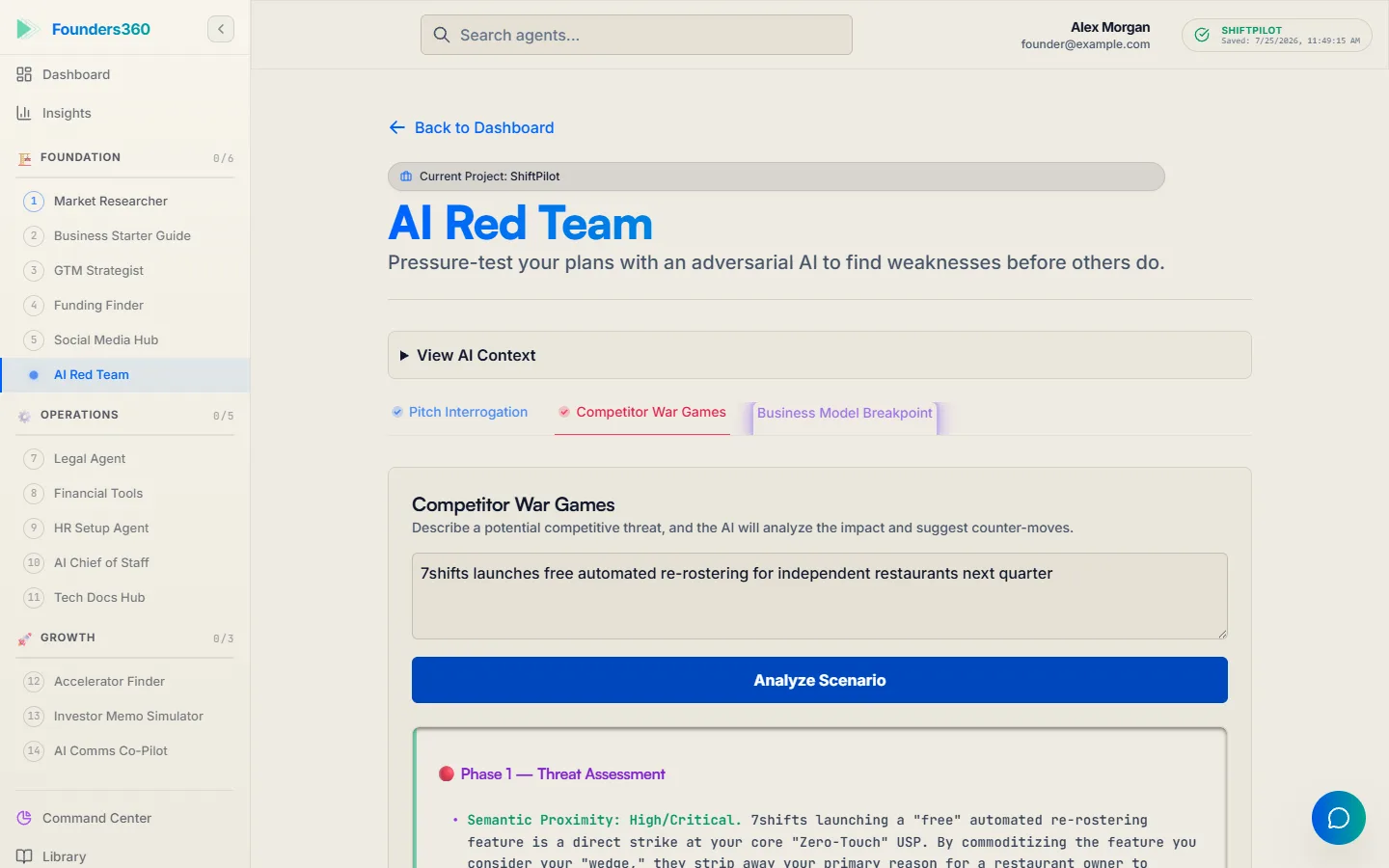
Stress testing your own claims before publishing is the cheapest version of this. Our AI Red Team agent exists to argue with a founder's assumptions, and the same instinct applied to a marketing page catches the unverifiable sentence before it ships. If you want the broader picture of how to research a category without inventing data, the guide to AI competitive intelligence covers the research side of the same problem.
Where to start this week
If you do nothing else, do these four things in order. Add a real frequently asked questions section to your three most commercially important pages. Rewrite the opening two sentences of every section on those pages so the answer comes first. Move any competitive fact that currently lives inside an image into text. Then run your buyer question list across two assistants and write down what comes back.
That sequence takes an afternoon and addresses the majority of what makes a startup invisible to answer engines. The deeper work, entity consistency and third party corroboration, follows naturally once you can see where you stand.
Frequently Asked Questions
What is answer engine optimization?
Answer engine optimization is the practice of structuring content so that AI assistants and AI search features quote it as a source when answering a question. It overlaps heavily with search engine optimization, but it optimises for being extracted and cited rather than for being clicked.
Is answer engine optimization different from SEO?
It is an extension rather than a replacement. Classic search engine optimization gets you into the index and establishes authority, which answer engines still rely on. Answer engine optimization adds a passage level discipline: leading with direct answers, using question shaped headings, publishing structured data, and keeping verifiable facts in selectable text.
How do I know if AI assistants are recommending my startup?
There is no complete tracker today, so sample manually. List the ten to fifteen questions a buyer asks before choosing in your category, run them across the assistants your buyers use on a fixed schedule, and log whether you were mentioned, whether the description was accurate, and which sources were cited instead. Supplement that with referral traffic from assistant domains and with branded search volume.
Does structured data actually help with AI search?
Structured data helps by removing ambiguity about what a page is, who published it, and which text is a question and which is its answer. FAQPage markup is the clearest example, because it labels question and answer pairs explicitly. It is not a ranking trick and it will not rescue thin content, but it makes strong content easier to parse correctly.
How long does it take to see results?
Structural changes such as adding a frequently asked questions section or rewriting section openings can affect how a page is quoted within weeks, because they change what is available to extract immediately. Entity level work, meaning consistent descriptions and third party corroboration, compounds over months. Sampling your buyer questions on a monthly schedule is usually enough to see the direction.
Tags
Related Articles
How to Set Up a Business in Dubai in 2026: Free Zone vs Mainland
To set up a business in Dubai, you choose an activity, pick a free zone or mainland route, register a trade name, win initial approval, get the licence, then handle visas and a bank account. This guide compares the two routes and covers corporate tax and timelines.
7 min readGuidesHow to Write a Business Plan for a Startup (2026 Template)
To write a business plan for a startup, pick a format that fits your audience, fill in eight core sections, and keep the whole thing short enough to update. This guide gives a section-by-section template, shows what investors and banks each look for, and explains how to keep the plan alive.
7 min readGuidesCap Table Template for Startups: How to Build and Read One
A cap table template is a spreadsheet that lists every holder of your company, what they own and how much that is after dilution. This guide gives you the columns, a worked example with checked arithmetic, and the point at which a spreadsheet stops being enough.
6 min readReady to Build Smarter?
Join thousands of solopreneurs using AI agents to scale their businesses.
Get Started Free