
Cap Table Template for Startups: How to Build and Read One
A cap table template is a spreadsheet that lists every holder of your company, what they own and how much that is after dilution. This guide gives you the columns, a worked example with checked arithmetic, and the point at which a spreadsheet stops being enough.
By Founders360 Team
A cap table template is a spreadsheet with one row per holder of your company and a handful of columns: who holds the security, what type it is, how many shares, what percentage that is on a fully diluted basis, and how it vests. Build it before your first raise and update it after every event that changes ownership.
What columns does a cap table template need?
A working cap table needs five core columns.
- Holder. The legal name of the person or entity, plus a role (founder, employee, advisor, investor).
- Security type. Common stock, stock options, an unissued option pool, a SAFE, a convertible note or preferred stock. Mixing types in one undifferentiated "shares" number is a common way a cap table goes wrong.
- Shares. The number of shares, or for a SAFE the number of shares it would convert into at the stated terms.
- Fully diluted ownership. The holder's shares divided by every share and share equivalent that could exist: issued stock, granted options, the unissued pool and converting instruments. This is the number investors care about.
- Vesting. The schedule and start date, for example four years with a one year cliff. See the co-founder agreement and vesting guide for how to choose the terms.
What does a cap table look like with real numbers?
Here is a complete cap table for an illustrative company. The numbers are invented for teaching and do not describe any real company. Two founders hold common stock, the company has reserved a 2,000,000 share option pool that has not been granted yet, and it has raised $500,000 on a post-money SAFE with a $5,000,000 valuation cap.
| Holder | Security type | Shares | Fully diluted % | Vesting | |---|---|---|---|---| | Founder A | Common stock | 4,500,000 | 40.50% | 4 years, 1 year cliff | | Founder B | Common stock | 3,500,000 | 31.50% | 4 years, 1 year cliff | | Option pool (unissued) | Reserved options | 2,000,000 | 18.00% | Set per grant | | SAFE investor | Post-money SAFE | 1,111,111 | 10.00% | None | | Total | | 11,111,111 | 100.00% | |
The arithmetic works like this. Before the SAFE, the company had 10,000,000 shares: 4,500,000 plus 3,500,000 plus 2,000,000. Founder A held 45%, Founder B 35% and the pool 20%.
According to Y Combinator, ownership sold on a post-money SAFE is the investment divided by the valuation cap. Here that is $500,000 divided by $5,000,000, which is 10%. So the SAFE must end up as 10% of the total, which means the existing 10,000,000 shares are the other 90%. The total is 10,000,000 divided by 0.9, which is 11,111,111 shares after rounding, and the SAFE converts into 1,111,111 of them.
The percentages check out: 40.50 plus 31.50 plus 18.00 plus 10.00 equals 100.00. Founder A went from 45% to 40.50% without selling a share, which is dilution. For the mechanics of the cap, read what a SAFE valuation cap actually costs you in dilution.
What is the difference between pre-money and post-money?
Pre-money valuation is what the company is worth before new money arrives; post-money is that value plus the new money. The difference decides how much of the company an investor owns.
Take another illustrative case: an investor puts $2,000,000 into a priced round at an $8,000,000 pre-money valuation. The post-money valuation is $8,000,000 plus $2,000,000, which is $10,000,000. The investor owns $2,000,000 divided by $10,000,000, which is 20%. The existing holders together own the remaining 80%.
If the same $2,000,000 had been offered at a $10,000,000 pre-money valuation, the post-money would be $12,000,000 and the investor would own about 16.67%. Same cheque, different ownership, so always check which one a term sheet quotes. If you need a defensible number for that conversation, see how to value a pre-revenue startup.
What does fully diluted really mean?
Fully diluted means counting every share that exists or could exist, not only the shares people hold today. That includes issued common and preferred stock, granted options, the unissued option pool, and shares that SAFEs and convertible notes would become.
The reason it matters is that two cap tables can show the same founder with the same shares and very different ownership. Founder A in the example holds 4,500,000 shares in both the before and after view. On an issued basis excluding the pool and the SAFE, that is 56.25% of 8,000,000 shares. On a fully diluted basis it is 40.50%. Investors price against the second number because the pool and the SAFE will become real shares.
Some people count the unissued pool as fully diluted and others do not, so note your definition at the top of the sheet.
What mistakes break a cap table?
Most cap table errors are quiet: the sheet still adds up, but it no longer matches the legal record. These are the ones to guard against.
- Leaving out convertibles. A SAFE or note is not a share yet, but it will be. A sheet that omits it shows founders owning more than they will.
- Forgetting the option pool. An unissued pool dilutes everyone who holds shares today, and investors often ask for it to be sized before they invest.
- Typing percentages instead of calculating them. Every percentage should be a formula: holder shares divided by the total. Hard typed percentages drift the first time a row changes.
- No link to the documents. Each row should point to the stock purchase agreement, grant or SAFE that created it. A number without a document is a rumour.
- Skipping vesting dates. Without a start date and schedule, you cannot say how much a departing founder has earned.
- Informal promises. A verbal offer of equity to an advisor or early contractor is an unrecorded claim. Put it in writing and in the sheet.
Dilution assumptions also feed your plan; the financial modeling guide for pre-revenue startups shows how to connect the two.
When should you move from a spreadsheet to cap table software?
Stay on a spreadsheet while the company has a few holders and one or two convertible instruments, and move to dedicated software when the sheet becomes a source of risk rather than a convenience. Practical triggers include a priced round, more than a handful of option grants, several SAFEs with different caps, or an investor or lawyer asking for records a sheet cannot track well.
Software can store signed documents, track option exercises and model rounds, but it does not replace a lawyer reviewing terms. Before your first raise, a clean spreadsheet is enough, and the pre-seed fundraising guide covers what investors expect to see at that stage.
Model your equity in the Financial Tools agent
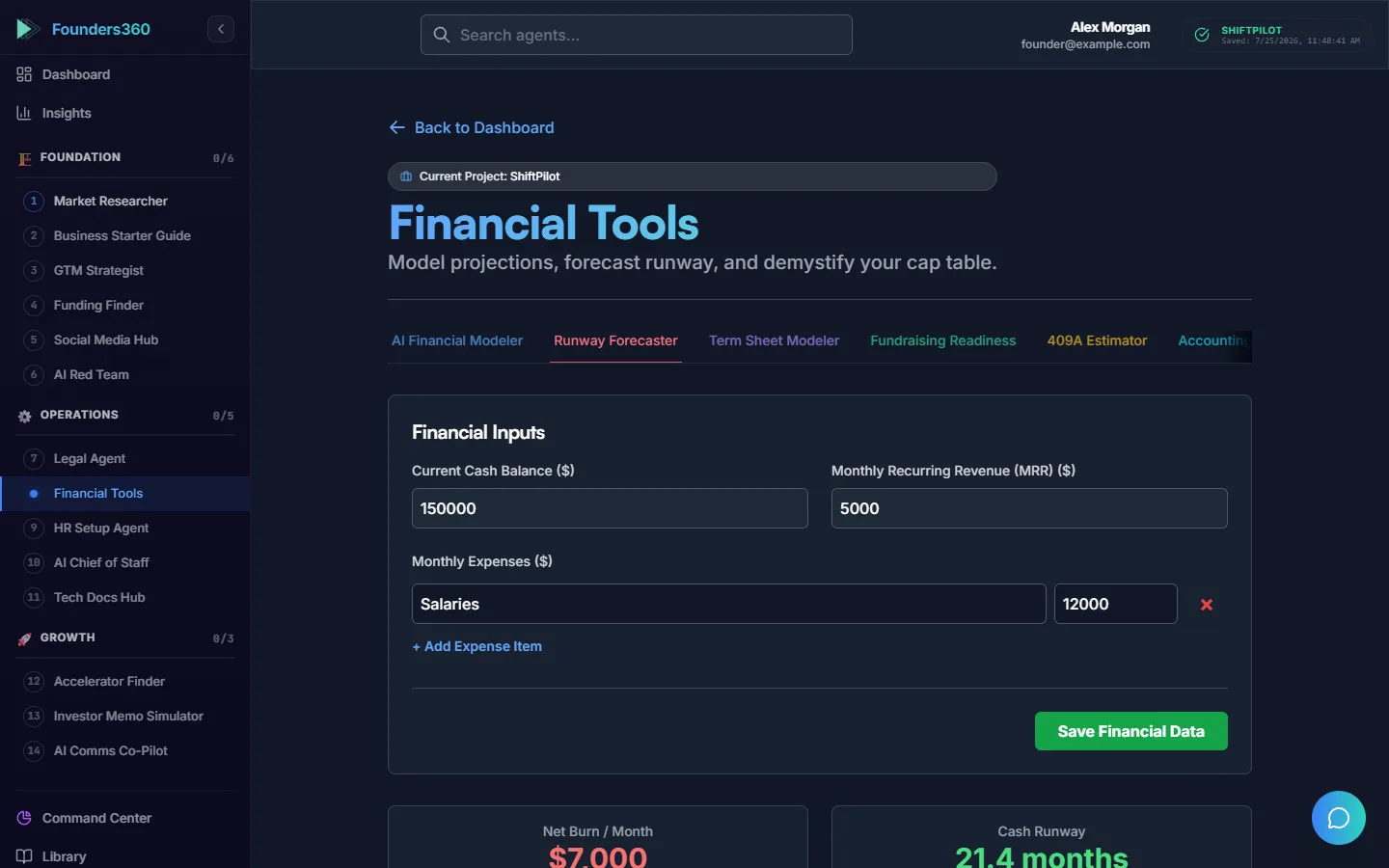
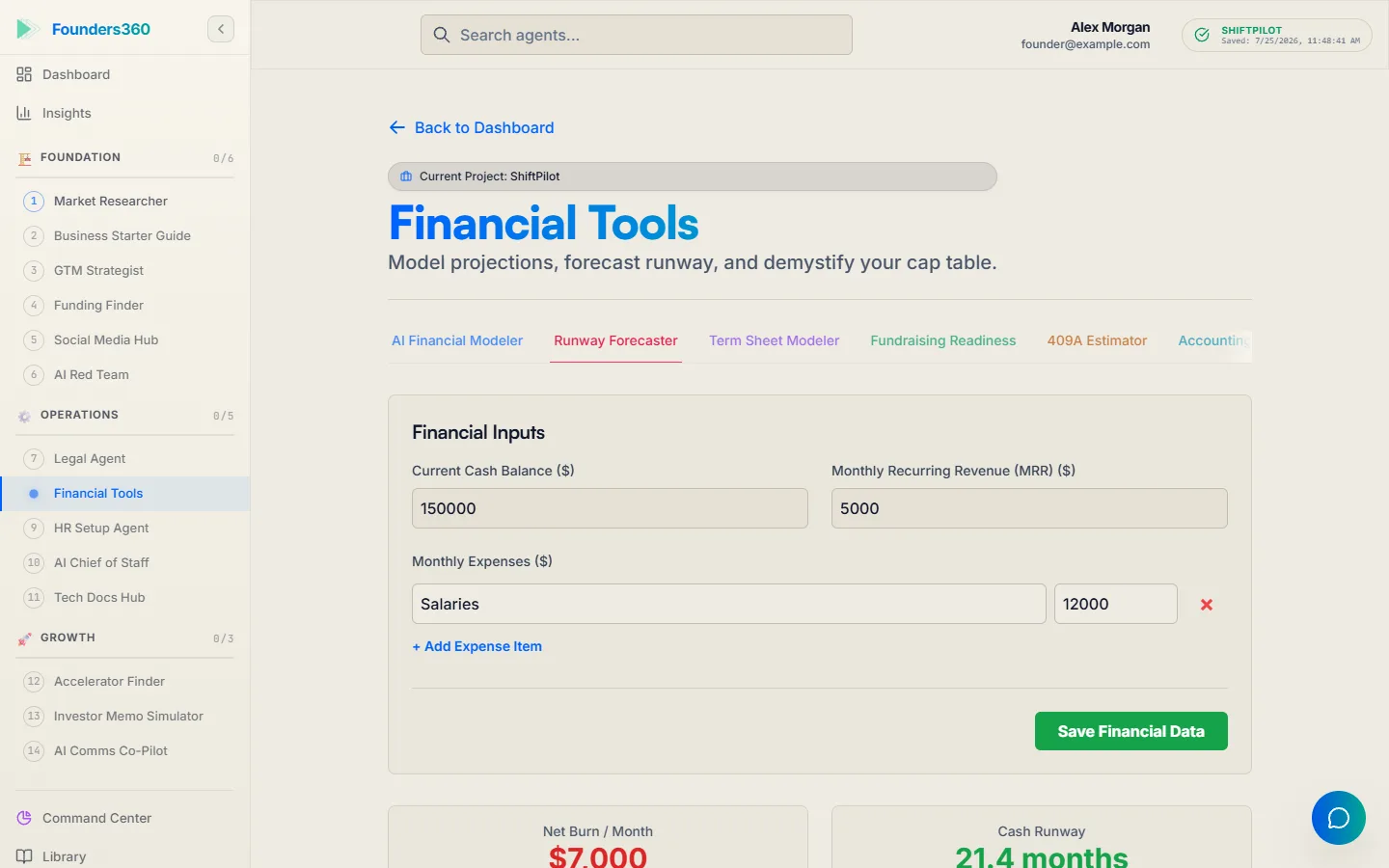
Once your cap table exists, test it against your plan: how many months of runway a raise buys and what it costs you in ownership. The Financial Tools agent in Founders360 supports that financial planning work, and it reads the same Shared Context as the other agents, so company details do not need retyping.
You can try it free at https://www.founders360.world

Frequently Asked Questions
What is a cap table template?
A cap table template is a pre-built spreadsheet recording every holder, the security each holds, the share count and the resulting ownership percentage.
How do you calculate fully diluted ownership?
Divide the holder's shares by the total of all issued shares, granted options, the unissued option pool and shares from converting instruments such as SAFEs. In the example above, Founder A holds 4,500,000 of 11,111,111 shares, which is 40.50%.
Should the option pool be on the cap table?
Yes. Show the unissued pool as its own row. It is not owned by anyone yet, but it will dilute every current holder when grants are made, and investors expect to see it counted in the fully diluted total.
Does a post-money SAFE show up on a cap table before it converts?
Yes, as a line item with the shares it would convert into, clearly labelled as a SAFE. According to Y Combinator, the ownership sold on a post-money SAFE is the investment divided by the valuation cap, so you can calculate that figure before any priced round happens.
Is a spreadsheet enough for a cap table?
A spreadsheet is enough before your first priced round if every percentage is a formula and every row links to its legal document. Move to cap table software when you have a priced round, many option grants or several convertibles with different terms.
Tags
Related Articles
How to Set Up a Business in Dubai in 2026: Free Zone vs Mainland
To set up a business in Dubai, you choose an activity, pick a free zone or mainland route, register a trade name, win initial approval, get the licence, then handle visas and a bank account. This guide compares the two routes and covers corporate tax and timelines.
7 min readGuidesHow to Write a Business Plan for a Startup (2026 Template)
To write a business plan for a startup, pick a format that fits your audience, fill in eight core sections, and keep the whole thing short enough to update. This guide gives a section-by-section template, shows what investors and banks each look for, and explains how to keep the plan alive.
7 min readGuidesLean Canvas vs Business Model Canvas: Which Should Your Startup Use?
For a startup that has no product or paying customers yet, the lean canvas is usually the better fit, because it starts from problems and risks. The business model canvas suits a company that already has a product and needs to map how the whole business runs.
7 min readReady to Build Smarter?
Join thousands of solopreneurs using AI agents to scale their businesses.
Get Started Free