
How to Write a Business Plan for a Startup (2026 Template)
To write a business plan for a startup, pick a format that fits your audience, fill in eight core sections, and keep the whole thing short enough to update. This guide gives a section-by-section template, shows what investors and banks each look for, and explains how to keep the plan alive.
By Founders360 Team
How to write a business plan for a startup comes down to three decisions: choose a format (a one-page lean plan or a longer traditional plan), write eight core sections in a fixed order, and keep the document short enough that you will actually revise it. Start with the problem and the customer, not with the spreadsheet, and treat every number as an assumption you intend to test.
What sections does a startup business plan need?
A startup business plan needs a summary, a description of the company, the market, the product, how you will sell, who runs it, what money you need and your financial projections. That list follows the US Small Business Administration guidance on writing a business plan, which lists eight common sections for a traditional business plan: executive summary, company description, market analysis, organization and management, service or product line, marketing and sales, funding request, and financial projections.
The same SBA page describes a second format, the lean business plan. It uses nine short elements: key partnerships, key activities, key resources, value proposition, customer relationships, customer segments, channels, cost structure and revenue streams. The SBA describes lean plans as typically only one page and says they can take as little as one hour to make, while traditional plans can run to dozens of pages (as of October 2026).
Which format should you use: lean plan or traditional plan?
Use a lean plan when you are still testing the idea and a traditional plan when someone outside the company needs a formal document. A lean plan is a thinking tool for you and your cofounders. A traditional plan is a communication tool for a reader who has never met you.
If you are unsure, write the lean plan first. It takes an afternoon, and every traditional section grows out of one of its boxes. Add a living document habit from day one, covered below.
What is the section-by-section template?
Write each section to answer one question, in two to six sentences for the first draft. Copy this outline into a document and fill it in.
- Executive summary. What you sell, to whom, why now, how big the market is and what you need. Write it last, but place it first. Aim for half a page.
- Company description. Legal structure, location, founding team and the problem the company exists to solve. If you have not yet chosen a structure, say what you plan to form and why.
- Market analysis. Who the customer is, how many of them there are, what they do today and who else serves them. Size the market bottom up where you can; the TAM, SAM and SOM guide shows the method.
- Product or service. What it does, what makes it different and what stage it is at: idea, prototype, pilot or live.
- Marketing and sales. The first channels you will use, who closes the sale, and the cost and time to win one customer. The 90-day go-to-market template for a pre-seed startup covers this section in depth.
- Organization and management. Who does what, which roles are open, and the experience that makes this team the right one to build this.
- Funding request. How much you are raising or borrowing, what it pays for, and what milestone it reaches. Tie every dollar to a result.
- Financial projections. Revenue, costs and cash for the next three to five years, with the assumptions written beside the numbers. The SBA suggests a five year outlook, with quarterly or even monthly figures for the first year. If you have no revenue yet, follow the method in financial projections for startups with no revenue.
What do investors read in a startup business plan, and what does a bank read?
Investors read for the size of the opportunity and the quality of the team, while a bank reads for the ability to repay. Both skim, and both start with the executive summary, so that half page decides whether they continue.
An investor typically wants to see the problem, the market, evidence of traction or learning, the team, and a credible path to a large outcome. Many pre-seed investors will ask for a pitch deck before a full plan, so your plan should support the deck rather than replace it. For slide-level guidance, see pitch deck structure: the 12 slides investors expect.
A lender, who wants financial projections that show repayment, reads for stability: your funding request, collateral or personal guarantees, cash flow projections and the experience of the owners. The market story matters less than the evidence that monthly cash will cover the payments.

How long should a startup business plan be?
A startup business plan should be one page for the lean version and roughly 10 to 20 pages for a traditional version. The SBA says lean plans are typically one page and traditional plans can reach dozens of pages; the 10 to 20 page range here is a practical editing target rather than an official rule, and a shorter plan is almost always the better one.
What are the most common startup business plan mistakes?
The most common mistakes are writing the plan once and filing it, hiding the customer, and presenting guesses as facts. Avoid these five:
- No clear customer. "Small businesses" is not a customer. Name the specific buyer, the trigger that makes them look for a solution and what they do today.
- Top-down market sizing only. "One percent of a huge market" tells a reader nothing. Count real buyers you can reach.
- Projections without assumptions. A hockey-stick chart with no stated drivers looks careless. Show what each number depends on.
- Ignoring competitors. Saying you have none signals that you have not looked. Your real competitor is often a spreadsheet or the status quo.
- Copying a generic output. An AI draft can give you a structure quickly, but it cannot supply your customer evidence. We tested where it helps and where it fails in can ChatGPT write your business plan.

How do you keep a business plan a living document?
Keep a business plan alive by assigning it an owner, a review date and a short change log. Review it every quarter, or sooner after any event that changes an assumption: a failed experiment, a pricing change, a new hire or a funding decision.
Start each review by checking the assumptions in your financial projections against what actually happened. Update the numbers, note why they moved, and then adjust the sections that depend on them. A plan that records its own corrections is more persuasive to an investor than one that never changed.
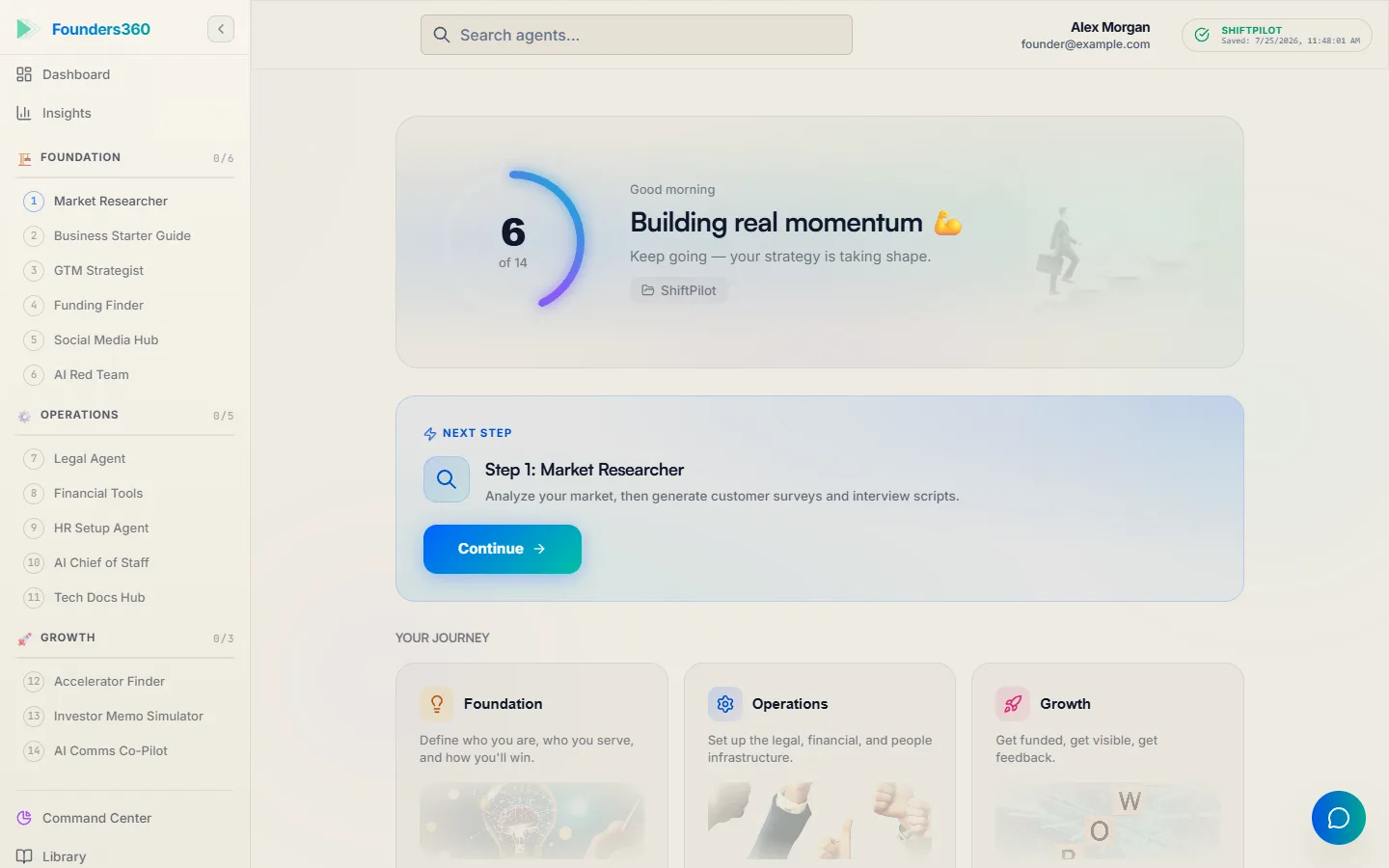
This is also where a shared company memory helps. In Founders360, the Business Guide agent and the other agents build on one company memory called Shared Context, so facts you establish in one place, such as your customer or market size, are available to the next agent you use rather than retyped. The Business Guide is one of five agents that are free forever. You can also pressure test your plan before a real meeting with the free Skeptical VC pitch grill.
To draft your first plan with the Business Guide, try it free at https://www.founders360.world.
Frequently Asked Questions
How do I write a business plan for a startup with no revenue?
Write a lean plan first, describe your customer and the problem in specific terms, and build projections from stated assumptions such as expected conversion and price. Label every number as an assumption, and plan to replace it with real data as soon as you have any.
What is the difference between a lean plan and a traditional business plan?
A lean plan is a one-page summary of nine elements, such as value proposition, customer segments and cost structure. A traditional plan is a longer document with sections such as market analysis, funding request and financial projections, according to the SBA.
Do investors read business plans?
Usually they read the executive summary and the pitch deck first, and ask for the longer plan only if interested. Write the plan so the first half page works alone, and so the deck and plan tell the same story.
How often should I update my business plan?
Review it every quarter and after any major change to an assumption. Record what changed and why, so the plan shows how your thinking improved.
Can AI write my startup business plan?
AI can draft a structure and wording quickly, but it cannot know your customers or your evidence. Use it for a first pass, then replace generic claims with facts you have verified.
Tags
Related Articles
How to Set Up a Business in Dubai in 2026: Free Zone vs Mainland
To set up a business in Dubai, you choose an activity, pick a free zone or mainland route, register a trade name, win initial approval, get the licence, then handle visas and a bank account. This guide compares the two routes and covers corporate tax and timelines.
7 min readGuidesCap Table Template for Startups: How to Build and Read One
A cap table template is a spreadsheet that lists every holder of your company, what they own and how much that is after dilution. This guide gives you the columns, a worked example with checked arithmetic, and the point at which a spreadsheet stops being enough.
6 min readGuidesLean Canvas vs Business Model Canvas: Which Should Your Startup Use?
For a startup that has no product or paying customers yet, the lean canvas is usually the better fit, because it starts from problems and risks. The business model canvas suits a company that already has a product and needs to map how the whole business runs.
7 min readReady to Build Smarter?
Join thousands of solopreneurs using AI agents to scale their businesses.
Get Started Free