
A Practical Guide to Financial Modeling for Pre-Revenue Startups
Learn how to build a robust financial model for your pre-revenue startup. This guide covers making assumptions without historical data, understanding unit economics, forecasting revenue, and managing critical cash flow to secure funding and validate your business idea.
By Founders360 Team
For pre-revenue startups, a robust financial model is not merely a projection; it is a strategic blueprint. It forces you to articulate your business assumptions, understand potential cash flow challenges, and provides a framework for decision-making. Investors will expect one, and it is a critical tool for managing your own runway and validating your business concept. Even without sales, a well-structured financial model translates your business thesis into numbers that investors and your team can stress-test, offering insight into your business's long-term health.
Key Components and Assumption Building for Pre-Revenue Models
Even without revenue, your financial model must include key sections: assumptions, revenue projections, cost of goods sold (COGS) or cost of services, operating expenses (OpEx), capital expenditures (CapEx), a cash flow statement, an income statement (P&L), a balance sheet, and key metrics including unit economics. Each component interconnects, meaning a change in one assumption will ripple through the entire model.
Building these assumptions without historical data requires meticulous research and informed estimates. Document every assumption transparently, as this is crucial for both your understanding and for any external party reviewing your model.
Anchoring Your Assumptions in Reality
- Market Research: Understand your total addressable market (TAM), serviceable addressable market (SAM), and serviceable obtainable market (SOM). Use reports, competitor analysis, and customer surveys to estimate potential market share and customer demand.
- Industry Benchmarks: Research similar businesses to understand typical customer acquisition costs, churn rates, or gross margins. Publicly available data, annual reports of public companies, or industry association reports can provide valuable proxies.
- Pilot Programs and Early Traction: Leverage pilot users, beta sign-ups, or early customer feedback to inform early adoption rates or conversion metrics.
- Operational Estimates: For costs, obtain quotes from potential vendors for software, services, or manufacturing. Estimate headcount and average salaries based on market rates. Ensure all numbers are anchored in research, not guesswork.
Understanding Unit Economics: The Core of Early Profitability
Unit economics represent the direct revenues and costs associated with your business model on a per-unit basis. Whether a 'unit' is a customer for a SaaS company or a product for an e-commerce business, understanding these economics is fundamental to determine if your business can be profitable at scale.
Key unit economics include:
- Customer Acquisition Cost (CAC): The cost to acquire one new customer, encompassing marketing, sales, and onboarding expenses.
- Customer Lifetime Value (LTV): The total revenue expected from a customer over their entire relationship with your company.
- Gross Margin Per Unit: Revenue from one unit minus its direct cost of goods or services sold.
- Payback Period: The time required to recover the CAC from the gross profit generated by that customer.
For instance, the fictional company ShiftPilot, developing an AI-powered scheduling solution, would define a unit as a monthly subscription. They would project marketing costs per subscriber, average subscription fees, and direct service costs (e.g., cloud computing, support). A model indicating LTV significantly higher than CAC suggests a viable business.
Strategies for Revenue Forecasting: Top-Down and Bottom-Up
Two primary approaches to revenue forecasting are often used in conjunction to validate projections.
Top-Down Forecasting
This method begins with the total available market and estimates the percentage your business can realistically capture. It demonstrates market potential but requires grounding in realistic market penetration to avoid over-optimism.
- Example for ShiftPilot (fictional): If the total market for AI scheduling tools for small businesses is 10 million, and ShiftPilot captures 0.1 percent in its first year, that is 10,000 customers. Multiplying this by the average monthly subscription fee yields annual revenue.
Bottom-Up Forecasting
This method builds revenue projections from the ground up, based on operational metrics and specific actions. Investors generally prefer it, as it reflects a deeper understanding of your operations. This approach is more granular, requiring detailed assumptions about sales and marketing funnels, and offers a more defensible forecast tied to planned activities.
- Example for ShiftPilot (fictional): ShiftPilot could project marketing spend, estimate website visitors, then conversion rates from visitors to free trials, and finally from free trials to paid subscribers.
Marketing Spend → Website Visitors (based on CPC) → Free Trials (based on conversion rate) → Paid Subscribers (based on conversion rate) → Revenue (subscribers * ARPU)
Managing Costs, Cash Flow, and Scenario Planning
A clear understanding of your costs is paramount. Costs fall into two main categories:
- Fixed Costs: Expenses that do not change with production volume, such as rent or core team salaries.
- Variable Costs: Expenses that fluctuate directly with production or sales volume, like raw materials or per-user cloud computing costs.
For pre-revenue startups, managing cash burn is critical. The cash flow statement, detailing the actual movement of cash, is your most important document in the early days. It reveals your 'cash runway' and when you will run out of funds without additional financing. Projecting when cash inflows exceed outflows is a major milestone and indicator of viability. While an income statement shows profitability by matching revenues and expenses, a cash flow statement tracks liquidity.
Stress-Testing Your Model with Sensitivity and Scenario Planning
Because your financial model is assumption-driven, testing its robustness is imperative through sensitivity analysis and scenario planning.
Sensitivity Analysis involves altering one key assumption at a time (e.g., customer acquisition cost, conversion rate, pricing) to observe its impact on your bottom line or cash runway. This identifies variables with the greatest leverage on financial outcomes. For example, if a small increase in CAC disproportionately impacts profitability, managing CAC becomes a critical success factor.
Scenario Planning entails creating multiple complete financial models with different assumption sets:
- Best Case: Optimistic but realistic assumptions.
- Base Case: Your most likely assumptions, typically presented.
- Worst Case: Conservative assumptions, outlining potential risks and planning contingencies.
Presenting these scenarios demonstrates foresight and a comprehensive understanding of your business's challenges and opportunities.
The Iterative Nature of Financial Modeling and Continuous Refinement
Your financial model is not static; it is a living tool that must evolve as your business gains traction and new data becomes available. Initially assumption-driven, it becomes more accurate as you acquire customers, run campaigns, and onboard employees, gathering real data.
- Update Regularly: Replace assumptions with actual data as it becomes available, enhancing your model's accuracy and reliability.
- Learn and Adapt: Analyze significant deviations from projections to understand underlying reasons, whether flawed assumptions or external market factors. Use these insights to refine your strategy.
- Review with Advisors: Share your model with mentors, advisors, or potential investors for valuable external perspectives and to identify blind spots.
A well-maintained financial model is a powerful decision-making tool, guiding everything from hiring plans to fundraising strategies.
How Founders360 Supports Your Financial Modeling Efforts
Founders360 offers specialized AI agents to streamline financial modeling. The platform provides a suite of 16 specialized AI agents, with a core differentiator being its shared project context. This means data and insights from one agent, such as market research, automatically inform others, including the financial tools.
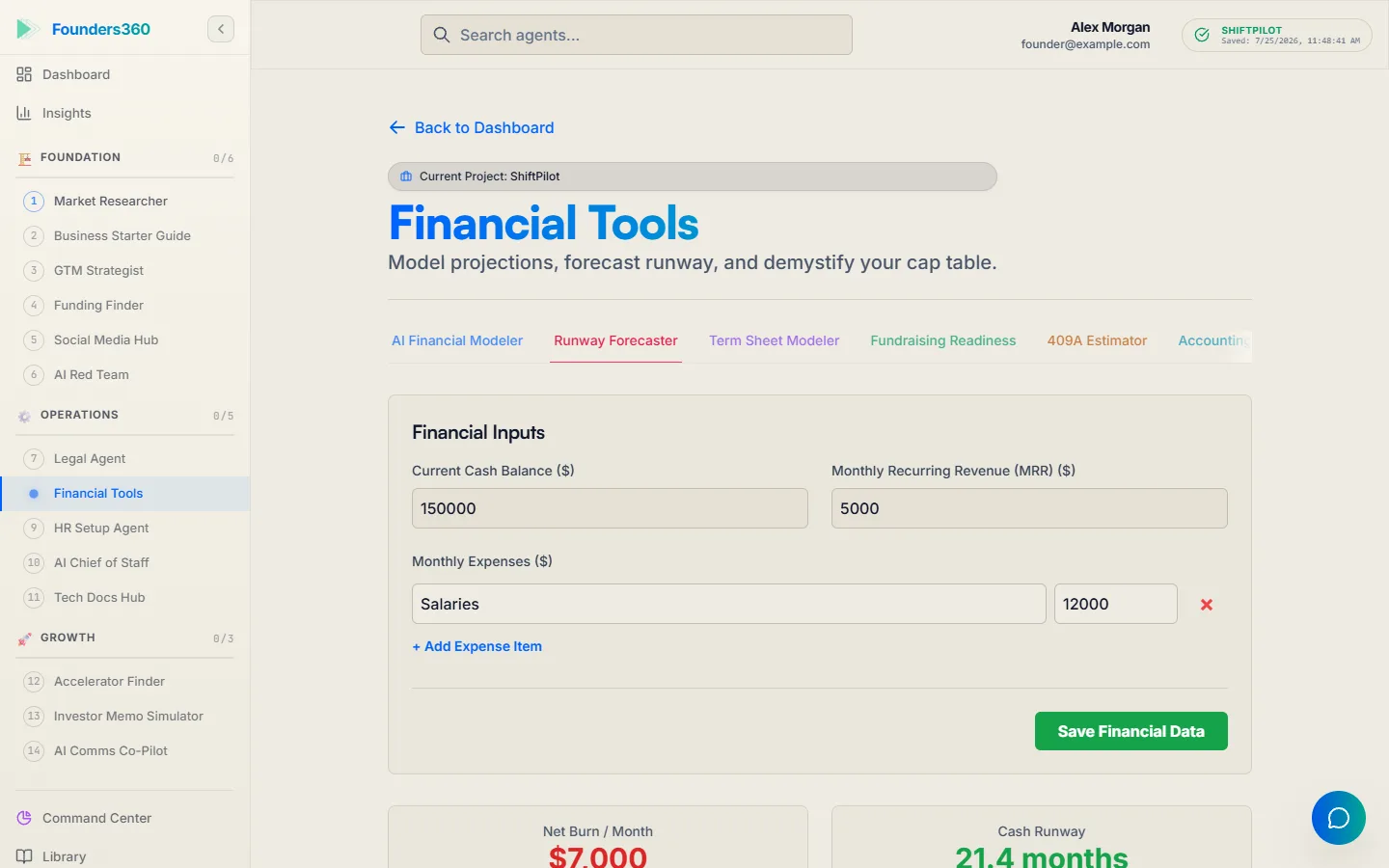
Founders can utilize the Financial Agent to build and refine financial models, assisting with revenue projections, cost analysis, and cash flow forecasting within an integrated environment. This eliminates manual data transfer between disparate tools, ensuring consistency and accuracy across your business plan. The Financial Agent is part of the Elite plan, offering comprehensive support for financial planning. Explore the full range of available agents on the Founders360 agents page.
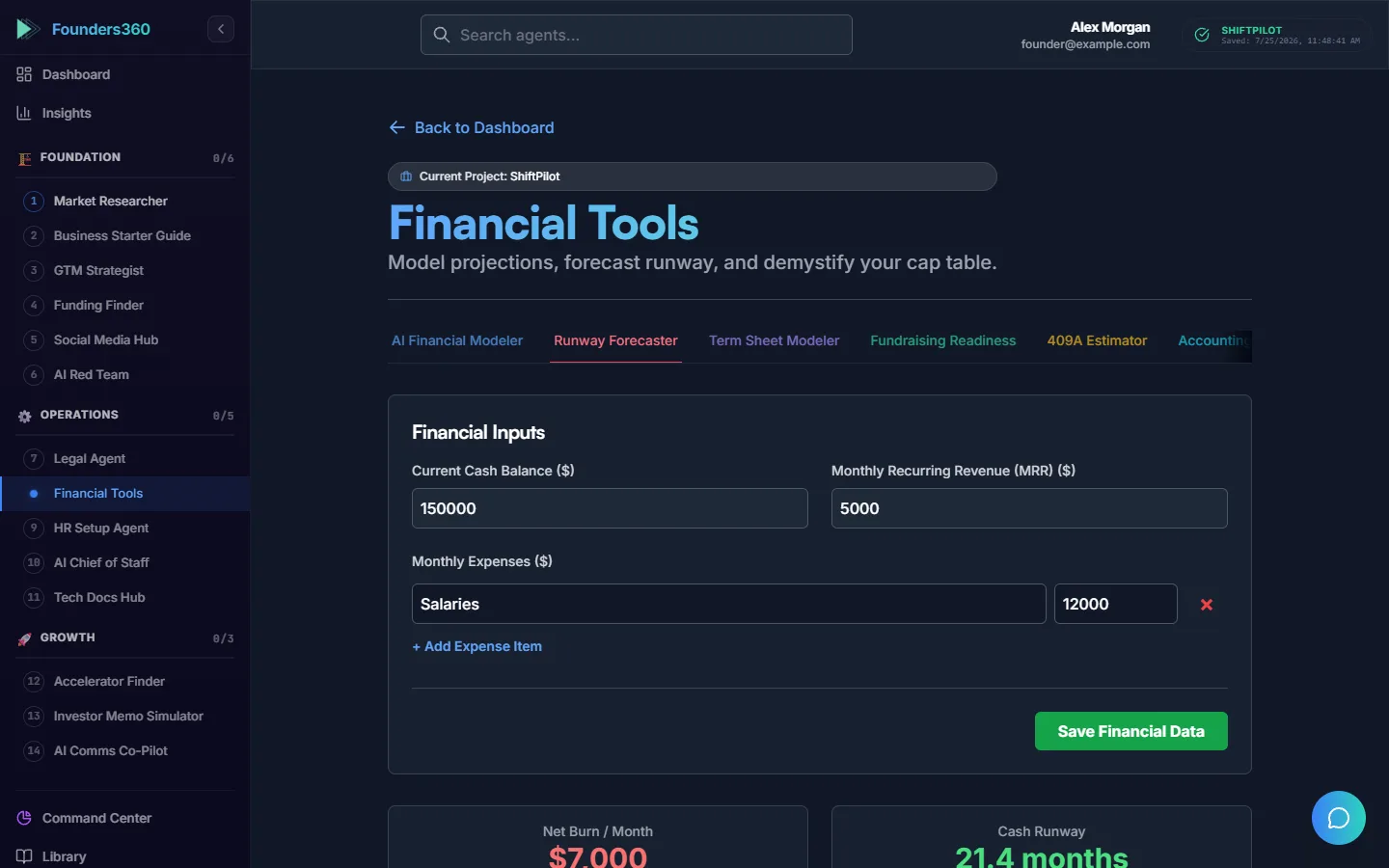
Other agents also contribute significantly. The Market Researcher, for instance, helps validate market size assumptions, while the GTM Strategist informs customer acquisition cost estimates. For a solopreneur, this integrated support provides a robust back office without requiring a full team. More information for solopreneurs is available at Founders360 for Solopreneurs. Plan options, including the Free and Founder Pro tiers, are detailed on our pricing page.
Building a financial model for a pre-revenue startup is a fundamental step in validating your business idea and charting a realistic path forward. It forces clarity, exposes assumptions, and provides a roadmap for growth and fundraising. By focusing on solid assumptions, unit economics, and continuous refinement, you can transform uncertainty into a strategic advantage, even before your first dollar of revenue.
Frequently Asked Questions
Why do I need a financial model if I do not have revenue yet?
A financial model is essential even without revenue because it forces you to articulate your business assumptions, understand your potential cash flow, and provides a strategic blueprint for your startup. It helps you manage your runway, validate your business concept, and is a critical tool for attracting investors.
What are the most important assumptions for a pre-revenue model?
The most important assumptions often relate to market size, customer acquisition costs, conversion rates, pricing, and operational expenses. These are the core drivers of your business and will have the greatest impact on your financial projections. Documenting these clearly and basing them on research is crucial.
How can I make revenue projections without historical sales data?
You can make revenue projections using a combination of top-down and bottom-up approaches. Top-down estimates market share from the total addressable market. Bottom-up builds from operational metrics such as marketing spend, website visitors, and conversion rates. Using industry benchmarks and early traction data also strengthens your projections.
What is the difference between an income statement and a cash flow statement for a startup?
An income statement (or Profit & Loss) shows your profitability over a period by matching revenues and expenses, regardless of when cash changes hands. A cash flow statement, however, tracks the actual movement of cash in and out of your business, which is critical for understanding your liquidity and runway, especially for a pre-revenue startup.
How often should I update my financial model?
Your financial model should be a living document, updated regularly. As you gather actual data from customer acquisition, expenses, and early sales, replace your initial assumptions with these real figures. This iterative process makes your model increasingly accurate and a more reliable tool for strategic decision-making.
Tags
Related Articles
How to Set Up a Business in Dubai in 2026: Free Zone vs Mainland
To set up a business in Dubai, you choose an activity, pick a free zone or mainland route, register a trade name, win initial approval, get the licence, then handle visas and a bank account. This guide compares the two routes and covers corporate tax and timelines.
7 min readGuidesHow to Write a Business Plan for a Startup (2026 Template)
To write a business plan for a startup, pick a format that fits your audience, fill in eight core sections, and keep the whole thing short enough to update. This guide gives a section-by-section template, shows what investors and banks each look for, and explains how to keep the plan alive.
7 min readGuidesCap Table Template for Startups: How to Build and Read One
A cap table template is a spreadsheet that lists every holder of your company, what they own and how much that is after dilution. This guide gives you the columns, a worked example with checked arithmetic, and the point at which a spreadsheet stops being enough.
6 min readReady to Build Smarter?
Join thousands of solopreneurs using AI agents to scale their businesses.
Get Started Free