
Human-in-the-Loop AI Governance for Startups: Where Autonomy Should Stop
Human-in-the-loop AI governance means deciding, action by action, what an AI agent may do on its own and what needs a person. Draw the line at the action, not the model, and put four guards behind every autonomous action: a kill switch that defaults to off, a daily cap, an idempotency key and a heartbeat.
By Founders360 Team
Human-in-the-loop AI governance is the set of rules that decides which actions an AI agent may take without a person and which must wait for one. Draw that line at the action, not at the model: an agent may draft, score, rank and recommend freely, but the moment its output leaves your system (an email sent, a post published, a payment made), a human or a guard designed by a human has to be in the path.
We run fifteen agents for early-stage founders, plus two internal programs that act on the outside world every day. This is the governance we arrived at, including the one time we got it wrong.
Draw the governance line at the action, not at the model
The useful question is not "how autonomous should our AI be" but "which actions can this system take that we cannot take back." Drafting is reversible. Sending is not. Generating a pitch deck is reversible. Emailing it to an investor list is not.
Sort every action your agents can perform into three buckets:
- Advisory. Output lands in front of a human who decides. Research, drafts, scores, plans. Autonomy here is free.
- Internal side effects. Output changes your own state: a database row, a cached fact, a queued job. Cheap to reverse, but worth counting and capping.
- External side effects. Output reaches a customer, a platform, a regulator or a bank. This is where the human belongs, or a guard a human designed and can switch off.
Nobody needs sign-off on a first draft. Everybody needs a stop button on the thing that talks to customers. The model in the middle is not the risk; the wire out of the building is.
Separate the code that drafts from the code that acts
Our daily social calendar drafts one post per platform per day, renders the card, scores the draft and writes it to a sheet. The drafting code has no way to post: no credential in that module, no client library, no path from "draft" to "published." The generator never touches the platform.
Publishing lives in a separate module that can only act on a row a human has marked approved. That separation turns a policy ("we review posts before they go out") into a structural fact ("the drafting process cannot post"). A policy depends on everyone remembering it. A structure holds while people are asleep.
The same separation applies anywhere an agent proposes an external action. Let the agent write the email, the reply or the refund note into a queue. Let a different process, with its own guards and its own switch, drain the queue.
The four guards behind every autonomous action
A separate publisher needs guards that hold even when the humans upstream made a mistake. We use the same four on the social publisher and on our outbound email program.
| Guard | What it does | Why it exists | |---|---|---| | Kill switch, default off | One environment variable stops all sends; a fresh deploy ships with it off | A new environment must not act until someone turns it on deliberately | | Daily cap per platform | Hard ceiling on actions per day, counted by the process that acts | A loop bug costs you a day of sends, not a month | | Idempotency key | The platform's own returned id is stored on the row before any retry | A retry after a network timeout must not double-post or double-send | | Heartbeat row per run | Every scheduled tick writes a row, even when it did nothing | "The cron fired" is a claim you can check, not a belief |
On the idempotency key: we store the id the platform returns, not one we generated, and we write it under a lock that we never hold across the network call. Holding a row lock while waiting on a third-party API is how a slow platform becomes a stuck database.
The heartbeat matters more than it looks. Scheduled jobs in our stack have fired and done nothing, silently, more than once. A row per run means "it ran and found nothing" looks different from "it never ran."
When a reviewer score can replace a human tap
A human tap on every action does not scale, and a queue nobody clears is autonomy with extra steps. The honest answer is to let a second model review the first one, and to let a high enough score stand in for the tap on low-risk actions only.
Our social reviewer scores every draft out of 100, with 40 of those points on whether each claim traces to the facts injected into the prompt. Below 80 the post is rejected, stored and flagged (a post that vanished would look identical to a broken generator). Between 80 and 89 it waits for a person. At 90 or above the post is approved without a tap, and the approval is logged as automatic so an audit can tell it apart from a human decision.
Three conditions made that acceptable. The action is a social post, which is public but cheap to delete. The daily cap still applies, so a run of bad high-scoring drafts costs two posts, not two hundred. And the threshold lives on the acting service, so setting it to zero returns to human-only in one change. We would not use a score to skip a human on a cold email, a refund or anything with a named recipient.
The kill switch must live on the process that acts
Our outbound email program runs on a separate scheduled service with its own environment variables. We once set the "require human approval before sending" flag on the API service instead. The setting saved. Nothing complained. The cron service, which is the process that actually sends, never saw it, and it sent a cold email to a program director who was supposed to be reviewed first.
The lesson is mechanical, and we now treat it as a rule: a kill switch must live on the process that acts, and you verify it by reading it back from that process, not from the place where you set it. A flag on the wrong service is worse than no flag, because it looks like governance while providing none.
Two habits follow. Every command that changes a cron-governing variable names the service explicitly. And the runbook for any autonomous program lists which service owns each switch, because the person turning it off at 2 a.m. should not have to guess. If you have one deployment today, write this down anyway: the day you split a worker out is the day this bug becomes possible.
Governance for advisory agents: let the AI argue, keep the human deciding
Advisory agents need a different governance. The risk is not that they act; it is that a founder takes a confident, wrong answer as settled. The fix is to build disagreement into the product.
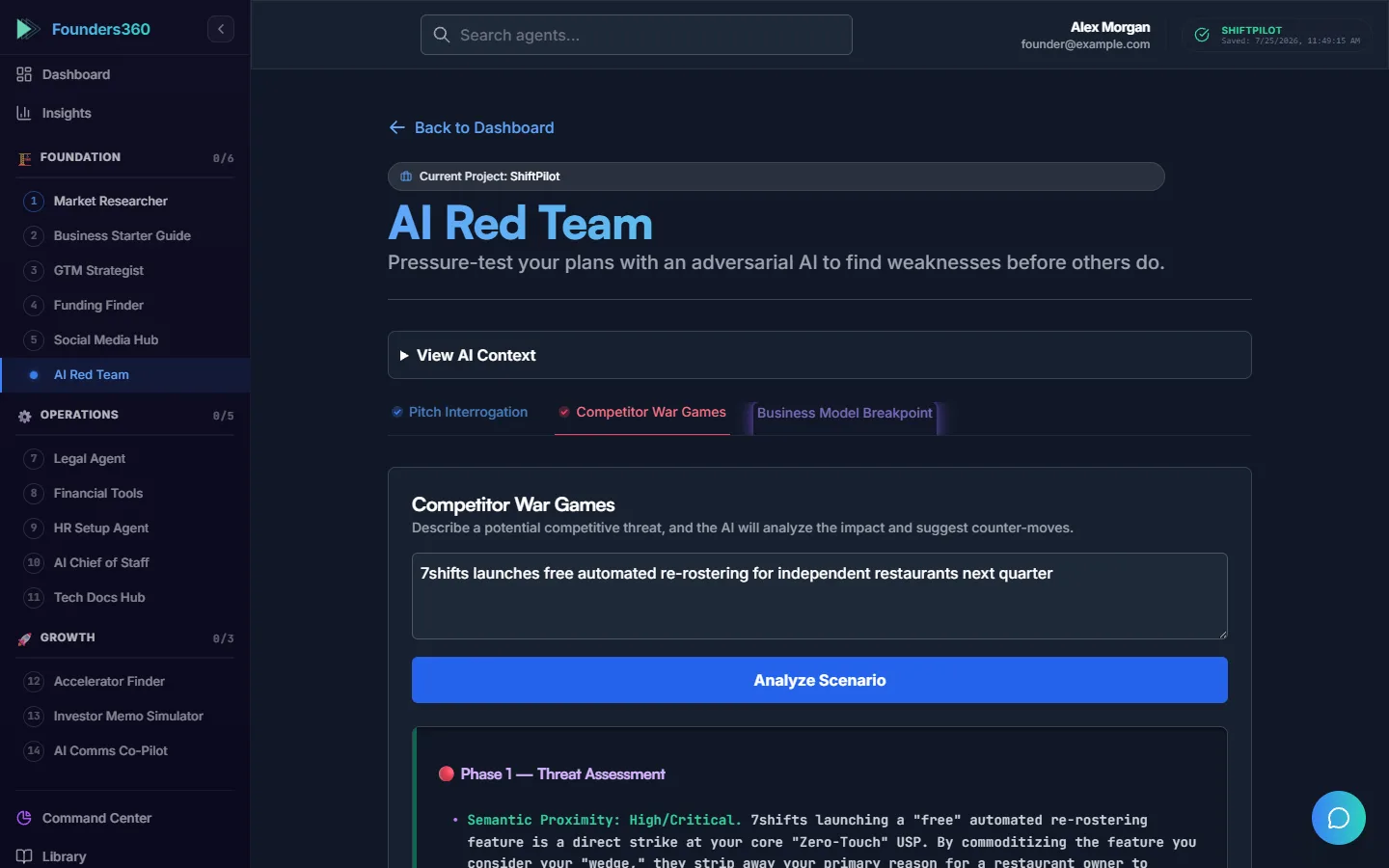
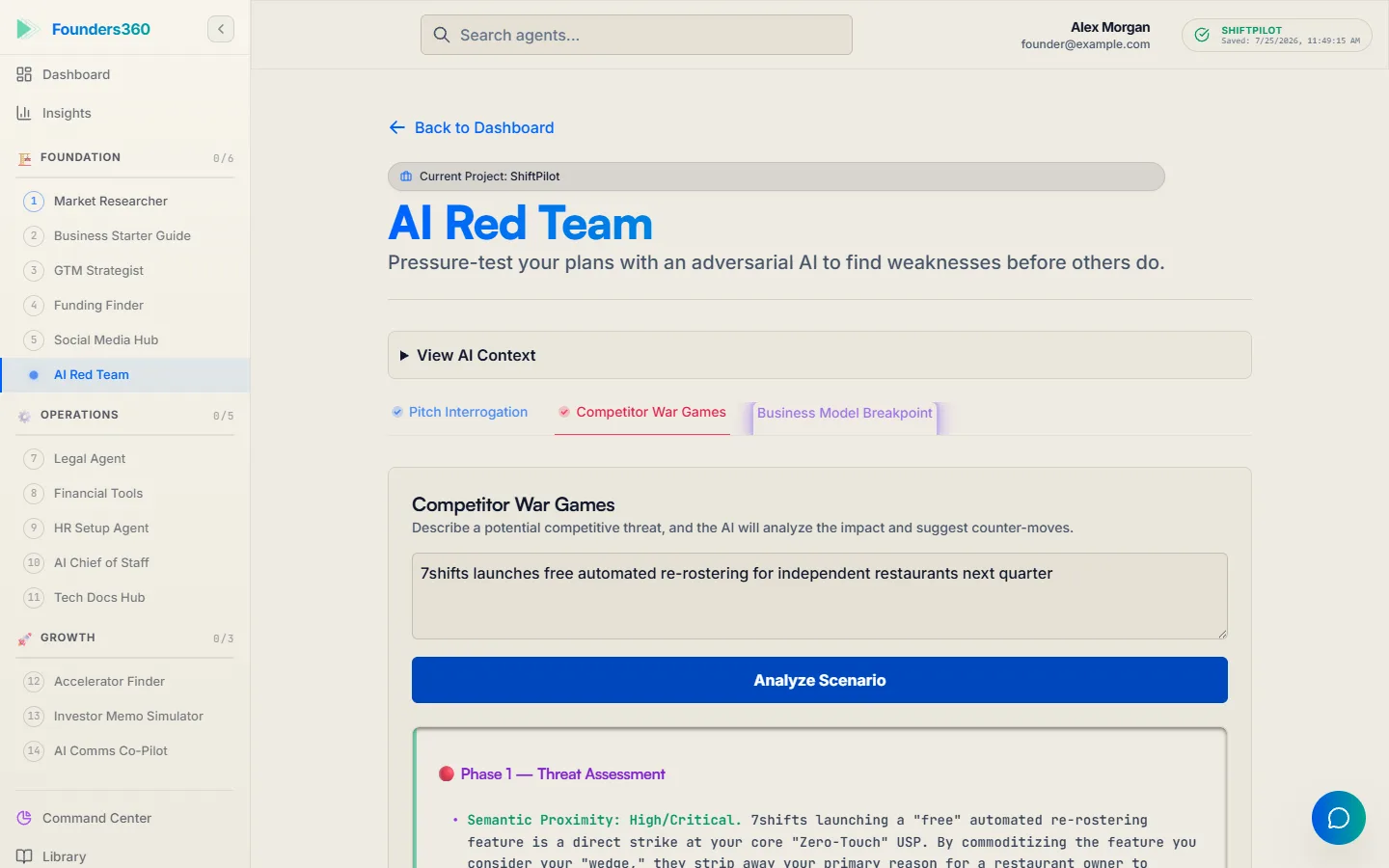
Our AI Red Team exists for this. On a fictional test company (ShiftPilot, an AI scheduling idea for restaurants), its first question named a real incumbent and asked what stops customers from clicking that incumbent's auto-fill button. The Funding Finder built a 12-slide deck from the same Shared Context and scored its own work 72 out of 100, calling its own revenue slide weak. That self-score tells the founder where the human still has to work. The reasoning is in why your AI co-founder should argue with you.
The Red Team writes its objections into Shared Context as facts, so the next agent sees the weakness rather than papering over it. The disagreement is recorded, not lost between sessions. You can see how the objections flow into the other agents on the agent library page.
A governance checklist you can adopt this week
Governance you cannot finish in a week stays a document. This one fits.
- List every external side effect your agents can cause: sends, posts, payments, deletions, third-party writes. If the list is empty, your only governance tasks are disagreement and cost, which we cover in how to control LLM costs in a startup.
- Move each one behind a separate acting process with no drafting code in it.
- Add the four guards: kill switch defaulting to off, daily cap, idempotency key from the platform's returned id, heartbeat row per run.
- Read every switch back from the process that acts, and write down which service owns it.
- Decide where a score may replace a tap, only for actions that are cheap to reverse and already capped.
- Write the test that asserts each guard holds: kill switch off sends nothing, a second run on the same row sends nothing, a run over cap sends nothing. How we run tests as the only gate is in multi-agent system design lessons.
Do the list first. Founders are usually surprised by how many of the items have no switch at all.
Frequently Asked Questions
What does human-in-the-loop mean for an AI agent?
A person, or a guard a person designed and can switch off, sits between the agent's output and any action that cannot be reversed. The agent may draft, score and recommend freely; it may not send, post, pay or delete without that checkpoint.
Should every AI action require human approval?
No. Approval on reversible actions creates a queue nobody clears. Reserve the human tap for external side effects, and put a kill switch, a daily cap, an idempotency key and a heartbeat on the process that performs them.
Can a second AI model replace human review?
Only for actions that are cheap to reverse and already capped. We let a reviewer score of 90 or more approve a social post without a tap, logged as automatic. We would not let a score skip a human on a cold email or a refund.
Where should an AI kill switch live?
On the process that performs the action. We set an approval flag on the wrong service once; it saved, it displayed, and the sending process never saw it. Verify a switch by reading it back from the service that acts.
How do you govern AI agents that only give advice?
Build disagreement into the product. Our AI Red Team raises named objections and our Funding Finder scores its own deck, so the founder sees where the human still has work to do. Record the objections as facts so later agents read them.
Tags
Related Articles
What Is Shared Context in AI Agents? One Memory Instead of Fifteen Chatbots
Shared context in AI agents is a single per-company memory that every agent writes to and every later agent reads from, so a market size found by one agent lands on the pitch deck built by another without being retyped. It is what separates one system from fifteen chatbots.
9 min readAI Deep DivesThe Shift from Point-Solution SaaS to Multi-Agent AI Architectures
Multi-agent AI architecture replaces per-seat process-mediation SaaS with execution layers that share one context store, validate every tool call and route work to the cheapest capable model. Here is what it cost us to build one.
9 min readAI Deep DivesMulti-Agent System Design: Lessons From Running Fifteen Agents on One Founder Memory
Multi-agent system design comes down to one pipeline every agent runs through, a shared store with both read and write halves wired, a fallback ladder that never repeats a prompt, and a test for every model call. Here is what running fifteen agents on one founder memory taught us.
9 min readReady to Build Smarter?
Join thousands of solopreneurs using AI agents to scale their businesses.
Get Started Free