
What Is Shared Context in AI Agents? One Memory Instead of Fifteen Chatbots
Shared context in AI agents is a single per-company memory that every agent writes to and every later agent reads from, so a market size found by one agent lands on the pitch deck built by another without being retyped. It is what separates one system from fifteen chatbots.
By Founders360 Team
Shared context in AI agents is one memory, held per company, that every agent writes into and every later agent reads from. When the Market Researcher sizes your market, the number lands in that store, and when the Funding Finder builds your deck a week later it puts the same number on the market-size slide without being asked. That is the whole idea. Fifteen chatbots that each start from a blank prompt are fifteen tools; fifteen agents on one memory are one system that gets sharper with every run. This article explains what the store holds, how the handoff works, what it costs to run and how to check whether a tool you are evaluating really has it.
What shared context means in practice
Shared context is a structured record of facts about your company, not a transcript of your conversations. The difference matters. A transcript is long, unranked and expensive to send with every request. A fact is short, typed and attributed: "TAM $2.8 billion, source Market Researcher, written on this date, importance high." The next agent receives a ranked block of facts rather than the last twenty chats, so it can act on what you already know without rereading it.
A chatbot with a long context window is not the same thing. The window is per conversation, and it is emptied when the conversation ends. Shared context persists across agents and sessions, and it belongs to the company rather than to any one chat. The practical test is simple: open a second tool and see whether it already knows what the first one found. If you have to paste, it is not shared.
We built Founders360 around this store because the cost of company building is mostly the cost of re-explaining. A founder who tells a legal tool, a finance tool and a pitch tool the same five facts about the business has done the same onboarding three times. One memory removes the repetition, and it removes the drift between versions of the same fact that creeps in when each tool holds its own copy.
The Market Researcher to Funding Finder handoff, step by step
The handoff runs in four steps, and none of them require the founder to copy anything.
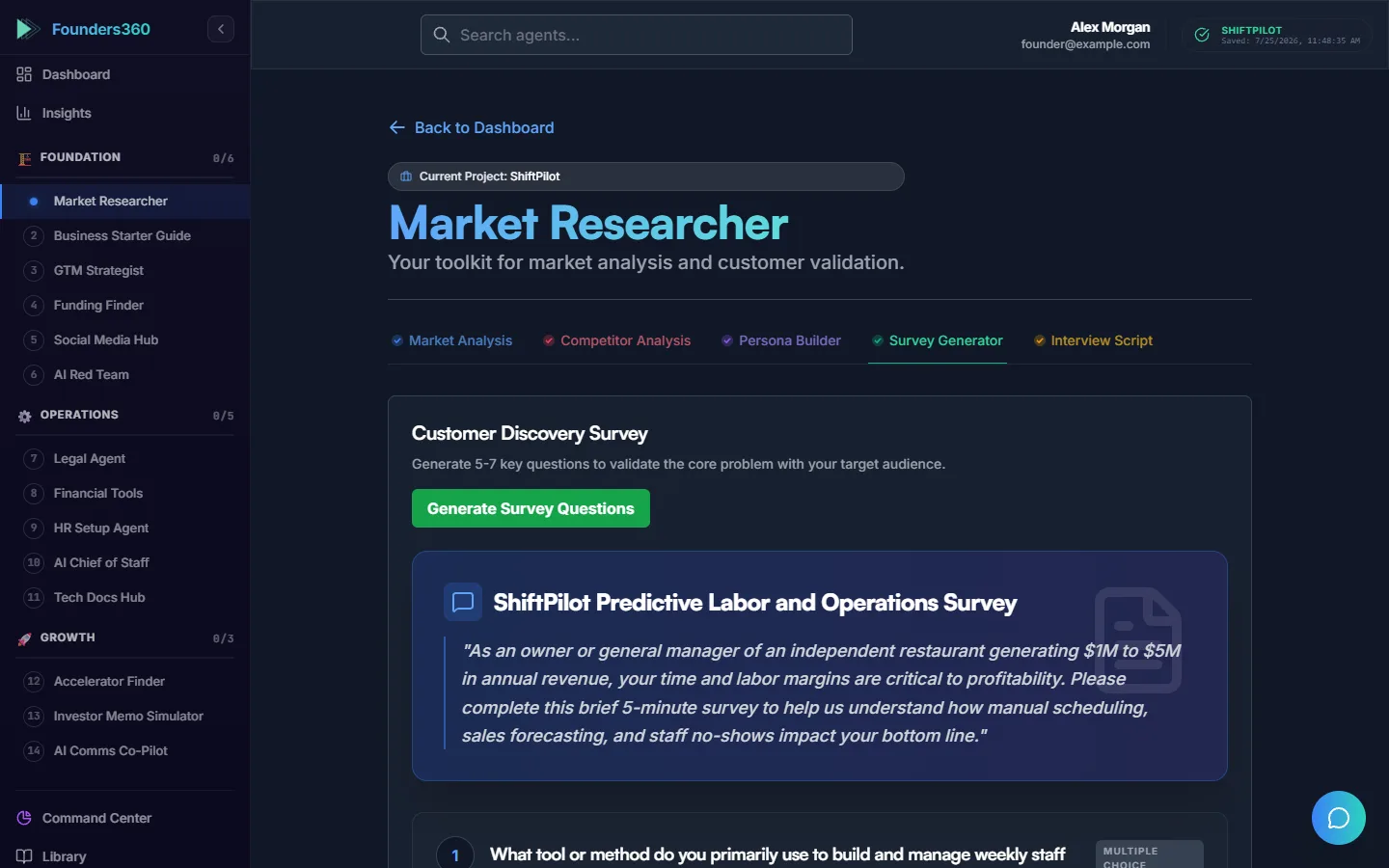
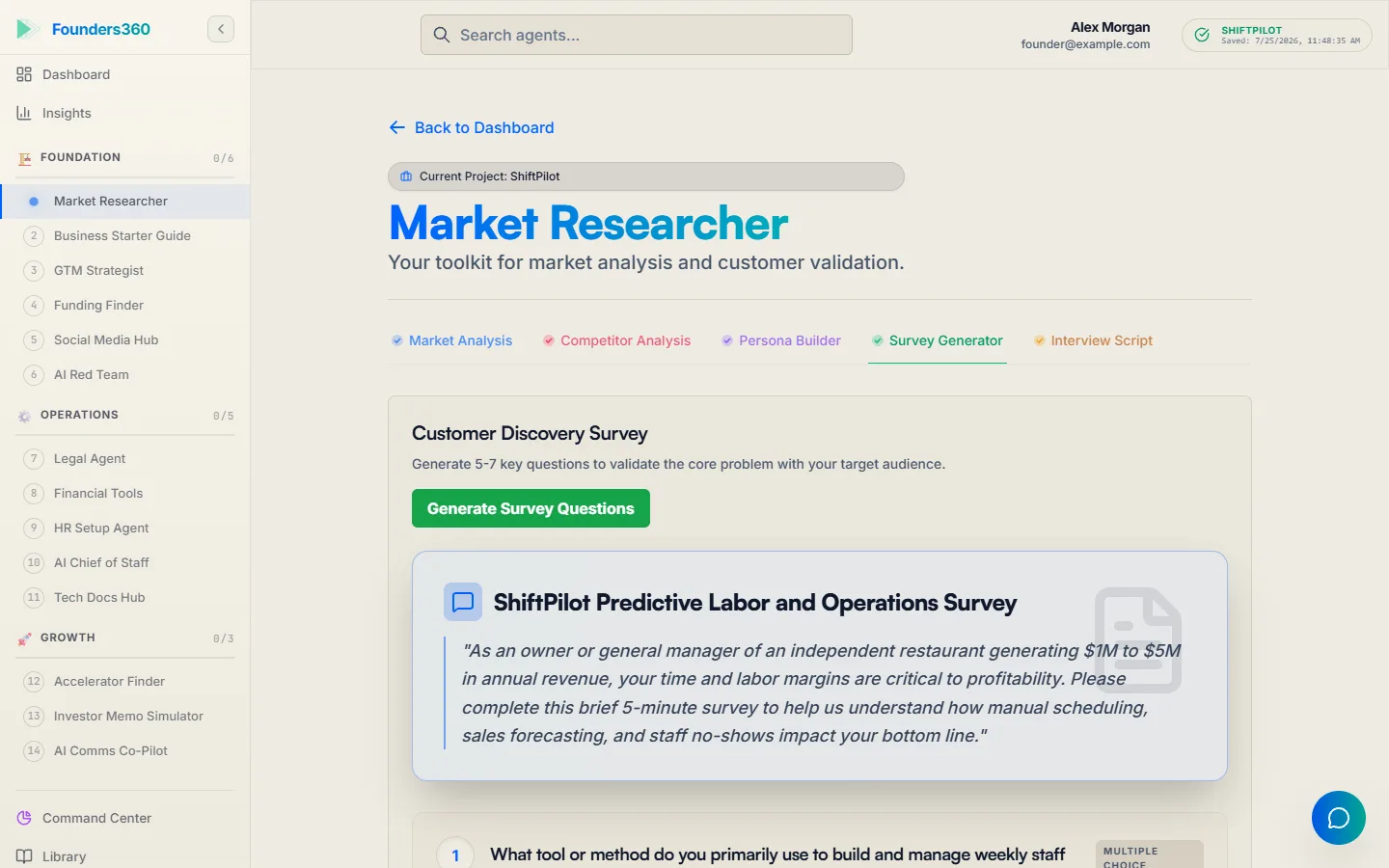
- The Market Researcher runs. It sizes the market top down, names the incumbents and states a serviceable and obtainable slice. On a fictional test company we use internally (ShiftPilot, an AI scheduling idea for restaurants), it walked the market from a $2.8 billion TAM down to a $212.6 million serviceable market and a $4.3 million obtainable slice.
- An extractor reads the output. After the answer is returned to the founder, a background process on a cheap model pulls the structured facts out of it: the three market figures, the named competitors, the customer segment. Each becomes a row with a source agent and an importance score.
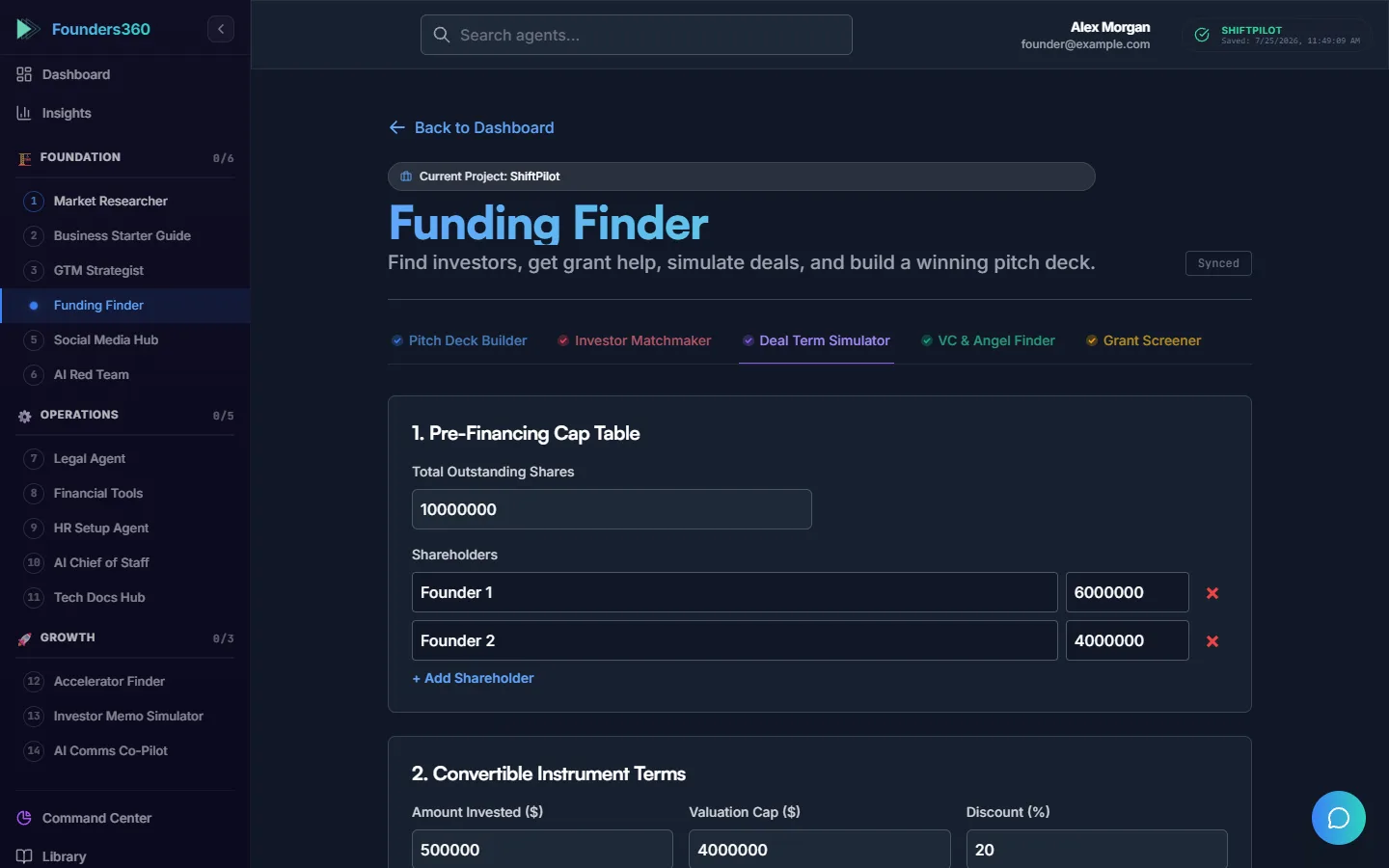
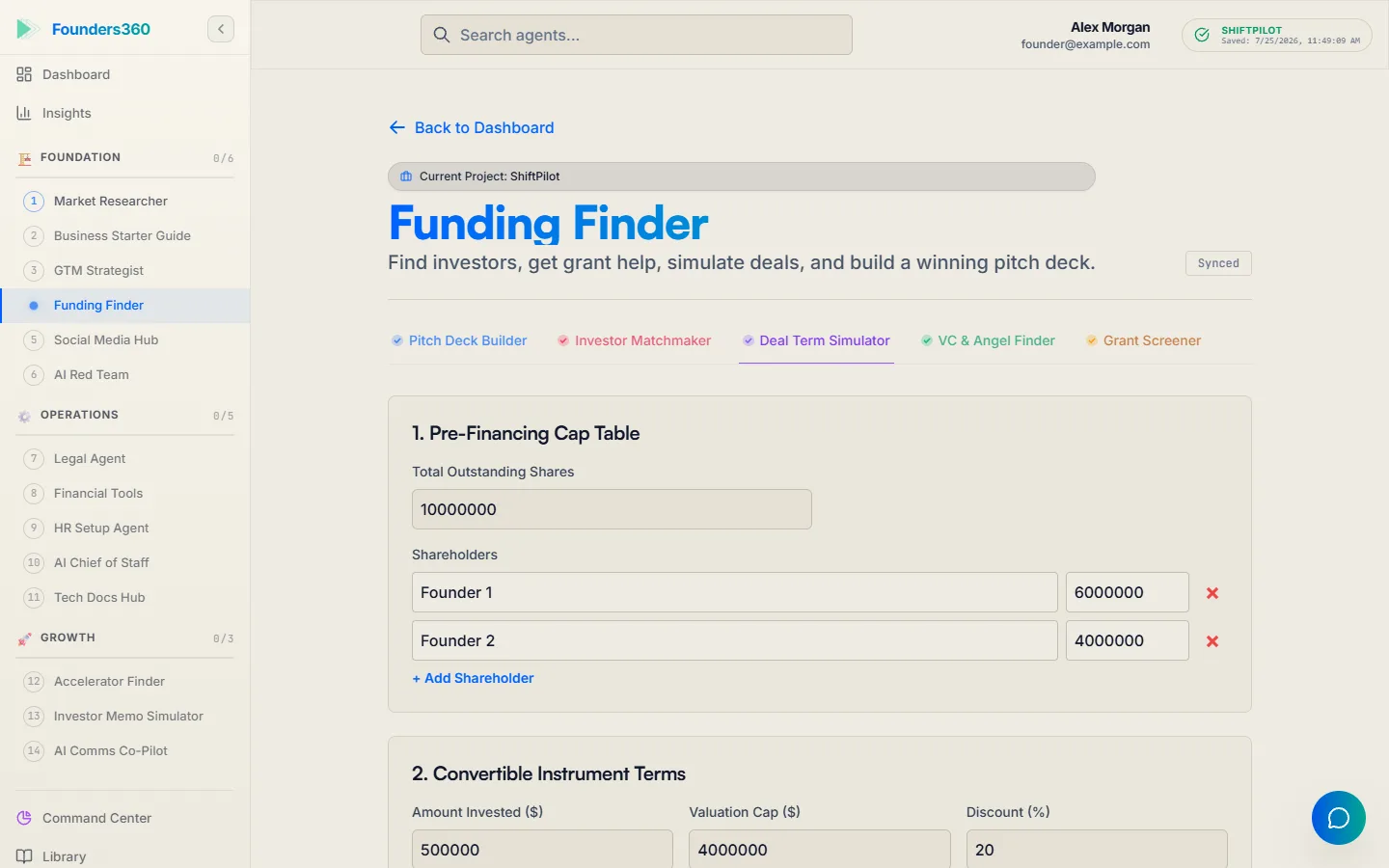
- The Funding Finder is invoked. Before its model call, the pipeline ranks the facts in the store and injects the top ten as a block above the prompt. The market figures rank high because they are recent and important.
- The deck carries the number. The market-size slide reads the TAM, SAM and SOM from the injected block. On the same test company the Funding Finder built a twelve-slide deck and then scored its own work 72 out of 100, calling its revenue slide weak.
Founders arrive wanting money: the Funding Finder is our most-used agent among external founders, at about 36 percent of all runs, with the Market Researcher second. That order is the handoff in reverse, and it is why the two agents are wired together first.
What a shared context fact looks like inside the store
Every fact carries five things: the value, the source agent, a timestamp, an importance score and an effective importance that decays with age. The decay is what keeps the store honest. With a cap of ten facts per injection, a strong fact written in March would otherwise crowd out a fresh one written today forever, and an agent would keep building on a market figure the founder had already revised. Ranking by decayed importance means a newer fact of equal weight wins, and an old fact fades unless it is confirmed again.
The source agent is the field a founder can verify. In production, roughly two thirds of all facts were written by the Market Researcher, which tells us where the store gets most of its substance and which agent to run first on a new company. The Funding Finder, the Legal agent and the Financial Tools agent write forward too, so a legal entity type chosen in one session shapes the cap table built in another.
Reads and writes are separate halves, and both must be wired for an agent to take part. An agent that writes facts but never reads them makes the store richer without getting smarter itself. An agent that reads but never writes is a consumer only. We audited our own pipeline for exactly this and found dedicated views that had been wired to write forward and never to read back, so the fix was to give every model-calling agent both halves through one pipeline. Our walkthrough of multi-agent system design covers what that audit found.
Why fifteen chatbots do not add up to one system
Isolated tools multiply the onboarding cost and divide the context. Each one asks for the company description, the stage, the market and the customer, and each one stores its own copy. When the founder updates a number in one tool, the other fourteen keep the old one, and the deck disagrees with the financial model, which disagrees with the legal memo.
A shared store inverts the economics. The first agent run seeds it, the second run is already better informed than the first, and the fifteenth run is working from everything the previous fourteen found. That compounding is the feature; the agent count is the packaging. It is also why we tell accelerator programs on our institutions page to judge a platform on its shared context demo and not on the number of logos in its agent library.
The comparison below is the one we use with founders evaluating tools.
| Question | Isolated chatbots | Shared context | |---|---|---| | Who holds the company facts? | Each tool, separately | One store, per company | | What happens when a fact changes? | Every tool must be updated by hand | The next extraction replaces it and the old one decays | | What does the tenth session start from? | A blank prompt | Everything the first nine found | | What can a founder verify? | Nothing outside the chat | The source agent and date on every fact |
How to check whether an AI tool really has shared context
Ask the tool to show you the facts it holds about your company, with their source and date. A vendor that cannot show that list has a context window, not a shared store. Then run the paste test: use one agent to establish a fact, open a second agent and ask a question that depends on it. If the second agent asks you for the fact, the handoff does not exist.
We learned the hard way that a shared store can look wired while writing nothing. Our HR agent's write-back was broken for the entire life of the feature by one wrong dictionary key: the code looked for hr where every caller sent hr-agent. A key that matches nothing does not raise, log or fail a request, so the allowlist read like full coverage while the HR agent never wrote a fact. The fix was a test that asserts every key is an id the system actually dispatches, and a health command that reports attempted-versus-produced per agent. A number that has not been re-derived from the store itself is a claim, not a measurement, and that applies to ours as much as anyone else's.
What shared context costs to run and how we keep it cheap
Extraction is a second model call after every agent response, so it is the first place cost grows. We run it on the cheapest model in our ladder, behind a length guard and a bounded background runner, so a long answer never becomes an expensive extraction and a burst of runs never floods the queue. Deterministic prompts go through a result cache. Every organization has a daily budget, and one with no explicit budget row gets a floor of five hundred tool calls rather than unlimited. When we add a model call we write the test that asserts its call count, because a call that is not counted is a cost that is not capped.
The injection side costs almost nothing extra. Ten ranked facts are a few hundred tokens, far less than a transcript, which is the point: a structured store is cheaper to read than the conversations it summarizes. For the wider design behind those choices, read our piece on the shift from point-solution SaaS to multi-agent AI.
What to do this week
Run the paste test on whatever you use today, and then run it on a store built for it. Four Founders360 agents are free forever: Command Center, Market Researcher, GTM Strategist and Business Guide, and the pricing page lists what the paid tiers add. Start with the Market Researcher on your real company, because it writes the most facts. Then open the GTM Strategist and ask it to draft a launch plan for your most obtainable segment without telling it what that segment is. If the plan names the segment the Market Researcher found, you have felt shared context work. If it does not, tell us, because that is a bug and every production bug here becomes a test before its fix ships. Our guide to an AI co-founder that argues with you shows what the same store looks like when the AI Red Team reads it.
Frequently Asked Questions
What is shared context in AI agents?
Shared context is a single per-company memory that every agent writes facts into and every later agent reads from before it answers. It replaces re-explaining the business to each tool with one store that compounds across sessions.
Is shared context the same as a long context window?
No. A context window belongs to one conversation and is emptied when it ends. Shared context belongs to the company, persists across agents and sessions, and holds ranked, attributed facts rather than raw transcripts.
How does an AI agent write to shared context?
After an agent answers, a background extractor on a cheap model pulls structured facts from the output and stores each with its source agent, a timestamp and an importance score. The founder does not copy anything.
How many facts does an agent read before it answers?
At most ten in our pipeline, ranked by importance with time decay applied, so recent facts of equal weight outrank old ones and a stale figure fades unless it is confirmed again.
How can I verify that a tool really shares context between agents?
Ask it to list the facts it holds about your company with their source and date, then establish a fact in one agent and ask a dependent question in another. If the second agent asks you for the fact, there is no shared context.
Tags
Related Articles
Human-in-the-Loop AI Governance for Startups: Where Autonomy Should Stop
Human-in-the-loop AI governance means deciding, action by action, what an AI agent may do on its own and what needs a person. Draw the line at the action, not the model, and put four guards behind every autonomous action: a kill switch that defaults to off, a daily cap, an idempotency key and a heartbeat.
8 min readAI Deep DivesThe Shift from Point-Solution SaaS to Multi-Agent AI Architectures
Multi-agent AI architecture replaces per-seat process-mediation SaaS with execution layers that share one context store, validate every tool call and route work to the cheapest capable model. Here is what it cost us to build one.
9 min readAI Deep DivesMulti-Agent System Design: Lessons From Running Fifteen Agents on One Founder Memory
Multi-agent system design comes down to one pipeline every agent runs through, a shared store with both read and write halves wired, a fallback ladder that never repeats a prompt, and a test for every model call. Here is what running fifteen agents on one founder memory taught us.
9 min readReady to Build Smarter?
Join thousands of solopreneurs using AI agents to scale their businesses.
Get Started Free