
How to Build an Investor-Ready Pre-Seed Data Room with AI Assistance
Raising pre-seed capital requires more than just a compelling pitch; it demands a meticulously organized data room that instills investor confidence. Discover how artificial intelligence can streamline the creation of your data room, ensuring accuracy and efficiency throughout your fundraising journey.
By Founders360 Team
Pre-seed fundraising is a critical, often challenging, stage for many startups. It is the moment when an idea begins to transform into a tangible business, attracting the very first external capital. While passion and vision are essential, securing this early funding round demands a structured approach, particularly when it comes to presenting your company to potential investors. A well-organized data room is not merely a collection of documents; it is a testament to your operational readiness and foresight, signaling to investors that you are prepared for the rigors of scaling a company.
Historically, compiling an investor-ready data room has been a time-consuming and labor-intensive process for founders. However, the advent of artificial intelligence (AI) has introduced powerful new capabilities that can streamline this crucial task, making it more efficient and accurate. By leveraging AI-assisted tools, founders can significantly enhance their fundraising efforts, allowing them to focus more on building their product and less on administrative overhead.
What Is a Pre-Seed Data Room?
A data room is a secure, digital repository where a startup stores and shares confidential company documents with potential investors during the due diligence process. Think of it as a comprehensive "proof library" where every claim made in your pitch deck is backed by evidence. For pre-seed companies, this room serves as the foundational impression, demonstrating professionalism and building trust with early-stage investors.
At the pre-seed stage, your startup is nascent, perhaps just a founding team with an idea or a prototype. Investors primarily want to verify the basics: the legitimacy of your business, its potential, and the robustness of your team. A data room allows you to centralize key company documents, streamline investor conversations by providing instant access to information, and support due diligence with transparency. It also demonstrates credibility and operational maturity, even if your business is relatively new.
Why an AI-Assisted Data Room Is Essential for Pre-Seed Founders
The fundraising process, especially at pre-seed, can be lengthy, typically taking three to six months from initial investor outreach to securing capital. Some sources suggest the entire pre-seed round, particularly when structured with SAFE notes, could span 12 to 18 months. This extended timeline underscores the need for efficiency. AI assistance offers several compelling advantages:
- Efficiency and Time Savings: AI can automate the generation of document outlines, initial drafts, and analysis, transforming what might take weeks into days or hours. This allows founders to allocate their limited time and resources to core business activities.
- Accuracy and Consistency: AI agents, when properly configured, can ensure that data and narratives across different documents remain consistent, reducing the risk of discrepancies that can raise red flags for investors. This consistency also reinforces a perception of meticulousness and control.
- Investor Confidence: A professionally organized and comprehensive data room, even for a pre-seed company, signals that founders are serious, organized, and understand the requirements of sophisticated investors. The ability to quickly provide accurate, detailed information boosts investor confidence.
- Strategic Insight: AI tools can help founders identify gaps in their documentation or areas where more evidence is needed, leading to a stronger overall presentation of the company.
Key Components of Your AI-Powered Pre-Seed Data Room
While a pre-seed data room can be leaner than those for later stages, it must contain essential documents. Here is how AI can assist in preparing each critical section:
Executive Summary and Pitch Deck
These are often the first documents investors review. The pitch deck is your startup's core narrative, outlining the problem, solution, market, business model, competition, and team. The executive summary provides a one-to-two-page high-level overview.
AI can help refine your messaging, suggest compelling narratives, and ensure logical flow. Founders360’s AI agents can assist in structuring these documents, drawing insights from your project context to ensure consistency. The Investor Memo Simulator can even pressure-test your pitch and assumptions, helping you anticipate investor questions before they arise.
Financial Projections
Even at the pre-seed stage, investors expect to see financial projections. While early numbers are often speculative, they demonstrate your understanding of the business model and strategic thinking. For pre-seed, focus on short-term projections (12 months) for cash management and planned development, and high-level longer-term forecasts (three to five years) to show strategy and market potential. Avoid excessive detail; one or two slides for financials in the pitch deck are sufficient.
AI financial tools can help generate initial financial models, forecast revenue based on various assumptions, and illustrate burn rate and runway. They can also help visualize key metrics such as user growth, paying customers, sales, revenue, gross profit, and net profit. When using Founders360, the Financial Agent can help you build these models, drawing upon market data and your business plan to generate realistic, yet ambitious, projections.
Market Research and Competitive Analysis
Proof of market need is crucial for attracting pre-seed investment. Investors want to see that you understand your target audience, market dynamics, and competitive landscape. Market research validates your assumptions, helps identify opportunities and threats, and informs your product positioning.
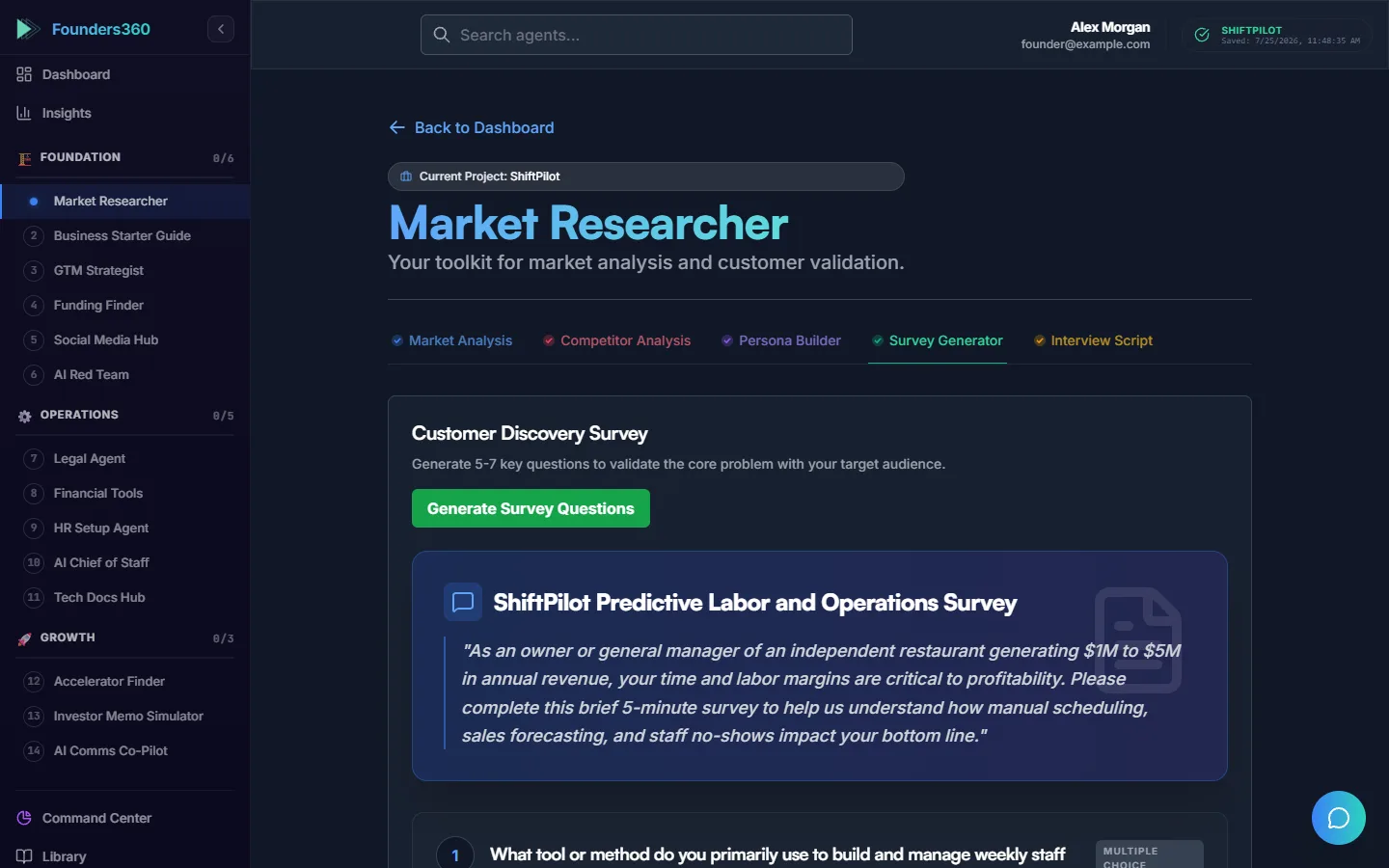
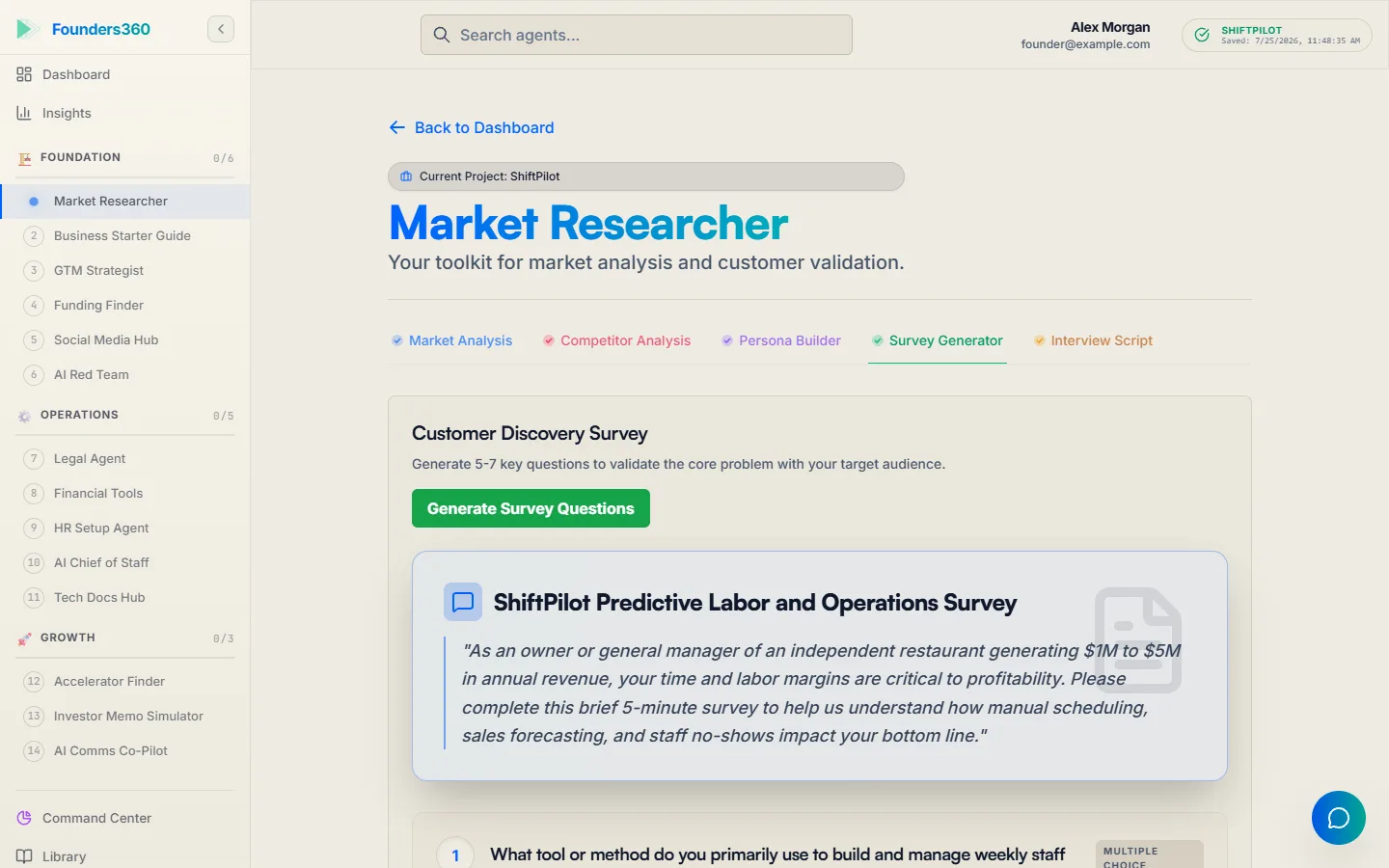
AI can rapidly process vast amounts of data to provide market analysis reports, competitive intelligence, and customer feedback summaries. Founders360’s Market Researcher agent is designed specifically for this, helping you build a comprehensive market understanding that underpins your entire business plan. This includes identifying total addressable market (TAM), serviceable available market (SAM), and serviceable obtainable market (SOM) analyses.
Legal Documents and Intellectual Property
This section protects the company and reveals potential risks. Key legal documents for pre-seed include incorporation documents, articles of association, company bylaws, and a clean capitalization table (cap table). Intellectual property (IP) assignment agreements for founders and early contractors are especially critical and often overlooked.
AI can assist in drafting initial versions of standard legal documents and help organize IP registrations or applications. However, it is paramount to remember that AI outputs are drafts. Critical legal and financial documents should always be reviewed and finalized by qualified legal professionals. The Founders360 Legal agent can provide a strong starting point for many of these documents, integrating with your shared project context to ensure consistency across your legal framework.
Team Biographies and Traction Metrics
Investors at the pre-seed stage are often betting heavily on the team. Short bios or resumes of key team members, outlining their experience and roles, are essential.
For traction, even early signals are valuable. This can include letters of intent (LOIs), pilot program scopes, early customer feedback, or product demo details. A clear product roadmap highlighting completed milestones and upcoming features also shows momentum. AI can help synthesize these into concise, impactful summaries.
Building Your Data Room with Founders360 Agents
Founders360 offers a suite of specialized AI agents designed to streamline the creation of your investor-ready data room, all benefiting from a shared project context. This means you enter your business context once, and all 15 agents leverage that information, eliminating repetitive data entry and ensuring consistency.
Here is how specific agents can help:
- Market Researcher: Generates detailed market analyses, competitive landscapes, and customer insights, forming the bedrock of your market section.
- GTM Strategist: Helps craft your go-to-market plan, essential for demonstrating how you will acquire customers and generate revenue.
- Financial Agent: Assists in building your financial projections, revenue models, and burn rate analysis, ensuring your numbers tell a coherent story.
- Legal Agent: Provides assistance with initial drafts of incorporation documents, IP assignments, and other critical paperwork. Remember, professional legal review is always necessary.
- Funding Finder: Once your data room is robust, this agent can help identify potential investors aligned with your stage and sector.
- Investor Memo Simulator: Allows you to pressure-test your entire narrative and financial model, providing feedback from an investor's perspective before you even pitch.
For example, a fictional company, ShiftPilot, developing an AI-powered logistics optimization platform, could use the Market Researcher to quantify the market size for logistics software, the GTM Strategist to define their initial customer acquisition channels, and the Financial Agent to project the impact of their solution on operational costs and revenue. All these agents would share the same core business information, ensuring that ShiftPilot’s investor materials are cohesive and accurate. The Founders360 suite provides a powerful back office for founders at every stage of their journey.
Best Practices for Presenting Your AI-Assisted Data Room
Creating the documents is only part of the process. How you present them is equally important:
- Organization and Clarity: Categorize your documents logically (e.g., Financials, Legal, Product, Team, Market Research) and use clear, concise labels. Investors appreciate a well-organized data room that saves them time.
- Security and Access Control: Host your data room on a secure platform that allows for permission-based access. Not every investor needs to see every document initially. Implement staged access: a basic set for initial interest, and a more comprehensive set for serious due diligence. Founders360 ensures your data is protected through SOC 2-compliant hosting, and its models do not train on user business data.
- Storytelling with Data: While AI helps generate data, your role is to weave that data into a compelling narrative. Explain the assumptions behind your projections and how they support your vision.
- Responsiveness: Be prepared to answer questions and provide additional context quickly. A well-prepared data room minimizes these requests, but investor questions are inevitable.
- Focus on Drafts: Clearly communicate that AI-generated legal or financial documents are drafts and subject to professional review. This transparent approach manages expectations and mitigates risks.
Frequently Asked Questions
What is the typical timeline for a pre-seed fundraise?
Pre-seed fundraising typically takes three to six months from your first investor outreach to securing capital. However, the entire pre-seed stage can range from several months to over a year, especially if you are continuously raising smaller checks via instruments like SAFE notes. Preparing thoroughly with an AI-assisted data room can help accelerate this timeline.
How many documents should be in my pre-seed data room?
For a pre-seed round, the data room can be leaner. A well-organized room with 20 to 30 accurate documents is usually sufficient and preferable to a bloated room with many outdated files. Quality over quantity is key, focusing on essentials like your pitch deck, financials, cap table, legal basics, team, and market validation.
Can AI entirely replace legal counsel for data room documents?
No, AI cannot entirely replace qualified legal counsel. While AI tools, such as the Founders360 Legal agent, can assist in drafting initial versions of legal documents and organizing information, critical legal documents should always be reviewed and finalized by qualified legal professionals. AI outputs are drafts and serve as a starting point, not a replacement for expert legal advice.
What is the difference between a pre-seed and a seed data room?
A pre-seed data room is generally leaner, focusing on the legitimacy of the business, team potential, and basic market validation. It typically includes essentials like the pitch deck, basic financials, cap table, incorporation documents, and early traction. A seed data room will require more robust evidence of traction, more detailed financial models, and potentially more comprehensive legal and intellectual property documentation, reflecting the progress the company has made since pre-seed.
Leveraging AI to build your pre-seed data room is not about cutting corners; it is about building a more robust, accurate, and investor-ready foundation for your startup. Founders360 provides the tools to achieve this, enabling you to navigate the complexities of fundraising with confidence and clarity. Explore how our agents can empower your pre-seed fundraise by visiting our agents page, learn more about how we support solopreneurs, or review our detailed pricing plans to find the best fit for your startup.
Tags
Related Articles
Building a Repeatable Customer Discovery Process as a Technical Founder
Technical founders often excel at building innovative products, but frequently face the challenge of ensuring their creations genuinely solve market problems. This article provides a concrete, repeatable customer discovery process designed to help technical founders validate ideas, understand customer needs, and avoid the common pitfalls of building in a vacuum. Learn how to transform assumptions into validated insights and build products that customers truly want.
10 min readStartup PlaybooksThe Venture Studio Playbook: How Companies are Built Differently
Venture studios represent a distinct and increasingly influential model in the startup ecosystem, fundamentally changing how new companies are conceived, built, and scaled. Unlike traditional venture capital firms or accelerators, studios act as co-founders, engaging deeply from ideation through launch and growth, providing extensive operational support and capital. This hands-on approach aims to de-risk the startup journey and increase the likelihood of success for portfolio companies.
8 min readStartup PlaybooksHow to Price Your First SaaS Product When You Have No Customers
Launching your first SaaS product without a customer base presents a unique pricing challenge. This guide offers practical strategies for setting prices, focusing on value, understanding costs, and iterating as you grow, even when traditional competitive benchmarks are not available.
8 min readReady to Build Smarter?
Join thousands of solopreneurs using AI agents to scale their businesses.
Get Started Free