
The Venture Studio Playbook: How Companies are Built Differently
Venture studios represent a distinct and increasingly influential model in the startup ecosystem, fundamentally changing how new companies are conceived, built, and scaled. Unlike traditional venture capital firms or accelerators, studios act as co-founders, engaging deeply from ideation through launch and growth, providing extensive operational support and capital. This hands-on approach aims to de-risk the startup journey and increase the likelihood of success for portfolio companies.
By Founders360 Team
The landscape of startup creation is constantly evolving, with new models emerging to support ambitious founders. Among these, the venture studio has solidified its position as a powerful, yet often misunderstood, force. Venture studios are not simply investors or incubators; they are active builders, operating as co-founders that systematically create and scale new companies from the ground up. This unique approach to company formation addresses many of the challenges faced by early-stage ventures, offering a blueprint for founders to consider, even if they are not part of a studio themselves.
What Exactly is a Venture Studio?
A venture studio, sometimes referred to as a startup studio or venture builder, is an organization that conceives, validates, builds, and launches multiple startups. It does this by combining company building with venture funding. Unlike traditional venture capital (VC) firms that primarily provide financial backing to existing startups, or accelerators that offer short-term programs for already-formed teams, venture studios initiate the company creation process from day zero. They often generate ideas internally, assemble founding teams, and provide extensive operational support and capital throughout the startup's lifecycle.
This model is distinguished by its deep, hands-on involvement, acting much like a co-founder rather than just a financial backer. The goal is to surround founders with a team of experts and resources, enabling companies to build, penetrate the market, acquire customers, and scale faster than they might on their own. The venture studio concept, pioneered by Idealab in 1996, has seen significant growth, with hundreds of studios operating globally today.
Idea Generation and Validation: A Systematic Approach
One of the fundamental differences in the venture studio model is its systematic approach to idea generation and validation. Rather than waiting for external founders to pitch ideas, studios often leverage their internal teams, market research, and industry insights to identify high-potential problems and opportunities. This proactive ideation process often begins by researching market needs, customer pain points, and emerging industry trends.
Once an idea is identified, the studio rigorously tests and refines the business concept. This involves building minimum viable products (MVPs), gathering user feedback, and continuously iterating. The validation phase also includes assessing the product's financial model and potential profitability, ensuring a calculated approach before significant resources are committed. This structured methodology aims to achieve problem-solution fit early, de-risking the venture before it even officially launches.
Building the Founding Team: More Than Just Investment
Traditional startups typically form a team and then seek investment. Venture studios often reverse this process, recruiting C-level talent or entrepreneurs-in-residence to lead validated concepts. The studio actively assembles the founding team, providing them with a robust support structure from day one. This means founders joining a studio-backed venture step into a role with a pre-validated idea, initial capital, and a comprehensive operational framework already in place.
The studio's role extends beyond recruitment; it involves providing the expertise that a typical early-stage team might lack. This can include seasoned architects for value proposition refinement, design teams for product crafting, and engineering experts for robust development. By having this shared bench of skilled professionals, studios ensure that critical capabilities are available immediately, allowing founders to focus on vision and execution rather than filling every early-stage hiring gap.
Comprehensive Operational Support and Shared Services
Perhaps the most significant differentiator of venture studios is the extensive operational support and shared services they provide to their portfolio companies. This goes far beyond strategic advice or networking; it involves direct, hands-on assistance across almost every functional area of a business.
Services typically offered by venture studios include, but are not limited to, finance, recruiting, marketing and public relations, branding, go-to-market strategy, product-market fit assessment, engineering, product design, and back-office support. This comprehensive support means that a new startup can tap into a pool of experts for legal guidance, financial modeling, human resources, and marketing execution without needing to build out each department internally in the very early stages. This dramatically reduces the initial overhead and operational burden on the founding team.
Capital Efficiency and Structured Funding Rounds
Venture studios typically fund the initial stages of the companies they build. They often provide the seed capital, allowing the newly formed ventures to reach key milestones before needing to seek external funding. This initial capital, combined with the shared operational resources, contributes to greater capital efficiency. Startups emerging from a studio environment are often better prepared for external fundraising rounds because they have already achieved significant validation and have a more developed operational infrastructure.
While studios do take a significant equity stake, often ranging from 20-60% or more, this reflects their deep involvement and the substantial resources and capital they inject into the company from its inception. This model has been shown to deliver faster milestone achievement and higher average returns compared to traditional VC-backed startups, indicating the effectiveness of this structured approach to investment and growth.
De-risking the Startup Journey
The entire venture studio model is designed to mitigate the inherent risks of launching a new company. By systematically validating ideas, providing seasoned operational teams, and offering shared resources, studios aim to increase the probability of success for their portfolio ventures. This contrasts with the traditional model where founders often face the daunting task of simultaneously validating an idea, building a product, recruiting a team, and securing funding, all with limited resources.
Founders benefit from the compounded experience and knowledge within the studio. Each venture, successful or not, contributes valuable insights that are applied to subsequent projects, creating a continuous learning loop that strengthens the overall studio methodology. This structured environment helps to uncover and analyze business opportunities early, often before a founder even joins the process, reducing many of the unknowns that plague nascent companies.
How Founders360 Supports a Studio-Like Approach
Even if you are not operating within a formal venture studio, you can adopt many of their principles to de-risk your own startup journey. Founders360 provides a powerful suite of AI agents that can replicate some of the specialized operational support found in a venture studio, especially for solo founders and early-stage teams. Founders who are building independently can find tailored resources on our dedicated page for solopreneurs. The platform functions as an AI-powered startup suite, offering 16 specialized agents that share a single project context, much like a studio's centralized brain [cite: product brief].
For example, the Market Researcher agent can assist with systematic idea validation and market analysis, mirroring the studio's initial ideation phase. The GTM Strategist helps define your path to customers, while the Financial agent assists with modeling and profitability assessments. The Legal agent can provide draft documents, and the HR Setup agent helps establish foundational human resources processes. This integrated approach ensures that information flows seamlessly between different functions, eliminating the need for constant copy-pasting and manual synchronization.
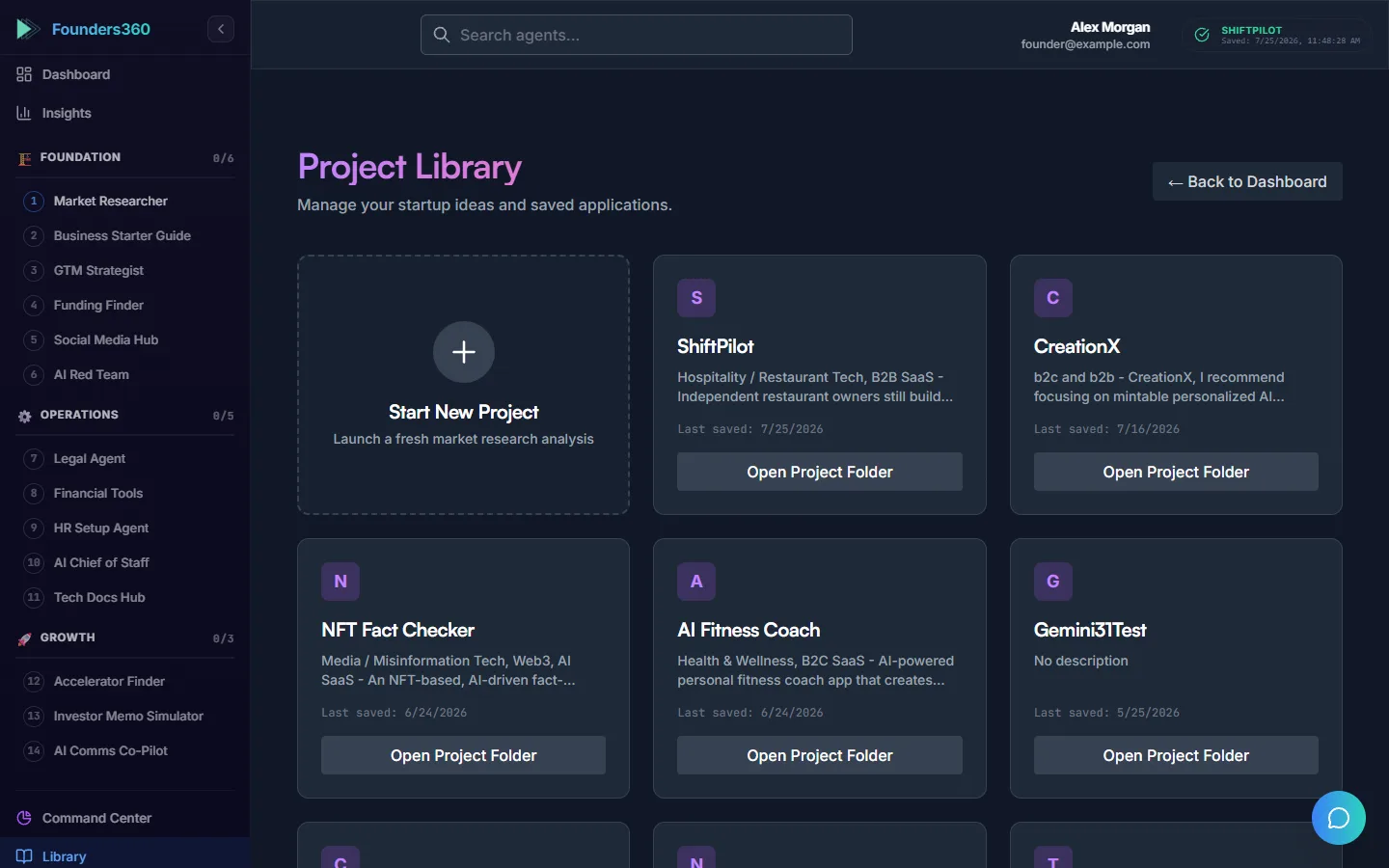
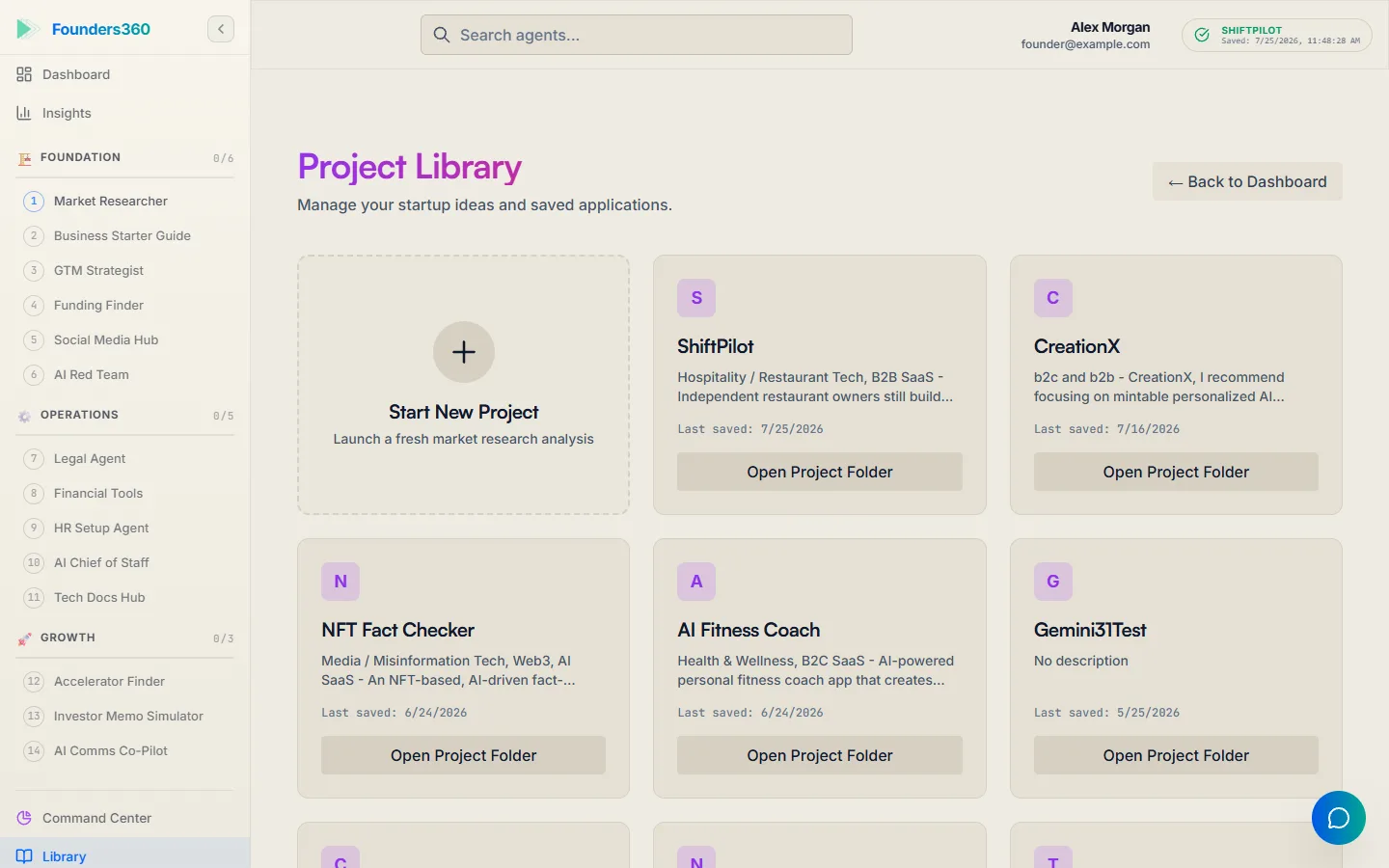
Founders360's core differentiator is its shared context. You complete market research once, and that intelligence automatically informs your legal documents, financial model, pitch deck, and every other output generated by the agents [cite: product brief]. This shared context streamlines operations and maintains consistency, similar to how a venture studio's centralized services maintain a unified vision across various departments. Founders can explore the full range of capabilities on the agents page, which provides a comprehensive overview of how these tools can act as an extended team.
Key Takeaways for Founders
For individual founders, the venture studio model offers valuable lessons:
- Prioritize Systematic Validation: Do not rush into building. Dedicate time to rigorous market research and idea validation. Test your assumptions with MVPs and customer feedback before committing significant resources.
- Leverage Specialized Expertise: Understand your weaknesses and actively seek out expertise in areas where you lack it. This could mean hiring, bringing on advisors, or utilizing tools that provide specialized support. Founders360, for instance, offers a range of AI agents that provide expert guidance across various functions, helping to fill knowledge gaps. You can explore our pricing plans to access essential agents, including a permanent free tier.
- Build an Operational Foundation Early: Establish solid processes for legal, finance, and HR from the outset. Neglecting these areas can lead to significant problems down the line. Even if you are a solopreneur, robust foundational elements are critical for long-term stability and growth.
- Focus on Capital Efficiency: Be strategic with your early capital. The studio model emphasizes building efficiently to achieve milestones before external funding, a principle all founders should adopt.
By understanding and adapting the structured, hands-on, and resource-rich approach of venture studios, founders can significantly enhance their chances of building successful, scalable companies.
Frequently Asked Questions
How does a venture studio differ from a venture capital firm?
A venture studio differs significantly from a venture capital firm because it is deeply involved in the creation and ongoing operations of startups, often acting as a co-founder. VC firms primarily offer financial backing to already-established businesses with validated concepts and teams, providing strategic advice and network access but typically not engaging in day-to-day building or early ideation. Studios generate ideas internally, build initial products, recruit teams, and provide extensive operational support, taking a larger equity share due to their higher level of involvement.
What kind of support does a venture studio provide?
Venture studios provide comprehensive, hands-on operational support across nearly all aspects of a startup's development. This includes, but is not limited to, idea generation and validation, product design and engineering, marketing and public relations, finance, legal, human resources, and recruiting. They essentially act as an extended back office, supplying the founding team with capabilities from a shared bench of experts, enabling faster scaling and de-risking.
Do venture studios provide funding to the startups they create?
Yes, venture studios typically provide the initial seed funding for the startups they create. This capital is often combined with extensive operational support and shared resources to help the new ventures reach key milestones efficiently. While studios fund the early stages, they also assist in preparing companies for external fundraising rounds as they grow and seek further investment.
What are the main benefits of working with a venture studio?
The main benefits of working with a venture studio include access to experienced teams and hands-on support in product development, go-to-market strategies, and securing funding. This model offers lower risk due to systematic idea validation and operational de-risking, as well as compounded experience and knowledge applied across multiple ventures. Startups can scale faster with comprehensive operational services and a structured path from ideation to growth.
What is the typical equity stake a venture studio takes in a company?
Venture studios typically take a significant equity stake in the companies they create, often ranging from 20% to 60% or more. This larger equity share reflects their deep involvement as co-founders, providing initial capital, extensive operational support, and a structured environment for building and scaling the business from its earliest stages. This is generally higher than the equity stake taken by traditional venture capital firms, which primarily offer financial investment at later stages.
Tags
Related Articles
Building a Repeatable Customer Discovery Process as a Technical Founder
Technical founders often excel at building innovative products, but frequently face the challenge of ensuring their creations genuinely solve market problems. This article provides a concrete, repeatable customer discovery process designed to help technical founders validate ideas, understand customer needs, and avoid the common pitfalls of building in a vacuum. Learn how to transform assumptions into validated insights and build products that customers truly want.
10 min readStartup PlaybooksHow to Price Your First SaaS Product When You Have No Customers
Launching your first SaaS product without a customer base presents a unique pricing challenge. This guide offers practical strategies for setting prices, focusing on value, understanding costs, and iterating as you grow, even when traditional competitive benchmarks are not available.
8 min readStartup PlaybooksHow to Build an Investor-Ready Pre-Seed Data Room with AI Assistance
Raising pre-seed capital requires more than just a compelling pitch; it demands a meticulously organized data room that instills investor confidence. Discover how artificial intelligence can streamline the creation of your data room, ensuring accuracy and efficiency throughout your fundraising journey.
9 min readReady to Build Smarter?
Join thousands of solopreneurs using AI agents to scale their businesses.
Get Started Free