
Building a Repeatable Customer Discovery Process as a Technical Founder
Technical founders often excel at building innovative products, but frequently face the challenge of ensuring their creations genuinely solve market problems. This article provides a concrete, repeatable customer discovery process designed to help technical founders validate ideas, understand customer needs, and avoid the common pitfalls of building in a vacuum. Learn how to transform assumptions into validated insights and build products that customers truly want.
By Founders360 Team
Technical founders possess a deep understanding of technology and its potential. This strength, however, can sometimes lead to developing products based on assumptions rather than validated customer needs. The path from a technical idea to a successful product demands a systematic approach to understanding the people who will use it.
Customer discovery is the foundational process for building a product that resonates with your audience and solves real problems. It is not merely talking to potential users; it is a structured investigation aimed at understanding customer pains, needs, and behaviors before significant resources are committed to development. For technical founders, mastering this process is paramount to de-risking their startup and setting it on a path toward success.
The Pitfalls of Building in Isolation
Many technical founders develop solutions based on what they think users want, not what they actually need. This often wastes time and resources, culminating in a technically brilliant product that fails to gain market traction. Founders may spend months or years perfecting a solution, only to discover it addresses the wrong problem or lacks a compelling market need.
This contributes to startup failures when there is no clear understanding of the customer and their actual pain points. Without genuine insight, even innovative technology struggles commercially. The assumption that a good product will automatically find its market is dangerous. Instead of making assumptions, founders must prioritize validating ideas through direct customer interaction, engaging with real potential customers.
Establishing a Repeatable Customer Discovery Process
A repeatable customer discovery process is a structured framework that enables founders to consistently gather, analyze, and apply customer insights. It moves beyond ad-hoc conversations to a systematic learning loop applicable to new features, market segments, or entirely new ventures. This process ensures product development is informed by real-world feedback, reducing guesswork and increasing the likelihood of customer adoption.
The key components of a repeatable process include:
- Hypothesis Formulation: Clearly articulating assumptions about customers and their problems.
- Target Identification: Precisely defining who your ideal customers are.
- Interview Design: Crafting unbiased, open-ended questions focused on past behavior.
- Systematic Execution: Conducting interviews consistently and without bias.
- Rigorous Analysis: Identifying patterns and themes from collected data.
- Continuous Iteration: Using insights to refine hypotheses and product direction.
This systematic approach fosters continuous learning and adaptation, crucial in the dynamic startup environment.
Phase 1: Formulating Hypotheses and Defining Your Target
Before customer engagement, articulate your initial assumptions. These are your hypotheses about who your customers are, their problems, and how your potential solution might address those problems. For example, a founder might hypothesize: "Small e-commerce businesses struggle with managing inventory across multiple sales channels, leading to stockouts and overselling. They would pay for an automated synchronization tool."
Formulating Clear Hypotheses
Your hypotheses should be specific and testable, covering:
- Customer Segment: Who experiences this problem?
- Problem: What specific pain points do they have?
- Existing Solutions: How are they currently solving this problem (if at all)?
- Value Proposition: What unique benefit does your proposed solution offer?
Identifying Your Target Customer Segments
Defining your target customer is a critical first step. Without a precise understanding, aligning products with needs is challenging. Consider demographics, psychographics, behaviors, and the specific contexts where they experience the problem. Who stands to gain most from your solution? Which groups actively seek better ways to solve this problem?
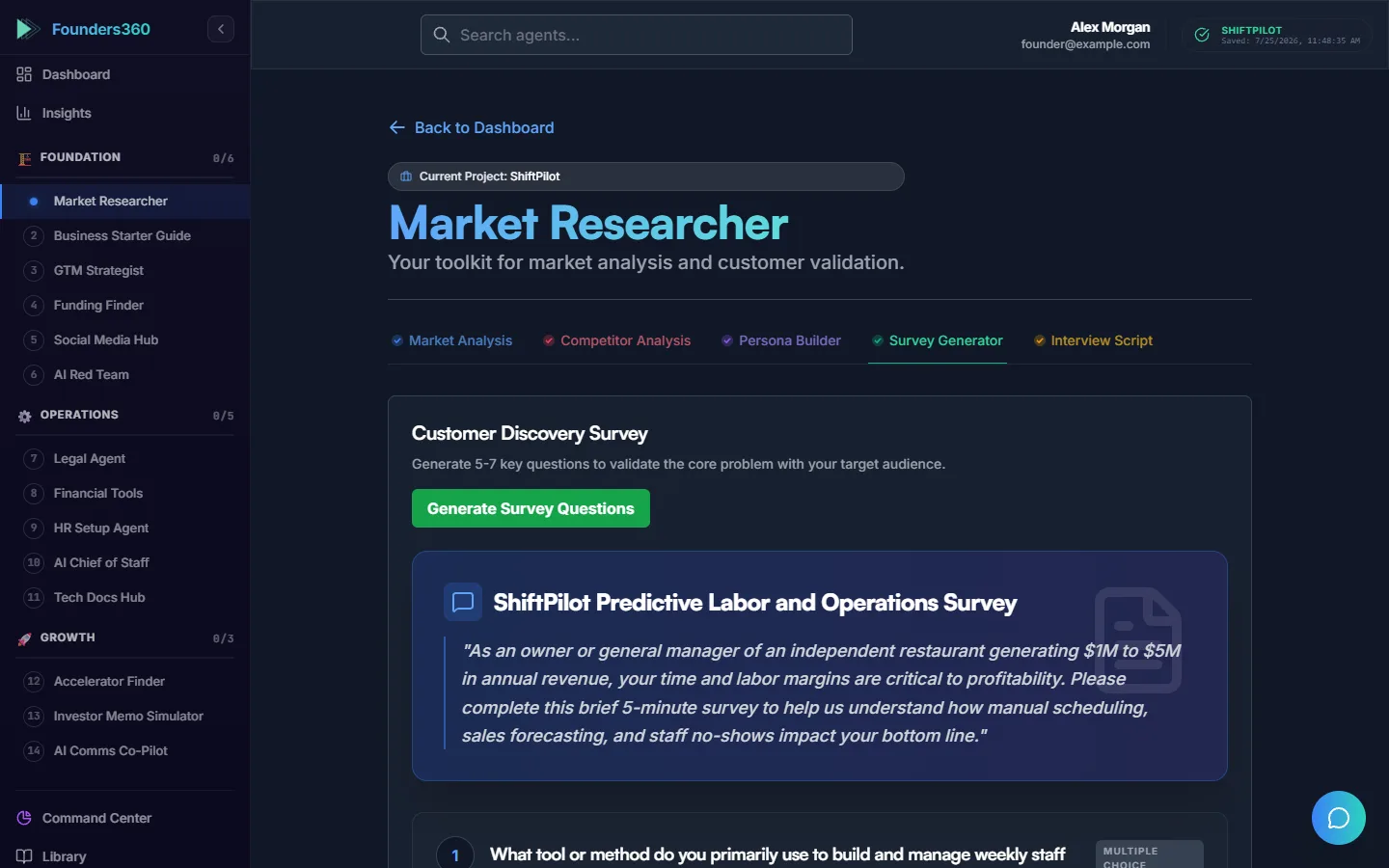
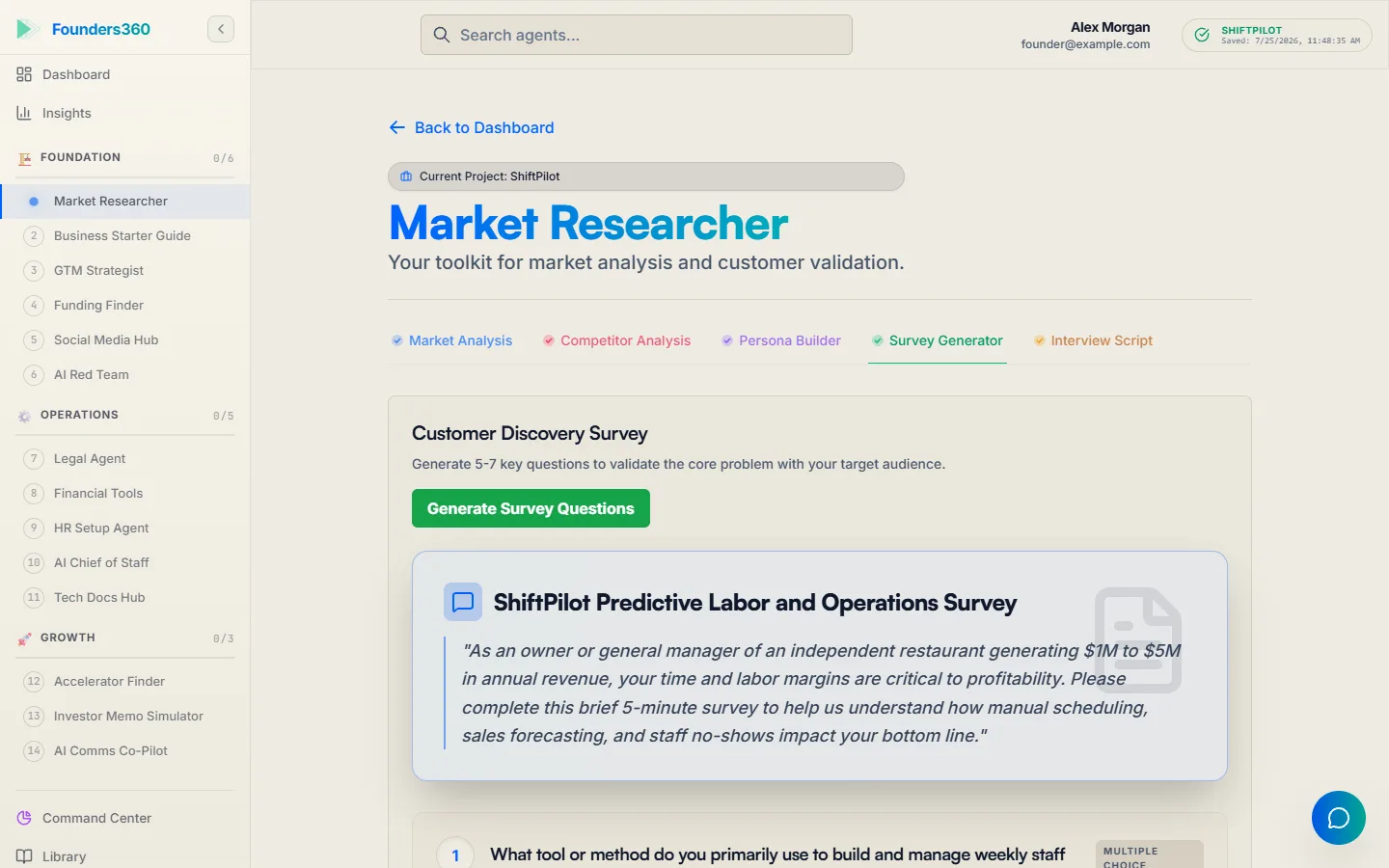
Founders360 can streamline this initial phase. The Market Researcher agent helps you quickly gather competitive intelligence and identify initial customer segments. It allows you to explore market trends, analyze potential user bases, and build foundational knowledge to inform your hypotheses before direct customer outreach. This structured approach grounds initial ideas in data, preventing misguided product development.
Phase 2: Engaging for Real Insights
This phase involves direct interaction, aiming to listen and learn, not to sell. The most effective way to gather insights is through one-on-one conversations. The objective is to understand the customer's world and the job they are trying to get done.
Crafting Effective Interview Questions
The quality of your insights directly correlates with the quality of your questions. Avoid leading questions or those asking about hypothetical future behavior. People are often poor predictors of future actions, and surveys relying on stated preferences can be misleading. Instead, focus on past experiences and current behaviors.
Consider these types of questions:
- "Tell me about the last time you encountered [the problem you are trying to solve]."
- "How do you currently handle [this specific task or situation]?"
- "What is the most frustrating part about [their current solution or process]?"
- "What have you already tried to solve this problem?"
- "What does an ideal solution look like for you in this context?" (Focus on outcomes, not features)
The Founders360 Market Researcher agent helps you quickly gather competitive intelligence and identify initial customer segments, which can inform the design of relevant customer interview questions and help ensure your conversations are focused and yield actionable insights.
Executing Interviews with Precision
When conducting interviews:
- Listen More, Sell Less: The purpose is to gather insights, not to pitch your product. Aim to be quiet 80% of the time, allowing the customer to speak freely.
- Be Empathetic: Understand their pain points and frustrations. Encourage them to share experiences that may not directly relate to your product, as these can uncover golden insights.
- Document Thoroughly: Take detailed notes or record conversations (with permission). This ensures you capture nuances and can revisit specific points during analysis.
- Avoid the 'Friends and Family' Echo Chamber: Seek feedback from impartial individuals. Friends and family are often too polite to give honest criticism, leading to false validation.
Phase 3: Analyzing, Iterating, and Validating
After gathering feedback, the work shifts to making sense of the information. This phase involves analyzing responses, identifying patterns, and using these insights to refine your hypotheses and product strategy.
Synthesizing Feedback and Identifying Patterns
Review your interview notes. What themes emerge? Are people experiencing the problem in the way you anticipated? Do certain pain points consistently arise? Look for shared language, metaphors, and workarounds customers describe. These patterns will help validate or invalidate your initial hypotheses.
Pay close attention to what customers reveal about the cost of their problem, whether in time, money, or emotional toll. If a problem is not painful enough for them to quantify its cost, it is likely not painful enough for them to pay for a solution.
Challenging Assumptions with AI
As you synthesize your findings, it is crucial to remain objective and actively challenge your own biases. This is where the Founders360 AI Red Team agent becomes invaluable. After forming initial conclusions from your customer discovery, the AI Red Team can attack your assumptions, identify potential weaknesses in your problem statement, and simulate objections. This helps technical founders avoid confirmation bias and stress-test their hypotheses before committing to further development.
Iterating and Adapting
Customer discovery is not a one-time event; it is an ongoing process. Be prepared to refine your product, pivot your business model, or even change your target market based on what you discover. Embrace feedback, even when challenging, as it provides valuable direction for your product and business strategy.
Avoiding Common Customer Discovery Mistakes
Even with a repeatable process, certain pitfalls can derail customer discovery efforts. Technical founders, driven by a passion for building, must be particularly mindful of these:
- Selling Your Solution Too Early: Resist the urge to pitch. Your primary goal is to understand, not to convince.
- Asking Leading Questions: Frame questions neutrally to avoid influencing answers. "Do you think X would solve your problem?" is less effective than "How do you currently try to solve X?"
- Relying on Surveys for Validation: While surveys can gauge interest, they often fail to capture true behavioral intent. People may say yes to a hypothetical solution but not act on it when presented with the real thing. Focus on observed behavior and willingness to pay, even if it is just a small commitment.
- Ignoring Negative Feedback: Dismissing concerns or suggestions as irrelevant is a common oversight that leads to products that do not meet user needs. Negative feedback is a gift that highlights areas for improvement.
- Talking to the Wrong People: Ensure you are speaking with individuals who genuinely experience the problem you are trying to solve and who have the authority or influence to adopt a solution.
The Transformative Power of Customer-Led Product Development
Implementing a repeatable customer discovery process transforms how a technical founder builds and launches products. It shifts the focus from 'can we build it?' to 'should we build it, and will anyone use it?' This approach offers numerous benefits:
-
Reduced Risk: By validating ideas early, you minimize the risk of building something nobody wants, saving significant time and financial investment.
-
Better Product-Market Fit: Deep customer understanding leads to products that genuinely solve problems and resonate with the target audience.
-
Faster Time to Market: Validated insights allow for focused, efficient building and iteration.
-
Improved Decision-Making: Customer feedback provides direction for strategic, technical, and go-to-market actions.
-
Competitive Advantage: Understanding customers better than competitors allows for more impactful and desirable solutions.
Founders360 supports this journey by providing a comprehensive suite of AI agents that work with a shared project context, ensuring your customer insights inform every aspect of your startup, from market research to financial modeling and legal documentation. You can explore the full range of tools available at founders360.world/suite.
By embracing repeatable customer discovery, technical founders can leverage their building skills to create truly impactful and successful ventures, moving from a hypothesis to a validated product with confidence.
Frequently Asked Questions
What is customer discovery?
Customer discovery is a structured process of engaging with potential customers to understand their needs, problems, and behaviors before developing a product or service. Its goal is to validate assumptions and gather insights to ensure the product addresses real market demands.
Why is customer discovery important for technical founders?
Customer discovery helps technical founders avoid building products that nobody wants, a common reason for startup failure. It ensures that their technical solutions are aligned with genuine market problems, reducing risk and increasing the likelihood of product-market fit and commercial success.
How many customer interviews should I conduct?
There is no fixed number, but many experts suggest aiming for a minimum of 15-20 interviews until you start hearing the same language, metaphors, and workarounds consistently. This indicates you have likely found something real and are reaching saturation in your learning.
What are common mistakes to avoid during customer discovery?
Common mistakes include selling your product instead of listening, asking leading questions, relying solely on surveys for validation, ignoring negative feedback, and only talking to friends and family. It is crucial to focus on past behaviors rather than hypothetical future actions.
How can AI tools help with customer discovery?
AI tools, such as the Founders360 Market Researcher agent, can assist in understanding market trends and customer segments based on data, which can inform the generation of customer interview questions, the analysis of feedback, and the development of customer personas. The AI Red Team can also challenge your assumptions, providing an objective viewpoint to avoid confirmation bias. You can learn more about these tools at founders360.world/agents.
Where can I find more resources on startup best practices?
Founders360 offers a range of resources for startup founders, including articles and guides on various topics like fundraising, market strategy, and operational excellence. You can explore these at founders360.world/resources.
Tags
Related Articles
The Venture Studio Playbook: How Companies are Built Differently
Venture studios represent a distinct and increasingly influential model in the startup ecosystem, fundamentally changing how new companies are conceived, built, and scaled. Unlike traditional venture capital firms or accelerators, studios act as co-founders, engaging deeply from ideation through launch and growth, providing extensive operational support and capital. This hands-on approach aims to de-risk the startup journey and increase the likelihood of success for portfolio companies.
8 min readStartup PlaybooksHow to Price Your First SaaS Product When You Have No Customers
Launching your first SaaS product without a customer base presents a unique pricing challenge. This guide offers practical strategies for setting prices, focusing on value, understanding costs, and iterating as you grow, even when traditional competitive benchmarks are not available.
8 min readStartup PlaybooksHow to Build an Investor-Ready Pre-Seed Data Room with AI Assistance
Raising pre-seed capital requires more than just a compelling pitch; it demands a meticulously organized data room that instills investor confidence. Discover how artificial intelligence can streamline the creation of your data room, ensuring accuracy and efficiency throughout your fundraising journey.
9 min readReady to Build Smarter?
Join thousands of solopreneurs using AI agents to scale their businesses.
Get Started Free