
How to Price Your First SaaS Product When You Have No Customers
Launching your first SaaS product without a customer base presents a unique pricing challenge. This guide offers practical strategies for setting prices, focusing on value, understanding costs, and iterating as you grow, even when traditional competitive benchmarks are not available.
By Founders360 Team
Pricing your first Software as a Service (SaaS) product without an existing customer base presents a significant challenge for founders. Determining a price that attracts early adopters, covers costs, and supports sustainable growth requires a concrete approach. This article outlines actionable steps for pricing your initial SaaS offering, detailing how Founders360 can assist in this critical phase.
Why Pricing is Not an Afterthought
Pricing is a fundamental pillar of your business strategy, not merely a number. It dictates revenue, impacts growth, and shapes customer perception of value. The right price accelerates market entry and adoption; the wrong one can hinder growth or jeopardize viability. Many founders underprice, fearing it will deter early users. However, underpricing can signal low quality and make future price increases difficult, harming long-term financial health. Treat pricing strategy with the same scrutiny as product development.
Common Pricing Strategies and Their Limitations for New Products
Established SaaS companies often rely on several proven pricing strategies. For a new product with no comparable customers, however, these strategies can be challenging to implement directly.
Cost-Plus Pricing
Cost-plus pricing calculates all business costs (development, hosting, support, customer acquisition) and adds a desired markup percentage to arrive at the selling price. While simple and predictable, this method often ignores the product's perceived value, which can be much higher in SaaS than its production cost. It also does not account for external factors like competitor pricing or market demand. While providing a baseline for your minimum acceptable price, it is not recommended as the sole basis for your go-to-market strategy.
Competitive Pricing
Competitive pricing sets prices based on what competitors charge for similar products or services. For new market entrants, this can seem sensible if other data is lacking. You might price below, at, or above the market rate depending on your strategy. However, blindly copying competitors is often a mistake. Your product likely has different value propositions, costs, and positioning. Relying solely on competitive pricing can lead to a "race to the bottom" and may not reflect the true value your product delivers.
Value-Based Pricing
Value-based pricing is considered the most effective strategy for SaaS. It involves setting prices based on the customer's perceived value of your product, rather than internal costs or competitor prices. This means your price reflects the return on investment (ROI), time saved, or pain relieved for the user. If customers perceive high value, they are often willing to pay a premium. For new products, the challenge lies in understanding and quantifying this perceived value without existing customer data, requiring deep upfront customer discovery.
Strategies for Pricing Your First SaaS Product
When you have no comparable customers, a multi-faceted approach combining elements of these strategies, prioritizing learning and iteration, is essential.
1. Deep Customer Discovery and Value Proposition
Before setting any price, you must deeply understand potential customers. What problems do they face? How does your product solve those problems? What tangible value does it create? Customer discovery is a structured process to validate product ideas, identify target customers, and understand their needs and willingness to pay.
- Identify Your Ideal Customer Profile (ICP): Focus on a specific segment that benefits most from your solution.
- Quantify Value: Determine how much time, money, or resources your product saves them, or how it improves their revenue or efficiency.
- Conduct Interviews and Surveys: Engage with potential customers to uncover pain points and willingness to pay. Founders360's Market Researcher agent can assist with initial market analysis, identify target segments, and gather insights into customer needs and value perception. This helps define your niche and how your product fits into the broader market.
2. Start with a Minimum Viable Price and Pilot Programs
For your very first customers, consider offering your product through a pilot program. This allows you to gain real-world feedback, establish a baseline price, and document success stories. Set an initial price high enough to signal value and cover operational costs, yet flexible enough to attract early adopters. Underpricing can be detrimental; it is often better to start higher, as raising prices later is harder than lowering them.
3. Implement Tiered Pricing
Tiered pricing offers different packages at various price points, usually based on features, usage limits, or user counts. This approach caters to different customer segments and their varying needs and budgets. Founders360 itself uses a tiered structure: a free plan to start, then Founder Pro and Elite. This allows the platform to serve solopreneurs and early-stage teams, offering more agents and features as their businesses grow.
4. Consider Freemium or Free Trial Models
Both freemium and free trial models can be powerful acquisition strategies.
- Freemium: Offers a permanent, usable version with limited features or usage. Users build habits and eventually need paid features. Founders360's Free plan with 4 agents is an example.
- Free Trial: Provides full product access for a limited time (e.g., 14 or 30 days). The goal is for users to experience full value and not want to lose it. This is effective for products with a fast time-to-value.
5. Price Anchoring
Price anchoring is a psychological strategy where a higher-priced option is presented first or alongside your target price, making the target price seem more reasonable by comparison. A premium tier, for example, might make a mid-tier offering appear more attractive and value-packed.
6. Focus on Value Metrics, Not Just Features
Align your pricing with the value customers derive by identifying a "value metric." This defines and separates packages in a way that aligns with customer needs and grows with them. Examples include usage-based pricing (e.g., data consumed, API calls) or outcome-based pricing. This ensures that as customers gain more value, they pay more.
Leveraging Founders360 for Pricing Intelligence
Founders360's suite of AI agents provides invaluable support for founders navigating SaaS pricing, especially when starting with no existing customer data.
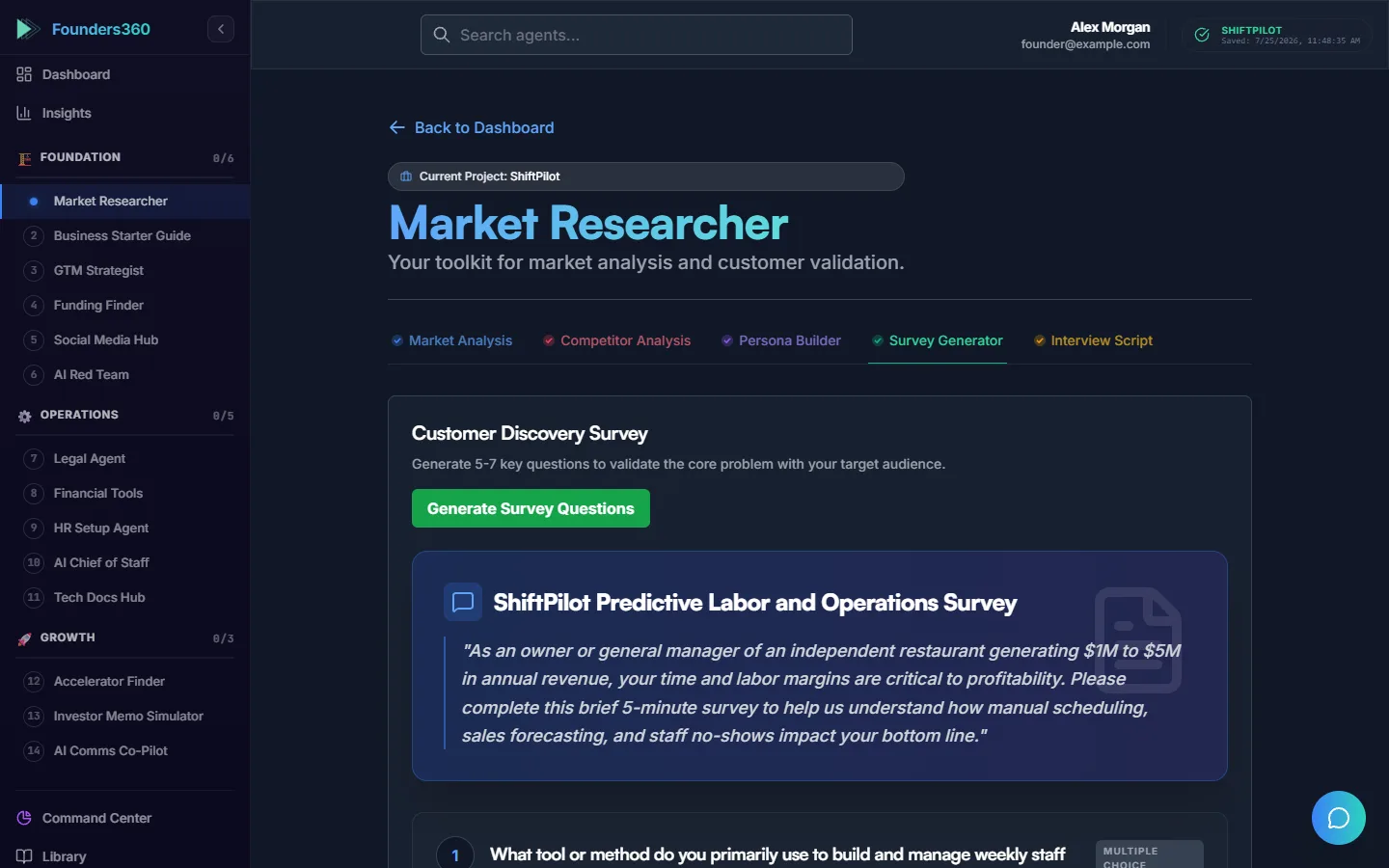
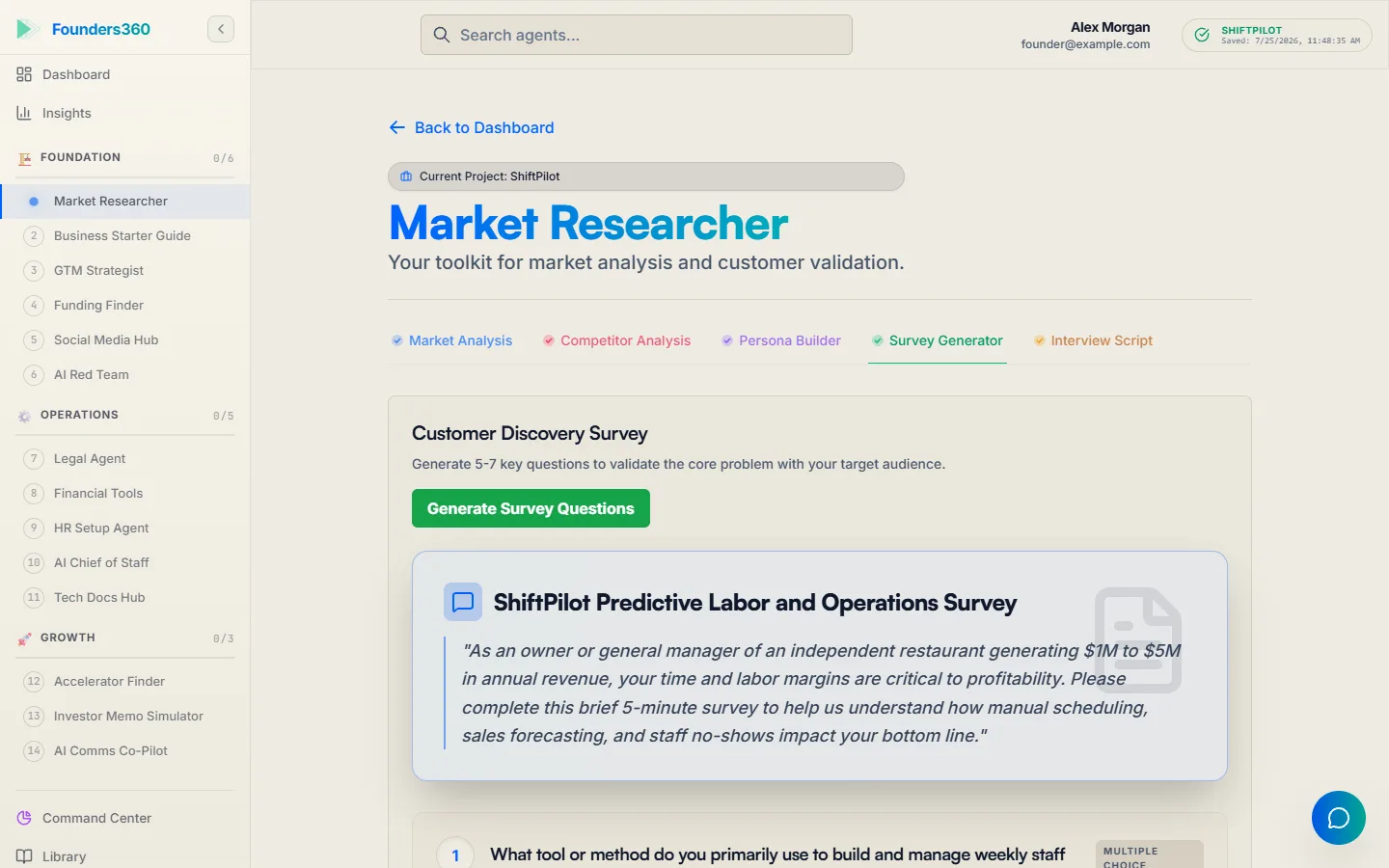
Market Researcher
The Market Researcher agent is crucial for understanding your market before you have customers. It performs competitor analysis, identifying what similar products offer and how they are priced. More importantly, it helps you deeply understand potential customer segments, their pain points, and what they value. This foundational research is essential for moving towards a value-based pricing model.
Financial Agent
The Financial Agent assists with the 'cost-plus' aspect of your pricing strategy. Understanding your costs is a critical baseline. This agent helps model operational expenses, development costs, and desired profit margins to ensure initial pricing covers overhead and allows for sustainable growth. It provides clarity on the minimum price required for profitability.
GTM Strategist
The GTM Strategist agent helps formulate your go-to-market plan, including how pricing will be positioned within marketing and sales efforts. It ensures your pricing strategy aligns with your value proposition and target audience, helping craft messaging that highlights benefits and ROI for early adopters.
AI Red Team
The AI Red Team agent can pressure-test your pricing assumptions. By simulating various market conditions and competitor responses, it helps anticipate potential weaknesses in your pricing model before launch. This allows for proactive adjustments, reducing the risk of a mispriced product.
Investor Memo Simulator
When you are ready to seek funding, the Investor Memo Simulator helps articulate your pricing strategy and its underlying rationale to potential investors. A well-justified pricing model, even for an early-stage product, demonstrates foresight and a clear path to profitability.
By leveraging these tools, Founders360 enables you to build a robust pricing strategy based on market insights, financial realities, and strategic positioning, even when you are just starting out. You can sign up for a Free Founders360 account to begin exploring these tools today.
Mistakes to Avoid
Sidestepping common pricing errors is as important as implementing effective strategies:
- Do Not Undervalue Your Offering: Many founders tend to underprice. This can signal low quality and make it hard to attract serious customers or increase prices later. Price it accordingly.
- Do Not Copy Competitors Blindly: While competitive research is useful, your product is unique. Do not assume competitors have perfect pricing or that their strategy aligns with your value proposition.
- Avoid Overly Complex Pricing: Keep pricing models clear and easy to understand. Too many tiers or confusing metrics can overwhelm potential customers. Aim for three options initially.
- Do Not Treat Pricing as a One-Time Event: Pricing is an ongoing process. You will need to iterate and optimize as you gather more customer data, add features, and understand market dynamics.
Iteration and Evolution
Your initial pricing is a hypothesis, not a permanent decision. As you acquire your first customers and collect data, you will gain invaluable insights. Regularly review your pricing (every six months is a good cadence). Be prepared to adjust based on customer feedback, usage patterns, and market shifts. Communicate changes transparently, and consider grandfathering existing customers into their original rates when you do raise prices; this builds loyalty. To explore how Founders360's full suite of agents can support your startup's growth, visit our /agents page. For a detailed breakdown of our plans and what they include, refer to our /pricing page. You can also discover more resources and guides on our blog, such as AI tools for startup founders.
Frequently Asked Questions
How important is pricing for a new SaaS product?
Pricing is critical for a new SaaS product because it directly impacts revenue, growth, and customer perception. The right price accelerates adoption and signals value, while the wrong price can hinder progress or undermine your startup's financial viability.
What are the main challenges in pricing a SaaS product with no existing customers?
Challenges include a lack of historical customer data to inform value perception and willingness to pay, and difficulty conducting competitive analysis without a clear market position. Founders must rely more on deep customer discovery and cost analysis to establish an initial pricing hypothesis.
Should I use cost-plus, competitive, or value-based pricing as a new founder?
While cost-plus pricing provides a necessary floor and competitive analysis offers market context, value-based pricing is generally the most effective long-term strategy for SaaS. For new founders, a hybrid approach is often best: understand costs, research competitors, and then focus heavily on customer discovery to define and price based on perceived value. Founders360 agents can support all these aspects.
Is it better to start with a low price to attract early adopters?
While a low introductory price can attract users, underpricing can signal low quality, make it difficult to increase prices later, and ultimately hurt profitability. It is often advisable to start with a price that reflects your product's value and covers costs, allowing for strategic adjustments as you learn more.
How often should I review and adjust my SaaS pricing?
Pricing should be an ongoing process. Many successful SaaS companies review their pricing every six months. This allows you to adapt to market changes, new features, and evolving customer needs, ensuring your pricing remains optimized for growth and profitability.
How can Founders360 help with my SaaS pricing strategy?
Founders360 offers a suite of AI agents. The Market Researcher helps with customer discovery and competitive analysis, the Financial Agent aids in understanding costs, and the GTM Strategist assists with positioning. The AI Red Team can pressure-test assumptions, and the Investor Memo Simulator helps present your strategy to investors. This integrated approach provides comprehensive support for informed pricing decisions.
Tags
Related Articles
Building a Repeatable Customer Discovery Process as a Technical Founder
Technical founders often excel at building innovative products, but frequently face the challenge of ensuring their creations genuinely solve market problems. This article provides a concrete, repeatable customer discovery process designed to help technical founders validate ideas, understand customer needs, and avoid the common pitfalls of building in a vacuum. Learn how to transform assumptions into validated insights and build products that customers truly want.
10 min readStartup PlaybooksThe Venture Studio Playbook: How Companies are Built Differently
Venture studios represent a distinct and increasingly influential model in the startup ecosystem, fundamentally changing how new companies are conceived, built, and scaled. Unlike traditional venture capital firms or accelerators, studios act as co-founders, engaging deeply from ideation through launch and growth, providing extensive operational support and capital. This hands-on approach aims to de-risk the startup journey and increase the likelihood of success for portfolio companies.
8 min readStartup PlaybooksHow to Build an Investor-Ready Pre-Seed Data Room with AI Assistance
Raising pre-seed capital requires more than just a compelling pitch; it demands a meticulously organized data room that instills investor confidence. Discover how artificial intelligence can streamline the creation of your data room, ensuring accuracy and efficiency throughout your fundraising journey.
9 min readReady to Build Smarter?
Join thousands of solopreneurs using AI agents to scale their businesses.
Get Started Free