
Contractor vs Employee for Your First Startup Hire
Your first startup hire should be a contractor only if the work is genuinely independent: defined deliverables, their own tools and hours, other clients. Someone working full time on your core product under your direction is an employee in the US and Canada whatever the contract says, and misclassifying them is the expensive mistake.
By Founders360 Team
Contractor vs employee for your first startup hire comes down to one question: who controls how the work is done? If the person sets their own hours, uses their own tools, delivers a defined piece of work and can take other clients, a contractor arrangement is defensible. If they work full time on your core product, on your schedule, under your direction, they are an employee in both the United States and Canada, and the contract you both signed does not change that.
The short answer: control decides, not the contract
Tax authorities classify a worker by the facts of the relationship, and a signed contractor agreement is one fact among many. The reasons a founder wants a contractor (flexibility, low paperwork) have nothing to do with the reasons the law allows one (independence).
The practical rule for a first hire: a contractor for a bounded project, an employee for a role. A designer building your landing page over six weeks with their own tools and three other clients is a contractor. A developer who joins your daily standup, works only for you and ships your core product indefinitely is an employee.
Misclassification is the mistake that compounds. In the US it can mean back payroll taxes, penalties and interest, and in some states wage-and-hour claims. In Canada it can mean retroactive CPP and EI contributions for both sides, plus penalties. Our startup HR checklist for the first hire covers the paperwork that follows once you have decided.
What the IRS common-law test looks at
The IRS weighs evidence in three groups: behavioral control, financial control and the type of relationship. No single factor decides it. The question underneath all three is whether the business has the right to direct and control how the work is done.
Behavioral control asks whether you give instructions on when, where and how to work, whether you train the person. A contractor is judged on the result; an employee is directed on the method.
Financial control asks who invested in the tools, whether the person has unreimbursed expenses, whether they can realise a profit or a loss, and how they are paid. A flat fee per project points to contractor; an hourly or salaried wage with no risk points to employee.
Type of relationship asks whether there is a written contract, whether the relationship is expected to continue indefinitely, and whether the work is a key part of your regular business. That last item is the one a startup fails most often: a contractor building the product is doing the core business.
If you cannot decide, Form SS-8 asks the IRS to rule. Note that the Department of Labor applies its own economic-reality test for minimum wage and overtime, so a worker can be a contractor for tax purposes and still have wage-and-hour exposure.
The ABC test in California and other states
Several states apply a stricter ABC test that presumes a worker is an employee unless the hiring business proves all three prongs. California adopted it by statute in 2019 (AB 5), and Massachusetts and New Jersey use versions of it for wage law.
The three prongs, all of which must hold:
- A. The worker is free from your control and direction in performing the work, both under the contract and in fact.
- B. The work is outside the usual course of your business.
- C. The worker is customarily engaged in an independently established trade or business of the same nature.
Prong B is the one that catches startups. A software company hiring a developer to build its software cannot say the work is outside its usual course, so under an ABC test that developer is an employee regardless of hours, tools or invoices.
If you are in an ABC state and the role touches your core product, plan for an employee from the start rather than a contractor you convert later.
What the CRA looks at in Canada
The CRA asks first what the two parties intended, then whether the facts of the relationship support that intent. Its guide RC4110 lays out the factors, and a signed contractor agreement satisfies the intent step but not the second one.
The factors the CRA weighs:
| Factor | Points to contractor | Points to employee | |---|---|---| | Control | Worker decides how, when and where | You direct the method and schedule | | Tools and equipment | Worker owns and maintains them | You supply them | | Subcontracting | Worker can hire helpers or send a substitute | Worker must do it personally | | Financial risk | Worker carries costs, can lose money | You cover costs, worker is paid regardless | | Investment and management | Worker runs a business with its own overhead | No business investment beyond time | | Opportunity for profit | Worker can earn more by working efficiently | Fixed wage, no upside from efficiency |
An employee triggers payroll registration, CPP and EI contributions (with an employer share), income tax withholding and a T4. A contractor invoices you, and you may issue a T4A. Either party can request a CPP/EI ruling from the CRA.
Contractor vs employee: what each one costs a startup
An employee costs more per month; a misclassified contractor costs more in total. The table is illustrative; specifics vary by state and province.
| Item | Contractor | Employee | |---|---|---| | Payroll registration | None | Required (EIN payroll account or CRA payroll account) | | Employer taxes | None | US: employer share of Social Security, Medicare and unemployment. Canada: employer CPP and EI | | Year-end form | 1099-NEC (US) or T4A (Canada) | W-2 (US) or T4 (Canada) | | Benefits and leave | None owed | Statutory minimums, plus whatever you offer | | IP ownership | Only what the contract assigns | Work made in the course of employment, plus an assignment to be safe | | Downside if wrong | Back taxes, penalties, wage claims | Overpaying for flexibility you did not need |
What the employee route buys is certainty: the classification question is closed, the IP is cleanly yours. The Founders360 Financial Tools agent puts the fully loaded cost of either option into the model and writes the resulting runway into Shared Context, so the burn rate and runway figure the Chief of Staff reports each week reflects the hire you actually made.
Get the contract and the IP assignment right either way
Whatever the classification, the first hire needs a written agreement that assigns intellectual property to the company and states confidentiality terms. For an employee this is an offer letter plus a confidentiality and invention assignment agreement. For a contractor it is a services agreement with a clear scope, deliverables, payment terms, an IP assignment clause and a statement that the contractor controls the method of work and may serve other clients.
The IP clause is the one that hurts when missing. In the US, work by an independent contractor is generally owned by the contractor unless assigned in writing, and the work-for-hire doctrine covers only narrow categories. A founder who paid a contractor to build the first version of the product without an assignment does not own it. The same problem appears with co-founders who wrote code before incorporating, which our co-founder agreement and vesting guide covers.
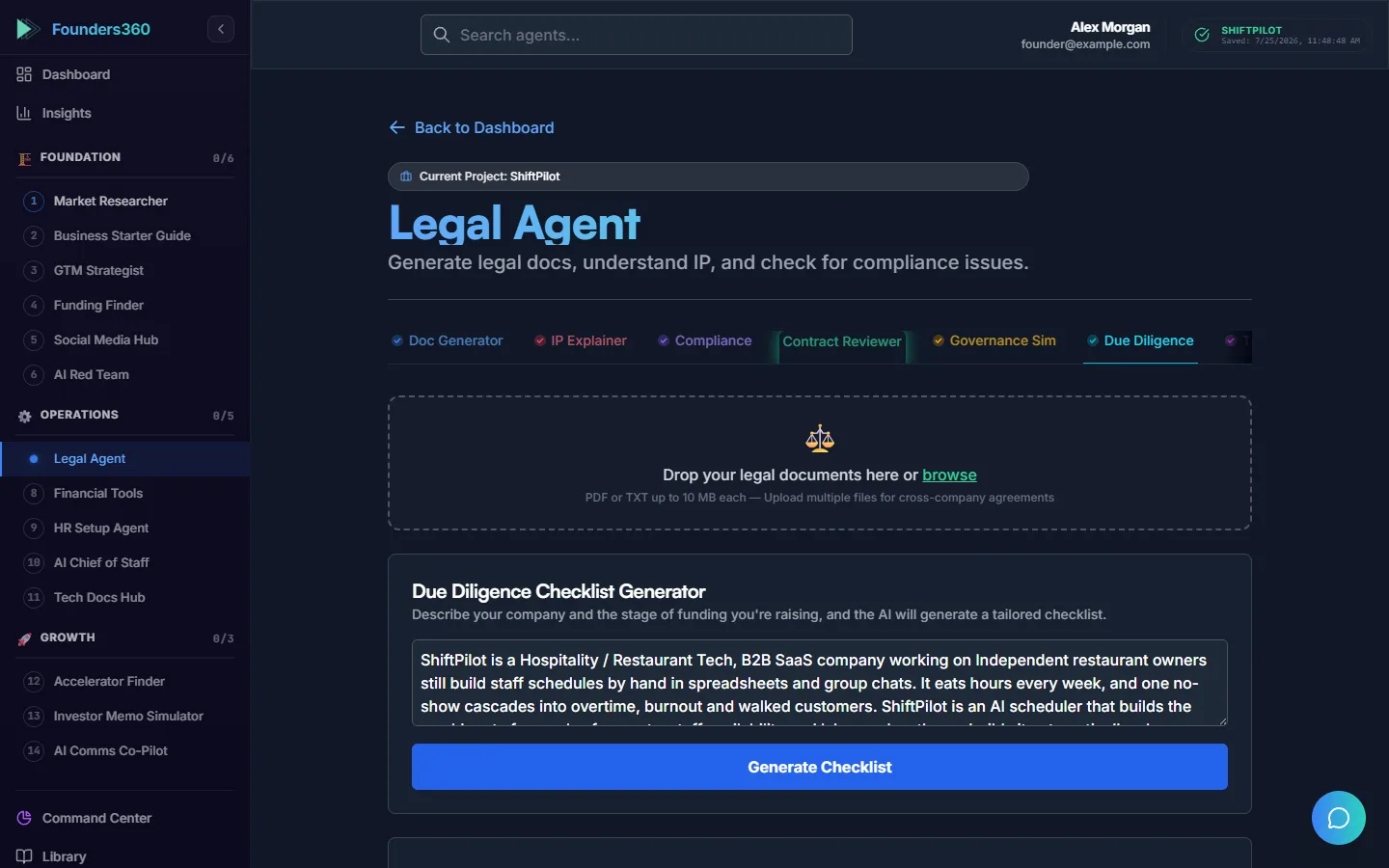
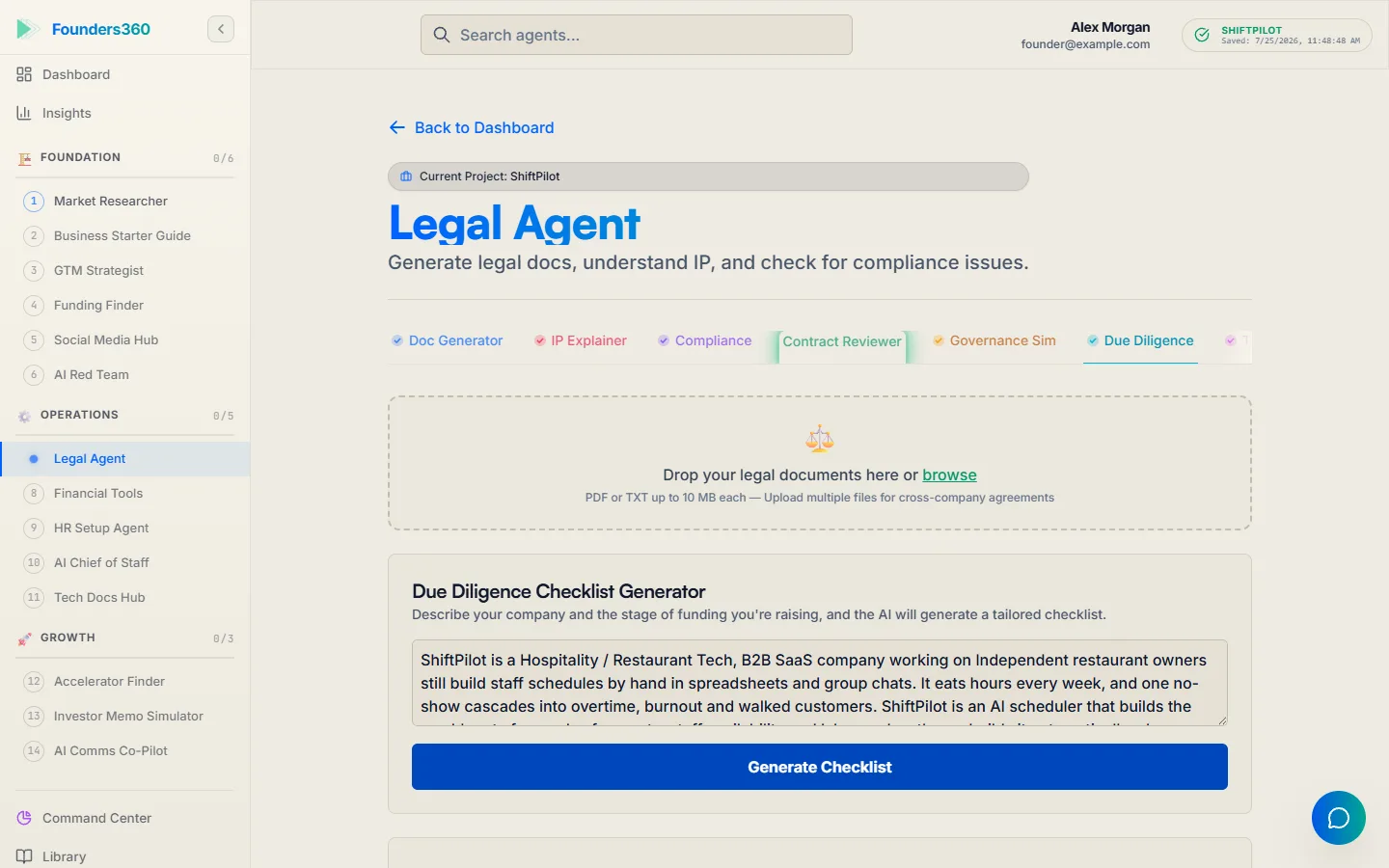
The Founders360 Legal agent drafts both documents from the company profile in Shared Context, so the entity name, jurisdiction and role description come from what the Business Guide and HR Setup agent already wrote rather than from a blank form.
When to get an accountant or a lawyer for a first hire
Pay a professional the moment the answer depends on a fact you cannot check yourself: a second jurisdiction, equity, an ABC state, or a contractor who has quietly become full time. The situations that need real advice:
- The worker is in a different state, province or country from the company.
- Any part of the pay is equity or options.
- The role touches your core product and you are in California, Massachusetts or New Jersey.
- A contractor has worked only for you for more than a few months.
- You are converting a contractor to an employee, or the person has asked about their status.
An accountant sets up payroll, withholding and remittances and tells you the true loaded cost. A lawyer reviews the agreement and the IP assignment and advises on classification where it is close.
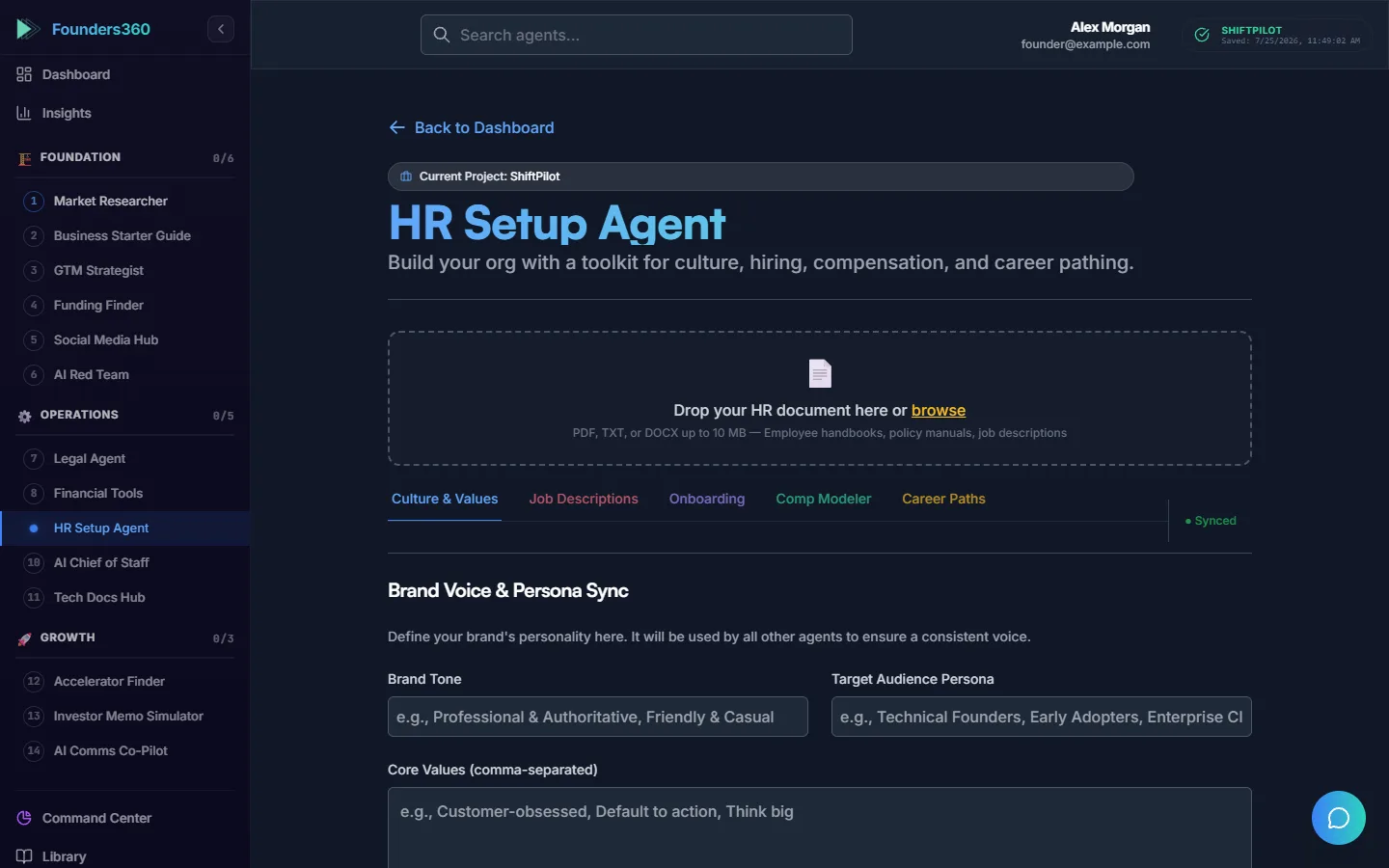
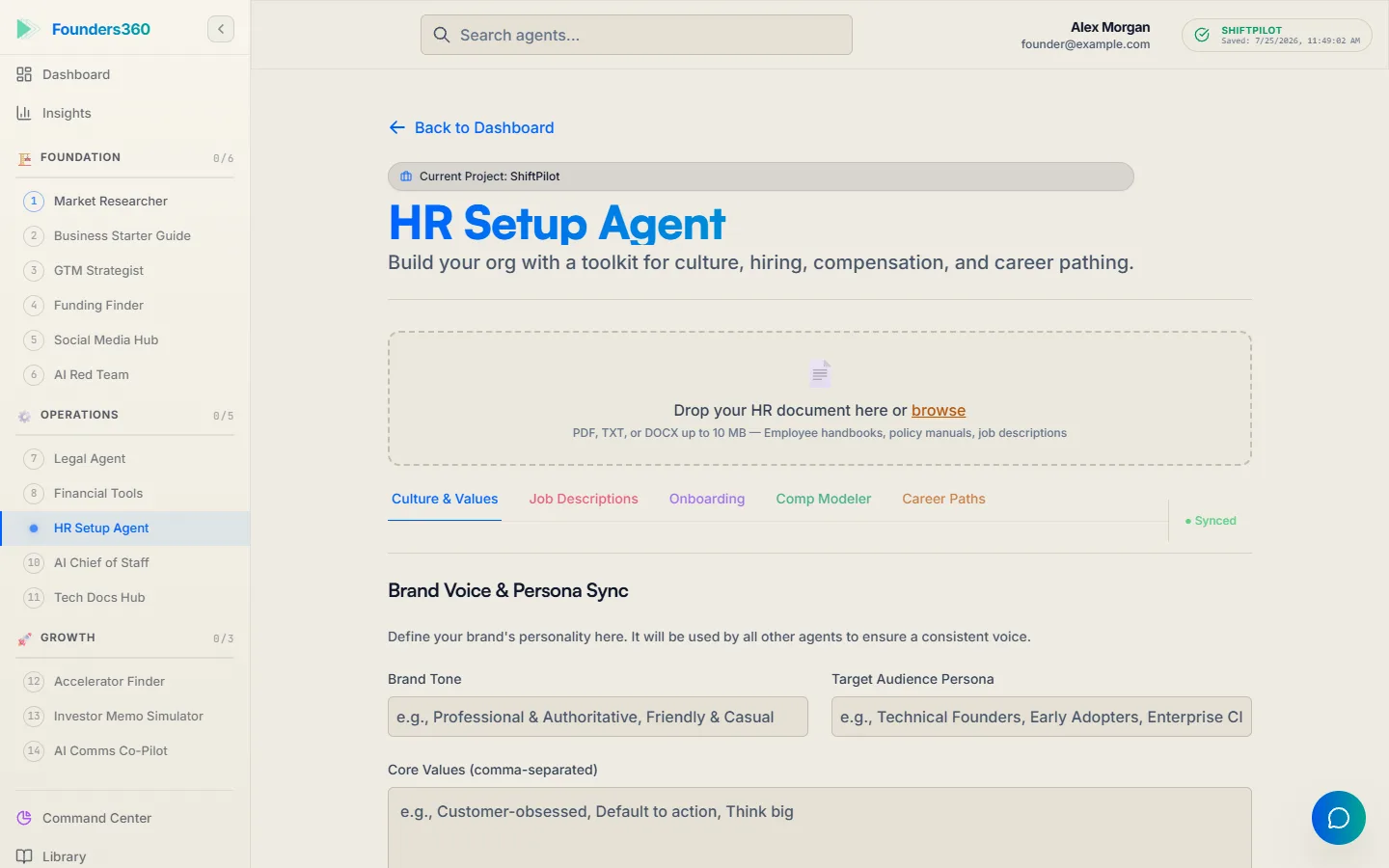
The Founders360 HR Setup agent produces the onboarding checklist, the role description and the classification questions to bring to that meeting, and writes the role into Shared Context so the Legal agent and the Financial Tools agent work from the same hire. One lesson from building it: the HR agent's write-back into Shared Context was broken for the entire life of the feature by one wrong dictionary key. Nothing raised or logged, and the coverage list read as complete while nothing was written; we fixed it with a test that checks every key against what the system actually dispatches. The lesson transfers: a checklist that reads as compliant is not one you have verified, so read the classification back from the facts, not the contract.
This week: write down, for the hire you are considering, who controls the hours, who owns the tools, whether the work is your core product, and whether the person has other clients. If three of the four point to employee, plan for an employee, and draft the offer letter and invention assignment before the start date. The Legal and HR Setup agents are on the Founder Pro and Elite tiers listed on the pricing page.
Frequently Asked Questions
Can my first startup hire be a contractor if they work full time for me?
Full-time hours alone do not decide it, but a person who works only for you, on your schedule, under your direction, on your core product, fails the control and independence factors in both the US and Canada.
What is the difference between the IRS common-law test and the ABC test?
The IRS test weighs many factors across behavioral control, financial control and relationship type, with no single one deciding. The ABC test used by California and some other states presumes employment and requires the business to prove all three prongs, including that the work is outside its usual course.
How does the CRA decide if a worker is an employee or a contractor?
The CRA looks first at what both parties intended, then at whether the facts support it: control over the work, ownership of tools, the ability to subcontract, financial risk, investment in a business, and the opportunity for profit. Either party can request a CPP/EI ruling to settle the question.
Does a contractor own the code they write for my startup?
In the US, generally yes unless a written agreement assigns it to the company, because work-for-hire covers only narrow categories. Canada has a similar default for contractors. Put an IP assignment clause in every services agreement before work starts.
When do I need a lawyer for my first startup hire?
When the worker is in another jurisdiction, when any pay is in equity, when the role is core product work in an ABC-test state, or when a contractor has become full time and exclusive.
Tags
Related Articles
Co-Founder Agreement and Vesting: What First-Time Founders Must Put in Writing
A co-founder agreement with a vesting schedule is the document that decides who owns what when a founder leaves. Sign it before the first line of code, the first customer, or the first cheque, because every one of those makes the conversation harder.
8 min readGuidesUnit Economics for Early-Stage Startups: CAC, LTV and Payback Before You Have Revenue
Unit economics for an early-stage startup are three numbers per customer: what one costs to acquire, what one is worth over their life, and how many months until the first pays back the second. Before revenue you build them from stated assumptions, label them as such, and replace each one with a measurement as soon as you have it.
9 min readGuidesTechnical Documentation for Startups: What to Write Before You Hire Your First Engineer
Technical documentation for startups is five documents written before the first engineer starts: a product requirements document, a data model, an architecture decision log, an API contract and a runbook. Everything else can wait.
8 min readReady to Build Smarter?
Join thousands of solopreneurs using AI agents to scale their businesses.
Get Started Free