
Co-Founder Agreement and Vesting: What First-Time Founders Must Put in Writing
A co-founder agreement with a vesting schedule is the document that decides who owns what when a founder leaves. Sign it before the first line of code, the first customer, or the first cheque, because every one of those makes the conversation harder.
By Founders360 Team
A co-founder agreement with vesting is the written deal that says how equity is split between founders, how each founder earns that equity over time, and what happens to the unearned part when someone leaves. If you have a co-founder and you do not have this in writing, the default is that every founder owns their full stake outright from day one, and a founder who walks out in month four keeps it forever.
This guide explains the mechanics. It is not legal advice; have a qualified lawyer in your jurisdiction review the final document before anyone signs.
Why founders leave, and why that is the whole point of vesting
Most co-founder splits happen in the first two years, and the problem is that the departing founder leaves with a large block of equity they will never work for again. That block dilutes the founders who stayed and every future hire, and it tells investors the company has an absent owner with full voting rights and no obligations.
Vesting solves this by making equity earned rather than granted. Each founder's shares are subject to a repurchase right that falls away on a schedule. Leave early, and the company buys back the unvested portion at cost (usually a nominal amount). Stay, and the repurchase right expires month by month until you own everything outright.
Investors expect it. A pre-seed term sheet will impose vesting on fully vested founders anyway, often on a schedule that resets the clock. Putting it in place yourselves lets you choose the terms.
The standard vesting schedule: four years with a one-year cliff
The market standard for founder vesting is four years, monthly, with a one-year cliff.
- Nothing vests during the first twelve months. A founder who leaves before the cliff leaves with zero.
- On the first anniversary, 25% vests in one block.
- The remaining 75% vests in 36 equal monthly instalments over the next three years.
Two variations are defensible: starting the clock on the date the founders actually began working rather than the incorporation date, and a six-month cliff where the founders have already worked together for years. What is not defensible is no cliff at all, or a two-year schedule that leaves founders fully vested before the company has raised a priced round.
How to split equity between co-founders
Split equity on expected future contribution, not on who had the idea. The idea is worth very little on its own; the four years of execution that follow are what the shares represent.
An equal split is the default for a reason. It removes the negotiation, it signals that the founders see each other as peers, and it avoids a resentment that compounds every month. Unequal splits are appropriate when the contributions are genuinely unequal in a way both founders can state out loud: one founder is part-time until a funding milestone, one is putting in meaningful capital, or one started eighteen months earlier and built the first version alone. Whatever the split, write the reasoning next to the numbers.
The table below shows how a 60/40 split looks after Founder B departs at different points on a standard four-year schedule with a one-year cliff. Figures are illustrative.
| Founder B leaves at | Founder B vested | Founder B keeps | Returns to company | |---|---|---|---| | Month 9 | 0% | 0% of company | 40% | | Month 12 (cliff) | 25% | 10% of company | 30% | | Month 24 | 50% | 20% of company | 20% | | Month 36 | 75% | 30% of company | 10% | | Month 48 | 100% | 40% of company | 0% |
Returned shares are usually cancelled or held in treasury, which raises every remaining holder's percentage proportionally.
The clauses a co-founder agreement must contain
A complete co-founder agreement covers seven things. Missing any one of them is the gap that becomes the dispute.
- Equity split and share class. The exact number of shares each founder holds, the class, and the price paid, typically a nominal par value at incorporation.
- Vesting schedule. Duration, cliff, frequency, and the vesting start date.
- Acceleration. What happens to unvested shares on an acquisition. Single-trigger vests everything on a sale; double-trigger vests only if the founder is also terminated without cause after the sale.
- Roles, decision rights and time commitment. Who is CEO, which decisions need unanimous consent (raising money, issuing equity, taking debt, selling the company), and the expected hours per week for each founder.
- Intellectual property assignment. Every founder assigns all IP created for the business to the company.
- Departure terms. Good leaver and bad leaver definitions, the repurchase price for unvested shares, and whether the company has a right of first refusal on vested shares the departing founder wants to sell.
- Dispute resolution. Mediation first, then arbitration or a named jurisdiction, plus a deadlock clause for a 50/50 two-founder company, because without one there is no tiebreak.
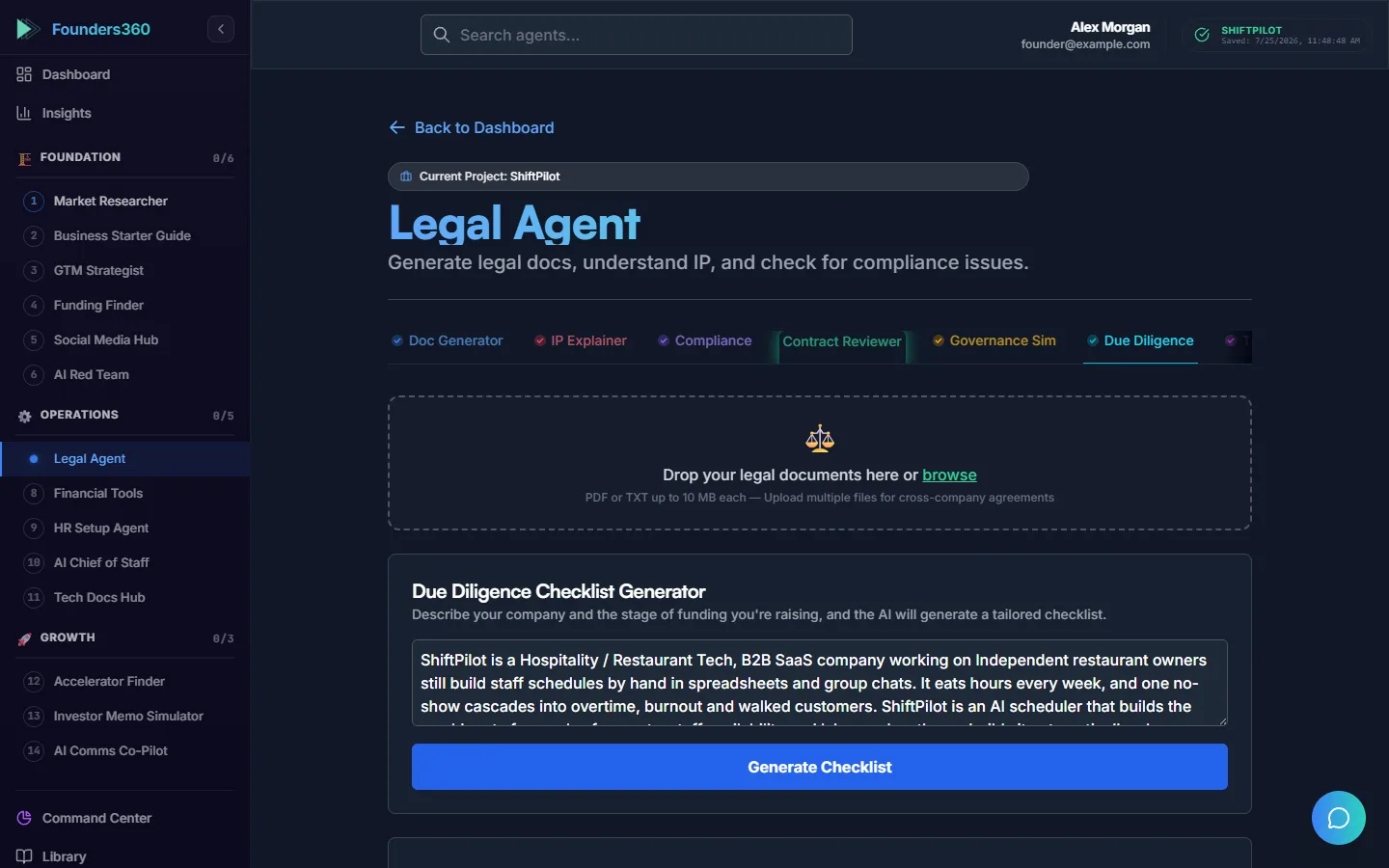
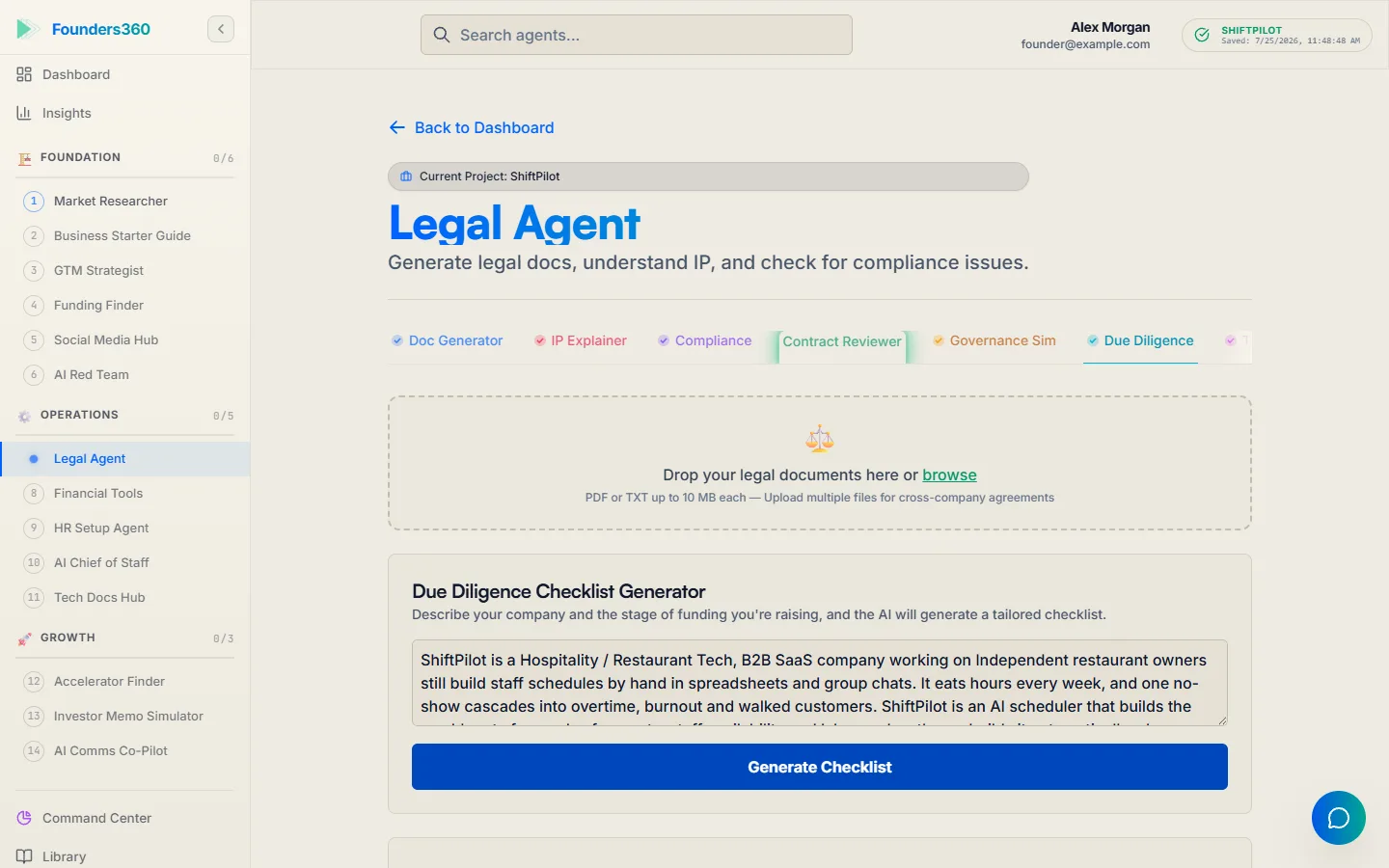
The Founders360 Legal agent drafts these documents from your company profile and writes the resulting terms (share counts, vesting start date, cliff, acceleration type, decision thresholds) into Shared Context, so the Financial Tools agent's cap table and the Funding Finder's deck use the same numbers rather than three copies that drift apart. If you are still deciding on entity type, our guide on how to incorporate a startup without a lawyer covers the step before this one.
The 83(b) election and why the deadline is absolute
If your company is a US corporation and your shares are subject to vesting, each founder must file an 83(b) election with the IRS within 30 days of the share purchase. There is no extension and no late filing.
The election tells the IRS to tax you on the value of the shares now, when they are worth almost nothing, rather than at each vesting date, when they may be worth a great deal. Without it, every monthly vesting event is taxable income at the then-current fair market value, and a founder at a company that has raised a priced round can owe tax on income they never received in cash. Founders outside the United States should ask a local adviser whether a comparable election exists.
Mistakes we see first-time founders make
Signing nothing because it feels awkward. The conversation is awkward once. The alternative is awkward for the life of the company. A founder who refuses to discuss vesting is telling you how they will behave if things go badly.
Vesting with no cliff. A founder who leaves in month two with 4% of the company has been paid for two months of work with a permanent stake.
Forgetting the IP assignment. The most common due diligence finding on a pre-seed cap table is a departed founder who still personally owns code, a domain, or a trademark the company uses every day.
Leaving acceleration undefined. On an acquisition, the acquirer will impose terms. Deciding double-trigger in advance means the founders negotiate from a position rather than from a blank.
How our own AI handles the disagreements this document is meant to prevent
We built the Legal agent to write terms into Shared Context rather than produce a standalone PDF because a founder agreement is a set of numbers that every later document must agree with. When a deck says the founders own 80% and the cap table says 75%, the inconsistency surfaces in diligence.
We learned how easily two records disagree silently from our own engineering. One of our agents wrote nothing into Shared Context for the entire life of the feature because of a single wrong dictionary key. Nothing raised an error and nothing logged. The coverage list read as complete while the store stayed empty for that agent. The fix was a test that asserts every key matches an id the system actually dispatches, plus a health command that reports attempted-versus-produced per agent. The lesson transfers to founder paperwork: check the reconciliation, not the existence.
If you want a hostile reading of your founding team before an investor gives you one, the Skeptical VC asks about founder commitment and vesting without being prompted, and our AI Red Team is built to argue with you on exactly these points. For the round that follows, our guide to what a SAFE valuation cap actually costs you picks up where the founder split ends.
Frequently Asked Questions
Do co-founders need a vesting schedule if they trust each other?
Yes. Vesting is not a statement about trust; it is protection against circumstances neither founder controls. Illness, a family situation, or a job offer that cannot be refused can take a founder out of the company through no fault of their own, and without vesting they leave with a permanent stake. Investors will require it anyway, so the choice is between terms you set now and terms imposed later.
What is a fair equity split between two co-founders?
An equal split is the default and the right answer when both founders are full-time, started at roughly the same time, and bring comparable value. Unequal splits are fair when there is a concrete, stated reason: a large difference in time commitment, one founder investing meaningful capital, or one founder having built the product alone for a substantial period. Write the reason down alongside the numbers.
What happens to unvested shares when a co-founder leaves?
The company repurchases them, usually at the original nominal price, and they are cancelled or held in treasury. The remaining shareholders' percentages rise proportionally. Vested shares stay with the departing founder unless the agreement gives the company a right of first refusal or a repurchase right at fair market value, which is common for bad-leaver departures.
Should we sign the agreement before or after incorporating?
After incorporating, because the agreement references shares that only exist once the company does, and the share purchase is what starts the 83(b) clock in the United States. Do the two steps in the same week; anything drafted before incorporation is a memorandum of intent, not the enforceable version.
What to do this week
Sit down with your co-founder and answer seven questions in writing: the split and why, the vesting schedule and start date, the acceleration type, each founder's role and weekly hours, which decisions need unanimity, what a good leaver and a bad leaver each keep, and how a deadlock breaks. That page is the brief for your lawyer. Then incorporate, purchase the founder shares, sign the agreement, and if you are in the United States, mail the 83(b) elections inside the 30-day window. Open the Founders360 agent library if you want the Legal agent to produce the first draft from your company profile and put the numbers where every other document can find them.
Tags
Related Articles
Unit Economics for Early-Stage Startups: CAC, LTV and Payback Before You Have Revenue
Unit economics for an early-stage startup are three numbers per customer: what one costs to acquire, what one is worth over their life, and how many months until the first pays back the second. Before revenue you build them from stated assumptions, label them as such, and replace each one with a measurement as soon as you have it.
9 min readGuidesTechnical Documentation for Startups: What to Write Before You Hire Your First Engineer
Technical documentation for startups is five documents written before the first engineer starts: a product requirements document, a data model, an architecture decision log, an API contract and a runbook. Everything else can wait.
8 min readGuidesStartup Runway and Burn Rate: How to Calculate It and How to Extend It
Startup runway is the cash in the bank divided by net monthly burn, and it is the number that decides when you must raise, cut or start earning. Most founders overstate it by counting receivables as cash and ignoring one-off costs. This guide shows how to calculate it correctly and six ways to extend it.
9 min readReady to Build Smarter?
Join thousands of solopreneurs using AI agents to scale their businesses.
Get Started Free