
Startup Runway and Burn Rate: How to Calculate It and How to Extend It
Startup runway is the cash in the bank divided by net monthly burn, and it is the number that decides when you must raise, cut or start earning. Most founders overstate it by counting receivables as cash and ignoring one-off costs. This guide shows how to calculate it correctly and six ways to extend it.
By Founders360 Team
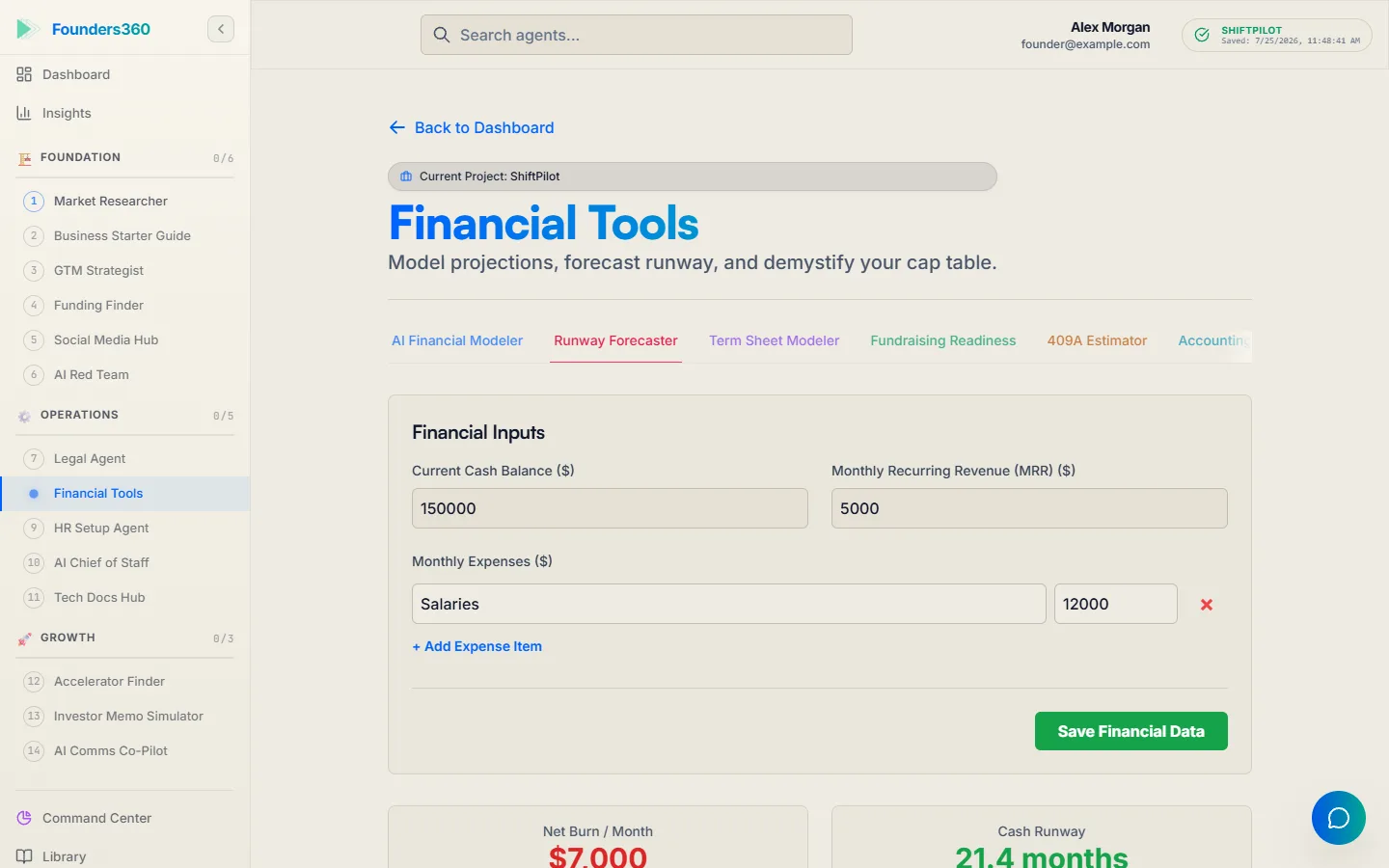
Startup runway is the cash in your bank account divided by your net monthly burn rate, expressed in months. Burn rate is the cash that leaves the company each month; net burn subtracts the cash that comes in. If you have $120,000 in the bank and you spend $15,000 a month while collecting $5,000, your net burn is $10,000 and your runway is 12 months.
The reason founders get it wrong is not the arithmetic; it is what they count as cash, what they leave out of burn, and how rarely they recalculate. This guide covers the calculation, the errors that make runway look longer than it is, how much you need before the next raise, and six ways to extend it. All worked figures are illustrative.
Gross burn, net burn and which one to track
Track both, and report net burn, because each answers a different question. Gross burn is total monthly cash out: salaries, contractors, software, rent, hosting, fees, everything. Net burn is gross burn minus cash received in the same month. Gross burn tells you the size of the operation you are running; net burn tells you how fast the bank balance is falling.
A company with $20,000 gross burn and $18,000 of monthly collections has a net burn of $2,000 and, on paper, years of runway. The same company loses one customer worth $6,000 a month and its net burn quadruples overnight.
Use cash, never accounting profit. A profit and loss statement records revenue when it is earned and costs when they are incurred; a bank account records money when it moves. An invoice you have sent is not cash, an annual subscription you collected in January is not twelve months of revenue in January, and the software bill charged annually in March is not zero in the other eleven months.
How to calculate runway correctly
Runway equals cash on hand divided by average net burn over the last three months, then adjusted for anything you already know will change.
Start with the bank balance today, not the balance after the receivables you expect. Add nothing that has not cleared. Then take the last three months of bank statements, total the outflows, subtract the inflows, and divide by three for average net burn. Divide cash by that figure. The result is your runway as of today, assuming nothing changes.
Then apply the known changes. A hire starting next month raises burn by their full loaded cost from that month. A contract ending in two months lowers collections from that month. An annual renewal in month four is a lump on that month, not a twelfth of it spread evenly. Rebuild the month-by-month cash line with these applied and find the month where the balance hits zero. That month, not the simple division, is your real runway.
An illustrative case. Cash $150,000, average net burn $12,000, simple runway 12.5 months. Add a $7,000 monthly hire in month two and a $9,000 annual insurance and software renewal in month five, and the balance hits zero in month nine. The simple division overstated runway by three and a half months, which is the entire window most founders need to close a round.
The errors that make runway look longer than it is
The most common error is counting receivables and committed revenue as cash. The second is leaving founder pay out of burn entirely. If the founders are paying themselves nothing, say so in the model and put a line in for the month that must change, because it will, and the burn jump is usually the largest single increase the company sees in year one.
Other errors we see repeatedly:
- Treating annual prepaid revenue as monthly. Cash collected up front is real, but it comes with twelve months of obligation and no further collections from that customer until renewal.
- Ignoring payroll taxes, benefits and employer contributions. A salary is not the loaded cost. Add 15 to 30 percent depending on jurisdiction.
- Forgetting one-off costs. Legal fees for the raise, incorporation and trademark filings, equipment, a conference. Each looks small; together they are often a month of runway.
- Using last month's burn when last month was unusually cheap. A month with no annual bills and a delayed invoice is not your burn rate.
- Assuming the raise closes on the day the term sheet is signed. Cash typically arrives four to eight weeks after that, and diligence can stretch it.
The AI Red Team in Founders360 checks a financial model for exactly these omissions, and the guide to financial modeling for pre-revenue startups covers the full model the burn line sits inside.

How much runway you need before the next raise
Plan to have 18 to 24 months of runway after a round closes, and start the next raise while at least 9 months remain. Those are the ranges investors generally quote, and the logic is simple: a pre-seed round takes three to six months from first meeting to cash in the bank, and a founder raising with three months left has no leverage and every investor knows it.
It gives roughly 12 months to hit the milestones the next round requires, and six months to raise on the strength of them. A company that raises 12 months of runway starts fundraising again almost immediately, and spends the middle of its runway pitching instead of building.
Bootstrapped founders should still track this, with a different target: the month when revenue covers gross burn. Every month of runway is a month to reach it. Our decision framework for bootstrapping versus venture capital covers how the two paths change the target, and the pre-seed fundraising guide covers the round itself.
Six ways to extend startup runway
Cutting burn is the fastest lever and pulling revenue forward is the second; the rest buy weeks rather than months, and they add up.
- Cut the costs that do not touch customers. Software with overlapping functions, the office, the tools bought for a plan that changed. Most pre-seed companies find 10 to 20 percent of gross burn here in an afternoon.
- Collect sooner. Offer a discount for annual prepayment, move net 60 terms to net 15 or payment on signature, and invoice on the day the work starts.
- Apply for non-dilutive money. Grants, tax credits for research and development, and government innovation programs. Slow to arrive, but they cost no equity; our guide to grants for early-stage startups lists where to look.
- Defer, do not skip. Vendors and landlords often accept deferred payment schedules for a small company that asks early.
- Raise prices. A 15 percent increase on a product customers already use often costs nothing in churn and lands in net burn immediately. Our guide to unit economics for early-stage startups explains why contribution per account is the lever that moves everything.
- Cap the variable costs. Cloud and AI usage are the two costs that scale without a purchase decision. Every model call in our own product is counted, capped and cached where the input repeats, and an organization with no explicit budget gets a daily floor rather than unlimited use. Treat your own usage-billed services the same way: set the cap before the surprise invoice, not after.
Recalculate weekly, and read the number from the account that pays
Recalculate runway weekly from the bank balance, not monthly from the model, because the model is a forecast and the balance is a fact.
We learned the cost of trusting a setting instead of reading it back from our own operations. Our outbound email program runs on a separate cron service with its own environment variables. We set the "require human approval" flag on the API service instead, it looked like it worked, and the cron sent a cold email to a program director who was supposed to be reviewed first. The lesson generalizes: a control that lives anywhere other than the process that acts is decoration, and you verify it by reading it from there. For runway, the process that acts is the bank account. A spreadsheet that says 14 months is a claim; the balance is the evidence.
In Founders360, the Financial Tools agent writes monthly burn, cash and runway into Shared Context as part of the financial model, and the Chief of Staff reads those facts when it drafts the weekly brief, so the runway figure in the founder's Monday plan is the one the model produced, not one recalled from memory. The Funding Finder reads the same facts when it drafts the raise timeline. See what each agent writes forward in the Founders360 agent library.


Frequently Asked Questions
What is a good burn rate for a pre-seed startup?
There is no universal figure; a good burn rate is one that reaches the next milestone with at least six months of runway to spare. For a team of two to four founders with no office, gross burn typically falls between $15,000 and $40,000 a month depending on salaries and location, but the test is milestones per dollar, not the absolute number.
How do I calculate burn rate from bank statements?
Add every outflow on the statement for the month to get gross burn, subtract every inflow that is revenue (not loans, investment or refunds) to get net burn, and average over three months to smooth out annual bills and late payments.
When should I start fundraising based on runway?
Start when nine months or more remain, because a pre-seed round typically takes three to six months from first meeting to cash in the bank, and the cash often arrives four to eight weeks after the term sheet.
Does founder salary count in burn rate?
Yes, at whatever the founders are actually paid, and if that is zero the model must show the month it stops being zero. Deferred founder pay is a real liability that reappears, usually at the next round, and a burn rate that assumes founders work unpaid indefinitely is not one an investor will underwrite.
What is the difference between runway and default alive?
Runway is months until cash reaches zero at the current burn. Default alive asks a different question: whether, at current growth, revenue will cover expenses before cash runs out. A company can have eight months of runway and be default alive if revenue is climbing fast enough, or have eighteen months and be default dead if it is not.
What to do this week
Open the bank account, not the model, and write down the balance. Pull the last three months of statements and calculate average net burn from what actually moved. Divide, then apply the known changes (the hire, the renewal, the contract ending) month by month until the balance hits zero. Write that month on the wall. If it is less than nine months away, this week is when the raise or the cuts begin, and the Financial Tools agent in Founders360 can build the month-by-month cash line from your company profile so every later decision starts from the same number.
Tags
Related Articles
Co-Founder Agreement and Vesting: What First-Time Founders Must Put in Writing
A co-founder agreement with a vesting schedule is the document that decides who owns what when a founder leaves. Sign it before the first line of code, the first customer, or the first cheque, because every one of those makes the conversation harder.
8 min readGuidesUnit Economics for Early-Stage Startups: CAC, LTV and Payback Before You Have Revenue
Unit economics for an early-stage startup are three numbers per customer: what one costs to acquire, what one is worth over their life, and how many months until the first pays back the second. Before revenue you build them from stated assumptions, label them as such, and replace each one with a measurement as soon as you have it.
9 min readGuidesTechnical Documentation for Startups: What to Write Before You Hire Your First Engineer
Technical documentation for startups is five documents written before the first engineer starts: a product requirements document, a data model, an architecture decision log, an API contract and a runbook. Everything else can wait.
8 min readReady to Build Smarter?
Join thousands of solopreneurs using AI agents to scale their businesses.
Get Started Free