
How to Incorporate a Startup Without a Lawyer
You can incorporate a startup without a lawyer when the setup is standard: a small number of founders, one country, no investors yet and no complicated IP history. This guide covers the entity and jurisdiction choice for the United States and Canada, the filing steps, approximate costs as of September 2026, the documents that matter after the filing, and the cases where paying a lawyer is the cheaper option.
By Founders360 Team
You can incorporate a startup without a lawyer when your situation is standard: one to three founders, all in the same country, no investors yet, and no intellectual property tangled up with a former employer. The lawyer earns their fee on the non-standard cases, and we list those plainly near the end.
This guide covers the United States and Canada. It explains mechanics, not law, and it is not legal advice. Fee figures are approximate and were observed in September 2026; check the filing office before you pay.
Decide the entity before the jurisdiction: C-corporation or LLC
If you intend to raise from angels or venture funds, or to grant stock options to employees, incorporate a C-corporation. If you are building a business you will own and run without outside equity, an LLC (or a Canadian corporation with a simple share structure) is cheaper to maintain and simpler at tax time.
The reason is not tradition. Institutional investors buy preferred shares, and preferred shares are a corporate concept; an LLC has membership interests and pass-through taxation that most funds cannot hold without restructuring you first. Converting an LLC to a corporation later is possible and common, but it is a lawyer-and-accountant project that costs more than incorporating correctly at the start.
The trade-off runs the other way for a bootstrapped business. An LLC passes profit straight to the owners, files less paperwork and has no annual franchise tax in most states. If you are not sure which path you are on, ask one question: will someone other than the founders own equity in the next two years? Yes means corporation.
United States: Delaware C-corp versus home-state LLC
Delaware is the default for venture-backed startups because investors know its law, its Court of Chancery decides corporate disputes quickly without juries, and every standard financing document assumes it.
The cost of that choice is a second registration. A Delaware corporation operating in California, New York or Texas must also register as a foreign corporation in the state where it actually works, and pay that state's fees and taxes too.
| Choice | Fits | Approximate cost (September 2026) | |---|---|---| | Delaware C-corp | Raising outside equity, granting options | Filing from about $89; annual franchise tax from $175 (authorized-shares method) or $400 (assumed par value method) plus about $50 annual report fee; registered agent $50 to $300 per year | | Home-state C-corp | Raising locally, staying in one state | Filing $50 to $300 depending on state; no second registration | | Home-state LLC | Bootstrapped, no outside equity | Filing $50 to $500 depending on state; some states charge an annual fee |
Two Delaware details trip founders up. Authorize a standard 10,000,000 shares and calculate the franchise tax with the assumed par value method; the authorized-shares method on ten million shares produces a bill in the tens of thousands, and the state will send that bill until you recalculate. And the registered agent is not optional: it is the address the state serves papers to, and a lapsed agent means you can lose a lawsuit you never heard about.
Canada: federal versus provincial incorporation
A Canadian founder chooses between incorporating federally under the Canada Business Corporations Act or provincially under the home province's statute. Federal incorporation gives you name protection across the country and the right to operate in any province after an extra-provincial registration; provincial incorporation is a single filing that covers one province and is enough for most businesses that will stay there.
Federal is the usual recommendation for a startup that expects to hire or sell across provinces, and its online filing fee (about $200 as of September 2026) is lower than most provincial fees. Provincial fees vary: Ontario is around $300 online and British Columbia around $350, both approximate.
Canadian founders raising from American investors face a second question: whether to incorporate in Canada at all, or to set up a Delaware parent with a Canadian subsidiary. That structure has real tax consequences on both sides of the border and is the clearest example in this article of a case that needs a lawyer and an accountant before the filing, not after.
A named corporation needs a name search report (a NUANS report federally and in most provinces, roughly $15 to $75); a numbered corporation skips it and can adopt a trade name later.
The filing steps, in order
The government part takes an afternoon. The steps are the same shape in every jurisdiction.
- Clear the name. Search the corporate registry and the trademark database. A name that is available to register can still infringe a trademark.
- Appoint a registered agent (US) or registered office (Canada). A commercial agent is worth the fee if no founder has a stable address in the jurisdiction.
- File the articles (US: certificate of incorporation). State the name, the authorized share count, the par value if any, the registered address and the incorporator. Keep the share count round and the par value tiny.
- Get the tax number. An EIN from the IRS is free and takes minutes online for a founder with a Social Security number; a founder without one applies by fax or phone and waits weeks. Canada issues a business number with the federal filing.
- Adopt bylaws and hold the organizational resolutions. The incorporator appoints the directors, the directors adopt the bylaws, appoint officers, authorize the bank account and approve the founder share issuance.
- Issue founder shares under a stock purchase agreement with vesting, and have every founder assign their relevant IP to the company in the same document set.
- File the 83(b) election within 30 days (US only, and non-negotiable if founder shares vest). Miss the window and every vesting milestone becomes a taxable event.
- Open the bank account with the articles, the EIN or business number and the resolutions.
The government filing is step three. Founders who stop there own a shell with no shares issued and no IP inside it, which is the single most common thing a lawyer later has to unwind.
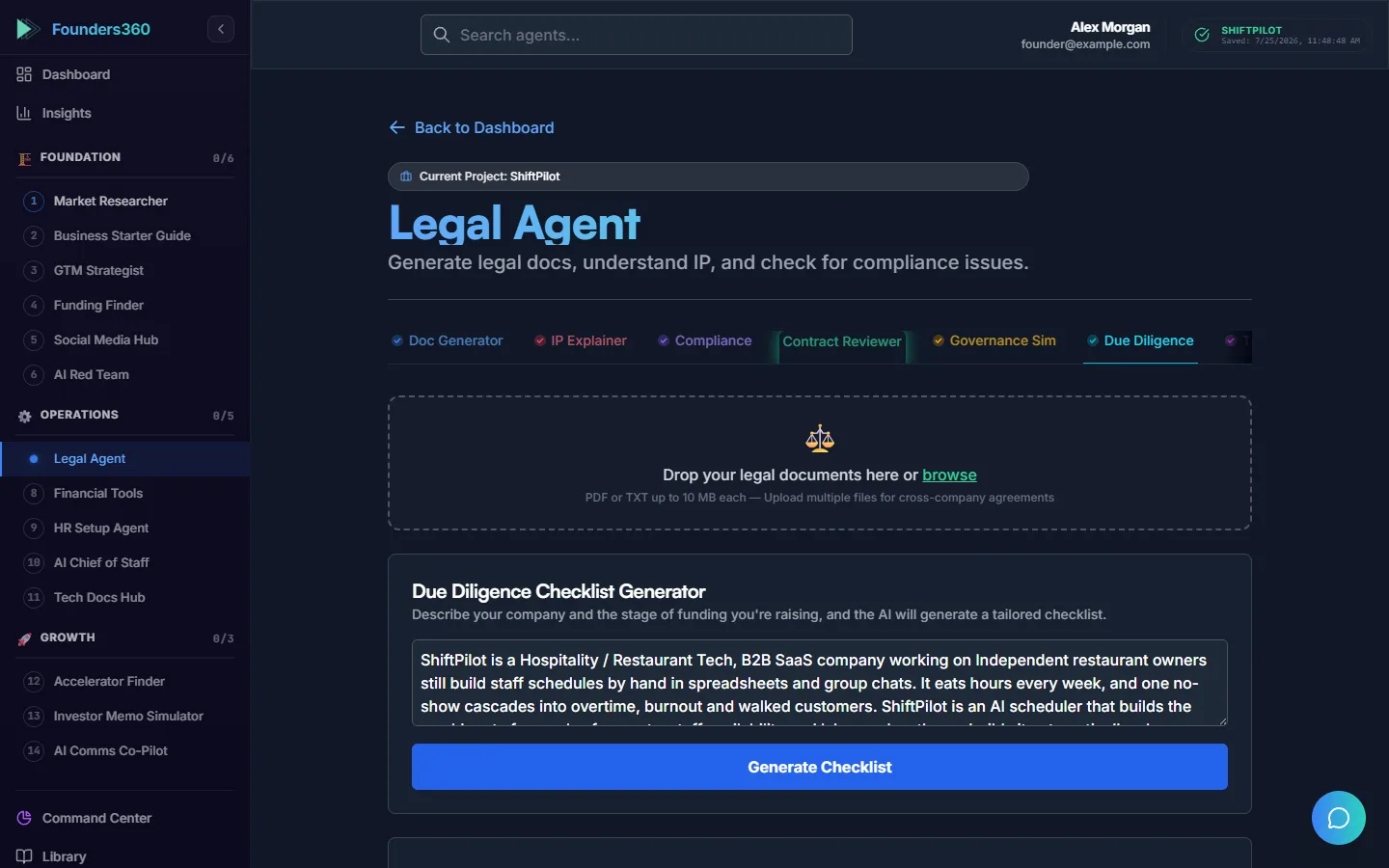
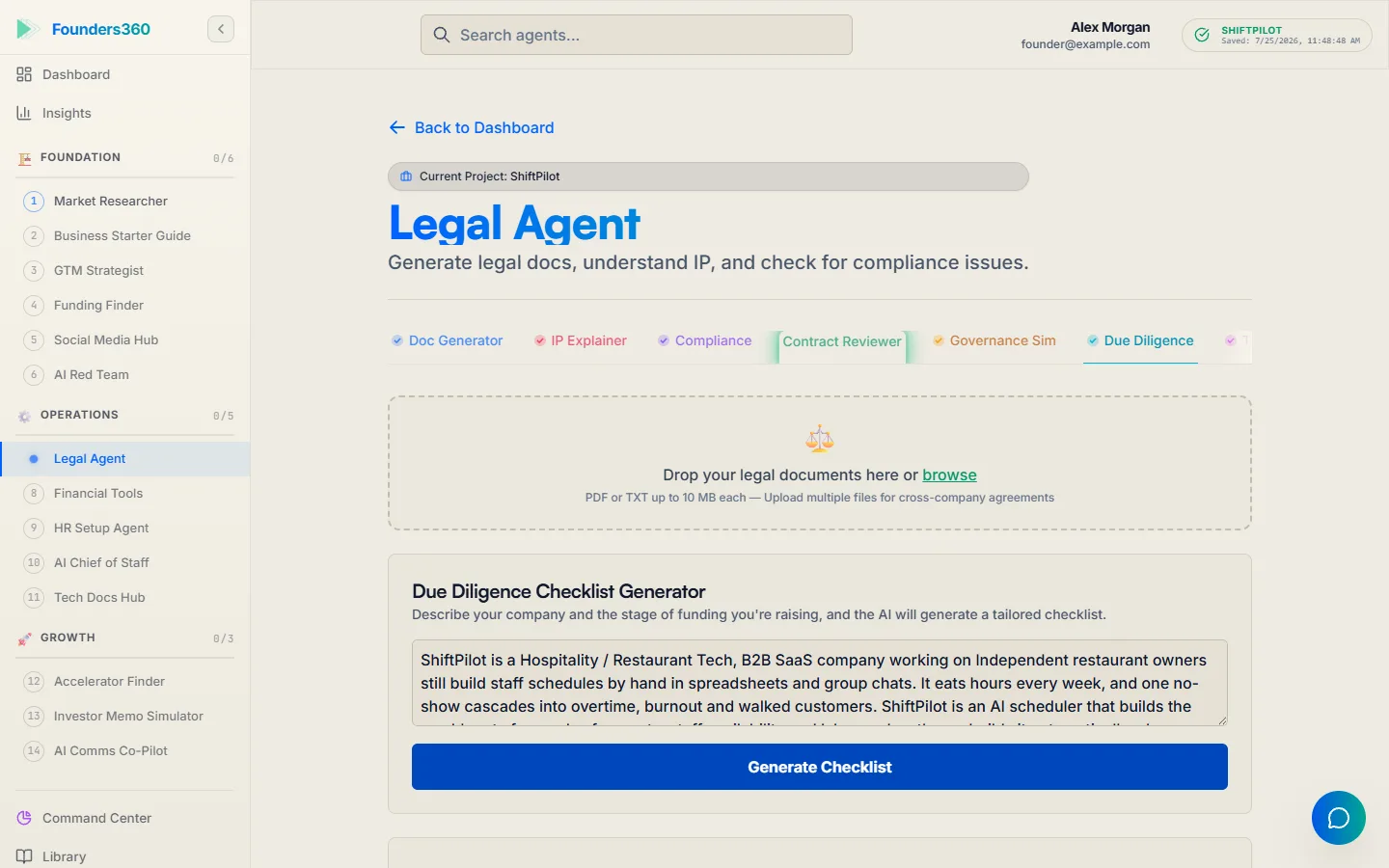
What to draft in the first 30 days, and what our Legal agent writes into Shared Context
The documents that decide who owns what are signed after the filing, and they are where founders without a lawyer make the expensive mistakes.
Founder stock purchase agreements with vesting come first. Four years with a one-year cliff is the market standard, and we explain the mechanics in the co-founder agreement and vesting guide. IP assignment comes second: every line of code and every design a founder produced before the company existed has to be assigned to it, or an investor's diligence will find a company that does not own its product. A cap table comes third, kept from day one so the numbers on the first SAFE are not a reconstruction. Our note on SAFE caps and pre-seed dilution shows why an accurate starting table matters more than the cap you negotiate.
Our Legal agent drafts each of these from the company profile and writes the structural facts into Shared Context: entity type, jurisdiction, authorized shares, each founder's stake and vesting schedule, and the 83(b) deadline. That is the claim a founder can verify. When the Funding Finder later builds a deck or the Financial Tools agent models a round, the ownership numbers come from that record rather than from a founder's memory. The templates are a starting point for a review, not a substitute for one, and the agent says so in the draft. You can see how the fifteen agents hand facts to one another on the agent library page.


When a lawyer is worth paying for
A lawyer is the cheaper option in six situations, and each one is cheaper before the filing than after it.
- Founders in more than one country. Cross-border structures (a Delaware parent with a Canadian subsidiary, or the reverse) carry tax rules that a template cannot see.
- A founder on a work visa or applying for one. Ownership and officer roles can affect immigration status in both countries.
- IP built at a previous employer or a university. An invention assignment clause you signed years ago can give your old employer a claim on your product.
- An investor already at the table. Investors will want their own terms, and reworking a template cap table under a term sheet costs more than drafting it right.
- A regulated industry. Health, finance, cannabis, alcohol and anything requiring a licence usually needs the entity structured around the licence.
- An unequal or unusual split. Different classes of founder shares, a founder contributing assets instead of cash, or a departing co-founder before incorporation.
For a standard case, a fixed-fee package from a startup-focused firm (roughly $1,000 to $3,000 for a Delaware formation with founder documents, September 2026, varying widely) buys a review of documents you could have drafted yourself.
What to do this week
Answer the equity question first: will anyone other than the founders own shares in the next two years? Then pick the jurisdiction, run the name search, and calendar the 83(b) deadline before you file anything, because the 30 days start on the share issuance date and nothing reminds you. If your first hire is next on the list, the startup HR checklist for a first hire covers what the corporation needs in place before it employs anyone.
Frequently Asked Questions
Can you incorporate a startup without a lawyer?
Yes, when the case is standard: a few founders in one country, no investors yet and no IP owned by a former employer. The filing is a form and the founder documents have established templates. Pay a lawyer for cross-border structures, immigration questions, prior-employer IP, a regulated industry or an investor already at the table.
Should a startup incorporate in Delaware or its home state?
Delaware if you plan to raise outside equity or grant stock options, because investors and standard financing documents assume it. Your home state if you are bootstrapping and staying local, because a Delaware corporation also has to register and pay in the state where it operates.
Is a Canadian startup better off incorporating federally or provincially?
Federally if you expect to operate or hire in more than one province; it protects the name nationally and the online fee (about $200 as of September 2026) is lower than most provincial fees. Provincially if the business will stay in one province. A Canadian startup raising from US investors should get advice before choosing either.
What is an 83(b) election and why does it matter?
A US tax filing that lets a founder pay tax on vesting shares at their value on the issue date, usually near zero, instead of at each vesting milestone. It must reach the IRS within 30 days of the share issuance and there is no extension.
How much does it cost to incorporate a startup?
Government fees are modest: a Delaware filing from about $89 plus annual franchise tax and a registered agent, a Canadian federal filing about $200, provincial filings roughly $300 to $350. All figures are approximate as of September 2026. Fixed-fee legal packages for a standard formation run roughly $1,000 to $3,000.
Tags
Related Articles
Co-Founder Agreement and Vesting: What First-Time Founders Must Put in Writing
A co-founder agreement with a vesting schedule is the document that decides who owns what when a founder leaves. Sign it before the first line of code, the first customer, or the first cheque, because every one of those makes the conversation harder.
8 min readGuidesUnit Economics for Early-Stage Startups: CAC, LTV and Payback Before You Have Revenue
Unit economics for an early-stage startup are three numbers per customer: what one costs to acquire, what one is worth over their life, and how many months until the first pays back the second. Before revenue you build them from stated assumptions, label them as such, and replace each one with a measurement as soon as you have it.
9 min readGuidesTechnical Documentation for Startups: What to Write Before You Hire Your First Engineer
Technical documentation for startups is five documents written before the first engineer starts: a product requirements document, a data model, an architecture decision log, an API contract and a runbook. Everything else can wait.
8 min readReady to Build Smarter?
Join thousands of solopreneurs using AI agents to scale their businesses.
Get Started Free