
Lean Canvas vs Business Model Canvas: Which Should Your Startup Use?
For a startup that has no product or paying customers yet, the lean canvas is usually the better fit, because it starts from problems and risks. The business model canvas suits a company that already has a product and needs to map how the whole business runs.
By Founders360 Team
In the lean canvas vs business model canvas choice, a startup with no product and no paying customers should usually pick the lean canvas, and a company with a working product and a known market should usually pick the business model canvas. Both are one-page templates with nine boxes. They share five of those boxes and differ in the other four, and those four differences decide which one fits your stage.
Where did the business model canvas and the lean canvas come from?
The business model canvas came first. It grew out of Alexander Osterwalder's 2004 doctoral thesis on the business model ontology at the University of Lausanne, directed by Yves Pigneur, and the book Business Model Generation by Osterwalder and Pigneur (Wiley, August 2010) made it widely known. Strategyzer says the book was co-created by 470 practitioners from 45 countries. The canvas template itself carries a Creative Commons Attribution-ShareAlike 3.0 licence, so you can use and adapt it as long as you credit Strategyzer and share adaptations on the same terms.
The lean canvas is an adaptation. Ash Maurya, author of Running Lean, explains in his own account of why he created it that he first saw the business model canvas in May 2010 and published the lean canvas in August 2010. He writes that it "was designed for entrepreneurs", so it focuses on customer problems and solutions rather than on the machinery of an operating company.
What are the nine boxes of the business model canvas?
The business model canvas has nine blocks that together describe how an organization creates, delivers and captures value. As named on Strategyzer's canvas, they are:
- Customer segments
- Value propositions
- Channels
- Customer relationships
- Revenue streams
- Key resources
- Key activities
- Key partners
- Cost structure
Notice what the list assumes: that you already know who your customers are, what you sell, and what you need in order to deliver it. Key resources, key activities and key partners describe the operating side of the company. They are easy to fill in honestly for an existing business, and hard for an idea.
What are the nine boxes of the lean canvas, and which ones differ?
The lean canvas keeps five boxes and trades four. In Maurya's explanation, he added problem, solution, key metrics and unfair advantage, and removed key activities, key resources, customer relationships and key partners. He does not map them one to one, but he gives a reason for each removal:
- Key activities should be derived from the solution box once the first version has been tested.
- Key resources overlap with unfair advantage, although not every unfair advantage is a resource.
- Customer relationships seemed better captured by the existing channels box.
- Key partners: chasing partnerships before the product is proven can be a form of waste.
The five boxes that carry over are customer segments, unique value proposition (the lean canvas name for value propositions), channels, revenue streams and cost structure.
The pattern is deliberate. Every removed box is something an early startup cannot yet know, and every new box is something a founder can write down on day one: a problem to test, a rough solution, a number that will show progress, and a reason a copycat cannot simply catch up.
Lean canvas vs business model canvas: side-by-side comparison
| Question | Lean canvas | Business model canvas | |---|---|---| | Created by | Ash Maurya, adapted from the business model canvas | Alexander Osterwalder and Yves Pigneur | | Built for | Startups searching for a model | Organizations of any size describing a model | | Starts from | The customer problem | The value proposition and the customer | | Boxes only on this one | Problem, solution, key metrics, unfair advantage | Key partners, key activities, key resources, customer relationships | | Boxes shared | Customer segments, value proposition, channels, revenue streams, cost structure | Customer segments, value propositions, channels, revenue streams, cost structure | | Main risk it surfaces | Is this problem real and painful enough? | Does the whole business fit together and pay for itself? | | Best stage | Before a product or first customers | After a product exists, or inside an established company |
When should a startup use the lean canvas instead of the business model canvas?
Use the lean canvas when you have an idea but have not yet proven that anyone will pay for it. Naming the problem, the solution and the one metric that matters turns vague enthusiasm into claims you can test, and each blank box points at an assumption you still need to check.
The natural next step is customer conversations. Our guide to validating a startup idea without spending money covers how to test the problem and customer segment boxes, and the guide to validating an idea with AI shows how to speed up the desk research behind them. When the customer segments box is still a loose phrase such as "small businesses", tighten it with an ideal customer profile template.
When should an established company use the business model canvas instead?
Use the business model canvas when the product exists and the question has changed from "is there a problem?" to "how does this whole business run?" Key partners, key activities and key resources help a team that already has suppliers, processes and assets to map where it is strong and where it depends on others. It also works well for comparing a current model with a new one, such as adding a second revenue stream.
Many founders use both in sequence. Start with the lean canvas, run experiments until the problem, segment and revenue boxes stop changing every week, then move to the business model canvas to plan the operating side.
Example: an illustrative filled lean canvas
This example is illustrative: the company and every entry are invented to show what each box can look like. Imagine a hypothetical startup called "PantryPilot", a tool that helps small independent restaurants cut food waste.
| Box | Illustrative entry | |---|---| | Problem | Kitchens over-order perishables and throw food away; staff track stock on paper or memory; there is no simple way to see what is about to spoil | | Customer segments | Owner-operated restaurants with one to three locations and a head chef who also orders stock (early adopters: owners who already complain about margins) | | Unique value proposition | Know what to order and what to use first, in five minutes a day | | Solution | A simple daily count screen, an expiry reminder list, a suggested order | | Channels | Restaurant owner groups, supplier sales reps, direct outreach to local kitchens | | Revenue streams | Monthly subscription per location | | Cost structure | Software development, customer support, a small amount of cloud hosting | | Key metrics | Locations counting stock at least four days a week; reported change in food thrown away | | Unfair advantage | None yet (an honest answer); possible later: a dataset of ordering patterns by cuisine |
Note that "none yet" is a normal, honest unfair advantage at this stage, and the key metrics box names behavior (counting stock) rather than vanity numbers. If you want to size the market behind a customer segment like this one, work through the TAM, SAM and SOM calculator guide.

Can an AI co-pilot help fill in either canvas?
It can help with the research that feeds the boxes, though the decisions stay yours. The customer segment, channel and revenue boxes depend on market facts such as who the buyers are and what alternatives exist. In Founders360, the Market Researcher agent gathers that kind of market information, and its findings are saved to Shared Context so later agents can build on them rather than starting from zero.
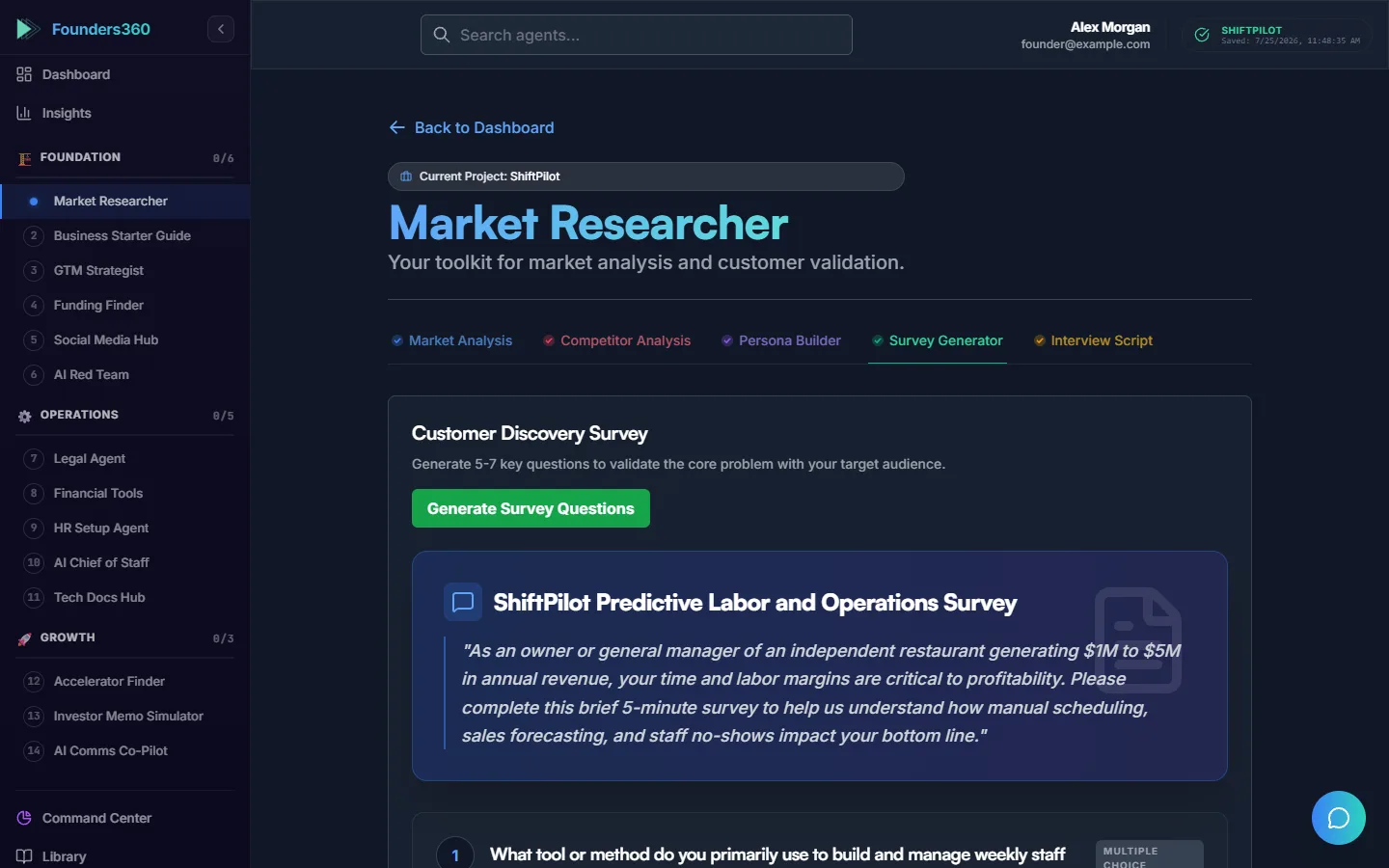
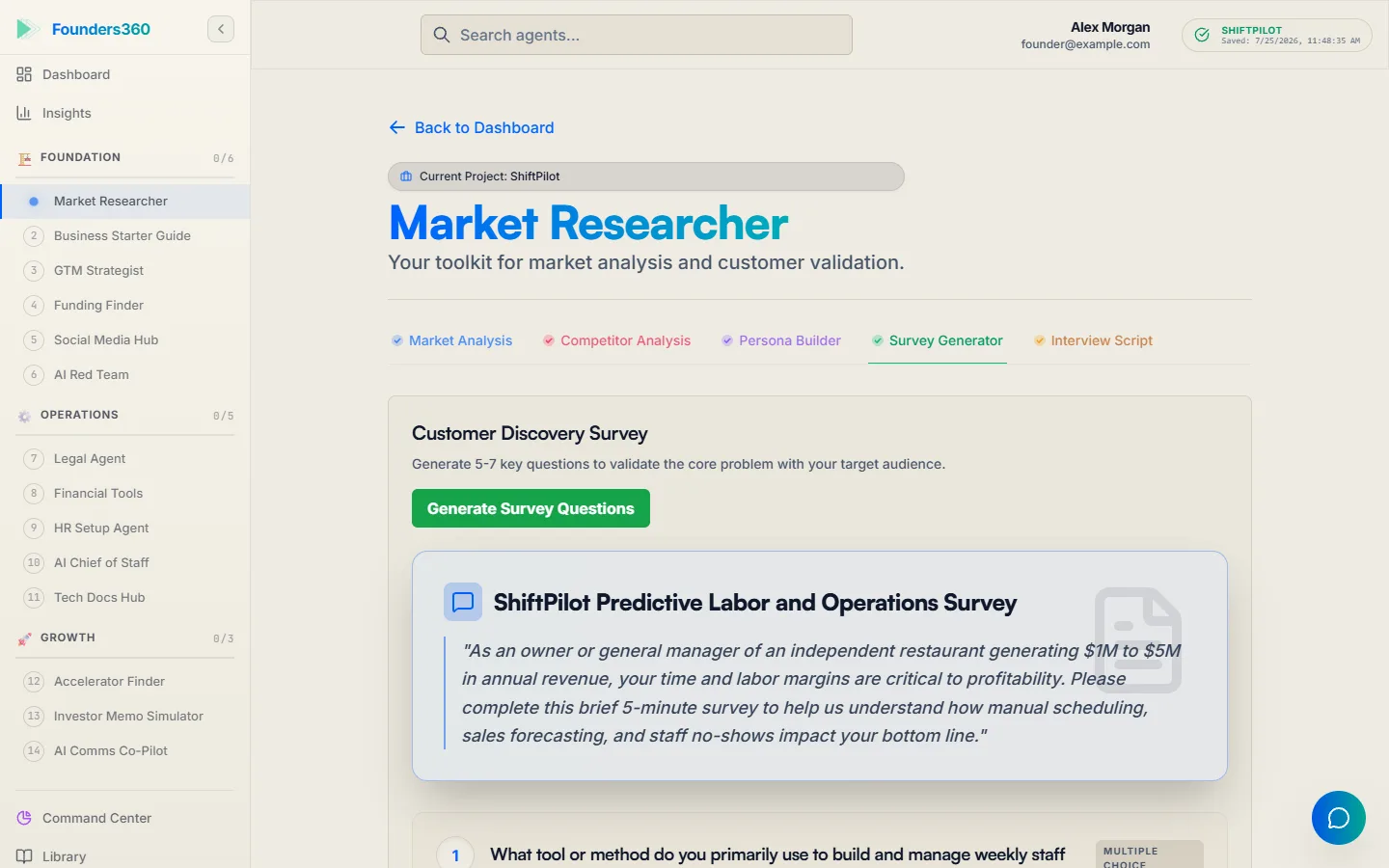
The Market Researcher is one of the five agents that are free forever. You can try it free at https://www.founders360.world.
Frequently Asked Questions
What is the main difference between the lean canvas and the business model canvas?
The lean canvas trades four boxes of the business model canvas for problem, solution, key metrics and unfair advantage, shifting the focus from how an operating business runs to which customer problem is worth solving.
Who created the lean canvas?
Ash Maurya created it in 2010 as an adaptation of Alexander Osterwalder's business model canvas, and he explains it in his book Running Lean (O'Reilly, 2012).
Is the business model canvas free to use?
Yes, with conditions. Strategyzer's canvas template is licensed under Creative Commons Attribution-ShareAlike 3.0, which lets you use, copy and adapt it, including commercially, as long as you credit Strategyzer and release any adapted version under the same licence. Check the notice on the current template before reproducing it.
Can I use both canvases?
Yes, and many teams do. Use the lean canvas while you are still testing whether the problem and customer are real, then move to the business model canvas once a product exists and you need to plan partners, activities and resources.
How long should it take to fill in a lean canvas?
Plan on an hour or less for a first draft. Some boxes will be guesses; treat each one as an assumption to test, and revise the canvas after each round of customer conversations.
Tags
Related Articles
How to Set Up a Business in Dubai in 2026: Free Zone vs Mainland
To set up a business in Dubai, you choose an activity, pick a free zone or mainland route, register a trade name, win initial approval, get the licence, then handle visas and a bank account. This guide compares the two routes and covers corporate tax and timelines.
7 min readGuidesHow to Write a Business Plan for a Startup (2026 Template)
To write a business plan for a startup, pick a format that fits your audience, fill in eight core sections, and keep the whole thing short enough to update. This guide gives a section-by-section template, shows what investors and banks each look for, and explains how to keep the plan alive.
7 min readGuidesCap Table Template for Startups: How to Build and Read One
A cap table template is a spreadsheet that lists every holder of your company, what they own and how much that is after dilution. This guide gives you the columns, a worked example with checked arithmetic, and the point at which a spreadsheet stops being enough.
6 min readReady to Build Smarter?
Join thousands of solopreneurs using AI agents to scale their businesses.
Get Started Free