
Ideal Customer Profile Template for B2B Startups (With Examples)
An ideal customer profile template gives a B2B startup one written description of the company most likely to buy, keep and recommend your product. This guide covers the fill-in template, two illustrative examples, and how to sharpen your ICP over time.
By Founders360 Team
An ideal customer profile template is a one-page form that describes the type of company most likely to buy your product, get value from it quickly and stay: its industry, size, location, the event that makes it search for a solution, the problem and what that problem costs, the people involved in the purchase, and the reasons you would walk away. Fill it in, test it in conversations, revise it quarterly.
What is an ideal customer profile, and how is it different from a buyer persona?
An ideal customer profile (ICP) describes a type of company. A buyer persona describes a type of person inside that company. You need both, but you need the ICP first, because it decides which companies you talk to at all.
Start with the ICP: a persona-first list ("operations managers") can fill with people at companies that will never buy or cannot pay.
An ICP is also not your total market. Your market might be every restaurant in North America; your ICP is the narrow slice where you can win first. To size the wider market, see the TAM, SAM and SOM calculator guide.
What does an ideal customer profile template look like?
A good template has seven blocks, and every block must be specific enough that a stranger could use it to decide whether a company qualifies. Copy this table into a document and fill in each row.
| Block | What to write | Your answer | |---|---|---| | Firmographics | Industry, company size (employees or revenue), geography, funding or growth stage | | | Trigger event | The change that makes the problem urgent now (new hire, new regulation, funding round, missed target, tool being retired) | | | Pain and its cost | The problem in the customer's words, plus what it costs them in money, hours or risk each month | | | Buyer, champion, user | Who signs, who pushes for the purchase, who uses the product daily | | | Budget owner | Whose budget pays, and the rough spending threshold that needs extra approval | | | Current alternative | What they do today: a spreadsheet, a competitor, an agency, nothing | | | Disqualifiers | The traits that make a company a bad fit, even if they say yes | |
Trigger event. Companies rarely buy because they have a problem. They buy because the problem became urgent. A trigger is something you can observe from the outside: a job posting, a funding announcement, a new regulation, a leadership change.
Pain and its cost. Write the pain in the words customers use, not in your product vocabulary. Then attach a rough cost: "six hours a week of manual scheduling" beats "inefficient scheduling".
Buyer, champion, user. In small companies these are often one person. In larger ones they are three. The champion is the person who wants your product and will argue for it internally.
Disqualifiers. This is the most useful row and the one most often skipped. Examples: needs a custom integration you will not build, a procurement cycle longer than six months, a team too small to feel the pain.
How do you build an ICP before you have customers?
Build a first ICP from evidence, not from imagination: customer discovery interviews, existing market research and a few honest guesses that you label as guesses. You are writing a hypothesis you will test, not a finished fact.
Start with ten to fifteen conversations with people at the kind of company you believe has the problem. Do not pitch. Ask what happened the last time the problem came up, what they did, what it cost and who was involved. Those answers fill most of the template. If you need a process for this, the guide on repeatable customer discovery for a technical founder walks through it.
Then add desk research: which segments competitors target and which customer logos they show. That tells you where money is already being spent on the problem.
Next, mark each row as "heard directly", "found in research" or "guess". A first ICP usually has two or three solid rows and four or five guesses.
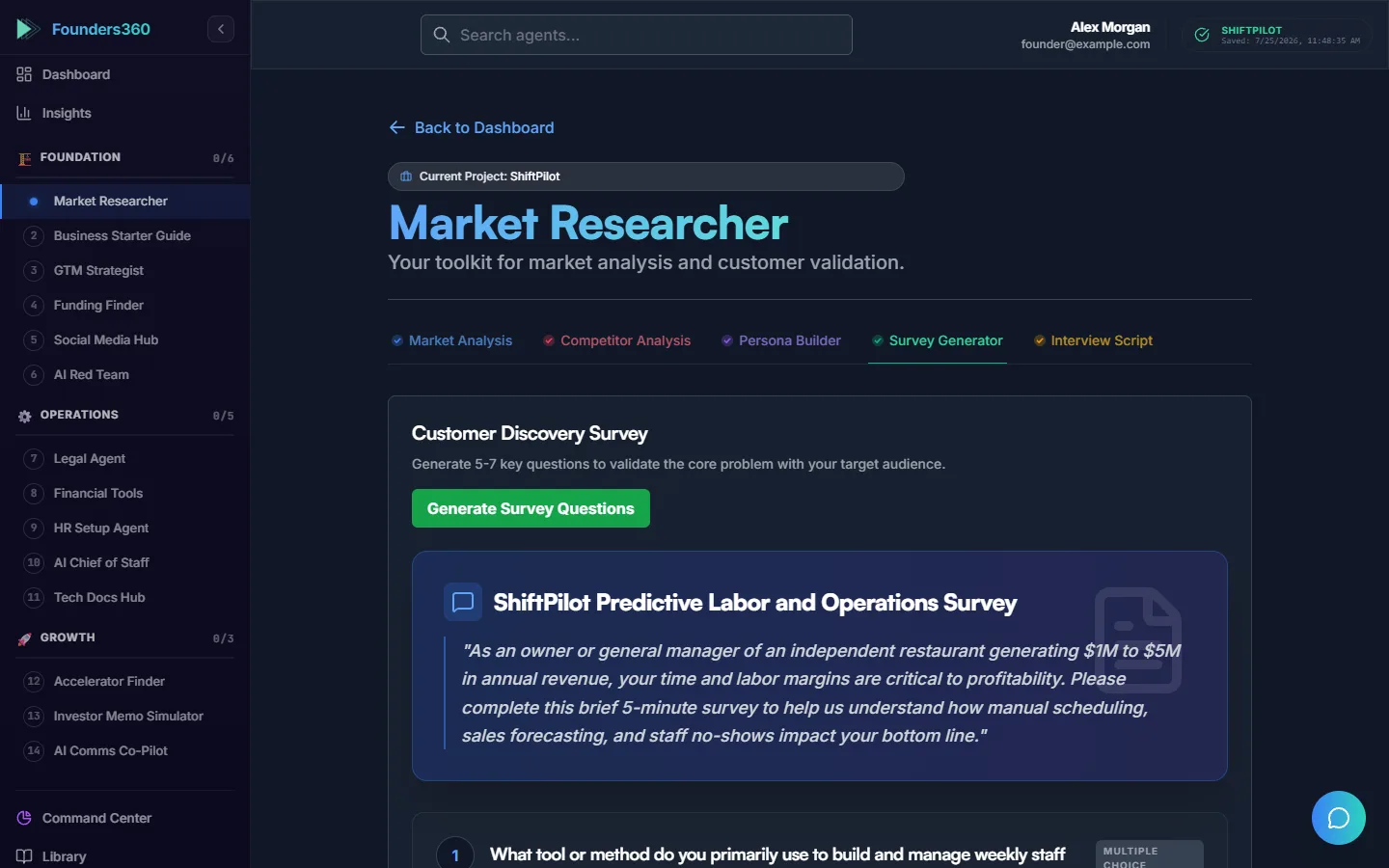
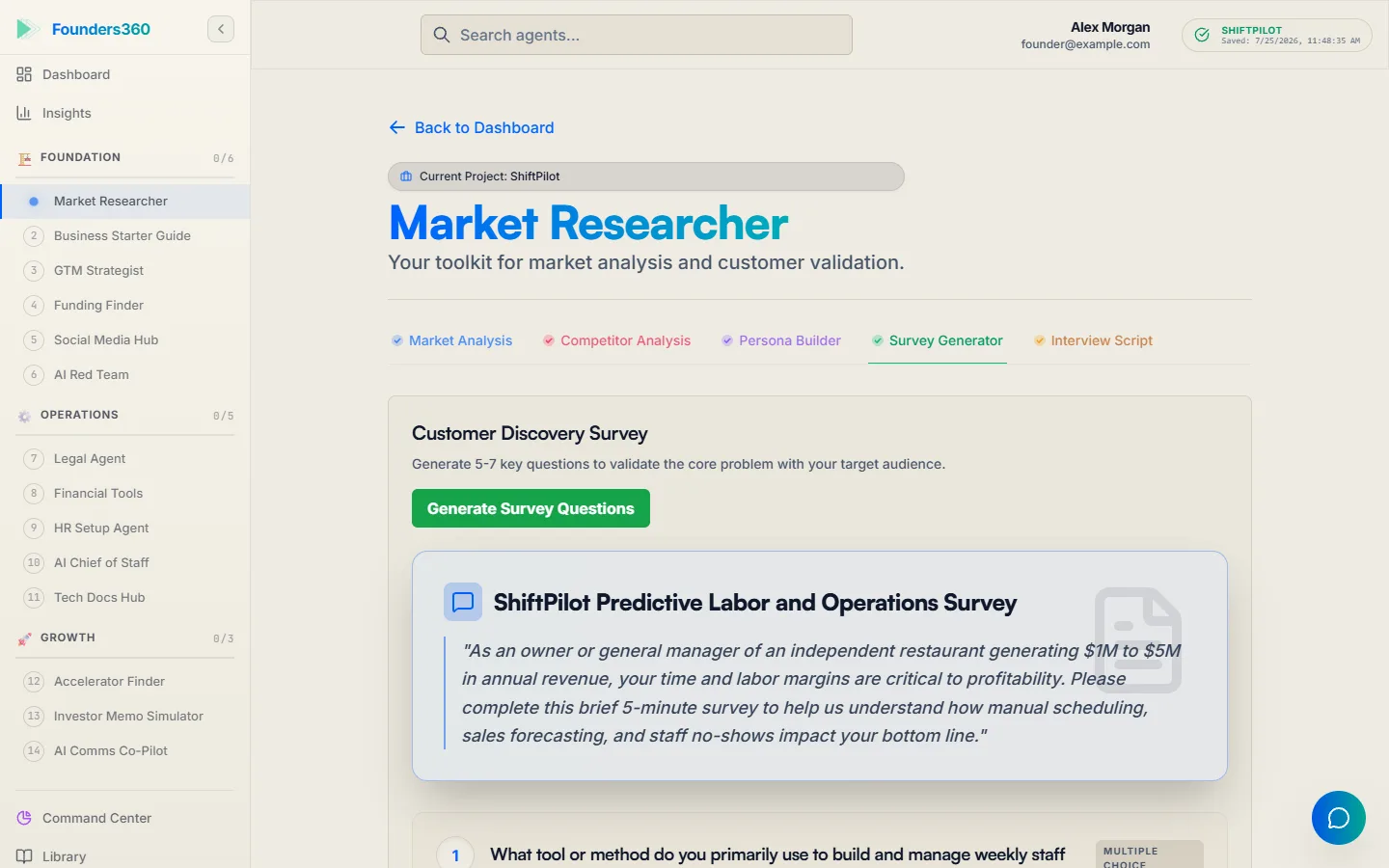
Founders360 can speed up the evidence step. The Market Researcher agent includes a Persona Builder and competitor analysis, so you can get a structured first draft of who buys in your space and who already sells to them. The GTM Strategist agent turns a draft ICP into positioning and channel ideas. Both write what they learn to the shared company brain, so when you later ask another agent to draft a pitch or an outreach message, it reads the same ICP instead of asking you to restate it. Treat the output as a draft to challenge in interviews.
What does a filled-in ICP look like? Two illustrative examples
Both examples below are illustrative. They are invented to show the level of detail to aim for, not real companies or real data.
Example 1: a scheduling tool for independent restaurants (illustrative).
- Firmographics: independent, owner-operated restaurants, 15 to 50 staff, one to three locations, in mid-sized North American cities.
- Trigger event: the owner just lost a manager, opened a second location, or started missing shifts because the schedule lives in a group chat.
- Pain and cost: "I spend Sunday night rebuilding the schedule." Estimated cost: several owner hours per week plus overtime from last-minute gaps.
- Buyer, champion, user: the owner buys; the general manager champions; servers and cooks use it on their phones.
- Current alternative: spreadsheet and a group chat.
- Disqualifiers: national chains with corporate scheduling systems, restaurants with fewer than ten staff, anyone who needs payroll integration on day one.
"Independent restaurant that just opened a second location" is a list you can build from public sources. "Restaurants" is not.
Example 2: an AI tool sold to university entrepreneurship programs (illustrative).
- Firmographics: university-run startup programs and incubators with 20 to 100 student or alumni ventures per year, in the United States or Canada.
- Trigger event: a new program director, a grant that requires reporting on venture progress, or a new cohort launching within a quarter.
- Pain and cost: staff time spent answering repeat questions and chasing progress updates.
- Buyer, champion, user: the program director or associate dean buys; a program manager champions; student founders are the daily users.
- Current alternative: office hours, shared documents and mentor volunteers.
- Disqualifiers: programs with no dedicated staff, or a long procurement review before any pilot.
The second example has a distinction the first does not: the people who use the product (students) are not the people who pay (the program). Write that down early.
How do you sharpen your ICP after your first 10 customers?
After ten customers, stop guessing and start sorting. Take every customer and every lost deal, and mark each one on four things: how fast they bought, how happy they are, how much they pay, and whether they refer others. Your real ICP is the group that scores well on all four, and it is often narrower than the one you wrote on day one.
- List your ten customers in a table with the template's seven rows as columns.
- Highlight the customers who closed fastest and use the product most. Look for what they share.
- List your lost deals and stalled conversations. Look for the traits that repeat. Those become new disqualifiers.
- Rewrite the template. Change "guess" rows to "confirmed" or delete them, and review it every quarter.
Expect surprises: customers you thought were secondary are often the best fit. For help turning that learning into a sales plan, see the guide to finding your first 10 B2B customers.
How does an ICP drive positioning, channels and outbound lists?
Your ICP decides who you talk to, what you say and where you say it.
Positioning. A positioning statement names a target customer, the problem, the alternative and why you are different. The ICP supplies the first three. If your ICP says "restaurant owners who just opened a second location, currently using a group chat", your message can speak to exactly that moment instead of to "businesses". The guide on how to write a startup positioning statement shows how to turn the ICP into one sentence.
Channels. Ask where your ICP already spends attention: communities, newsletters, trade events and search terms. Pick the one or two where it is concentrated and ignore the rest for now. The 90-day go-to-market plan for a pre-seed startup shows how to sequence this.
Outbound lists. The firmographics and trigger rows are your search filters. Build a list of 50 companies that match, check each for a visible trigger, and find the buyer or champion. Reference the trigger in the first line of your message: "I saw you opened a second location" is a reason to reply.
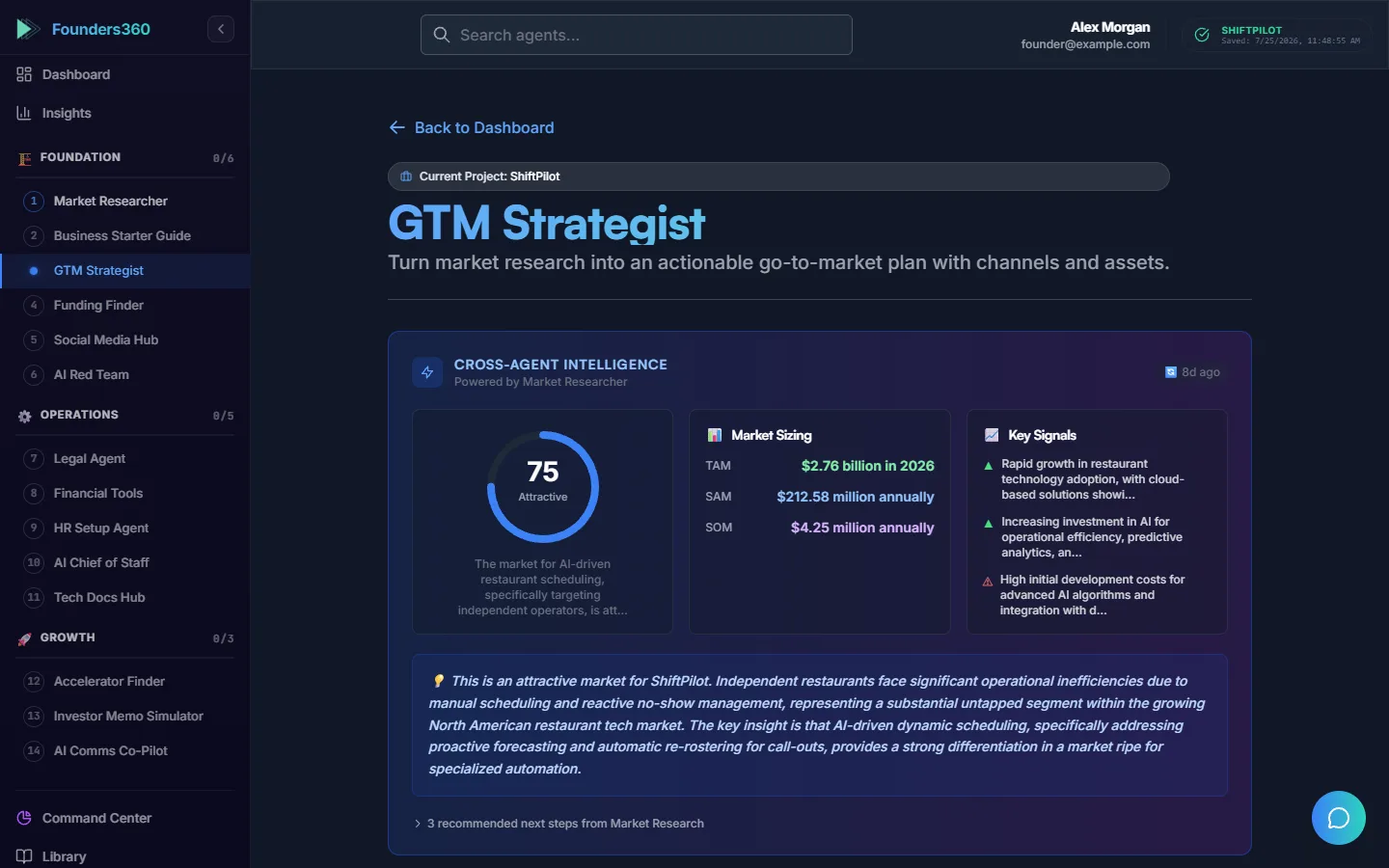
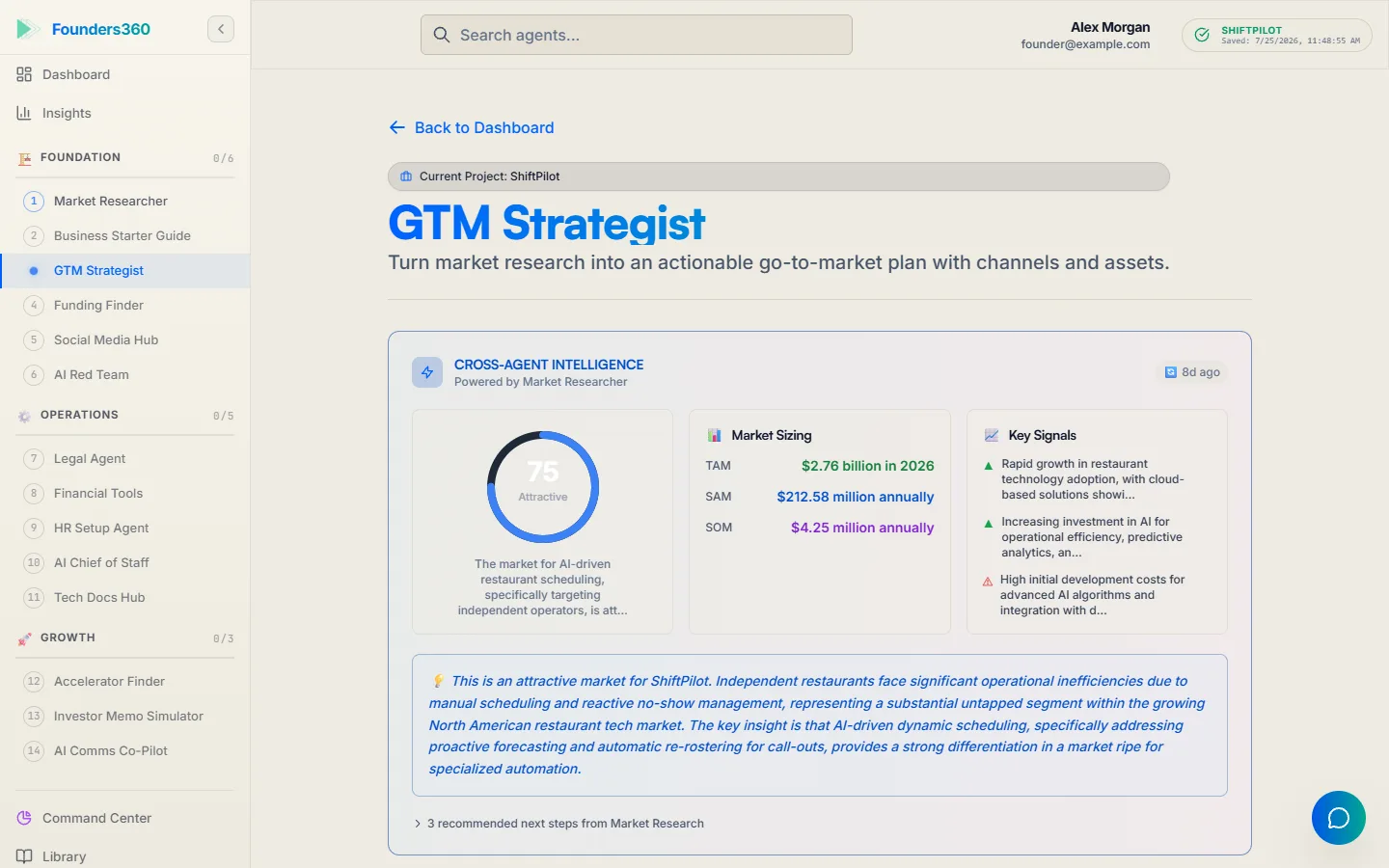
The GTM Strategist agent in Founders360 helps with this step by drafting channel and messaging options from the company context it already holds. Because it reads the ICP written by Market Researcher, you do not paste it in again.
What are the most common ICP mistakes?
The most common mistakes are being too broad, describing only demographics, never revisiting the document and skipping disqualifiers. Each is easy to spot once you know what to look for.
Too broad. "Small and medium businesses" or "any company that needs marketing" is not an ICP. A test: can you name ten specific companies that fit, and find them in a public source in under an hour? If not, narrow it.
Demographics only. Industry and headcount tell you who could buy. They do not tell you who will buy now. Add the trigger event and the pain.
Never revisited. The ICP you wrote before you had customers is a guess. Review it quarterly and after every cluster of lost deals.
Skipping disqualifiers. Without them, every interested company looks like an opportunity, including the ones that will drain your time and churn.
Frequently Asked Questions
What is an ideal customer profile?
An ideal customer profile is a written description of the type of company that gets the most value from your product and is most likely to buy it, stay and recommend it.
What is the difference between an ICP and a buyer persona?
An ICP describes a company, while a buyer persona describes a person inside that company. Use the ICP to pick organizations, then build personas inside them.
How many ICPs should an early-stage startup have?
One. Pick the narrowest segment where you can win first and focus there. Add a second only when the first has proof.
Can I build an ICP with no customers yet?
Yes. Use customer discovery interviews and desk research to write a first version, and label each row as heard directly, found in research or a guess. Then test the guesses in conversations.
How often should I update my ICP?
Review it every quarter, and also after your first ten customers and after any cluster of lost or stalled deals.
Which Founders360 agents help with an ICP?
Market Researcher includes a Persona Builder and competitor analysis, which give you a structured first draft. GTM Strategist turns that into positioning and channel ideas. Both write what they learn to the shared company brain, so later agents reuse your ICP rather than asking for it again.
Tags
Ready to Build Smarter?
Join thousands of solopreneurs using AI agents to scale their businesses.
Get Started Free