
White-Label Platforms: Why Startup Programs Are Rebranding Their Tooling
Startup accelerators, incubators, and university programs are increasingly turning to white-label platforms to unify their founder tooling. This strategy allows them to rebrand powerful software solutions as their own, enhancing brand consistency, improving the founder experience, and streamlining operations without the burden of in-house development.
By Founders360 Team
The landscape of startup support is more competitive and dynamic than ever before. Accelerators, incubators, and university entrepreneurship programs constantly seek ways to deliver exceptional value to founders. A critical aspect of this involves providing access to sophisticated tools and resources. However, building or maintaining an array of in-house software solutions can be costly and resource-intensive, often leading to fragmented experiences for participating startups. This is where white-label platforms are emerging as a strategic game-changer, allowing programs to rebrand essential tooling and offer a seamless, branded experience to their cohorts.
What Exactly Is a White-Label Platform?
In essence, white-label software is a product or service developed by one company that another company can rebrand and sell as its own. The term "white label" originates from the concept of a blank white label on a product's packaging, which allows a reseller to apply their own branding. This means a program can take a robust, pre-built software solution, customize it with their own logos, colors, and specific program elements, and present it to their founders as an integral part of their offering.
White-label solutions are typically delivered as ready-to-use products, often via a Software as a Service (SaaS) model, which makes them scalable and easy to deploy. This approach allows organizations to expand their offerings quickly and efficiently without the significant time, costs, and resources required for in-house software development. Instead of building every tool from scratch, which can be an expensive and time-consuming endeavor, programs can leverage proven technology and focus their resources elsewhere.
The Evolving Needs of Startup Programs
Startup accelerators and incubators face unique operational challenges in supporting a diverse array of early-stage companies. They must provide mentorship, networking opportunities, and access to essential business tools, all while managing a high volume of applications and maintaining quality control. A significant hurdle often arises from juggling too many disconnected applications and tools. This fragmented technology stack can lead to siloed data, inconsistent user experiences, and substantial manual workload for program managers.
Founders participating in these programs expect sophisticated, integrated tools that can genuinely accelerate their progress. When programs rely on a patchwork of generic or disparate tools, it can detract from the overall founder experience and dilute the program's unique identity. The need for consistent, high-quality output across an entire cohort – whether for market sizing, pitch decks, financial models, or legal drafts – further underscores the demand for unified and specialized tooling.
Why Rebrand? The Power of Program-Specific Tooling
Rebranding generic tools through a white-label approach offers a powerful strategic advantage for startup programs. It is not merely about slapping a logo onto a product; it is about creating a cohesive ecosystem that reflects the program's values and strengthens its brand identity.
Enhanced Brand Equity and Recognition
When founders use tools branded specifically for their program, it reinforces the program's identity and value proposition. Consistent branding across all touchpoints, including the software tools provided, builds trust and credibility. This professional presentation helps programs stand out in a crowded market, making them more attractive to prospective founders and partners. It ensures that every interaction with the program feels unified and intentional.
Consistent Founder Experience
A white-labeled platform ensures that all participating founders receive a standardized, high-quality experience. Instead of navigating various interfaces and onboarding processes for different tools, they interact with a single, familiar environment that aligns with the program's pedagogical approach. This consistency helps founders focus on building their businesses rather than wrestling with disparate software, ultimately leading to more uniform and investor-ready outputs across the cohort.
Competitive Differentiation
In a competitive landscape, programs must differentiate themselves. Offering a bespoke technology stack that appears custom-built for their specific curriculum and methodologies provides a significant edge. This demonstrates a commitment to providing cutting-edge resources and a thoughtful, integrated approach to startup development. It positions the program as a leader that provides premium, tailored support.
Key Advantages of White-Label Platforms for Institutions
Adopting a white-label platform can transform how accelerators, incubators, and university programs operate and deliver value. The benefits extend beyond branding to fundamental operational efficiencies and strategic growth.
Speed to Market and Cost Efficiency
Developing a comprehensive suite of specialized AI agents or business tools from scratch would require substantial investment in time, capital, and engineering talent. White-label solutions eliminate this burden, allowing programs to deploy sophisticated tooling quickly and cost-effectively. This approach frees up valuable resources that can be redirected towards mentorship, networking, and other core program activities. Programs can launch or upgrade their offerings rapidly, staying agile and responsive to the evolving needs of startups.
Focus on Core Competencies
By leveraging white-label software, institutions can concentrate on their core mission: fostering entrepreneurship and guiding founders. They do not need to become software development companies themselves. The white-label provider handles the technical heavy lifting, including maintenance, updates, and infrastructure, allowing the program to dedicate its expertise to curriculum development, founder coaching, and community building.
Scalability and Flexibility
White-label platforms are typically designed for scalability. As a program grows and its cohorts expand, the underlying technology can often scale to meet increasing demand without requiring significant additional effort from the program's team. Many solutions also offer customization options, allowing programs to tailor features and workflows to their specific needs.
For example, Founders360 offers white-label solutions for institutions, enabling accelerators, incubators, and university programs to provide a full suite of 15 specialized AI agents under their own brand. This comprehensive startup suite includes crucial tools like market research, GTM strategy, legal drafting, and financial modeling, all sharing a single project context for cohesive output. To learn more about this integrated offering, visit the Founders360 for Institutions page.
Overcoming Operational Hurdles with a Unified Platform
Traditional startup programs often grapple with operational inefficiencies stemming from a fragmented toolchain. Program managers may waste valuable time piecing together data from disparate applications, leading to inconsistencies and difficulties in tracking progress. This can also make it challenging to maintain a consistent experience for founders, as they navigate different interfaces and data entry requirements.
A white-label platform addresses these challenges by consolidating essential tools into a single, cohesive environment. This unification streamlines workflows, improves data integrity, and enhances overall program management. Imagine a dashboard where founders can access all their AI agents, track their progress, and see how different aspects of their business plan connect – all within a branded interface that feels like an extension of the program itself.
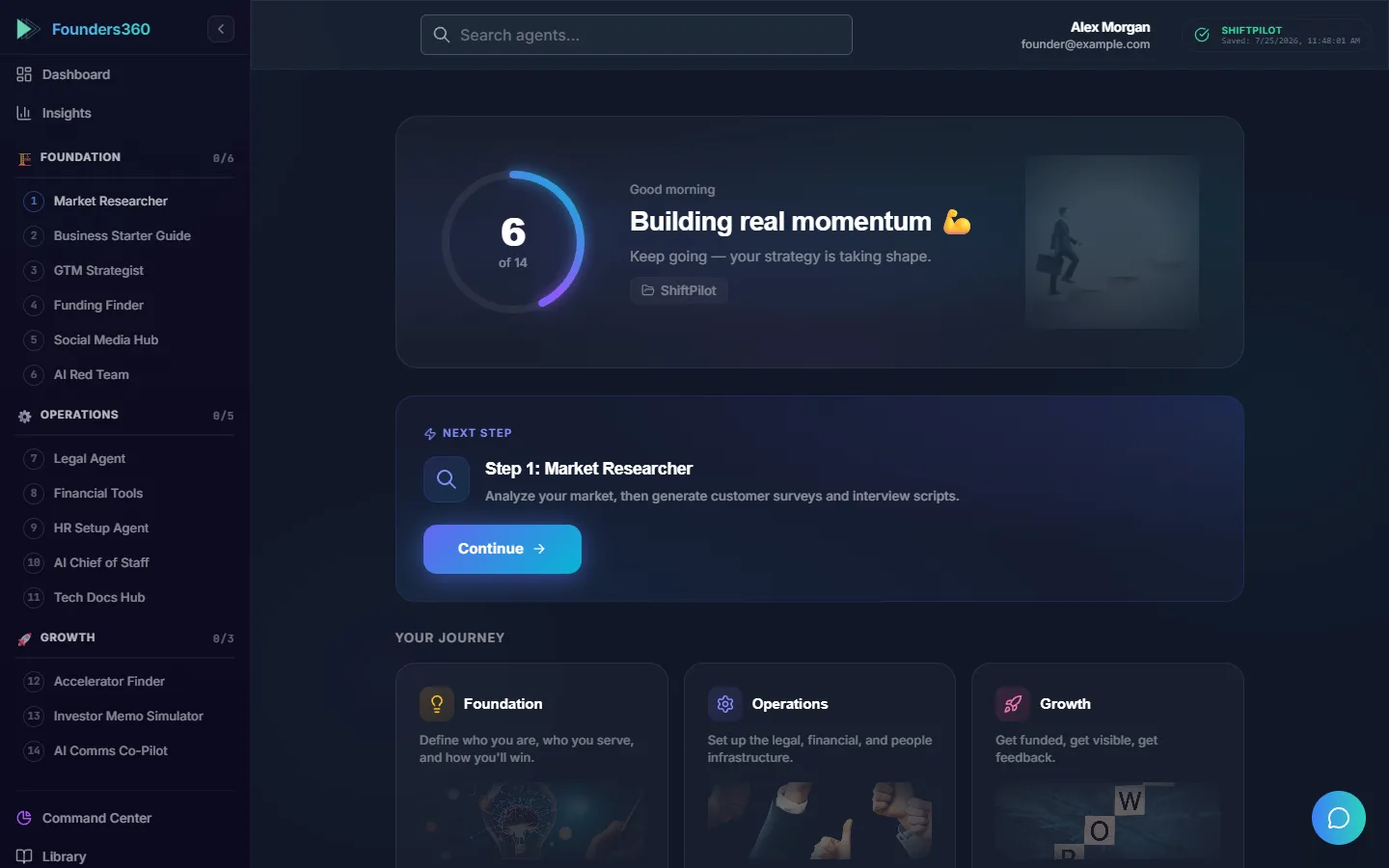
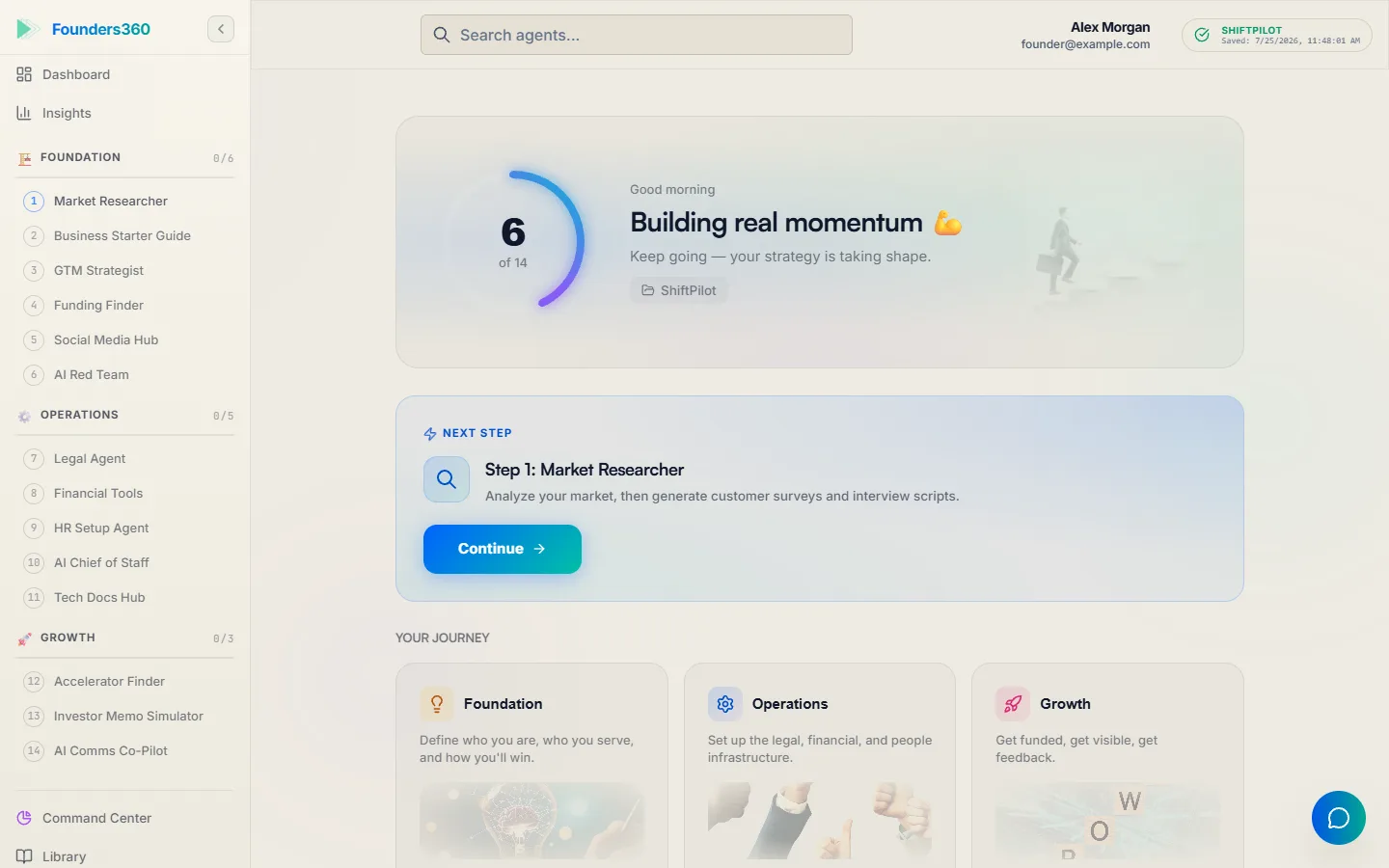
The screenshot above illustrates how a unified project dashboard can provide a clear overview of a startup's journey, making it easier for both founders and program administrators to track progress and identify next steps. With a shared context across all tools, data entered for market research, for instance, automatically informs the financial model or pitch deck, eliminating redundant data entry and ensuring consistency. This level of integration is a hallmark of advanced platforms like Founders360, where a "shared-context engine" feeds all 15 agents, ensuring that once market research is complete, it seamlessly informs legal documents, financial models, and other outputs without manual copy-pasting.
Explore the full range of AI agents available to institutions on the Founders360 Agents page.
Choosing the Right Partner for Your Program
Selecting the appropriate white-label partner is a critical decision for any startup program. Key considerations include the breadth and depth of the features offered, the level of customization available, the platform's scalability, and the quality of support provided.
Programs should look for a partner that offers a comprehensive suite of tools relevant to the startup journey, from ideation and validation through growth and fundraising. The ability to integrate seamlessly with existing program structures and provide robust security and data privacy measures is also paramount. Furthermore, a good partner will understand the unique needs of institutional clients, offering dedicated support and a clear roadmap for future development.
The Future of Startup Program Infrastructure
The trend towards white-label platforms for startup programs is not just a passing fad; it represents a fundamental shift in how institutions deliver value. As the startup ecosystem continues to evolve, programs that can offer integrated, branded, and highly efficient tooling will be best positioned to attract top talent and produce successful ventures. The focus will increasingly be on creating an unparalleled founder experience, allowing founders to concentrate on innovation and execution, rather than administrative overhead or tool fragmentation.
By embracing white-label solutions, programs can future-proof their operations, enhance their brand, and ultimately contribute more effectively to the success of the next generation of founders. The value creation lies in providing a cohesive, supportive, and technologically advanced environment that empowers entrepreneurs at every stage.
Frequently Asked Questions
What is the difference between white-label and an API integration?
White-labeling typically involves taking a fully developed software product and rebranding its user interface and sometimes its domain, presenting it as your own. An API (Application Programming Interface) integration, conversely, involves connecting distinct software systems so they can exchange data or functionality. While a white-label solution might use APIs internally, the primary difference for the end-user is that white-label provides a single, branded experience, whereas API integrations often link separate applications.
Is white-labeling suitable for small programs or only large ones?
White-label solutions are suitable for programs of all sizes. They particularly benefit smaller programs by providing access to sophisticated tools without the need for significant in-house development resources. For larger programs, white-labeling helps maintain consistency and brand integrity across multiple cohorts and locations.
What kind of customization is possible with white-label platforms?
Customization options vary by provider but generally include branding elements such as logos, color schemes, and program-specific domains. Some platforms also allow for deeper customization of workflows, features, and content to align perfectly with a program's curriculum or unique methodology.
How does data security work with white-label platforms?
Reputable white-label providers prioritize data security, often employing industry-standard measures such as TLS 1.3 for data in transit and AES-256 encryption for data at rest. They typically host on SOC 2-compliant infrastructure and often ensure that user business data is not used to train their AI models. It is important to verify a provider's security protocols and compliance certifications.
Will founders know they are using a white-label solution?
The intent of white-labeling is for the software to appear as if it was developed by the program itself. With proper rebranding and integration, founders will experience the tools as a seamless part of their program's offering. The transparency of the underlying technology is typically managed at the institutional level, focusing on presenting a unified brand experience to the end-users.
Tags
Related Articles
Building a Repeatable Customer Discovery Process as a Technical Founder
Technical founders often excel at building innovative products, but frequently face the challenge of ensuring their creations genuinely solve market problems. This article provides a concrete, repeatable customer discovery process designed to help technical founders validate ideas, understand customer needs, and avoid the common pitfalls of building in a vacuum. Learn how to transform assumptions into validated insights and build products that customers truly want.
10 min readStartup PlaybooksThe Venture Studio Playbook: How Companies are Built Differently
Venture studios represent a distinct and increasingly influential model in the startup ecosystem, fundamentally changing how new companies are conceived, built, and scaled. Unlike traditional venture capital firms or accelerators, studios act as co-founders, engaging deeply from ideation through launch and growth, providing extensive operational support and capital. This hands-on approach aims to de-risk the startup journey and increase the likelihood of success for portfolio companies.
8 min readStartup PlaybooksHow to Price Your First SaaS Product When You Have No Customers
Launching your first SaaS product without a customer base presents a unique pricing challenge. This guide offers practical strategies for setting prices, focusing on value, understanding costs, and iterating as you grow, even when traditional competitive benchmarks are not available.
8 min readReady to Build Smarter?
Join thousands of solopreneurs using AI agents to scale their businesses.
Get Started Free