
83(b) Election Explained: Deadline, How to File, and Why Founders Cannot Miss It
An 83(b) election is a written choice, filed with the IRS within 30 days of receiving restricted stock, to be taxed on its value at grant instead of as it vests. For most founders with near-zero share value, it is a cheap step that avoids a very large tax bill later.
By Founders360 Team
An 83(b) election is a written choice, made under section 83(b) of the US tax code, to be taxed on restricted stock at the moment you receive it rather than as it vests. The election must reach the IRS within 30 days of the transfer, and for most founders it costs almost nothing when shares are worth almost nothing. This is general information, not tax advice, so confirm your facts with a tax professional.
What is an 83(b) election?
An 83(b) election tells the IRS that you want to report the value of your restricted shares as income in the year you receive them, instead of year by year as they vest. Section 83(b) lets a person who receives property for services choose to include in income the difference between its value at transfer and anything they paid for it.
Without the election, the default rule in section 83(a) taxes you each time a slice of stock vests, based on its value on that date. With the election, the taxable amount is fixed on day one. If you paid the full fair market value at purchase, the amount is zero, and you owe nothing at that point.
The election exists because founder stock usually comes with vesting, which means the company can buy back unvested shares if you leave. Those shares are substantially nonvested, and that is what triggers the default rule. For the vesting mechanics themselves, see our co-founder agreement and vesting guide, which has a short 83(b) section. This article is the deep dive.
What is the 83(b) election deadline?
The deadline is 30 days after the date the shares are transferred to you, and it is fixed by statute. The law says the election must be made "not later than 30 days after the date of such transfer", and the Treasury regulation adds that it may also be filed before the transfer date.
Three practical points follow from that:
- The clock starts on the date of the share grant or purchase, not the date you incorporate and not the date you sign the vesting paperwork, unless those are the same day.
- If day 30 falls on a Saturday, Sunday or legal holiday, the Form 15620 instructions say a mailed election postmarked by the next business day is timely, under section 7503. Do not plan to use that as slack; file in the first week.
- There is no extension. Law firm summaries of the current IRS form, such as this one from Morrison Foerster, state that late submissions are not permitted.
What happens if you miss the 83(b) deadline?
If you miss the deadline, you are taxed under the default rule: as ordinary compensation income each time shares vest, at their value on the vesting date. If the company succeeds, that value can be far above the price you paid, and you owe tax on shares you cannot easily sell.
The regulation also says an 83(b) election may not be revoked except with the consent of the IRS, and consent is limited to a mistake of fact about the transaction. A missed deadline is not a fixable mistake, which is why founders treat the date as absolute.
An illustrative example
This example is illustrative only, with invented numbers and no tax rates. Suppose a founder buys 4,000,000 shares for a total of $400, which is $0.0001 per share and equal to their fair market value at the time. The shares vest over four years.
- With a timely election: the shares are worth what the founder paid, so the income reported at grant is $0. Later growth is generally not taxed as compensation, and the holding period for capital gains generally begins at grant.
- Without an election: suppose the company grows and the shares are worth $1.00 each when the first 1,000,000 vest. The founder would have compensation income of about $1,000,000 for that vesting, less what was paid for those shares, even though no cash changed hands.
The gap between those two outcomes is the entire reason this form exists.
Who needs an 83(b) election?
You generally need to consider an 83(b) election if you are a US taxpayer who receives or buys shares that are subject to vesting or another substantial risk of forfeiture. In startups, that usually means founders, early employees and advisers who receive restricted stock, and not holders of options or fully vested shares.
Some limits worth knowing:
- Stock options are generally not eligible, because an option is not a transfer of property. Early exercise of options for restricted stock is a separate situation to discuss with an adviser.
- Shares that are fully vested at grant do not need an election, because there is nothing to wait for.
- Non-US taxpayers follow their own country rules, and cross-border founders should ask a qualified adviser before assuming anything.
- Restricted stock units are not eligible for the election in the usual case.
What are the risks of an 83(b) election?
The main risk is paying tax on shares you later forfeit. If you file an election, pay tax on value at grant, and then leave before the shares vest, you generally cannot recover that tax. The regulation treats a forfeiture after an election as a sale that can produce a capital loss equal to the amount you paid minus what you received back, but it does not give back the tax.
That risk is small when the shares are worth very little at grant, which is the usual case at incorporation. It grows if you receive stock after a priced funding round, when the spread between price paid and value can be large. Get advice before you decide.
How to file an 83(b) election with Form 15620
To file, complete IRS Form 15620 (Section 83(b) Election) and submit it within 30 days of the transfer, then give a copy to the company. The form carries a revision date of April 2025 on the IRS site. The form is optional: its instructions say a written statement that meets the regulation still works, which is how founders filed before it existed.
As of October 2026, there are two ways to file:
- By mail. The form instructions say to mail the signed form to the IRS office where you file your federal income tax return. Use a tracked service.
- Online. Law firm summaries, including Morrison Foerster and Goodwin, report that since mid 2025 taxpayers can sign in to an IRS online account through ID.me, complete Form 15620 and submit it electronically, with immediate confirmation of receipt. The online page sits behind the IRS sign in, so confirm the current steps there.
Use one method only, not both; the online form asks you to confirm you have not already mailed an election for the same shares. Then give the company a signed copy, as both the regulation and the form require. You no longer attach a copy to your tax return: Treasury Decision 9779 removed that requirement for property transferred on or after January 1, 2016. Keep the filed form and the confirmation or proof of mailing with your company records.

Where the Legal agent helps
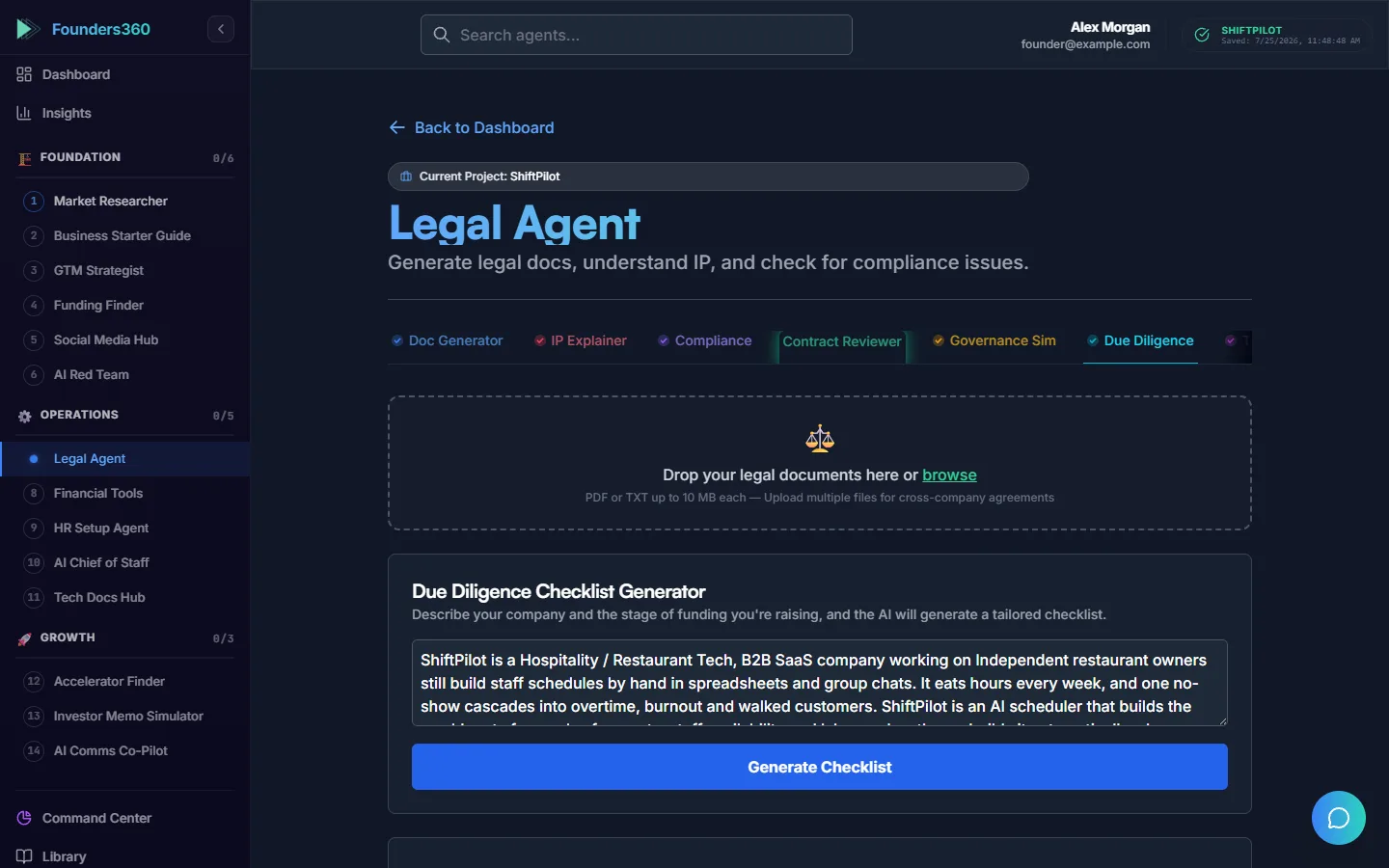
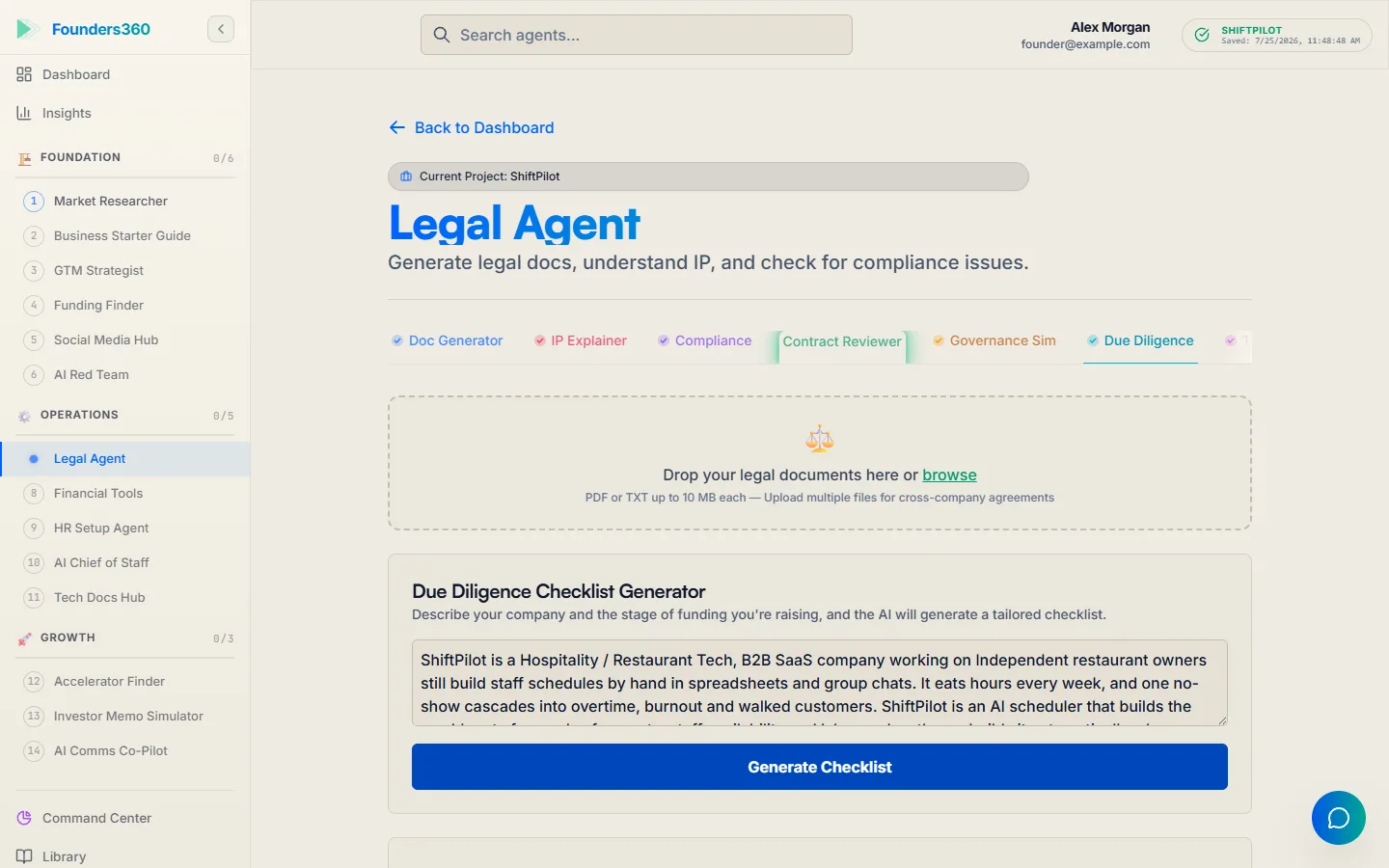
Founders miss the date because it is buried in a stack of incorporation tasks. The Legal agent inside Founders360 is a place to work through your incorporation and equity paperwork, and it works from your company details held in Shared Context. Use it to prepare your questions, then confirm the 83(b) step and its date with a tax professional. It is a planning aid and does not replace one.
Before you issue shares, the startup legal documents cost guide compares law firm and AI routes, and how to incorporate a startup without a lawyer covers the order of operations. Try the Legal agent free at https://www.founders360.world.
Frequently Asked Questions
What is an 83(b) election in simple terms?
It is a choice to pay tax on your restricted stock at its value when you receive it, not as it vests. If the stock is worth very little at grant, the tax at that point is usually zero or close to it.
Can I file an 83(b) election after 30 days?
No. The statute sets a 30-day limit from the transfer date, and law firm summaries of the current IRS process state that late elections are not accepted. If you missed it, talk to a tax professional about your options.
Do I need an 83(b) election if I have stock options?
Generally no, because a standard option is not a transfer of property. The election matters when you receive or buy restricted shares, including shares bought through an early exercise, so ask an adviser about your specific plan.
Do I send the 83(b) election to the company too?
Yes. The regulation and Form 15620 require the person making the election to give a copy to the company. You do not need to attach a copy to your tax return, a requirement removed in 2016. Keep the IRS confirmation or proof of mailing together with the signed form.
Can I cancel an 83(b) election?
Only with IRS consent, and consent is limited to a mistake of fact about the transaction, requested within 60 days of discovering it. A drop in the value of the shares is not a reason.
Tags
Related Articles
How to Set Up a Business in Dubai in 2026: Free Zone vs Mainland
To set up a business in Dubai, you choose an activity, pick a free zone or mainland route, register a trade name, win initial approval, get the licence, then handle visas and a bank account. This guide compares the two routes and covers corporate tax and timelines.
7 min readGuidesHow to Write a Business Plan for a Startup (2026 Template)
To write a business plan for a startup, pick a format that fits your audience, fill in eight core sections, and keep the whole thing short enough to update. This guide gives a section-by-section template, shows what investors and banks each look for, and explains how to keep the plan alive.
7 min readGuidesCap Table Template for Startups: How to Build and Read One
A cap table template is a spreadsheet that lists every holder of your company, what they own and how much that is after dilution. This guide gives you the columns, a worked example with checked arithmetic, and the point at which a spreadsheet stops being enough.
6 min readReady to Build Smarter?
Join thousands of solopreneurs using AI agents to scale their businesses.
Get Started Free