
An AI Chief of Staff for Solo Founders: What It Should Actually Do
An AI chief of staff for a solo founder does four jobs: it remembers everything the company has decided, turns that memory into a weekly plan, prepares each meeting and pushes back on the founder. Without a shared memory it is a chat window with a calendar.
By Founders360 Team
An AI chief of staff for a solo founder should do four things: remember every decision the company has made, turn that memory into a weekly plan, prepare the founder for each meeting, and push back when the plan and the evidence disagree. It should not send email, spend money or post anything on its own. A solo founder has no co-founder to hold the thread, so the value of the role is the thread, not the chat.
This article is for the founder running the company alone who has tried using a general chatbot as an operator and found that every Monday starts from zero. We build one of these agents, so we will say what it should do, what it should refuse to do, and how to test whether any product, ours included, actually does it.
What a chief of staff does in a company, and what changes when it is an AI
A human chief of staff is the person who knows what the CEO decided last quarter, why, and what is still open. They run the operating rhythm, prepare the materials, and tell the CEO the thing nobody else will. Their power is context: they sit in every meeting and read every document.
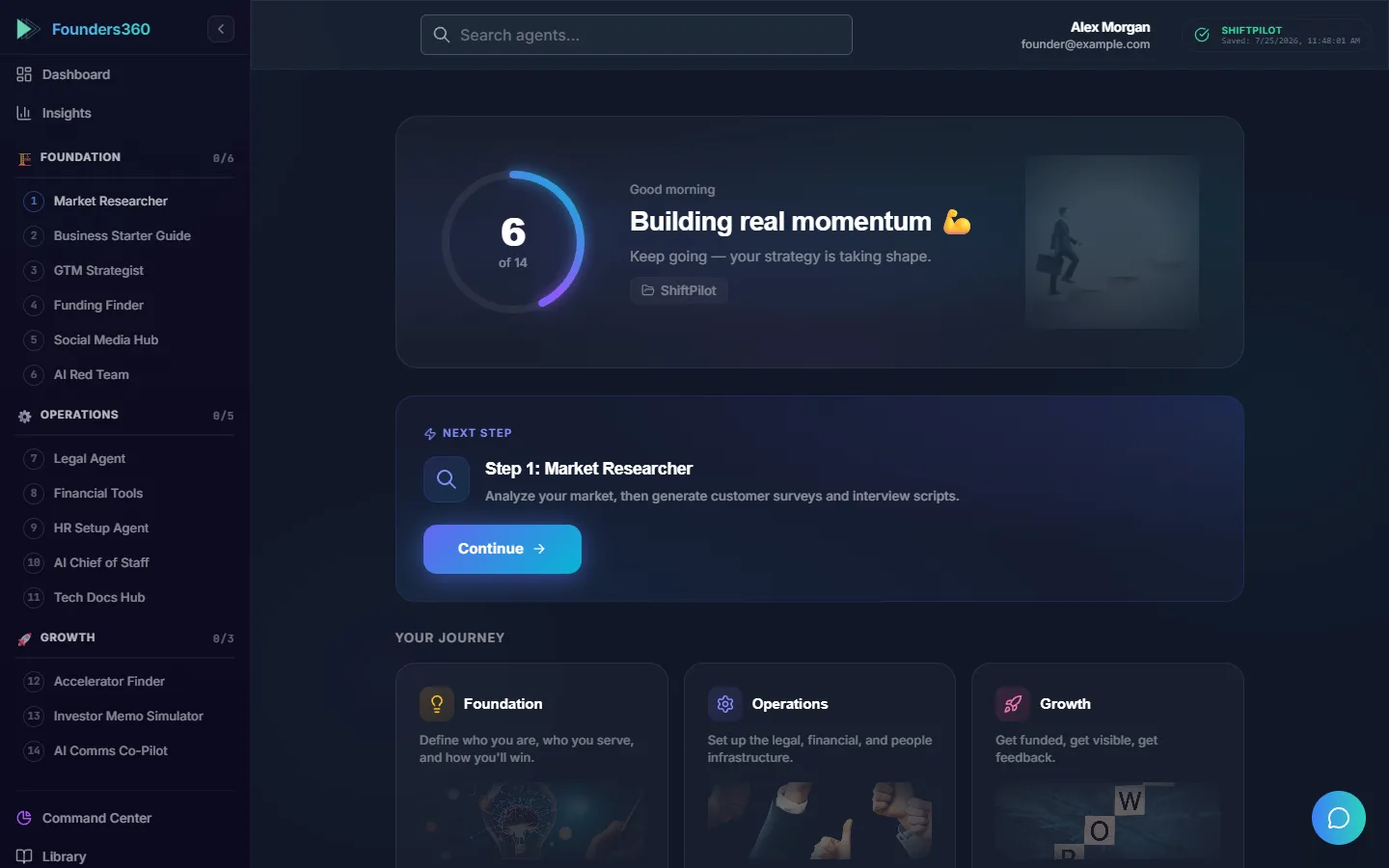
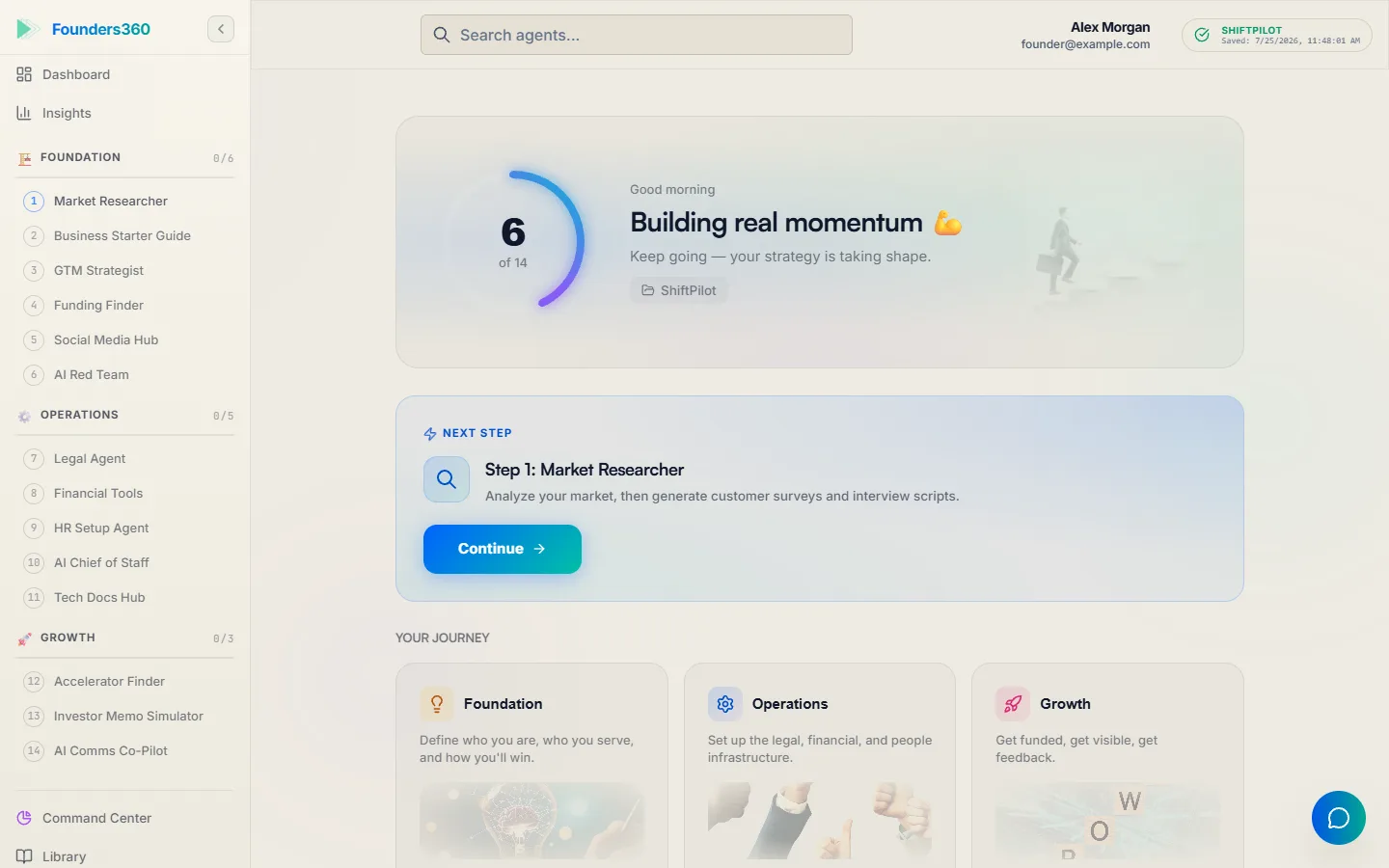
An AI version keeps the same job description and changes one thing: the context has to be built deliberately. A human absorbs it by being in the room. A model only knows what is in its prompt, so the memory is the product, and the quality of an AI chief of staff is the quality of what it can read. On Founders360 the Chief of Staff reads Shared Context, the per-company store that every other agent writes into: the market size from the Market Researcher, the runway from the Financial Tools agent, the open legal items, the pitch deck the Funding Finder built. It plans the week from those facts, not from whatever the founder happened to type that morning.
Job one: remember every decision without being told twice
The first job is memory, and the failure mode is silent. A chatbot forgets when the window closes. A worse failure is a system that claims to remember and does not, because the founder trusts the plan it produces.
We shipped that failure ourselves. Our HR agent's write-back into Shared Context was broken for the entire life of the feature by one wrong dictionary key: the code looked for hr where every caller sent hr-agent. A key that matches nothing does not raise, log or fail a request, so the agent ran, the founder got an answer, and nothing was stored. The allowlist read like coverage. The fix was a test asserting every key is an id the system actually dispatches, plus a health command that reports attempted-versus-produced facts per agent. The lesson for any founder evaluating a memory-based tool: ask it what it knows about your company and check the answer against something you can verify. If it cannot state your market size and where that number came from, it is not remembering.
Job two: turn the memory into a weekly plan with three priorities
The second job is prioritization, and the output should be short: three priorities for the week, each tied to a fact in the memory and a reason it matters now. A list of twenty tasks is a to-do app, not an operator.
The plan should be argued from evidence. If runway is nine months and the raise takes six, fundraising preparation is priority one whether the founder feels like it or not. If the Market Researcher wrote a competitor into the store last week, the plan should name it. Our own Chief of Staff drafts the week from Shared Context and writes the plan back, so the following Monday it can say which of last week's three priorities moved. A founder who wants the full operating rhythm this sits inside can read our weekly operating cadence for early-stage founders.
Job three: prepare every meeting from what the company already knows
The third job is preparation. Before an investor call, a customer discovery interview or a conversation with a lawyer, the chief of staff should produce a one-page brief: who the person is, what the company wants from the meeting, the three facts most likely to come up, and the one question the founder should be ready to answer.
This is where a shared memory earns its keep. The brief for an investor call should carry the TAM the Market Researcher sized, the deck the Funding Finder built, and the weak slide it flagged. On our fictional test company ShiftPilot (an AI scheduling idea for restaurants, invented for testing) the Funding Finder built a 12-slide deck and scored its own work 72 out of 100, calling the revenue slide weak. A chief of staff reading that store prepares the founder for the revenue question before the investor asks it. A chatbot with no store prepares the founder for nothing in particular.
Job four: push back when the plan and the evidence disagree
The fourth job is disagreement, and it is the one most AI products skip because agreeable models get better ratings. A chief of staff that tells the founder every idea is strong is useless in exactly the moment it is needed.
Push-back has to be grounded to be worth anything. On ShiftPilot our AI Red Team's first question named a real incumbent and asked what stops a customer clicking that incumbent's auto-fill button instead. That question was possible only because the Market Researcher had already written the competitor into Shared Context. A chief of staff should do the same at the planning level: if the founder wants to spend the week on a feature and the store says the last three customer interviews asked for something else, the plan should say so. We wrote more about why this matters in why your AI co-founder should argue with you.
What an AI chief of staff must not do on its own
It must not act on the world without a human gate. No sent email, no posted content, no payment, no autonomous outreach. The reason is not caution for its own sake; it is that a solo founder has nobody else watching.
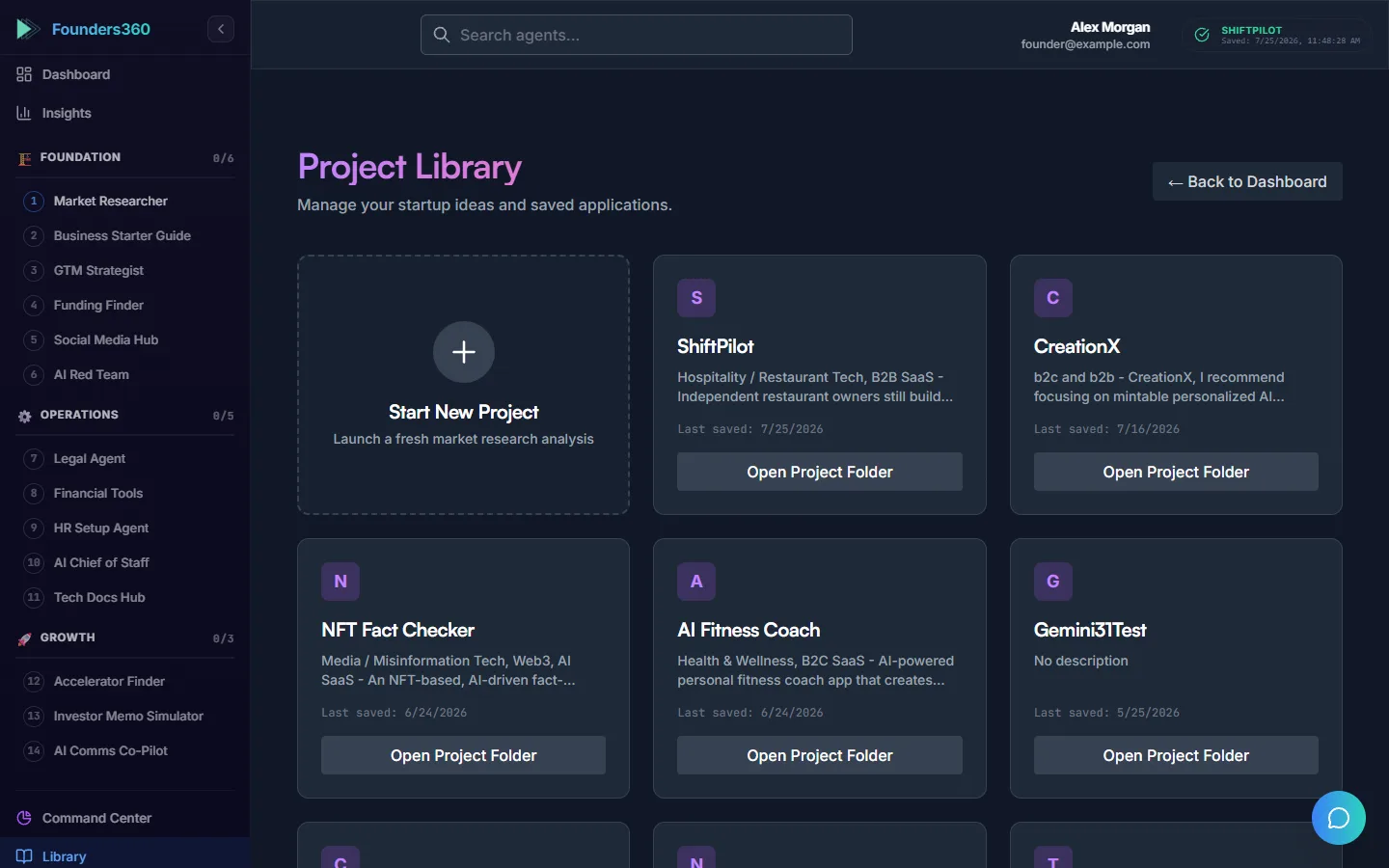
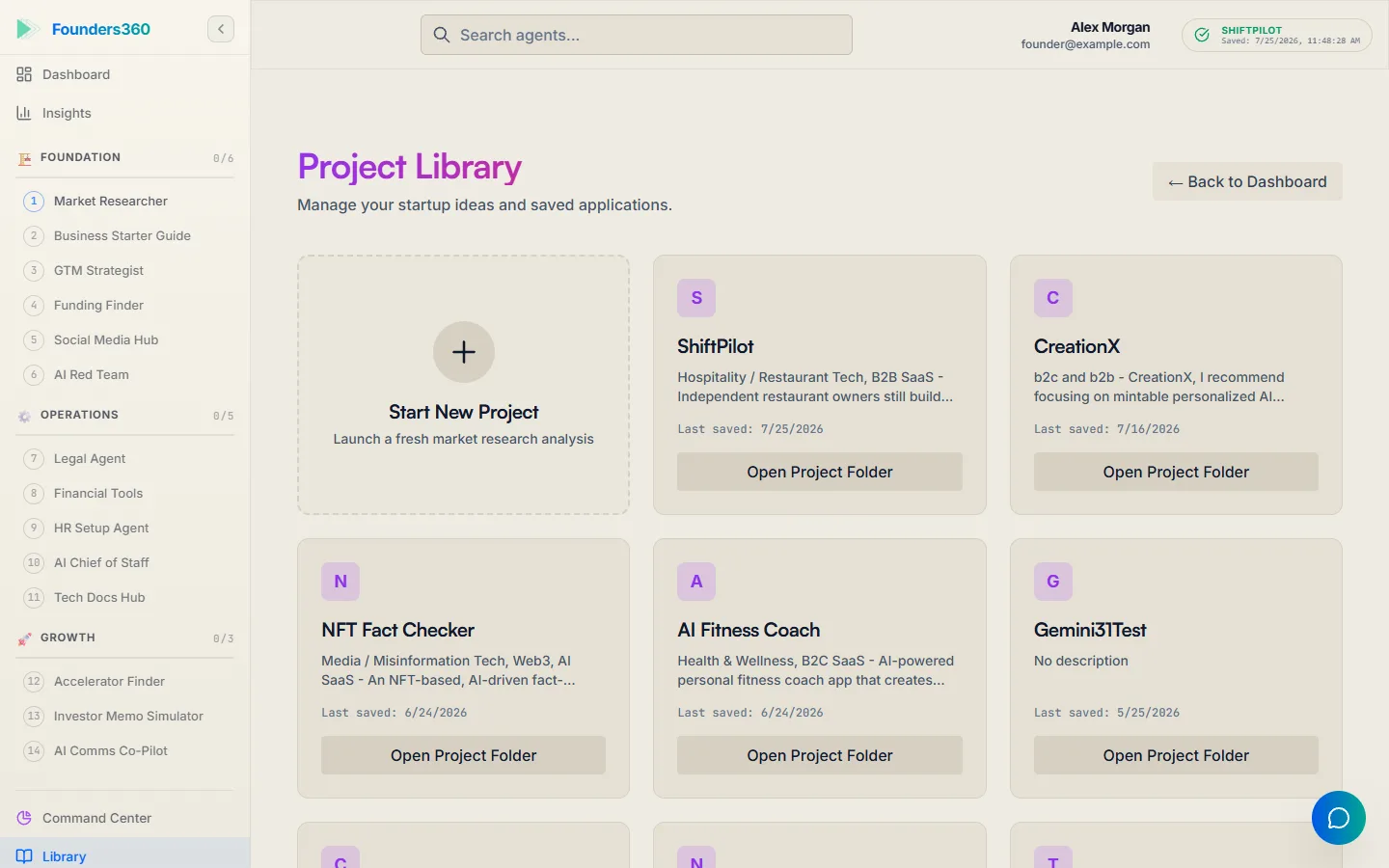
We learned the cost of a missing gate on our outbound email program. The sending runs on a separate cron service with its own environment variables. We set the "require human approval" flag on the API service instead. It looked like it worked, and the cron sent a cold email to a program director who was supposed to be reviewed first. The rule we took from it: a kill switch must live on the process that acts, and you verify by reading it back from there. Our Chief of Staff drafts, plans and prepares. It does not send. The Command Center, the dashboard a founder sees on login, shows what every agent produced and what is waiting on a decision, so the founder stays the one who acts. Our guide to using AI as a co-founder covers where that line sits for the other agents.
How to test any AI chief of staff in one week
Run four tests before trusting one. Each takes an afternoon and none needs a technical background.
| Test | What to do | Pass condition | |---|---|---| | Memory | Enter three facts on Monday, ask on Thursday | All three come back with their source | | Second turn | Ask a question that makes it look something up, then ask a follow-up | The follow-up works | | Plan | Ask for the week with a known runway and a known deadline | The deadline drives priority one | | Push-back | Propose a plan that contradicts a stored fact | It names the contradiction |
The second-turn test comes from our own lead chatbot, which captured zero leads for seven weeks. Every conversation that called a tool failed on the very next turn, because we sent the tool result back on a role the model API does not accept, and pricing questions always called a tool. The highest-intent question a visitor asks was the broken path. Test the turn after the lookup, and re-baseline before drawing a conclusion from any number a tool reports about itself.
Run those four tests this week on whatever you use now. The Chief of Staff and Command Center are on the full agent list, and the Command Center is free forever alongside the Market Researcher, GTM Strategist and Business Guide, so the memory has something to read before you pay anything. For the wider category of tools that try to be the operating layer of a company, our startup operating system roundup sets out what to compare.
Frequently Asked Questions
What does an AI chief of staff do for a solo founder?
It holds the company memory, turns it into a weekly plan of three priorities, prepares a one-page brief before each meeting, and pushes back when the founder's plan contradicts the evidence. It does not send, spend or post on its own.
Is an AI chief of staff the same as a chatbot with a calendar?
No. A chatbot answers the question in front of it and forgets when the window closes. A chief of staff reads a persistent memory of everything the company has decided, so its plan on Monday reflects what the Market Researcher, the financial model and the last customer interview said.
How is the Founders360 Chief of Staff different from the Command Center?
The Command Center is the dashboard: it shows what every agent has produced and what is waiting on the founder. The Chief of Staff is the operator: it reads Shared Context, drafts the weekly plan and meeting briefs, and writes them back so the next week can measure the last one.
Should an AI chief of staff send email or post on my behalf?
Not without a human approval step. A solo founder has nobody else watching the outbox. Our own outbound program once sent a cold email that was meant to be reviewed because an approval flag was set on the wrong service; the safeguard belongs on the process that acts.
How do I know whether an AI tool is really remembering my company?
Ask it to state a fact you entered last week and where the fact came from. If it cannot, the memory is not working, and a broken memory is silent: our HR agent wrote nothing into Shared Context for months because one dictionary key was wrong, and no request ever failed.
Tags
Related Articles
Human-in-the-Loop AI Governance for Startups: Where Autonomy Should Stop
Human-in-the-loop AI governance means deciding, action by action, what an AI agent may do on its own and what needs a person. Draw the line at the action, not the model, and put four guards behind every autonomous action: a kill switch that defaults to off, a daily cap, an idempotency key and a heartbeat.
8 min readAI Deep DivesWhat Is Shared Context in AI Agents? One Memory Instead of Fifteen Chatbots
Shared context in AI agents is a single per-company memory that every agent writes to and every later agent reads from, so a market size found by one agent lands on the pitch deck built by another without being retyped. It is what separates one system from fifteen chatbots.
9 min readAI Deep DivesThe Shift from Point-Solution SaaS to Multi-Agent AI Architectures
Multi-agent AI architecture replaces per-seat process-mediation SaaS with execution layers that share one context store, validate every tool call and route work to the cheapest capable model. Here is what it cost us to build one.
9 min readReady to Build Smarter?
Join thousands of solopreneurs using AI agents to scale their businesses.
Get Started Free