
The Weekly Operating Cadence for Early-Stage Founders
The weekly operating cadence for early-stage founders is a Monday plan with one metric and three outcomes, protected build and customer blocks from Tuesday to Thursday, a written Friday review, and a monthly layer that checks runway and runs a pre-mortem.
By Founders360 Team
The weekly operating cadence for early-stage founders is four fixed points: a Monday plan that names one metric and three outcomes, protected build and customer blocks from Tuesday to Thursday, a written review on Friday, and a monthly layer that checks runway and runs a pre-mortem. Everything else in the week is flexible. The cadence exists because an early-stage company has no manager, no board meeting and no sprint review to force the question "did this week move anything?", so the founder has to build that force themselves.
We run a version of this cadence ourselves, and where one of our agents holds part of it we say which one and what it writes into Shared Context, because that is the part you can verify.
Why an early-stage founder needs a cadence before a team
A cadence replaces the accountability that a team would otherwise provide. A solo founder or a two-person company has nobody waiting on their output, so a week can pass in reactive work (support replies, tool setup, an investor who wanted a call) with nothing shipped and nothing learned. The cadence does not add work. It adds a fixed moment where the founder must state what the week was for and, five days later, whether it happened.
Three failure modes show up without one. The first is motion instead of progress: a full calendar and no change in the one number that matters. The second is the unmeasured week: something shipped, but nobody checked whether it worked, so the next decision is made on a feeling. The third is the forgotten decision: a choice made on Tuesday is re-litigated the following Tuesday because nobody wrote it down.
We learned the second one from our own product. Our public lead chatbot captured zero leads for seven weeks, and the number sat in a dashboard the whole time. It was not disinterest: every conversation that called a tool failed on the very next turn, and pricing questions always called a tool, so the highest-intent question a visitor asks was the broken path. A weekly review that asked "why is this number zero?" in week two would have found it. Re-baseline before drawing a conclusion from any number, and check the number every week, not when it is convenient.
Monday: one metric and three outcomes
Monday morning produces a one-page plan with one metric and no more than three outcomes, in under an hour. The metric is the single number that says whether the company is working right now: interviews completed, activated users, paying customers, weekly revenue. It changes as the stage changes, but it is one number at a time. An outcome is a state of the world at the end of the week, not a task: "five restaurant managers used the scheduler on a real week" is an outcome; "work on the scheduler" is not.
The discipline is in what gets left off. Everything that is not one of the three outcomes goes on a parking list, and the founder is allowed to feel bad about it on Friday, not on Wednesday. If the three outcomes do not plausibly move the metric, the outcomes are wrong.
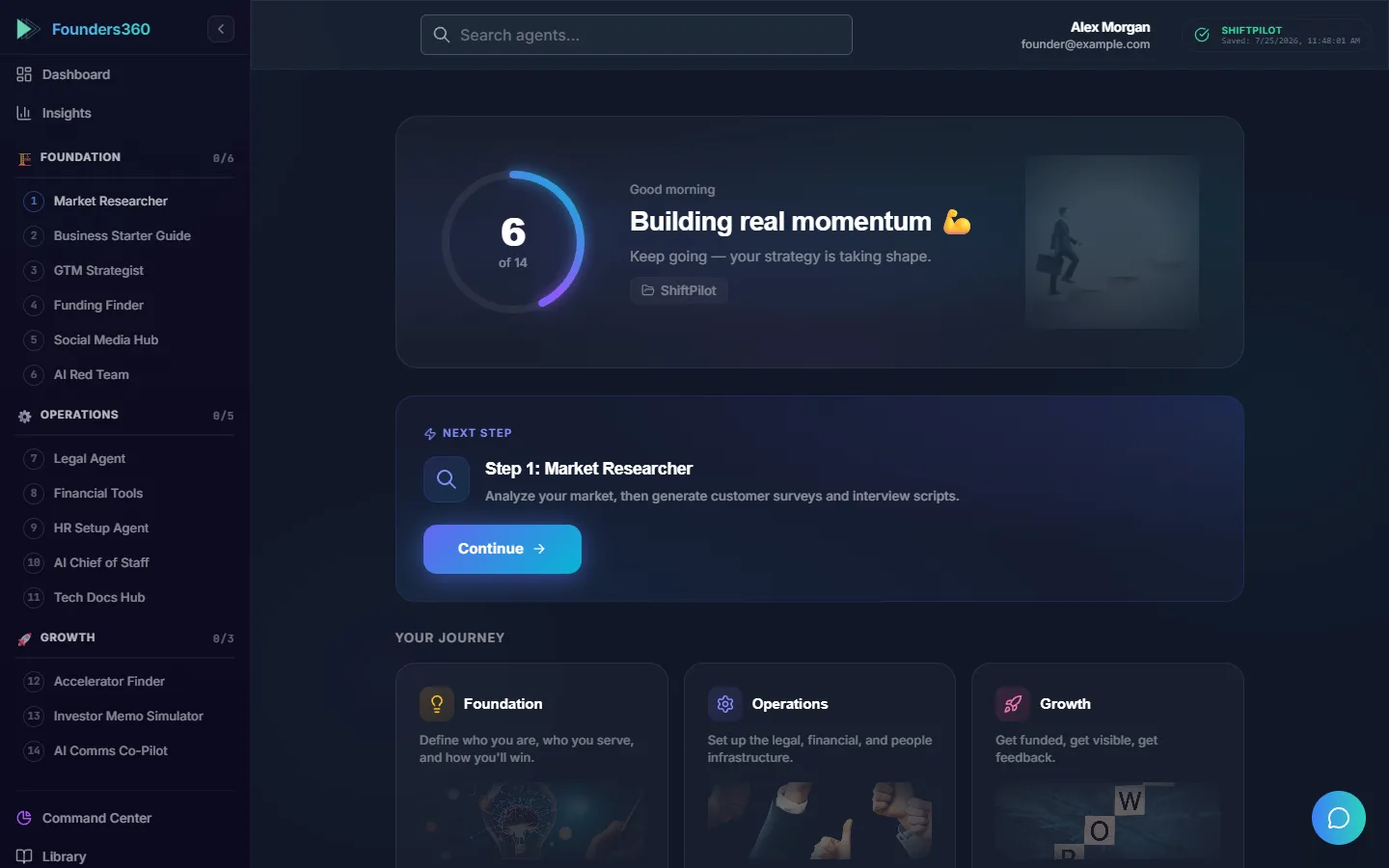
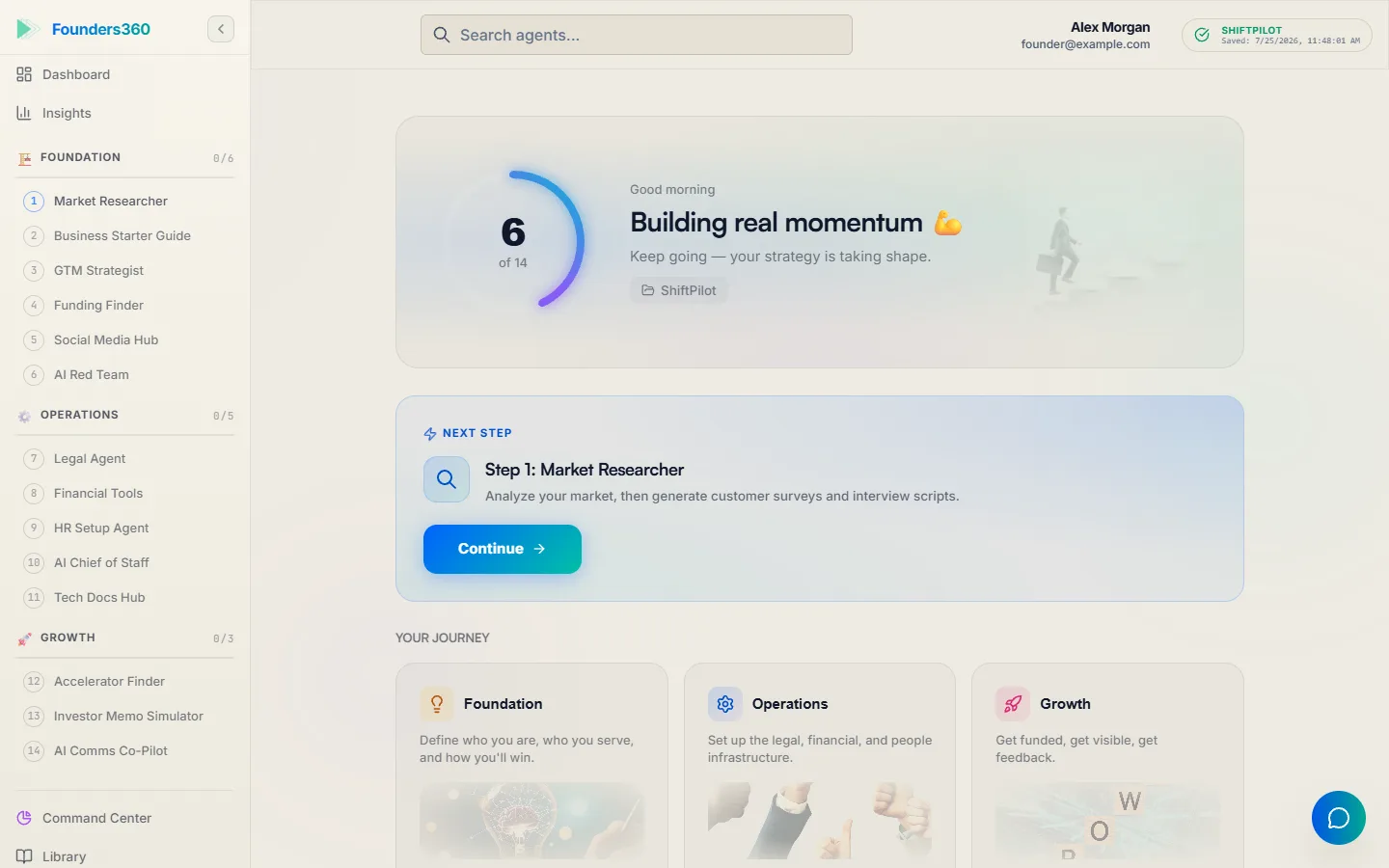
In Founders360 the Chief of Staff agent drafts this plan from what the rest of the suite has already written into Shared Context: the customer profile the Market Researcher recorded, the go-to-market plan the GTM Strategist produced, the open items from last week's review. It proposes the metric and outcomes; the founder edits them. The point is that the plan starts from the company's actual facts, not from a blank document on a Monday morning.
Tuesday to Thursday: protected build blocks and customer conversations
Tuesday to Thursday are the productive days, and the rule that protects them is that the first four hours of each are for the outcomes and nothing else. No email, no tool setup, no calls. Customer conversations, which are the other non-negotiable, go in the afternoon block, at least three per week at any stage before product-market fit. A founder who cannot name three customers they spoke to this week does not have a customer problem; they have a calendar problem.
Two habits keep these days honest:
- Ship to a real URL every day. A change that exists only on a laptop has not happened. Deploying daily also surfaces the problems (a broken migration, a missing environment variable) on the day they are cheap.
- Write down every decision in one place. A single running document, dated, with the decision and the reason. This is what prevents the forgotten-decision failure mode, and it becomes the source for Friday's review and for the first hire's onboarding.
For the customer conversations, use the same script every week so the answers compare across weeks. Our guide on running repeatable customer discovery as a technical founder has one. In Founders360 the notes from those conversations belong in Shared Context, where the GTM Strategist and the Funding Finder both read them: a pattern in the objections becomes a positioning change, and a quote from a customer becomes a line on the traction slide.
Friday: the written review and the update
Friday afternoon produces a short written review: the metric's value against last week, which of the three outcomes happened, what was learned, and the three outcomes proposed for next week. Written, not thought, because a written review can be re-read in a month, and because the act of writing "outcome two did not happen because I spent Wednesday on a logo" is the accountability the cadence exists to provide.
The review is also the raw material for the investor or advisor update. The best cadence for that update is monthly, in the same format every time, and a founder who has four Friday reviews already has the update mostly written. Our investor update email template gives the format; the Comms Co-Pilot in Founders360 drafts it from the reviews and the facts in Shared Context, so the numbers in the update are the numbers the other agents have been working from all month.
One rule we apply to every automated process, and it applies to a founder's own review: never trust "it fired." Our scheduled jobs write a heartbeat row every run, because cloud routines here have fired and done nothing, and a job that ran but produced nothing looks identical to a job that ran well unless something records the outcome. A Friday review that says "shipped the onboarding flow" without the number of users who completed it is a heartbeat without an outcome. Record both.
The monthly layer: runway, hiring and the pre-mortem
Once a month, on the last Friday, the review expands to three questions the weekly one does not ask. How many months of runway are left, recalculated from the actual bank balance and the actual burn, not the model from three months ago; our startup runway and burn rate guide has the arithmetic. Is there a hire that would move the metric more than my own next month would, answered honestly and usually with a no. And what would make this company fail in the next ninety days, answered as a pre-mortem, with the top cause fixed before the next monthly review.
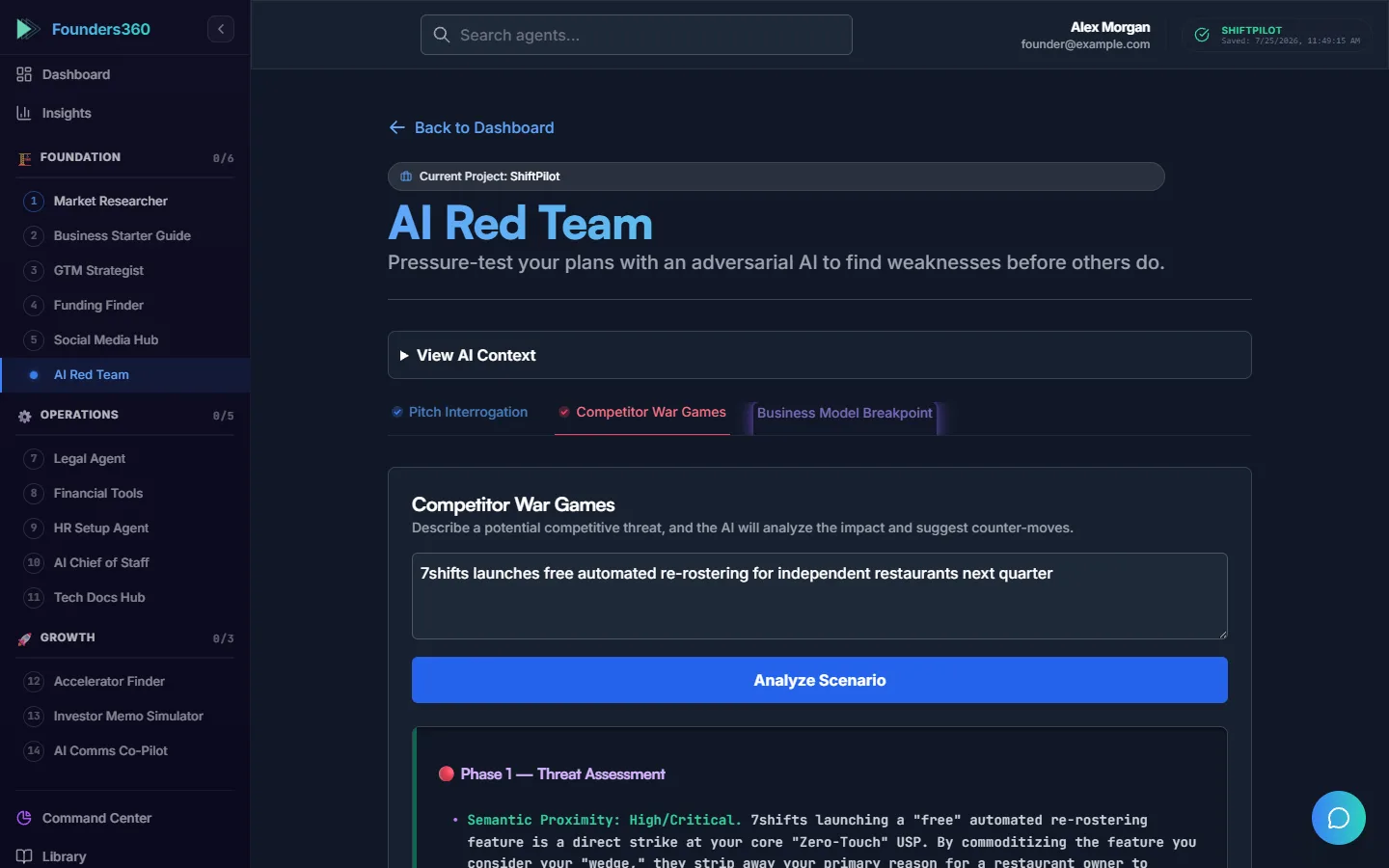
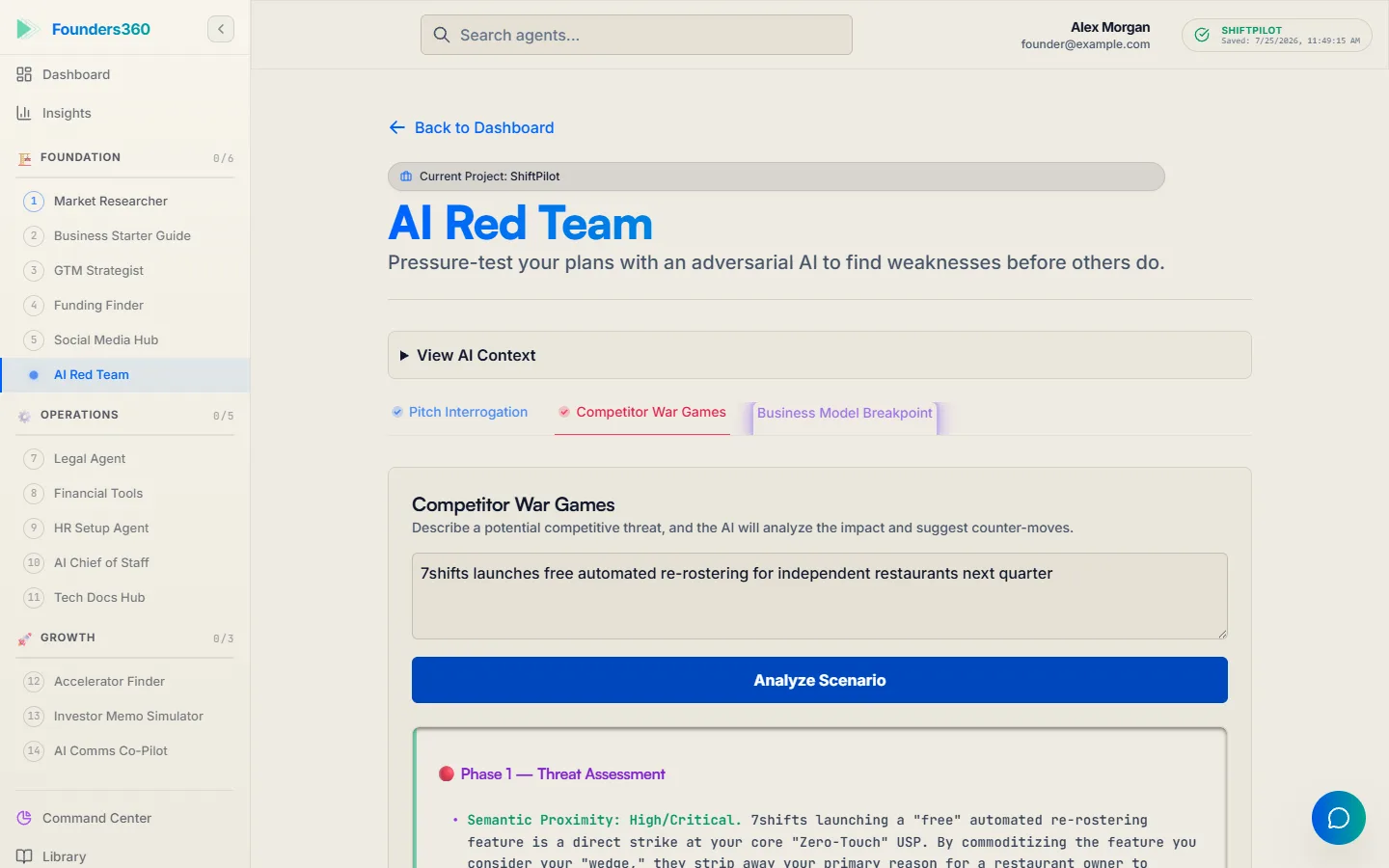
The pre-mortem is the question founders skip, because it is uncomfortable and nobody is asking. The AI Red Team in Founders360 asks it adversarially. On a fictional test company we use internally (ShiftPilot, an AI scheduling idea for restaurants), its first question named a real incumbent and asked what stops customers clicking that incumbent's auto-fill button instead. That is the question a monthly review should surface, and it is cheaper to answer in month two than in month eight. We wrote up the method in how to run a startup pre-mortem before you build.
What an AI chief of staff does in this cadence
An AI chief of staff holds the cadence when the founder does not, which is the only version of the role that is worth paying for. It drafts the Monday plan from the company's facts, tracks the three outcomes through the week, assembles the Friday review from what was shipped and what the metric did, and flags the monthly questions when the last Friday arrives. It does not decide; the founder decides. It makes sure the questions get asked on schedule.
The reason this works in Founders360 and does not work with a general chatbot is memory. The Chief of Staff reads the same Shared Context every other agent writes to, so it knows the market size the Market Researcher recorded, the pricing the Financial Tools agent modelled and the objections the customer conversations produced. The Command Center is where the founder can see all of it in one place, which is the check we recommend: if a fact is not on that screen, no agent will use it, and the plan will start from a blank page. We describe the role in more detail in an AI chief of staff for solo founders; the Command Center is free forever, and all fifteen agents are on the agents page.
A last lesson from our own engineering about cadences and automation: the outputs of a routine should be counted, not assumed. We learned it the hard way when an agent's write-back into Shared Context was broken for the life of the feature by one wrong dictionary key. Nothing raised, nothing logged, and the coverage list read as if it worked. The fix was a health check that reports attempted-versus-produced per agent. Your Friday review is that health check for the company.
Frequently Asked Questions
How long should the weekly planning and review take?
Under an hour on Monday and under an hour on Friday. If the plan takes longer, there are too many outcomes. If the review takes longer, the week was not measured as it went, and the review is doing the measuring after the fact.
What should the one metric be at the pre-product stage?
Customer conversations completed, or people who recognised the problem without prompting. Before there is a product, the only progress is learning, and the metric should count it. Once there is a product, it becomes activated users, then paying customers, then revenue.
Should a solo founder really write a weekly review nobody reads?
Yes. The founder reads it, in a month, when a decision needs its history, and again when writing the investor update or onboarding the first hire. A review that exists only in memory is re-litigated; a written one is settled.
How do I protect the build blocks from customers and investors?
By putting the customer conversations in a fixed afternoon block and treating investor calls as outcomes that must earn one of the three slots. A founder raising a round has "advance the raise" as an outcome for those weeks; a founder not raising does not take the call that week.
Does the cadence change after the first hire?
The shape stays and the plan gains a line per person. The Monday plan becomes a fifteen-minute meeting, the three outcomes are shared, and the Friday review is written by the founder with a paragraph from each person. The monthly layer adds a one-to-one.
This week: run one Monday and one Friday
Do not redesign your week. On Monday, write one metric and three outcomes on a single page and put everything else on a parking list. On Friday, write four lines: the metric against last week, which outcomes happened, what you learned, next week's three. If the two documents disagree about what the week was for, you have found the first thing the cadence was going to teach you.
Tags
Related Articles
How to Run a Startup Pre-Mortem Before You Build
A startup pre-mortem is a 90-minute session that assumes the company has already failed eighteen months from now and asks everyone to write down why. Ranked by likelihood, cost and how late you would notice, the causes become the tests you run before writing code.
9 min readPlaybooksRejected by Y Combinator? What to Do in the Next 90 Days
A Y Combinator rejection is a data point about fit on one day, not a verdict on the company. This 90-day playbook covers what the rejection does and does not tell you, how to stress-test the pitch against an adversary, how to build the traction the application lacked, and how to line up other funding.
8 min readPlaybooksInvestor Update Email Template and the Cadence That Keeps Investors Warm
An investor update email is a short monthly note with the same five numbers every time, one clear ask, and an honest lowlights section. The template below is copyable; the cadence is what makes it work.
8 min readReady to Build Smarter?
Join thousands of solopreneurs using AI agents to scale their businesses.
Get Started Free