
Build in Public: A Social Media Strategy for Early-Stage Founders
A build in public strategy for early-stage founders is a weekday pillar rotation, one real number a week, AI-drafted posts that a human approves, and a durable link in every post. Here is the system we run on our own accounts and what broke when we ran it.
By Founders360 Team
A build in public strategy for early-stage founders is a fixed rotation of topics by weekday, one real number shared every week, posts drafted by AI and approved by a human, and a durable link in every post. That system produces a post a day without the founder writing a post a day, which is the only version of building in public that survives contact with an actual startup.
We run exactly this on our own accounts across X, LinkedIn, Instagram and Facebook, and most of what follows is what we learned by shipping it, including the post that went live with the formatting asterisks still visible. The lessons are ours; the plan works for any founder with a product and a weekday calendar.
Why building in public works for an early-stage founder
Building in public works because an early-stage founder has no track record, and a visible record of decisions is the substitute. A buyer, an investor or a future hire cannot check your revenue, but they can read three months of posts and see how you think, what you shipped, and whether you tell the truth when a number is bad.
It also solves the content problem that kills most founder accounts: nothing to say. A company that is being built generates material every day. The trick is to stop treating each post as a creative act and start treating it as a report from a system that already exists. The founders who sustain it are the ones who decided what to post on Tuesdays in advance.
Pick seven pillars and rotate them by weekday
Assign one theme to each weekday and never decide what to post in the morning. Our rotation, which any founder can adapt, is: Monday funding, Tuesday how the product connects two things, Wednesday a founder pain point, Thursday a tough investor question, Friday something for institutional buyers, Saturday a repost of a long-form article, Sunday build in public with a real aggregate number.
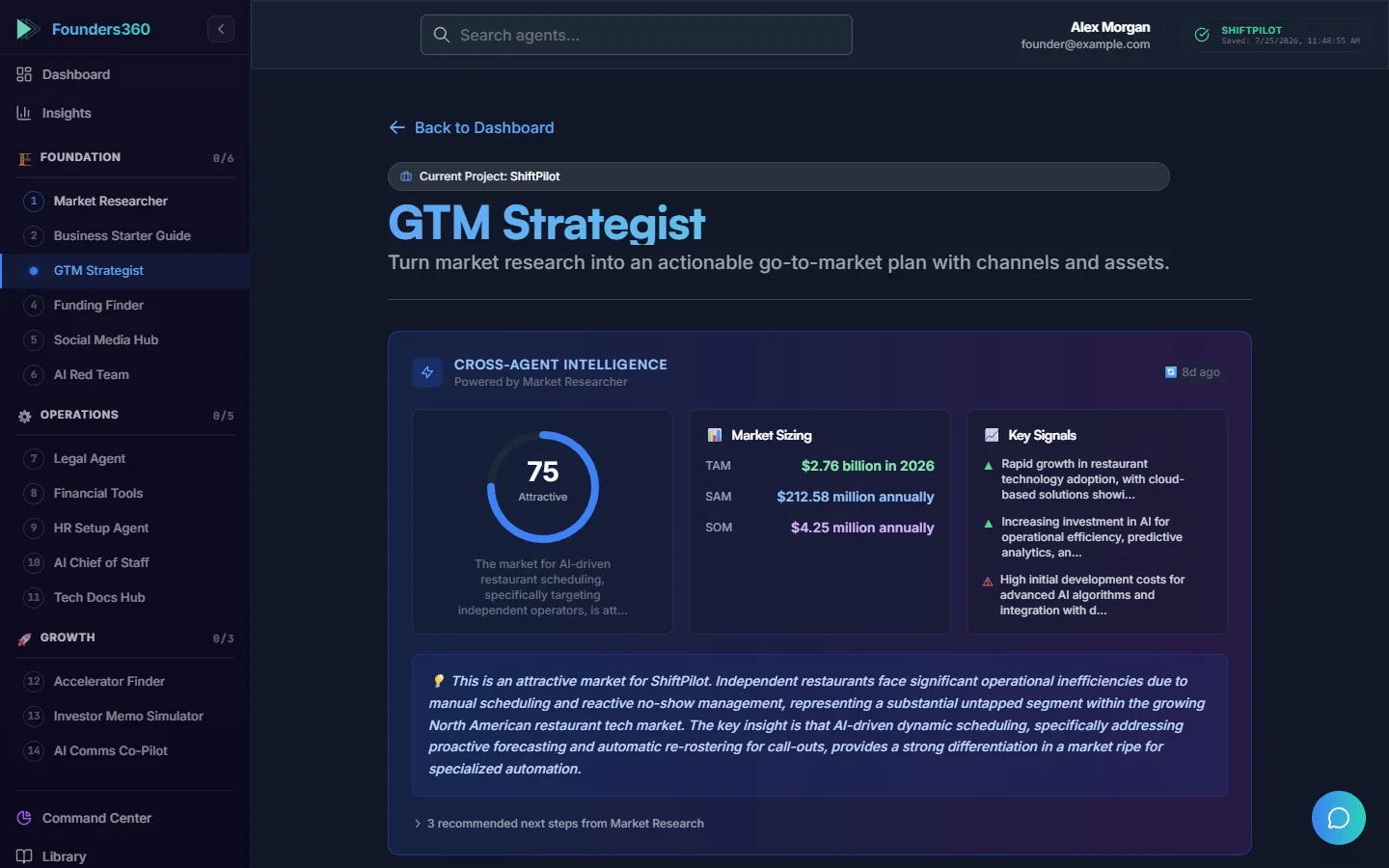
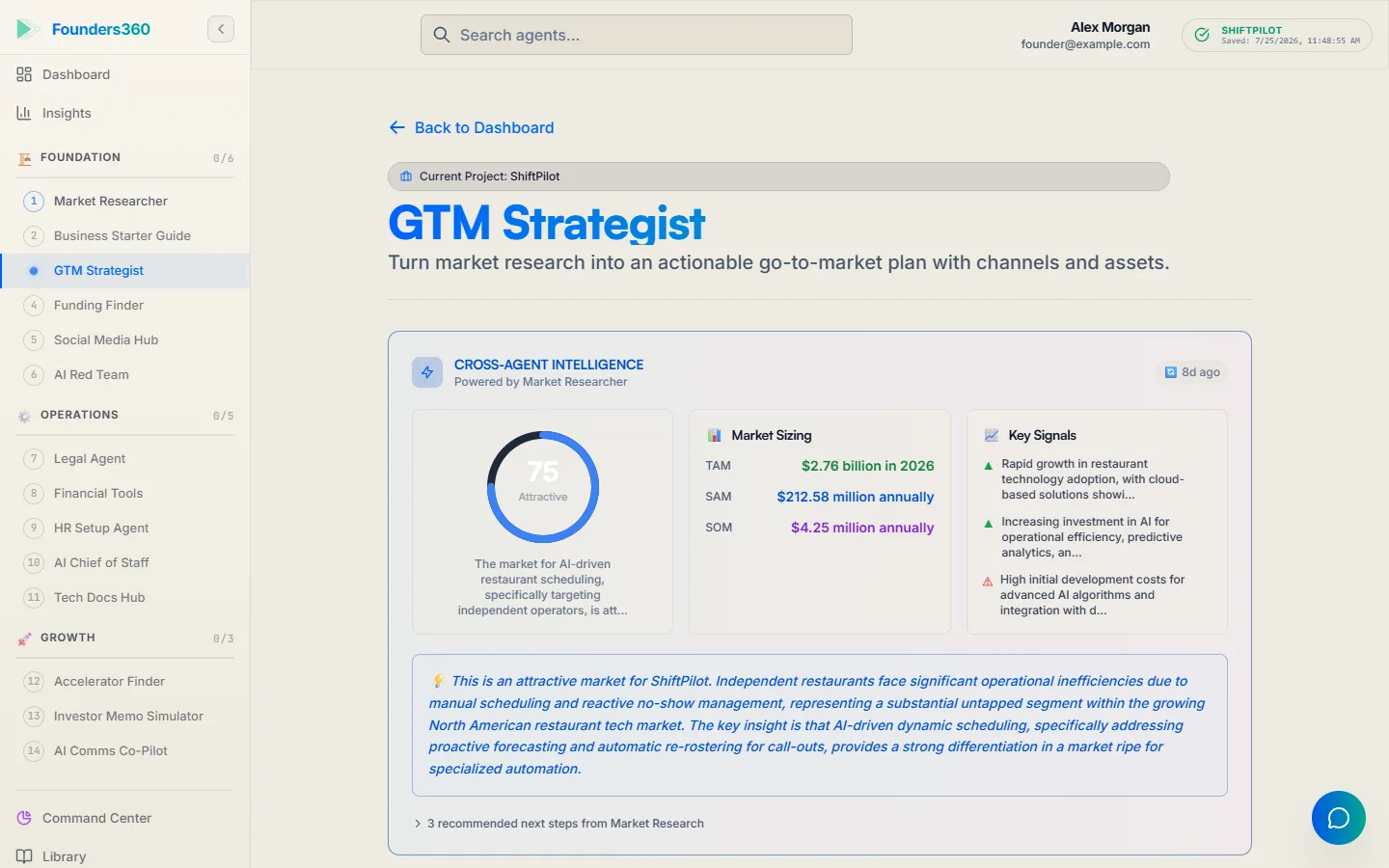
The rotation does two things. It guarantees variety across a week so a follower never sees three fundraising posts in a row, and it makes the visual identity predictable: our cards alternate a navy theme and a cream theme on adjacent days so the Instagram grid reads as one brand. The themes should map to what your company actually knows. Our Thursday pillar exists because the Skeptical VC, our free AI investor, generates hard questions every day and each one is a post. If your GTM Strategist has already written your channels and ideal customer into Shared Context, Wednesday's pain point comes from that record rather than from imagination.
Share one real number every week, not a highlight reel
The Sunday post is one aggregate figure from the live system, and it is the post that builds the most trust because it is the hardest to fake. Total agent runs this month. Facts written into the company memory. Signups, if you are willing to share them, including the weeks they are flat.
Two rules make this work. The number must be real and pulled from the source, never typed from memory; ours comes from the production database at generation time, and a fallback fills it from the live figure if the model leaves it out. And it must stand alone on the card: a single number padded into a four-slide carousel is filler wearing a format. We learned to keep the rest of the week's pillars on carousels and Sunday on a stat card for that reason. If you want an example of an honest number, we have said publicly that the deepest single-founder engagement we have seen is 128 agent runs in one week by one person. That fact is true and far more useful to a reader than a growth curve.
Draft with AI, approve with a human, and never let the drafter post
The generator writes; it has no way to post. That separation is the single most important design decision in the system, and it costs nothing to copy.
Our daily job drafts the next three days of posts for four platforms in one model call per day. A second model, the reviewer, scores each draft out of 100, with 40 of those points on whether every claim traces to a fact that was injected into the prompt; a quoted problem is discarded unless that text is really in the copy, because the first live run invented a contraction that was not there. Anything below 80 is rejected but still stored and still reaches the review sheet, flagged, because a post that vanished would look identical to a broken generator. A score of 90 or more skips the human tap; everything else waits for an approve or a request-changes from a phone, with at most three revisions.
Only an approved row is eligible for publishing, and the publisher is a separate module behind four guards: a kill switch that defaults to off, a daily cap per platform, an idempotency key using the platform's own returned post id, and a heartbeat row per run so a job that fired and did nothing is visible. We took the same guard set from our outbound email program, where we once set the approval flag on the wrong service and a cold email went out unreviewed. A founder using any AI content tool should ask one question: can the thing that writes also press publish? If yes, put a person between them.
Enforce house style in code, because a live post shipped with visible asterisks
Formatting rules must be enforced after generation, not requested in the prompt. We learned this when a live Instagram post carried the line 1. **Choose Your Structure**: with the asterisks visible. No social platform renders markdown, and the model had been asked politely not to use it.
The fix was a style pass that runs on every draft: no contractions, no dashes, and no markdown of any kind, which means asterisks, underscores, backticks, brackets, headings, bullets, HTML tags and table pipes are all stripped. Two details matter if you build your own. Mask URLs before stripping anything, because an underscore in a slug reads as emphasis and a naive strip publishes a dead link. And strip underscores only at word boundaries so a term like snake_case survives. Every string on a card is also cut at a word boundary, because a character slice once shipped "Total Addressable Mar" to Instagram. The pattern generalizes: if a rule can be checked by code, check it by code, and keep the prompt for judgement.
Put a durable link in every post and rotate which one
Every post carries a link to a long-form article, not only the Saturday repost. A post without a destination is a thought; a post with one is a top-of-funnel step, and the article outlives the post by years.
We rotate the linked article by least-recently-linked over a fourteen-day window, so no single guide gets all the traffic and older pieces keep getting surfaced. The article's title and excerpt go into the prompt so the copy leads into it rather than ending with an unexplained URL. On Instagram the link is not clickable, and we print it anyway because it names the destination while the bio can only point at one thing. The link is appended by code after generation, not trusted to the model, and carries no tracking parameters because a human retypes it. This is also where social and search compound: an article that is cited in an AI answer and linked from a daily post gets two kinds of traffic, and our guide to answer engine optimization for startups covers the search half.
Measure by pillar and layout, then feed what worked back into the plan
Track impressions and clicks per post against two columns you set at generation time: the pillar and the card layout. After a month the comparison is the strategy; before a month it is a guess.
We use seven card layouts (a hook cover, a numbered step slide, a payoff slide with a ticked recap, a stat card, a split card showing what one agent found and another used, a quote card for the investor question, and a plain link card) and record which one each post used. That column is what lets us say, after a few weeks, whether Thursday quote cards outperform Tuesday split cards, rather than arguing about it. On Founders360 the Social Media Hub is the agent that drafts posts and writes them into Shared Context, so the GTM Strategist can see what the company has been saying publicly when it plans the next channel. A founder chasing early customers can pair this with our playbook on finding the first ten customers for a B2B startup, because the build in public feed is where those first conversations start.
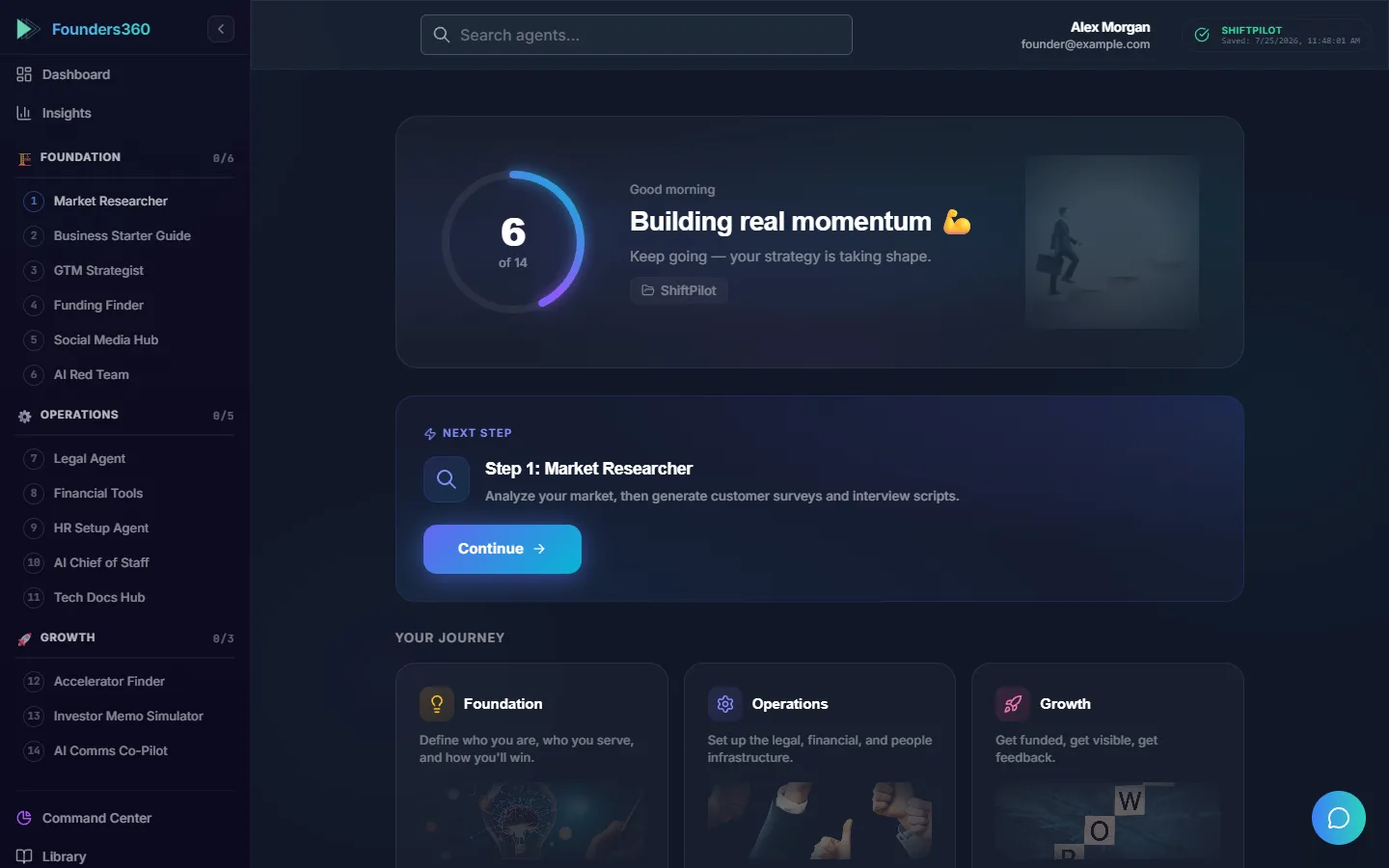
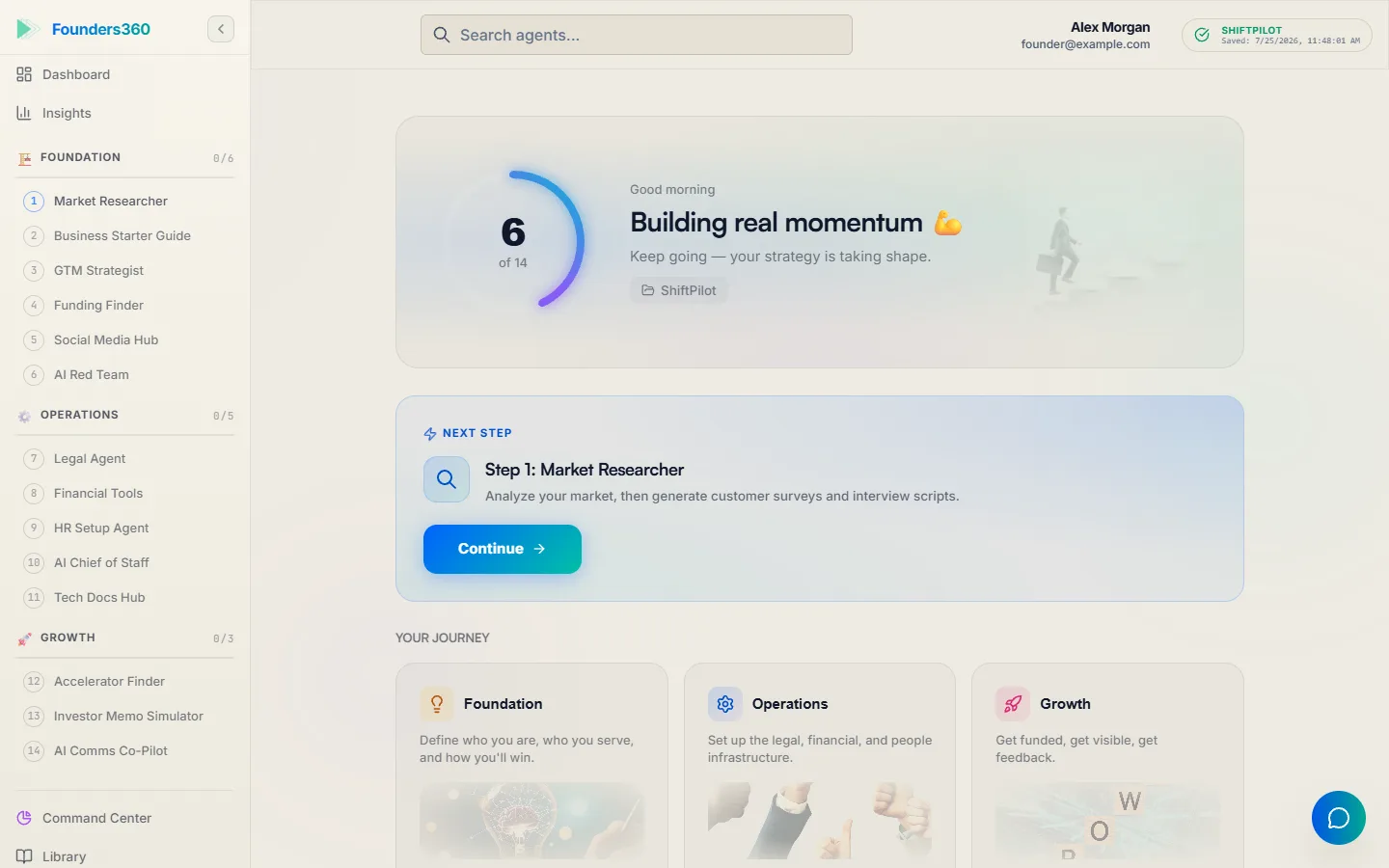
This week: write your seven pillars on one line each, pick the one real number you will share on Sunday and where it comes from, and put a person between whatever drafts your posts and whatever publishes them. The Social Media Hub is on the full agent list if you want the drafting done from your company's own facts.
Frequently Asked Questions
What is a build in public strategy for an early-stage founder?
A fixed weekday rotation of themes, one real number shared every week, posts drafted by AI and approved by a human, and a link to a durable article in every post. The rotation removes the daily decision and the number builds trust that a highlight reel cannot.
How often should a founder post when building in public?
Once a day across the platforms you use, drafted in batches of three days ahead. Daily is sustainable only when the topic for each day is decided in advance and the drafting is automated; a founder writing from scratch every morning stops within a month.
Should I let AI post directly to my social accounts?
No. Keep the thing that writes separate from the thing that publishes, and put a human approval between them. Our own publisher runs behind a kill switch that defaults to off, a daily cap per platform, an idempotency key and a heartbeat, and only an approved post is eligible.
What numbers should a founder share publicly?
One aggregate figure a week pulled from the live system: runs, facts stored, signups, or another metric you would defend to an investor. Share it on the flat weeks too. A number typed from memory or padded into a multi-slide carousel reads as filler.
Why did our AI-generated post show asterisks?
The model wrote markdown bold and the platform rendered it literally. No social platform renders markdown, so formatting rules must be enforced by code after generation: strip markdown, mask URLs first so slugs survive, and cut card text at word boundaries.
Tags
Related Articles
The Weekly Operating Cadence for Early-Stage Founders
The weekly operating cadence for early-stage founders is a Monday plan with one metric and three outcomes, protected build and customer blocks from Tuesday to Thursday, a written Friday review, and a monthly layer that checks runway and runs a pre-mortem.
9 min readPlaybooksHow to Run a Startup Pre-Mortem Before You Build
A startup pre-mortem is a 90-minute session that assumes the company has already failed eighteen months from now and asks everyone to write down why. Ranked by likelihood, cost and how late you would notice, the causes become the tests you run before writing code.
9 min readPlaybooksRejected by Y Combinator? What to Do in the Next 90 Days
A Y Combinator rejection is a data point about fit on one day, not a verdict on the company. This 90-day playbook covers what the rejection does and does not tell you, how to stress-test the pitch against an adversary, how to build the traction the application lacked, and how to line up other funding.
8 min readReady to Build Smarter?
Join thousands of solopreneurs using AI agents to scale their businesses.
Get Started Free