
How to Write a Y Combinator Application That Gets You an Interview
A practical walk through the YC application, from the one-line description to the founder video, based on what Y Combinator itself publishes as of October 2026. Learn what reviewers want, which mistakes cost applicants interviews, and how to rehearse before you submit.
By Founders360 Team
To write a Y Combinator application, answer every question in plain words, lead each answer with the point, state your progress as precise facts, and disclose your weaknesses instead of hiding them. Clarity is the whole game. This guide walks through the application piece by piece, using what YC publishes itself, checked in October 2026.
What does Y Combinator actually ask for in 2026?
YC asks for a written application, a short video of the founders, and, for promising applicants, an interview. The details below come from ycombinator.com as of October 2026, and you should recheck them before you apply because YC changes them.
According to the YC apply page, the Winter 2027 batch runs from January to March in San Francisco. The on-time deadline is November 2 at 8pm PT, and applications submitted by then receive a decision by December 11. Later applications are still considered, but without a promised timeline. YC says most interviews are held by video conference in November and December.
On the standard deal, the YC deal page says YC invests $500,000: $125,000 on a post-money SAFE that converts into 7% of the company, and $375,000 on an uncapped MFN SAFE. YC states it charges no fees to participating companies. According to the YC FAQ, you should submit only one application per batch.
I could not retrieve a current, citable list of the exact application questions, so this guide organizes advice by the topics every YC application covers rather than quoting question text. Open the application itself and read each prompt before you write.
How do you describe your company in one sentence?
Write one plain sentence that says what you make and who it is for. Paul Graham's YC essay on applying says to give the point "right in the first sentence, in the simplest possible terms," and that the best answers are "the most matter of fact."
The test is simple: could a smart stranger repeat your sentence to a friend? Avoid category words such as "platform," "ecosystem" and "AI-powered." Name the user, the job and the result. If it helps, follow the essay's tip to explain your idea as a variant of something the reviewer already knows.
Here is an illustrative before and after. The company is invented.
- Before: "We are a next-generation AI-powered platform leveraging synergies to transform logistics workflows."
- After: "We help small trucking companies get paid by their customers faster by sending and chasing invoices automatically."
The second version names the customer, the action and the benefit. Reviewers read a very large pile of applications, so the version they can understand in five seconds wins.
What are you making, and why now?
Say what the product does today, then give one concrete reason the timing is right. Do not describe a roadmap. Describe what a user can do with it this week.
"Why now" needs a specific change: a regulation, a cost drop, a new technology, a shift in customer behavior. "The market is growing" is not a reason. Pick the one change that made this possible or necessary in the last two years and name it.
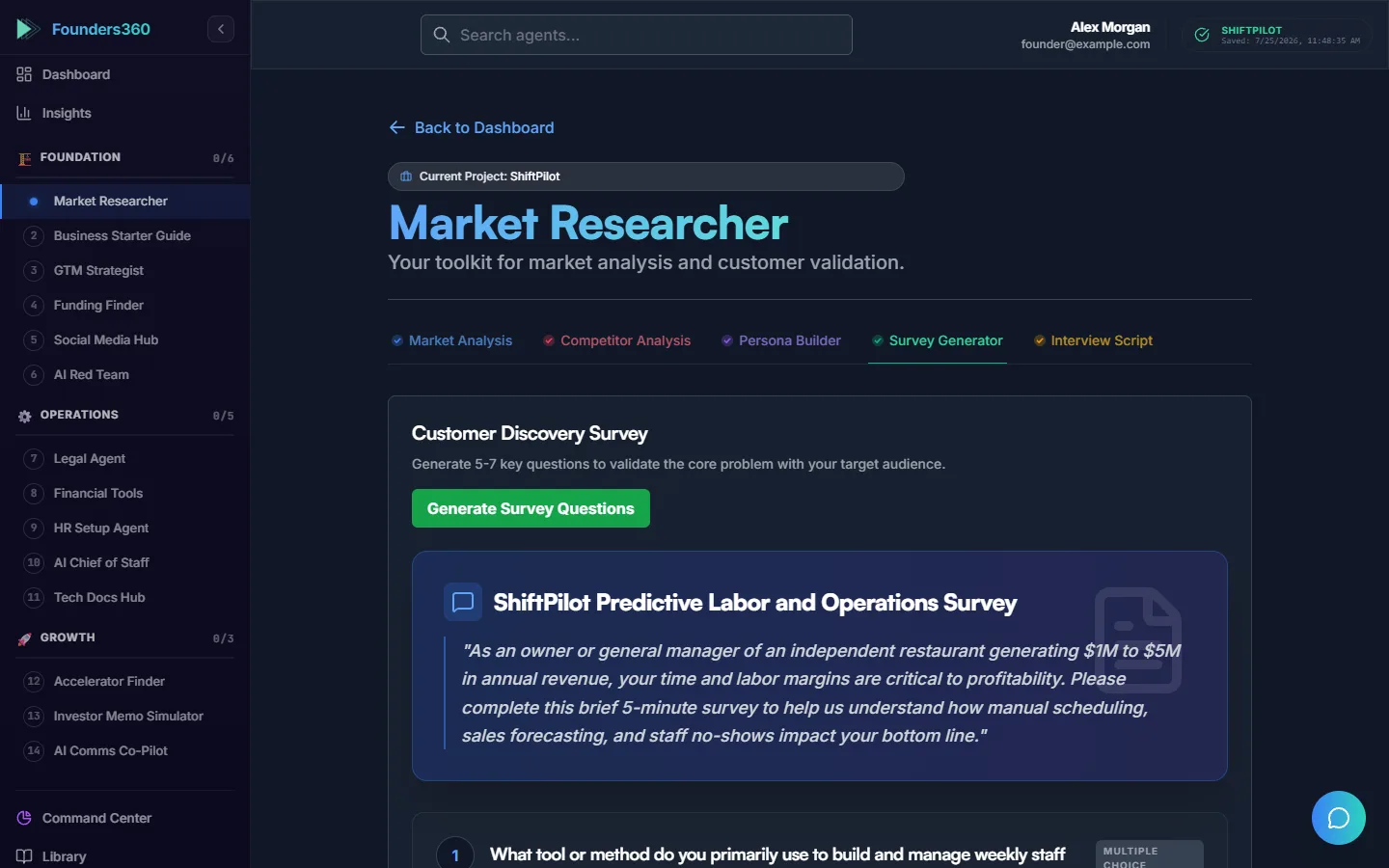
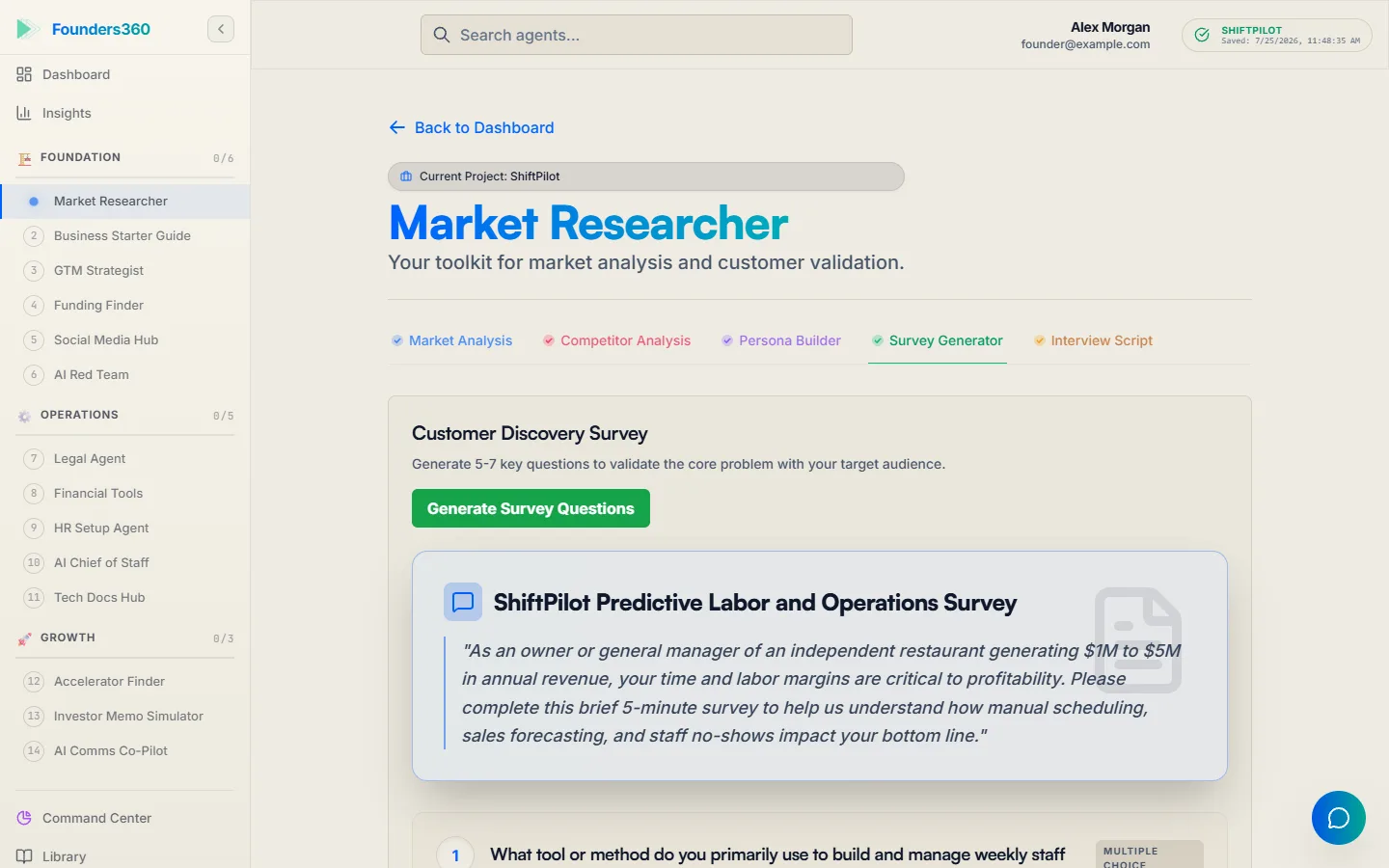
If you are unsure how large the market is, do not guess. The Market Researcher agent in Founders360 is free to start and can gather evidence on market size and trends, which you can then check yourself and cite in your own words. For the method, see our guide to TAM, SAM and SOM.
How do you state progress and traction?
State progress as exact facts with dates and units. "We have 14 paying customers and $3,200 in monthly revenue, up from $900 in July" beats "strong early traction." If you have no revenue, give the strongest real signal you have: conversations held, pilots signed, a waitlist, weekly active users.
Rules that keep traction honest:
- Use numbers, not adjectives.
- Say how long it took. Speed is a signal.
- Separate paid from free, and real users from friends and family.
- If a number is small, say it is small and say what you did to get it.
Vague metrics force the reviewer to assume the worst. Precise small numbers read as credible, and credible beats impressive.
How do you show that people want what you are making?
Show behavior, not opinions. The best evidence is that people pay, come back, or complain when the product breaks. Compliments and survey scores are weak.
Describe how you found out. Name the number of people you spoke to, what you learned that surprised you, and what you changed because of it. A founder who talked to 40 customers and rebuilt the onboarding twice shows more than one who says "everyone loved it." For a repeatable method, read our guide on repeatable customer discovery.
How do you answer the competition question honestly?
Name the real alternatives, including the spreadsheet and the status quo, then say what is distinct about your approach. The YC essay asks what will be distinctive about your solution, and advises acknowledging obstacles with a plan for each.
Never write "we have no competitors." Reviewers read it as either not having looked or not having customers. Customers already solve the problem somehow, and that somehow is your competitor.
The same essay makes a point that surprises many founders: it is better to disclose all the flaws in your idea than to try to conceal them. A reviewer who finds a hole you hid stops trusting the rest. A reviewer who sees you named the hole and have a plan for it trusts you more.
What should you do in the founder video?
Keep it to one minute, with every founder on camera and nothing but the founders talking. That is YC's own instruction on its application video page.
YC also says the video is not the place for a demo or promotional footage, because demos have their own section of the application. It says not to recite a script and to use bullet points instead. Introduce yourselves, say what you are building and why, and add anything else about the founders or the project that matters.
Practical advice that follows from this:
- Record it on a phone in good light, in one or two takes.
- If you are in different places, YC suggests recording a video call.
- Practice the bullets, not the words, so you sound like yourself.
- Watch it once with the sound off to check you are not stiff.
What mistakes cost applicants an interview?
The most common mistakes are jargon, vague numbers, and hiding weaknesses. In the YC essay, Paul Graham says that every unnecessary word in your application subtracts from the effect of the necessary ones, and that marketing-speak is just noise to the reader.
Check your draft against this list:
- Jargon and buzzwords where a plain noun would do.
- Traction written as adjectives instead of numbers.
- A competition answer that says "none."
- A long answer that buries the point in the third paragraph.
- A video that is a pitch deck read aloud.
- Unexplained claims about market size with no source.
Cut every sentence that does not change what the reader believes. Then have someone outside your industry read it and tell you what the company does. If they cannot, rewrite.
How do you rehearse before the YC interview?
Rehearse with someone who will push back, because YC interviews are fast and direct. According to the YC apply page, promising applicants are invited to interview, and decisions typically come the same day.
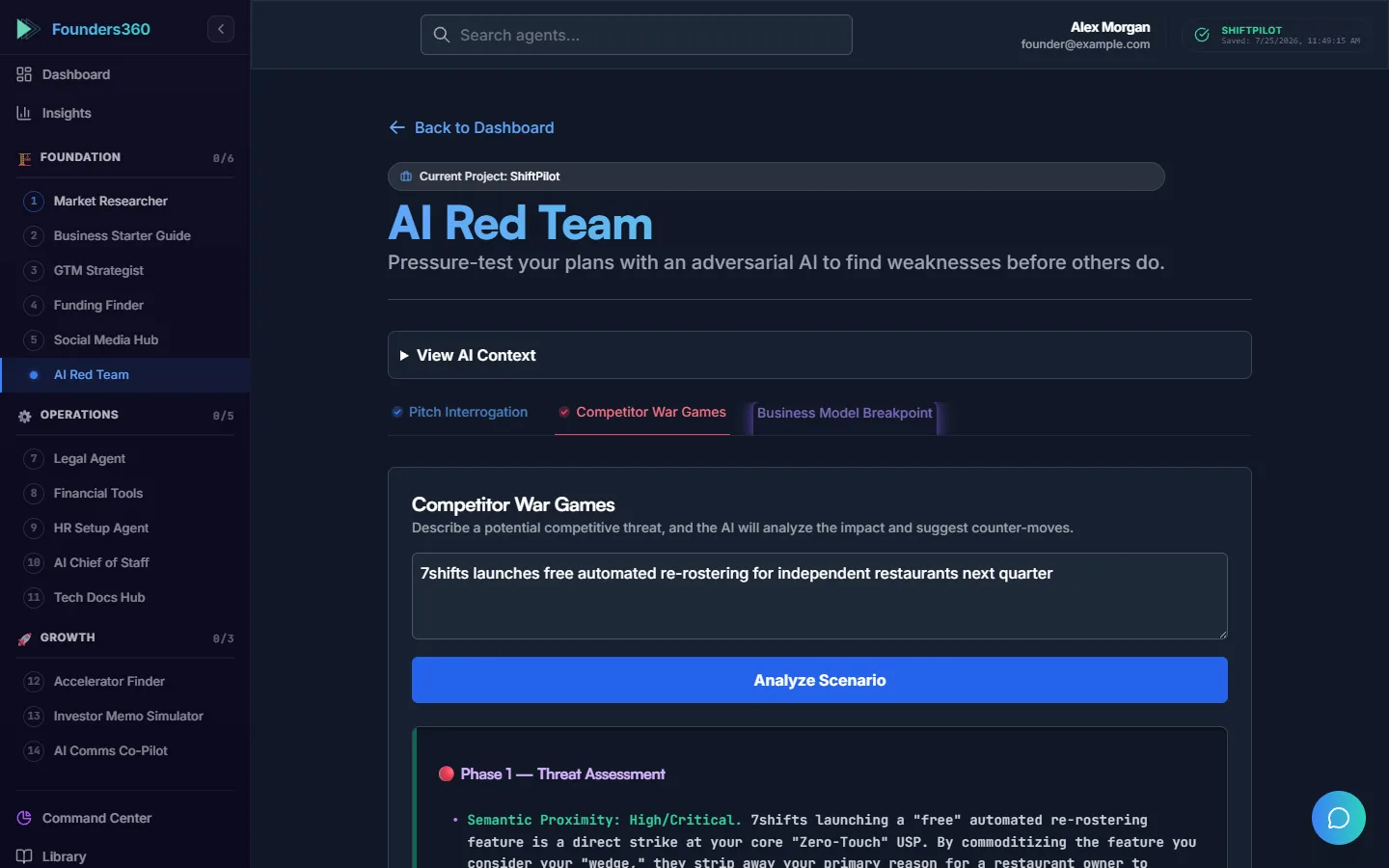
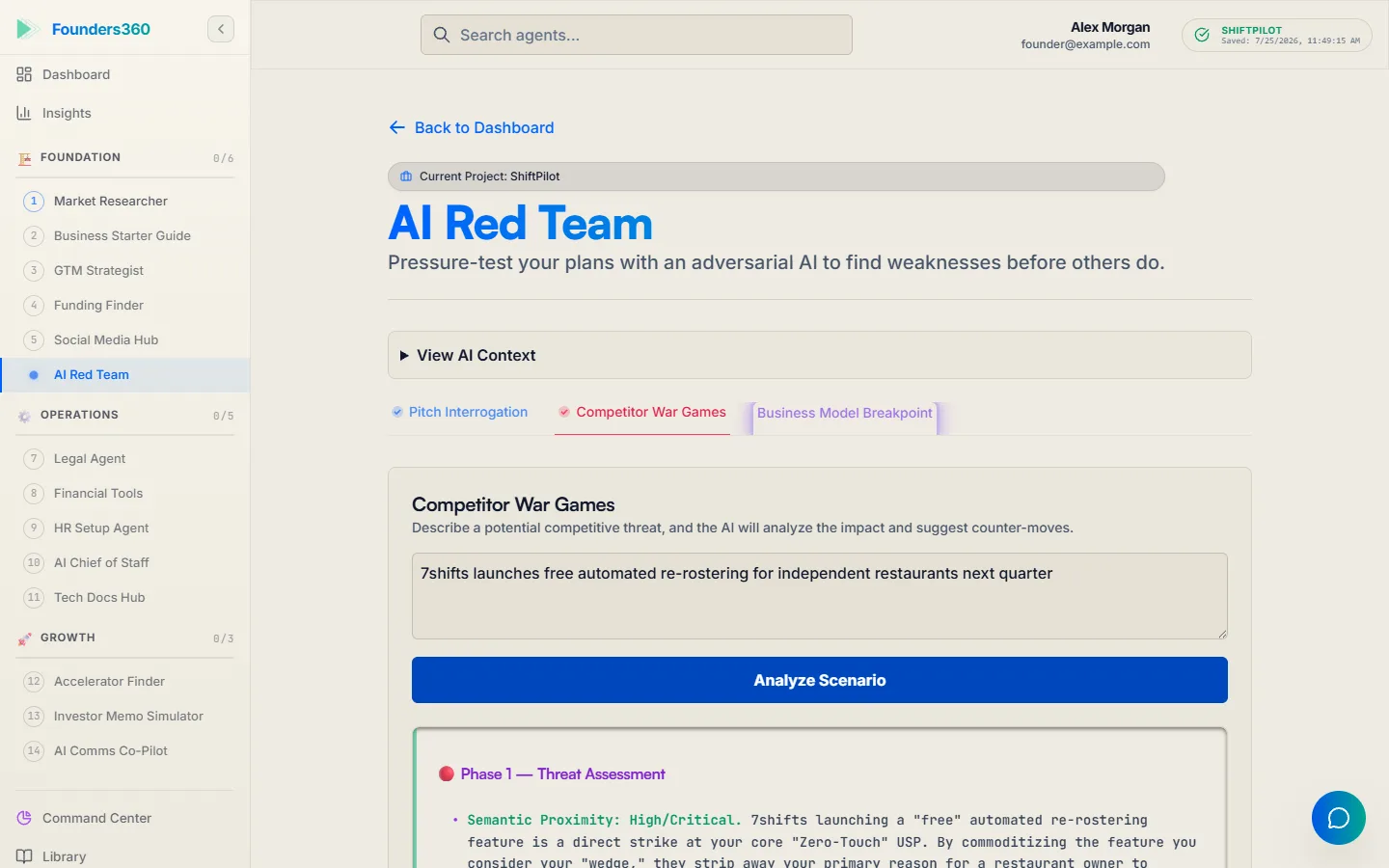
Two free-to-start options help. The AI Red Team agent in Founders360 pressure-tests your claims, assumptions and weak spots before a real investor or reviewer does. For a quick, no-signup round, the free AI VC at /vc-grill grills your pitch and ends with a blunt verdict. Pair them with our list of the hardest investor questions and how to answer them.
Write your answers down once the hard questions stop surprising you. They will usually improve your application too.
What if Y Combinator is not the right accelerator?
Apply anyway if it fits, but do not make one program your whole plan. The clarity you build for YC pays off everywhere: any accelerator, angel or grant committee reads the same kind of application and rewards the same plain, specific, honest answers. Your one-line description, your traction facts and your competitor answer become reusable assets.
If YC says no, read rejected by Y Combinator: what to do next. If you want to compare programs, start with how to choose a startup accelerator. The Accelerator Finder agent in Founders360 can help you find programs that fit your stage, location and sector. For the description itself, see how to write a startup positioning statement.
Frequently Asked Questions
When is the Y Combinator application deadline?
According to the YC apply page as of October 2026, the Winter 2027 on-time deadline is November 2 at 8pm PT, with a decision by December 11 for applications submitted by then. Check ycombinator.com/apply for the current date.
How long should the YC founder video be?
One minute, according to YC. It should contain nothing except the founders talking, with every founder included. YC says not to submit a demo or promotional video and not to read a script.
What is the standard Y Combinator deal?
As of October 2026, YC states it invests $500,000: $125,000 on a post-money SAFE for 7% of the company and $375,000 on an uncapped MFN SAFE. YC states it charges no fees.
Can I apply to YC with only an idea?
I could not verify YC requirements on this from a primary source, so check the YC FAQ. What is clear from YC's advice is that you should show real evidence of progress and of what each founder has built or achieved, whatever your stage.
Do I get feedback if I am rejected?
According to the YC FAQ, YC does not provide feedback on application results unless you are invited to interview. If you are invited, YC says you will get detailed feedback after the interview, whether or not you are selected.
Should I apply more than once per batch?
No. The YC FAQ asks applicants to submit only one application per batch. Spend the time improving that one application instead.
Tags
Related Articles
The Weekly Operating Cadence for Early-Stage Founders
The weekly operating cadence for early-stage founders is a Monday plan with one metric and three outcomes, protected build and customer blocks from Tuesday to Thursday, a written Friday review, and a monthly layer that checks runway and runs a pre-mortem.
9 min readPlaybooksHow to Run a Startup Pre-Mortem Before You Build
A startup pre-mortem is a 90-minute session that assumes the company has already failed eighteen months from now and asks everyone to write down why. Ranked by likelihood, cost and how late you would notice, the causes become the tests you run before writing code.
9 min readPlaybooksRejected by Y Combinator? What to Do in the Next 90 Days
A Y Combinator rejection is a data point about fit on one day, not a verdict on the company. This 90-day playbook covers what the rejection does and does not tell you, how to stress-test the pitch against an adversary, how to build the traction the application lacked, and how to line up other funding.
8 min readReady to Build Smarter?
Join thousands of solopreneurs using AI agents to scale their businesses.
Get Started Free