
Go-to-Market Plan for a Pre-Seed Startup: A 90-Day Template
A go-to-market plan for a pre-seed startup fits on one page and runs for 90 days: pick one beachhead segment in the first month, test two channels in the second, and close, measure and decide what repeats in the third. This template gives the weekly milestones and the six numbers that tell you whether it worked.
By Founders360 Team
A go-to-market plan for a pre-seed startup is a one-page document that names one beachhead segment, one positioning line, two channels and the six numbers you will count every week for 90 days. Anything longer is a plan for a company that has product-market fit, which a pre-seed startup does not, so the plan's job is to find the segment that repeats and to kill everything else. This template runs in three 30-day blocks: choose, test, decide.
What a 90-day go-to-market plan for a pre-seed startup contains
Six items, each on one line: the segment, the buyer, the trigger, the positioning sentence, two channels and a weekly scorecard. If any of those is missing on day one, the first week's job is to fill it, not to launch.
The plan is a hypothesis, and the 90 days are the experiment. You believe a specific kind of company, with a specific person in it, feels a specific pain at a specific moment, and that a specific message will get that person on a call.
In Founders360 the GTM Strategist writes the same six items into Shared Context, so the Comms Co-Pilot drafts outreach against the segment you chose and the Funding Finder puts the same beachhead on the go-to-market slide. If you have not settled the idea itself yet, start with our guide to validating a startup idea with AI and come back.
Days 1 to 30: choose the beachhead segment and write the positioning line
The first 30 days end with one segment you can list by name and one sentence that describes the product in the buyer's words. A beachhead is narrow enough that 50 accounts fit in a spreadsheet, the buyers share a job title, and you can see the trigger event (a hire, a funding round, a tool migration, a deadline) from the outside.
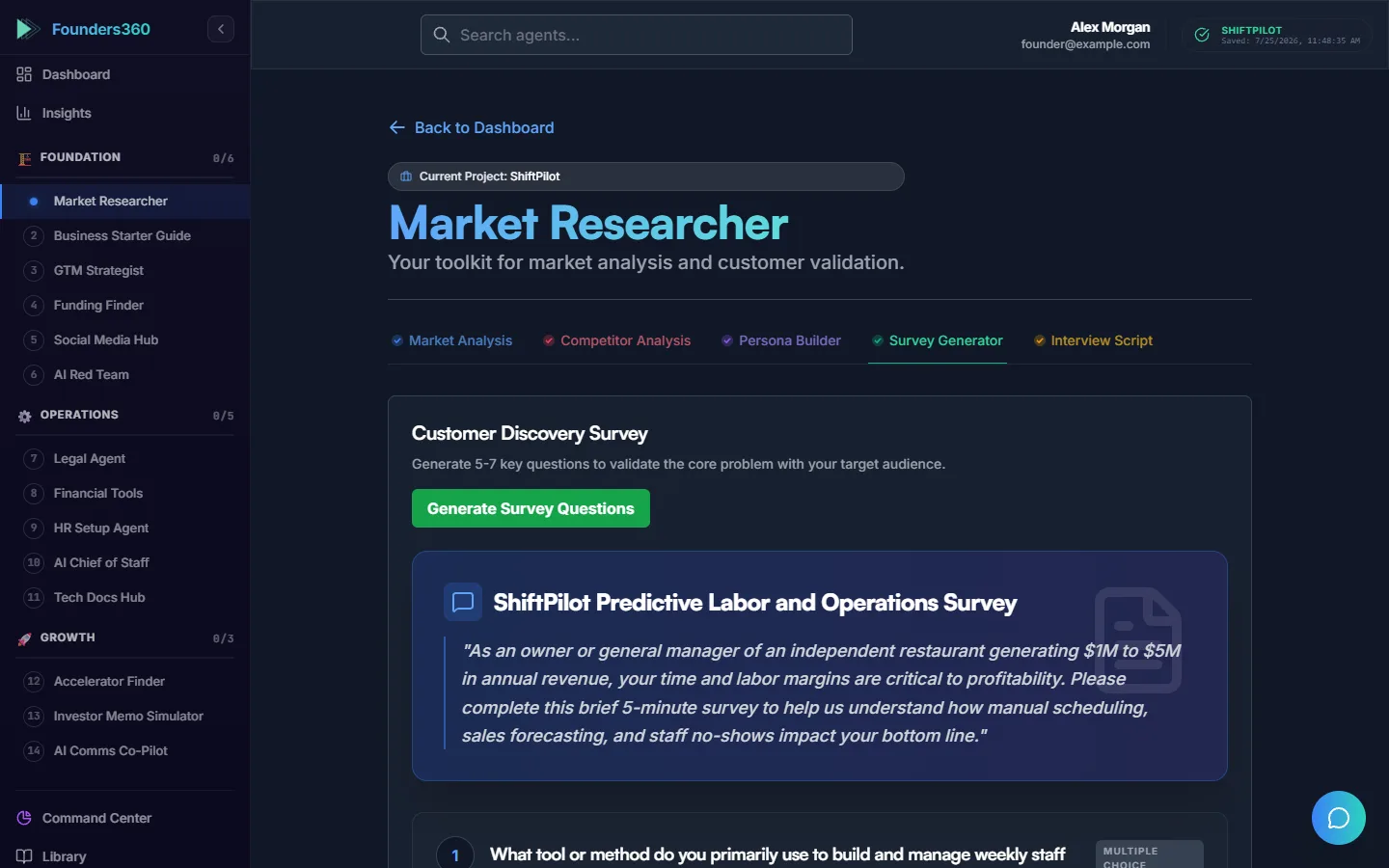
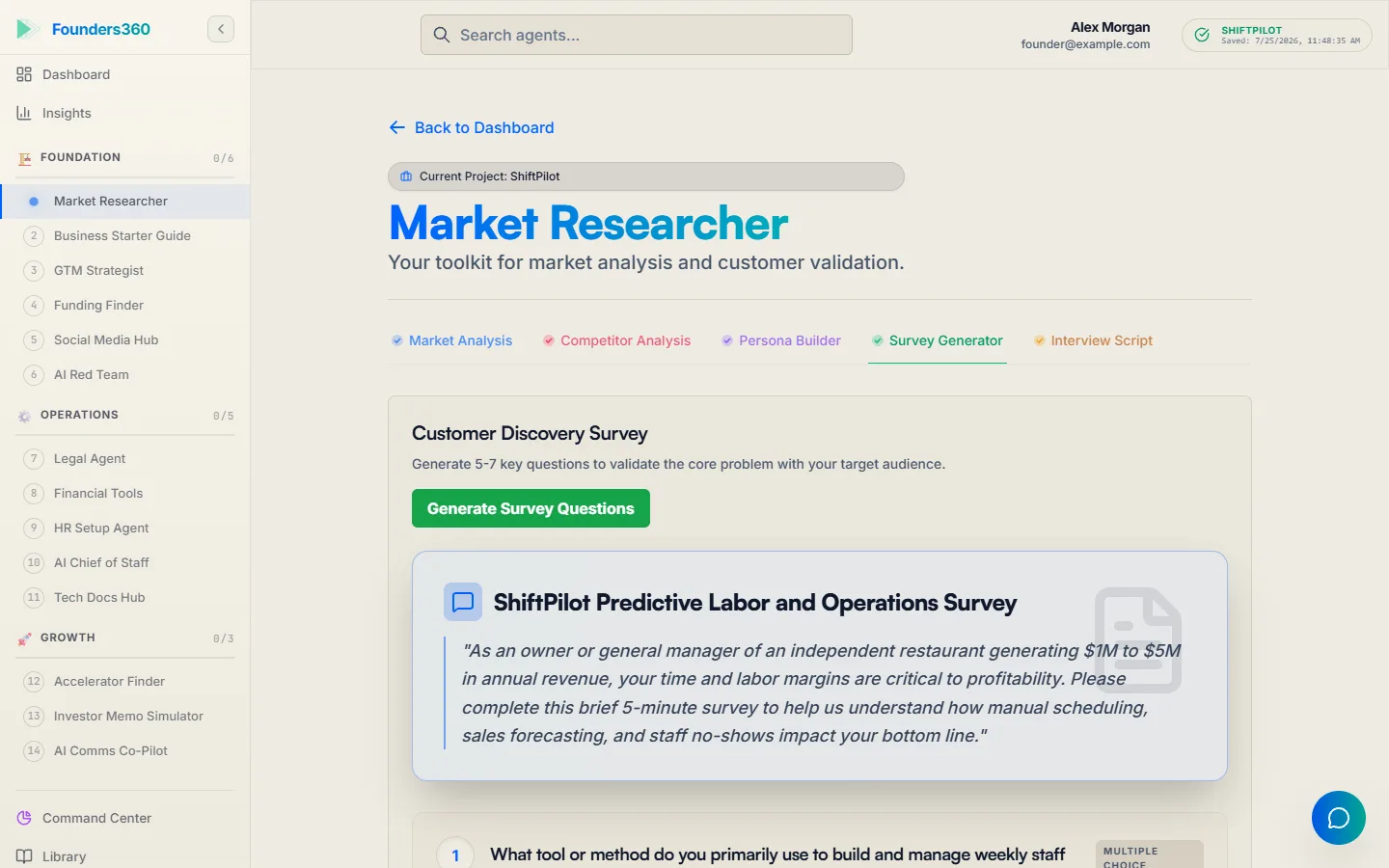
Weeks one and two are interviews. Fifteen conversations with people who match the segment, run as research rather than pitches, with one goal: hear the phrase they use for the problem. Weeks three and four turn the interviews into the positioning sentence and the list. The Market Researcher does the desk half of this in one run: it writes the competitive landscape, the incumbent each buyer probably uses and a first buyer profile into Shared Context.
The check at day 30 is mechanical. Can you name the buyer's title? Can you point at the trigger for at least half of the 50 rows? Can you say the positioning sentence to a stranger in the segment and get a nod rather than a question? Three yeses means move on. Any no means the second month starts with more interviews, not outreach. Our guide to writing a startup positioning statement covers the sentence itself.
Days 31 to 60: test two channels against the named list
The second month sends the message through exactly two channels and counts what comes back. Two, because one channel gives you no comparison and three spreads a solo founder too thin to run any of them well. For most B2B pre-seed companies the pair is warm introductions from the founder's own network plus cold outreach to the named list.
Each channel gets the same message: the trigger you observed, the problem in the buyer's words, one sentence on what you have seen work, and an ask for 20 minutes. Send it to 10 accounts in week five, 15 in week six, and the rest by week eight, with three follow-ups over two weeks per account. Every send goes in the spreadsheet with the date and the outcome.
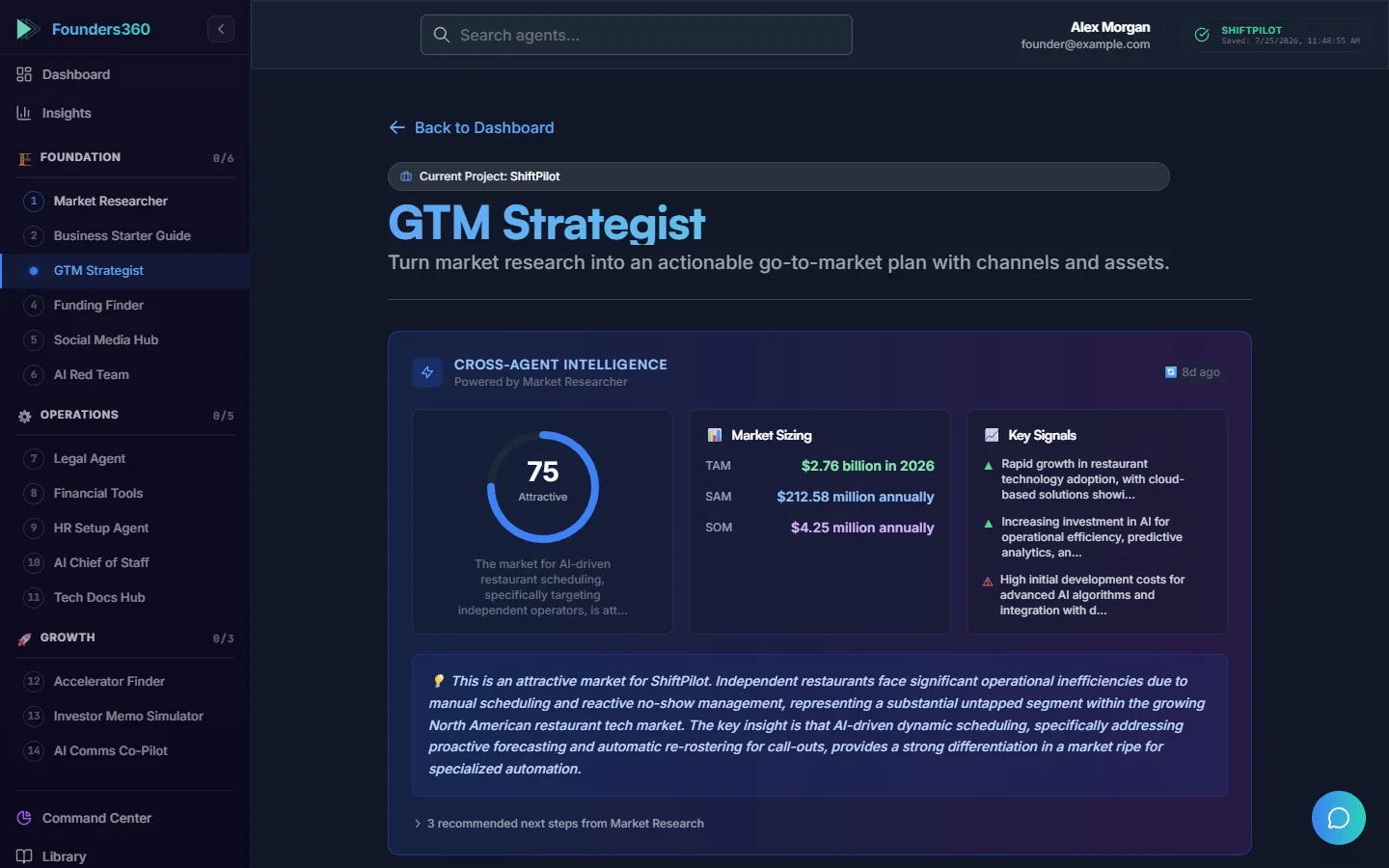
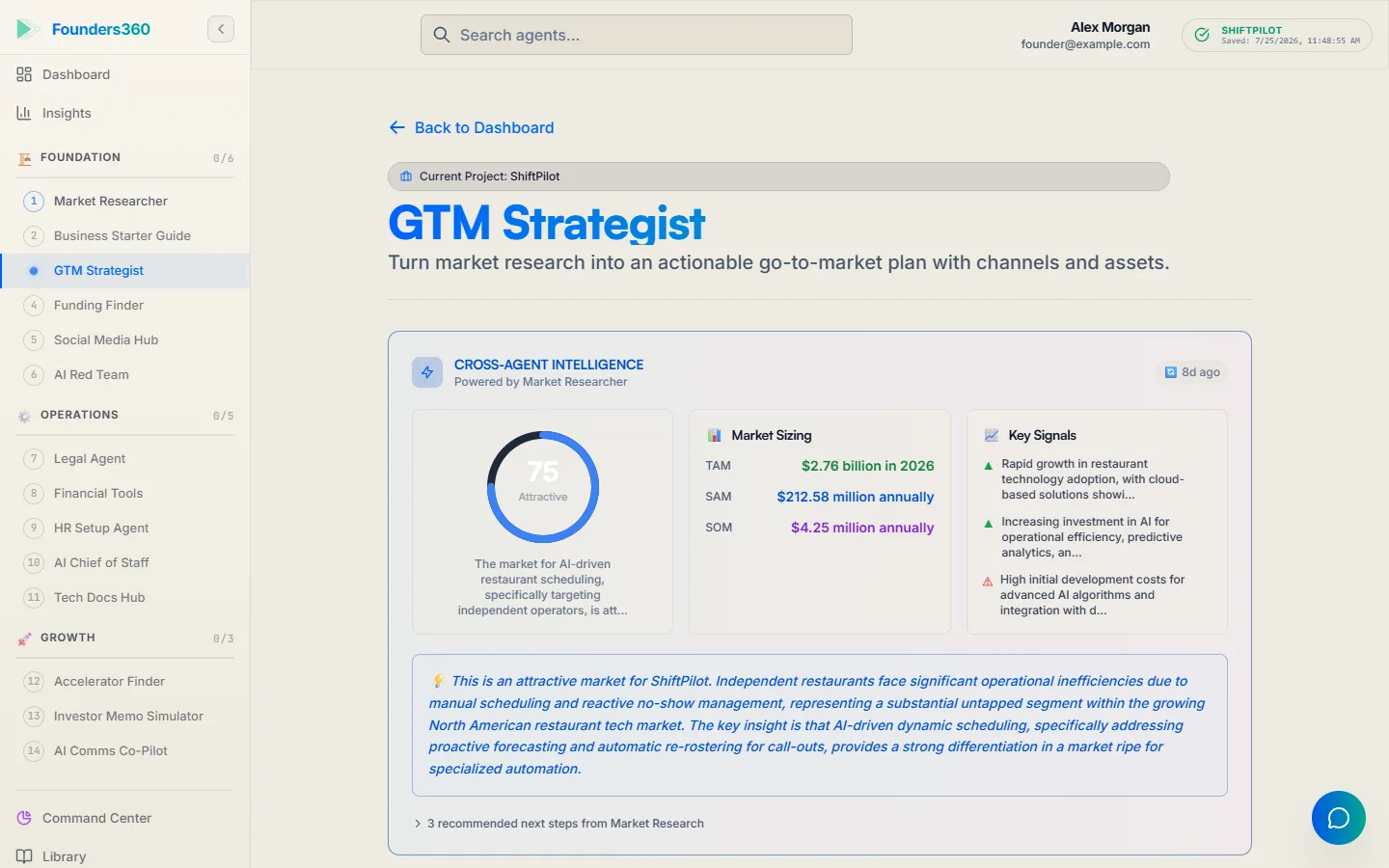
The GTM Strategist writes the channel plan and the first sequence for each channel from the segment already in Shared Context. The full method for working the list, including how to run the calls and price the first deals, is in our playbook on finding your first 10 customers for a B2B startup.
Days 61 to 90: close the first deals and decide what repeats
The third month converts calls into paid pilots and ends with a written decision: keep the segment, narrow it, or change it. By day 60 you have reply rates by channel, a set of held calls and an objection list. The last 30 days are for closing whoever is warm, running the calls that were booked late, and reading the pattern in who said yes.
Close by hand, on a call, at a price the buyer can approve alone, with a date on the pilot. A free pilot produces no signal, so charge something from the first customer. Every closed deal ends with the same request: which two peers should hear about this?
The day-90 decision uses the scorecard, not the mood of the last call. Two or more paying customers who look alike means keep the segment and repeat the second month with the referrals added. Calls but no closes means the price, the demo or the buyer's authority, and the segment survives. No calls from either channel means the message or the segment, and the plan restarts at day one with a narrower definition.
Weekly milestones for the 90-day plan
The table below is the whole schedule. Illustrative targets, sized for a solo founder or a pair selling to companies.
| Week | Milestone | Number to hit | |---|---|---| | 1 to 2 | Customer interviews, no pitching | 15 conversations | | 3 | Beachhead segment chosen, buyer title and trigger named | 1 segment | | 4 | Positioning sentence written, list of 50 accounts built | 50 rows | | 5 to 6 | First outreach through two channels | 25 accounts contacted | | 7 to 8 | Remaining accounts contacted, follow-ups running | 50 accounts, 3 touches each | | 9 to 10 | Discovery calls held, objection list written | 10 calls | | 11 | First paid pilots proposed | 5 proposals | | 12 | Deals closed, referrals asked, day-90 decision written | 2 paying customers |
The numbers on the right are the six weekly counts in disguise: sent, replied, booked, held, proposed, closed. Track them from week five and the day-90 decision writes itself.
How to know the go-to-market plan is working before day 90
Look at the ratio between stages, not the totals. A pre-seed plan rarely produces enough volume for the totals to mean much, but the ratios diagnose the plan early. Low replies with decent volume means the message or the list. Replies but no calls means the ask. Calls but no proposals means the demo or the segment. Proposals but no closes means the price or the buyer's authority. Each has a different fix, and none of them is "add a third channel".
We learned to trust the ratios the hard way. Our public lead chatbot captured zero leads for seven weeks after launch, and the number looked like a verdict on demand. It was a bug: every conversation that called a tool failed on the next turn, and pricing questions always called a tool, so the highest-intent visitors hit the broken path every time. The lesson we now apply to every funnel is to test the second step, not only the first, and to re-baseline before drawing a conclusion from a number.
Our usage data also shows why the entry point matters. Among external founders on Founders360, the Funding Finder is the most-used agent at roughly 36% of runs, ahead of everything else. Founders arrive wanting money. Your first customers tell you the same thing about your product, and the day-90 decision is where you listen.
Where an AI co-pilot shortens a pre-seed go-to-market plan
AI shortens the desk work in month one and the drafting in month two; it does not replace the calls. The interviews, the demos and the closes are the founder's job.
What it does compress is real. The Market Researcher writes the landscape and buyer profile into Shared Context in one run. The GTM Strategist reads that profile and proposes the beachhead, the channel pair and the first sequence. Because every agent reads and writes the same store, the segment you chose in week three is the segment the deck describes in week twelve, without being re-entered. The four agents that cover month one (Command Center, Market Researcher, GTM Strategist and Business Guide) are free forever, and the pricing page lists what Founder Pro and Elite add for the later months. For a longer look at what an AI go-to-market generator should and should not produce, read our go-to-market strategy generator guide.
This week: write the six lines. Segment, buyer, trigger, positioning sentence, two channels, scorecard columns. Book five interviews from your own network for next week. If you cannot fill the trigger line, that is your first finding, and the plan has already started.
Frequently Asked Questions
How long should a go-to-market plan be for a pre-seed startup?
One page. A pre-seed plan names one segment, one buyer, one trigger, one positioning sentence, two channels and a weekly scorecard. Anything longer describes a company that already knows who buys, and the point of the 90 days is to find that out.
Should a pre-seed startup use more than two channels?
No. Two channels give you a comparison and are the most a solo founder or a pair can run properly while also holding the calls. A third channel spreads the same effort thinner and makes every channel look weak. Add a channel only after the day-90 decision confirms the segment.
What if no customers close in 90 days?
Read the ratios before changing anything. Calls that did not close point at price or buyer authority, and the segment survives. No calls at all points at the message or the segment itself, and the plan restarts at day one with a narrower definition.
Does a pre-seed startup need paid advertising in its go-to-market plan?
Not in the first 90 days. Paid channels amplify a message that already converts, and until two customers have paid you do not know what that message is. Spend the first quarter on founder-led outreach and interviews, then test paid spend against a segment you can already close by hand.
How does the 90-day plan connect to a pre-seed fundraise?
The day-90 decision, with its numbers, is the traction slide. Investors at pre-seed are backing evidence that a founder can find a repeatable segment, and two paying customers who look alike, with the funnel ratios that produced them, is exactly that evidence.
Tags
Related Articles
The Weekly Operating Cadence for Early-Stage Founders
The weekly operating cadence for early-stage founders is a Monday plan with one metric and three outcomes, protected build and customer blocks from Tuesday to Thursday, a written Friday review, and a monthly layer that checks runway and runs a pre-mortem.
9 min readPlaybooksHow to Run a Startup Pre-Mortem Before You Build
A startup pre-mortem is a 90-minute session that assumes the company has already failed eighteen months from now and asks everyone to write down why. Ranked by likelihood, cost and how late you would notice, the causes become the tests you run before writing code.
9 min readPlaybooksRejected by Y Combinator? What to Do in the Next 90 Days
A Y Combinator rejection is a data point about fit on one day, not a verdict on the company. This 90-day playbook covers what the rejection does and does not tell you, how to stress-test the pitch against an adversary, how to build the traction the application lacked, and how to line up other funding.
8 min readReady to Build Smarter?
Join thousands of solopreneurs using AI agents to scale their businesses.
Get Started Free