
Rejected by Y Combinator? What to Do in the Next 90 Days
A Y Combinator rejection is a data point about fit on one day, not a verdict on the company. This 90-day playbook covers what the rejection does and does not tell you, how to stress-test the pitch against an adversary, how to build the traction the application lacked, and how to line up other funding.
By Founders360 Team
Rejected by Y Combinator? What to do next is simple to state and hard to do: treat the rejection as a data point about fit on one day, extract the little signal it carries, and spend the next 90 days building the evidence the application lacked. YC accepts a very small share of applicants (the program has publicly described the rate as around one percent; treat that as approximate as of September 2026 and check its own site), so a rejection puts you in the same group as almost every company that applied, including many that later raised. The plan below runs in four phases, and the last one ends with either a stronger reapplication or a round raised without the program.
What a Y Combinator rejection actually tells you
A rejection tells you that a small number of readers, with minutes per application, did not see enough on that day to invite you to an interview. It does not tell you the idea is bad, the market is wrong, or the team is weak, because the readers did not have time to establish any of those. If you reached an interview and were declined, you usually receive a short note with a reason; if you were declined at the application stage, you typically receive none (our observation as of September 2026, and the program's own guidance says as much).
The honest reading is that the application failed to make the case quickly enough. That is a writing and evidence problem, and both are fixable in 90 days.
We learned this lesson in our own product in a different costume. Our public lead chatbot captured zero leads for seven weeks, and we nearly concluded nobody was interested. The real cause was a bug: every conversation that called a tool failed on the next turn, and pricing questions always called a tool. The highest-intent path was the broken one. The lesson transfers directly: re-baseline before you draw a conclusion from a number. One rejection is a number, not a baseline.
Days 1 to 7: separate the signal from the verdict
Spend the first week extracting whatever signal exists and then closing the file. Reread your application as a stranger would, with a timer set to three minutes, and mark every sentence that requires context the reader did not have. Those are the sentences that lost you the interview. If you received interview feedback, write it down verbatim and resist the urge to argue with it; the argument is for the next phase.
Then list the three claims in your application that a skeptical reader could not verify from the text: usually the market size, the reason customers switch, and the evidence of demand. Those three claims set the agenda for the next 60 days, because they are the ones you will either prove or replace.
Close the file at the end of the week. Founders who keep relitigating a rejection into month two are spending the exact time that would have produced the traction for the next application.
Days 8 to 30: put the pitch through an adversary
The fastest way to find what the readers saw is to have something argue against the pitch before the next reader does. A founder cannot see the weak slide in their own deck; a skeptic can, in minutes. Our Skeptical VC does this with no login: it interrogates the pitch, presses on the claim it finds weakest, and ends with a blunt verdict naming the weakness and the agent that fixes it. Run it on the pitch as it stood in the application, not on an improved version, so the verdict lines up with what the readers saw.
Then go deeper with the AI Red Team, which pre-mortems the company from the inside. On a fictional test company (ShiftPilot, an AI scheduling idea for restaurants), its first question named a real incumbent and asked what stops customers from clicking that incumbent's auto-fill button. That is the question an application reader asks silently and you never hear. Every objection the Red Team raises is written into Shared Context, so when you rebuild the deck with the Funding Finder, the market slide and the competition slide already answer them. Our piece on why your AI co-founder should argue with you explains why we built it to disagree.
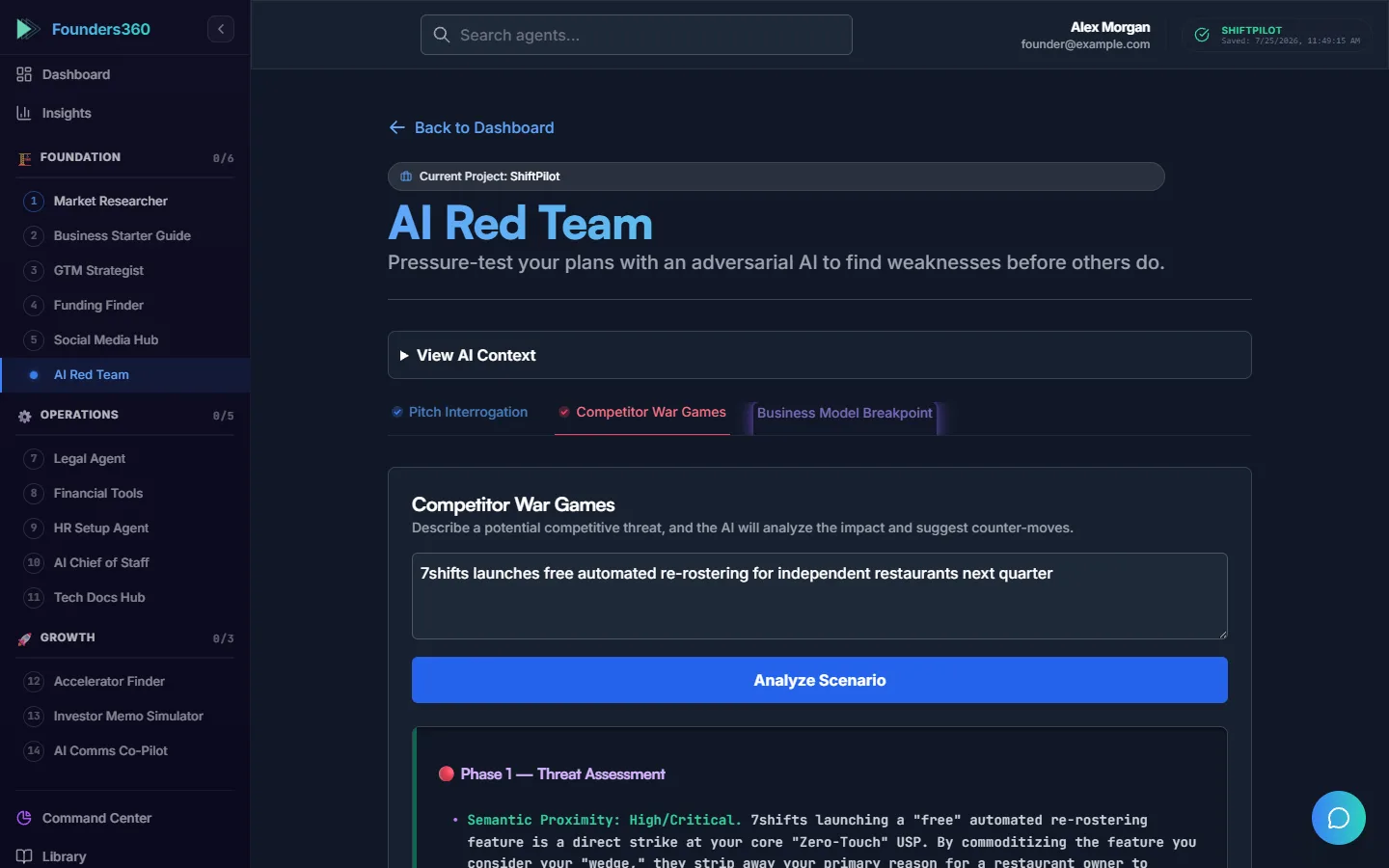
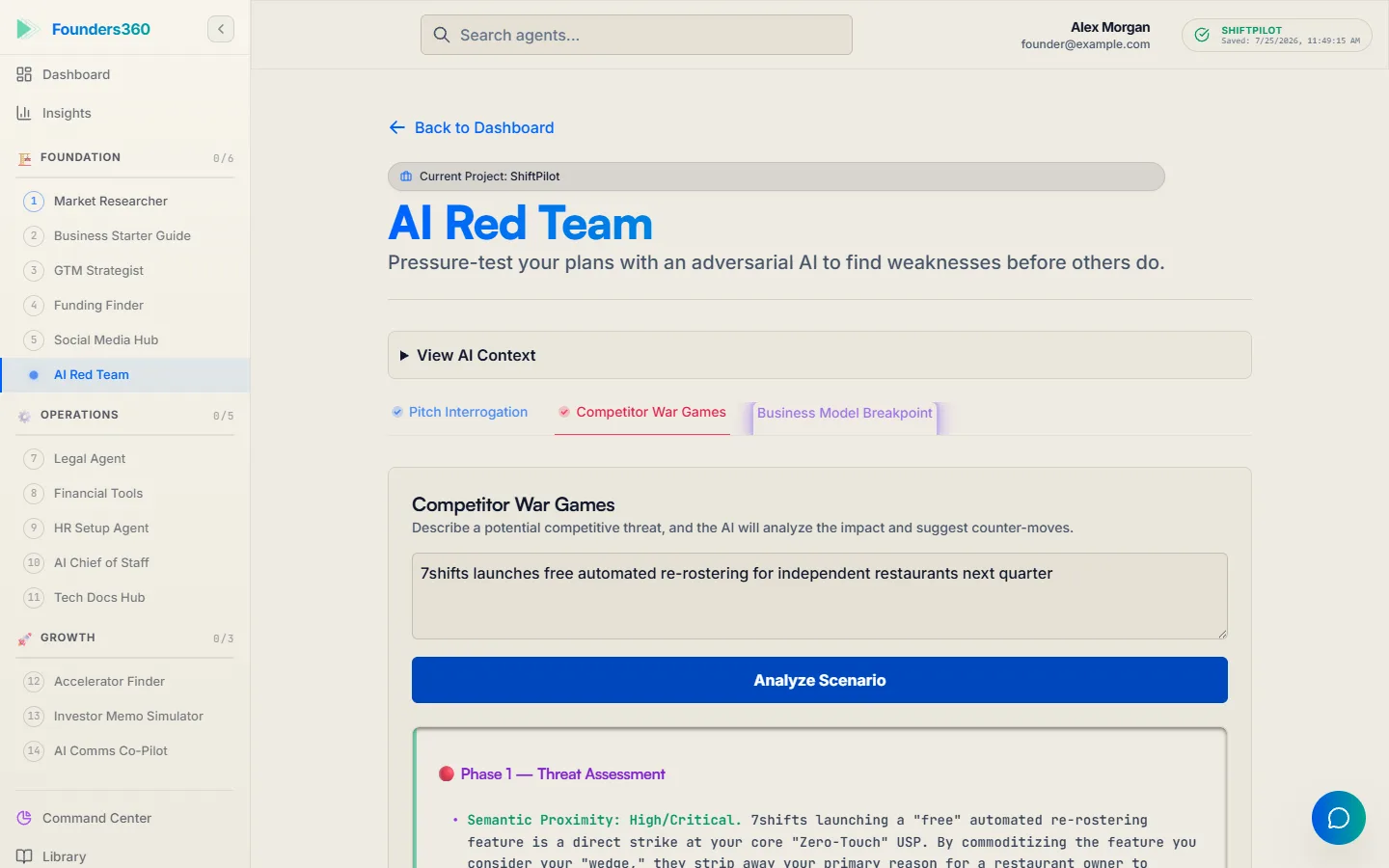
By day 30 you should have a written list of the five objections a reader would raise, ranked by how badly each one hurts, and a plan for which ones you will answer with evidence rather than with better wording.
Days 31 to 60: build the traction the application lacked
Traction is the answer to most objections, and 30 days is enough to produce some. Pick the one metric that a YC reader or a pre-seed investor would want to see for your kind of company (paying customers, weekly active users, signed pilots, letters of intent) and make the month about moving it. A company that goes from zero to five paying customers in a month has a different application than the one that was rejected.
Rebuild the market argument while you do it. Most rejected applications quote a top-down market number from a report and cannot say what share is reachable. Our Market Researcher writes a TAM, SAM and obtainable estimate into Shared Context with the assumptions listed; on the same fictional ShiftPilot company it walked a $2.8 billion TAM down to a $212.6 million SAM and a $4.3 million obtainable slice. A bottom-up number with visible assumptions survives a skeptical reader; a headline figure does not.
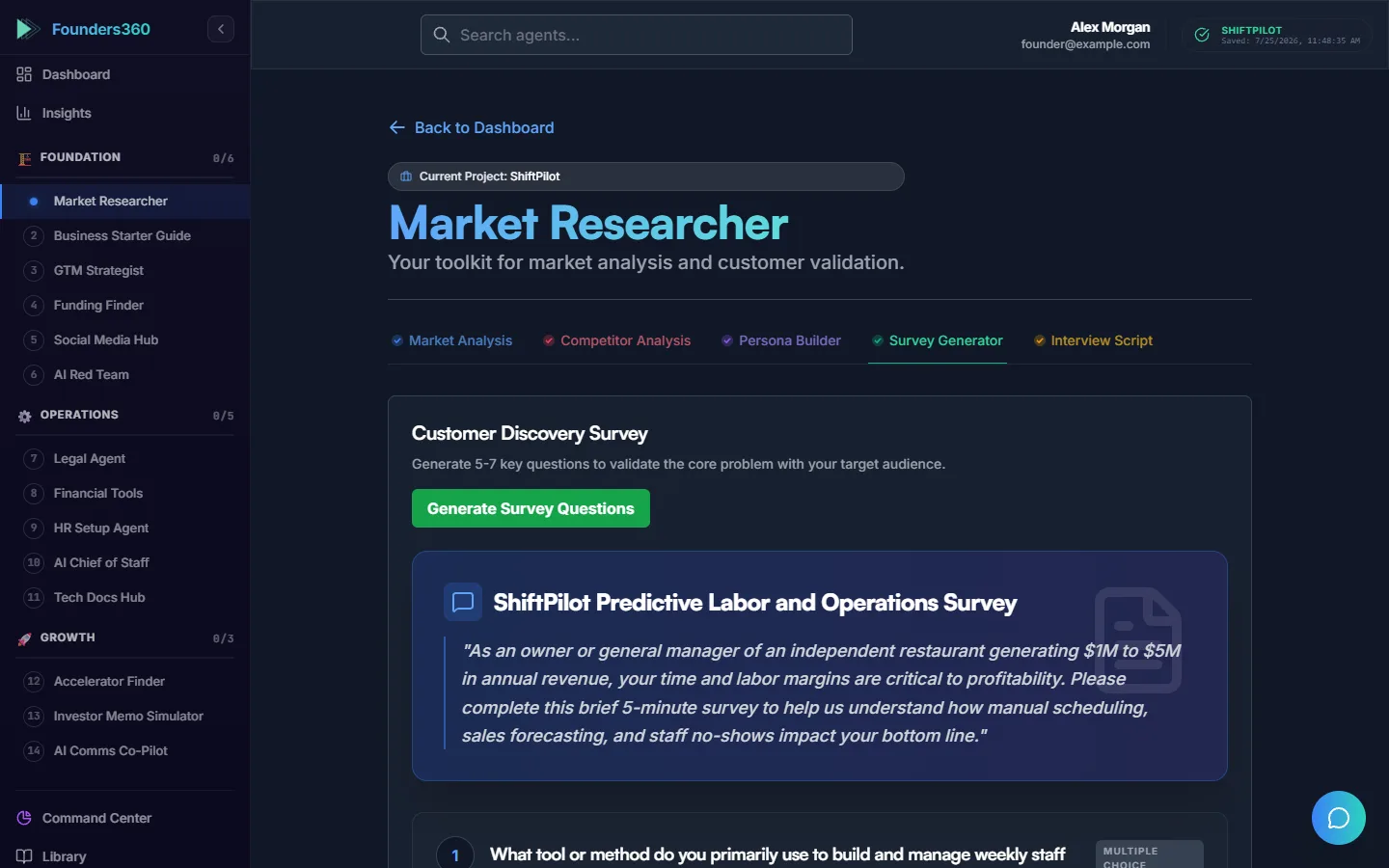
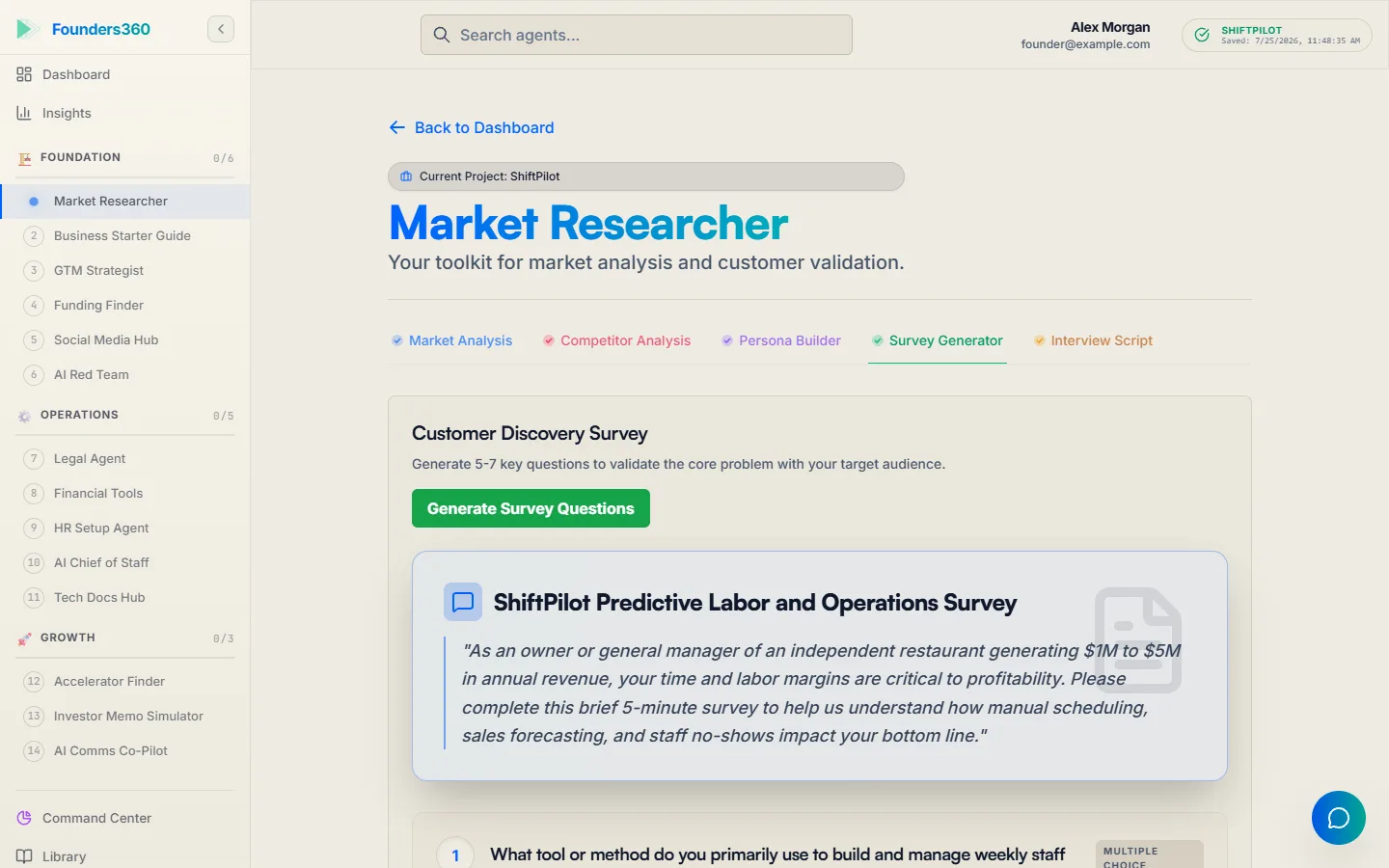
Keep the evidence in one place as you collect it. Screenshots of paying customers, a dated waitlist chart, a signed pilot: these are the attachments the next application, and the next investor, will ask for. Our guide to stress-testing a pitch before investor meetings covers how to turn each objection into a piece of evidence.
Days 61 to 90: line up the alternatives
Spend the last month building the funding path that does not depend on any one program. Three routes exist and they are not exclusive.
Other accelerators. Programs differ in stage, sector and terms, and a company too early for YC may be exactly right for a pre-seed or sector program. Our Accelerator Finder matches programs to the stage, sector and traction already written into Shared Context and reviews a draft application against each program's published criteria. Our guide on how to choose a startup accelerator covers how to read terms and check a network before you apply.
A direct pre-seed round. Angels and micro funds fund companies at YC's stage every week without a demo day. The traction from days 31 to 60 and the rebuilt deck are the whole of what they need. Our pre-seed fundraising guide sets out who funds you before traction and how to run the raise in a fixed window.
Non-dilutive money. Grants and public programs cost reporting rather than equity, and a rejected application often already contains most of what a grant application needs. Our list of grants for early-stage startups covers where to look.
Run all three in parallel during the final 30 days. A founder with two accelerator interviews, three angel conversations and a grant application in progress is negotiating from a different position than one waiting on a single decision.
Should you reapply to Y Combinator?
Reapply if the company has changed materially since the last application, and only then. YC has said publicly that it welcomes reapplications and that many accepted companies applied more than once, but a second application that shows the same evidence with better phrasing is a second rejection. The test is concrete: could a reader who saw both applications point to two or three numbers that moved?
If the answer is yes, reapply and lead with the change. Put the new traction in the first sentence of the application, name what you learned from the last cycle, and treat the old application as the baseline you beat. If the answer is no, spend another cycle on the metric before you spend another application on it.
Reapplying is also not the only way to win. A company that raised a pre-seed round in the 90 days and reaches the milestones of a YC company without the program has the outcome the program was meant to produce.
Mistakes founders make after a rejection
Treating the rejection as a verdict is the most common one, and it drives the second: rewriting the pitch instead of changing the company. A rejected application that comes back with new adjectives and the same numbers loses again. The third is going quiet. Investors and other programs read momentum, and a founder who disappears for three months after a rejection reads as a founder who stopped.
Two quieter mistakes. Applying to five programs the same week as the rejection, before the pitch has been stress-tested, spends every alternative on the same weak application. And skipping the direct round because it feels harder than an application form; for many companies, angels are the faster path and the terms are better.
Frequently Asked Questions
Does Y Combinator give feedback on rejected applications?
Usually not at the application stage; if you reached an interview and were declined, you typically receive a short note with the main reason. This is our observation as of September 2026 and the program's own guidance is the authority. Assume you will have to find the reason yourself, which is what the first 30 days of this plan are for.
How soon can I reapply to Y Combinator?
The next batch. YC accepts reapplications and has said many funded companies applied more than once. The question is not when you can reapply but whether the company has changed enough for a reader to notice; if two or three numbers have not moved, wait a cycle.
Is a YC rejection a sign the idea is bad?
No. Readers spend minutes per application and cannot evaluate the idea in that time; they evaluate how clearly and how quickly the application makes its case. A rejection is evidence that the case was not made, not that it cannot be.
What should I fix first after a rejection?
The claim a skeptical reader could not verify. For most applications that is the market size or the evidence of demand. Have something argue with the pitch to find it (the Skeptical VC or a blunt advisor), then spend a month producing the number rather than rewording the claim.
What can I do this week?
Run the application pitch, unchanged, through our free Skeptical VC and write down the verdict. Then reread your own application with a three-minute timer and mark every sentence a stranger could not follow. Those two lists are the plan for the next 90 days.
Tags
Related Articles
The Weekly Operating Cadence for Early-Stage Founders
The weekly operating cadence for early-stage founders is a Monday plan with one metric and three outcomes, protected build and customer blocks from Tuesday to Thursday, a written Friday review, and a monthly layer that checks runway and runs a pre-mortem.
9 min readPlaybooksHow to Run a Startup Pre-Mortem Before You Build
A startup pre-mortem is a 90-minute session that assumes the company has already failed eighteen months from now and asks everyone to write down why. Ranked by likelihood, cost and how late you would notice, the causes become the tests you run before writing code.
9 min readPlaybooksInvestor Update Email Template and the Cadence That Keeps Investors Warm
An investor update email is a short monthly note with the same five numbers every time, one clear ask, and an honest lowlights section. The template below is copyable; the cadence is what makes it work.
8 min readReady to Build Smarter?
Join thousands of solopreneurs using AI agents to scale their businesses.
Get Started Free