
Pitch Deck Structure: The 12 Slides Investors Expect and What Goes on Each
A pitch deck structure investors expect runs twelve slides in a fixed order: title, problem, solution, why now, market size, product, business model, traction, competition, team, financials and the ask. Each slide answers one question, and the deck should be scored before it is sent.
By Founders360 Team
A pitch deck structure that investors expect runs twelve slides: title, problem, solution, why now, market size, product, business model, traction, competition, team, financials and the ask. Each slide answers one question, in that order, and an investor reading it cold should reach the last slide knowing what you do, why it will work and what you need. Investors read hundreds of decks fast, so the expected structure lets them spend their attention on your argument rather than on finding the market slide.
The 12-slide pitch deck structure at a glance
Every slide has one job. If a slide cannot be summarised as a single question with a single answer, it is two slides or it is filler.
| # | Slide | The question it answers | Passes when | |---|---|---|---| | 1 | Title | What is this company? | One sentence a stranger could repeat | | 2 | Problem | Who suffers, and how much? | Names a person and a cost | | 3 | Solution | What do you do about it? | Fits in one screen, no jargon | | 4 | Why now | Why did this not exist five years ago? | Points at a specific change | | 5 | Market size | How big can this get? | Bottom-up, with the arithmetic shown | | 6 | Product | What does it look like in use? | Real screens, not a feature list | | 7 | Business model | Who pays, how much, how often? | A price and a unit | | 8 | Traction | What has already happened? | Numbers with dates | | 9 | Competition | Who else, and why you? | Names the incumbent honestly | | 10 | Team | Why are you the people for this? | Ties each person to the problem | | 11 | Financials | What do the next three years look like? | Ties to the raise on slide 12 | | 12 | The ask | How much, for what, to reach which milestone? | A number and a milestone |
Twelve is a ceiling, not a target to pad up to. A pre-seed company with no revenue can fold financials into the ask and land at eleven. Anything beyond twelve belongs in an appendix you show only when asked.
Slides 1 to 4: title, problem, solution and why now
The first four slides earn the right to be read further, so they carry the argument in its shortest form.
The title slide is the company name, a one-line description and your contact details. The one-liner names the customer and the outcome: "scheduling software for independent restaurants" beats "reimagining hospitality operations".
The problem slide names the person who has the problem and what it costs them. "Hiring is broken" signals that you have not spoken to customers. "A restaurant manager rebuilds the rota by hand every Sunday and loses two shifts a month to no-shows" signals that you have. Our guide to repeatable customer discovery for technical founders covers how to gather quotes like that.
The solution slide says what you do, in the same nouns the problem slide used. Do not introduce the product name or the technology yet; the investor wants to see that the solution matches the problem.
The why now slide is the one founders skip and investors miss. Every good company has a reason it could not have existed earlier: a regulation changed, a cost dropped, a platform opened. Name the change and show one number that proves it happened.
Slides 5 to 8: market size, product, business model and traction
The middle four slides move from the argument to the evidence.
The market size slide should be built bottom-up. Count the customers who match your problem slide, multiply by what each one would pay, and show the working. Top-down sizes ("the global restaurant industry is worth trillions") signal that the founder has not done the arithmetic. State the total addressable market, the serviceable market you can reach, and the obtainable share over a stated period.
The product slide shows the product. Real screenshots, or a short flow of three screens, beat a paragraph of features. If the product does not exist yet, show the prototype and label it as one.
The business model slide states who pays, how much, and how often. One price, one unit, one payment frequency. If you have not chosen a price yet, our piece on pricing a first SaaS product with no customers will get you to a defensible number before the meeting.
The traction slide is whatever has already happened, dated. Revenue if you have it; signed pilots, waitlist size, retention or letters of intent if you do not. If you have no traction at all, say so plainly and let the team slide carry more weight.
Slides 9 to 12: competition, team, financials and the ask
The last four slides close the argument and make the request.
The competition slide names the incumbent honestly. Every investor will ask why the biggest existing player does not simply add your feature, so answer it here. A two-by-two grid with you in the top right corner convinces nobody; a short table of the alternatives a customer uses today, and what each fails to do, convinces more.
The team slide ties each person to the problem. One line per person on why their background matters for this company beats a list of previous employers. If there is a gap in the team, say what it is and who you plan to hire with the raise.
The financials slide is a three-year projection with the key assumptions visible: revenue, costs, headcount and cash. At pre-seed nobody expects the numbers to be right; they expect the assumptions to be reasonable and the arithmetic to be consistent with the ask. Our guide to financial modelling for pre-revenue startups covers the model behind the slide.
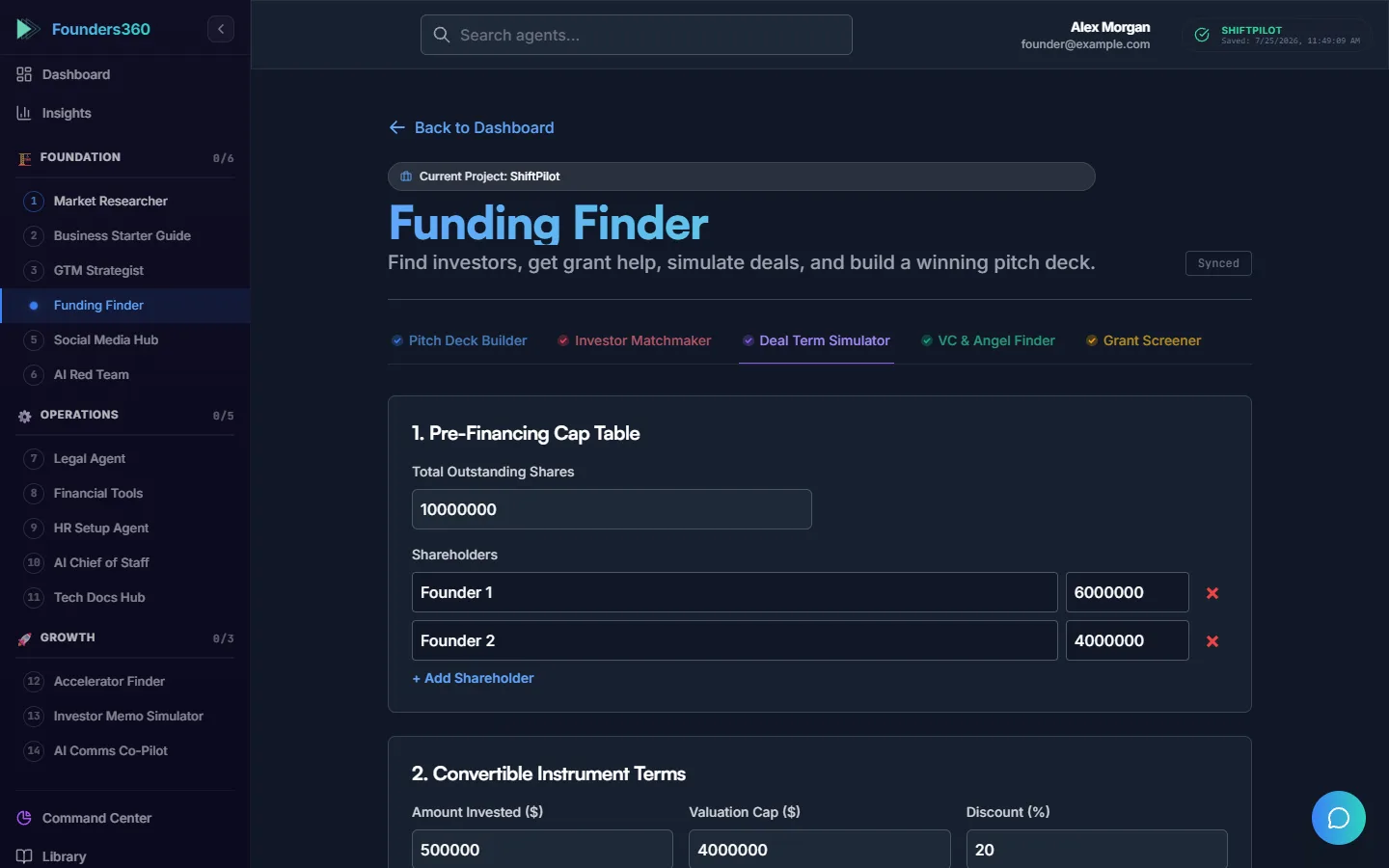
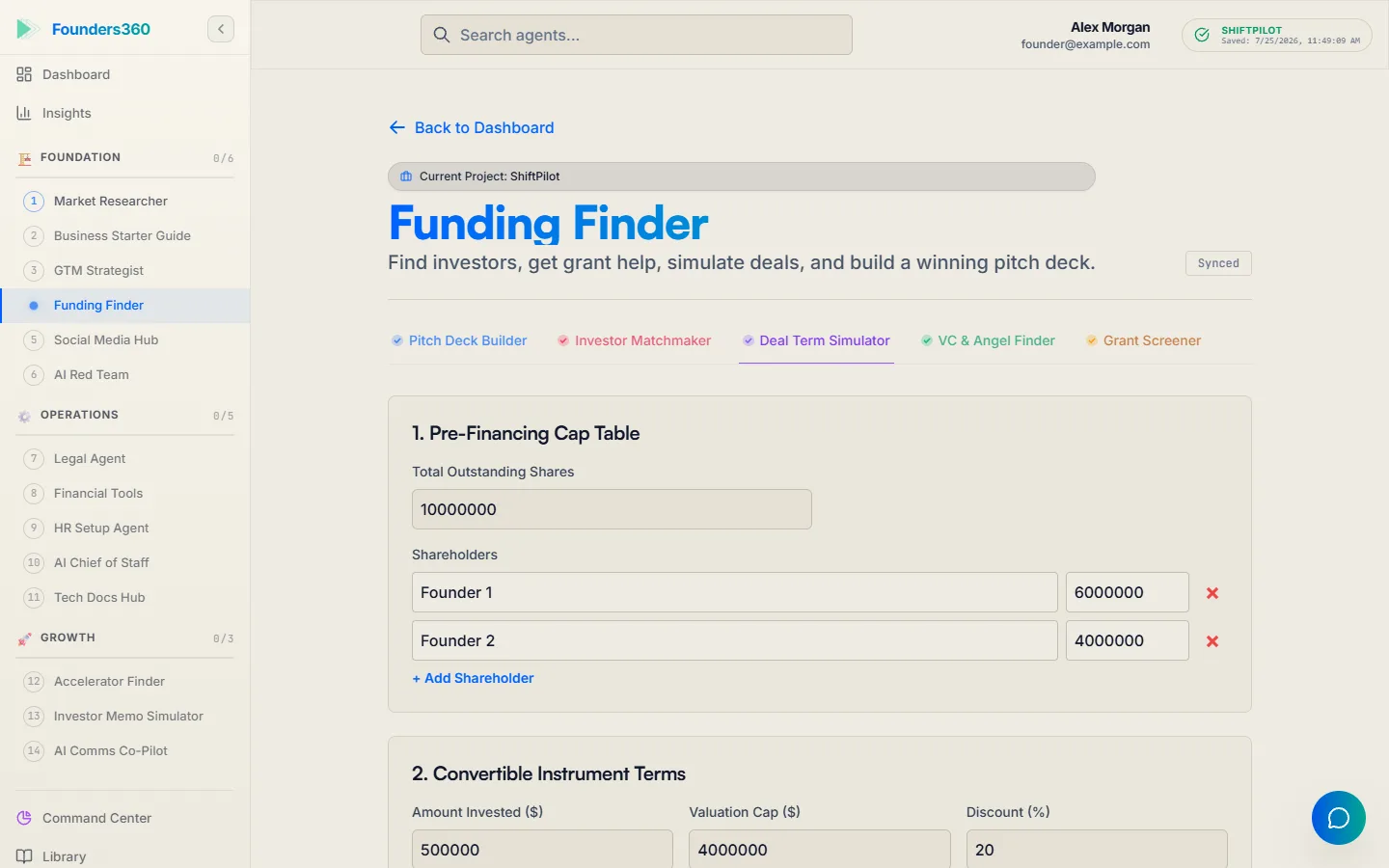
The ask slide states how much you are raising, on what terms, and which milestone the money reaches. "Raising $500,000 on a SAFE to reach 40 paying restaurants and a $30,000 monthly recurring revenue run rate in 14 months" is an ask. "Raising a pre-seed round" is not. If you are raising on a SAFE, read what a valuation cap actually costs you in dilution before you put a number on this slide, because the cap is rarely the term that moves ownership most.
Where the market-size slide comes from
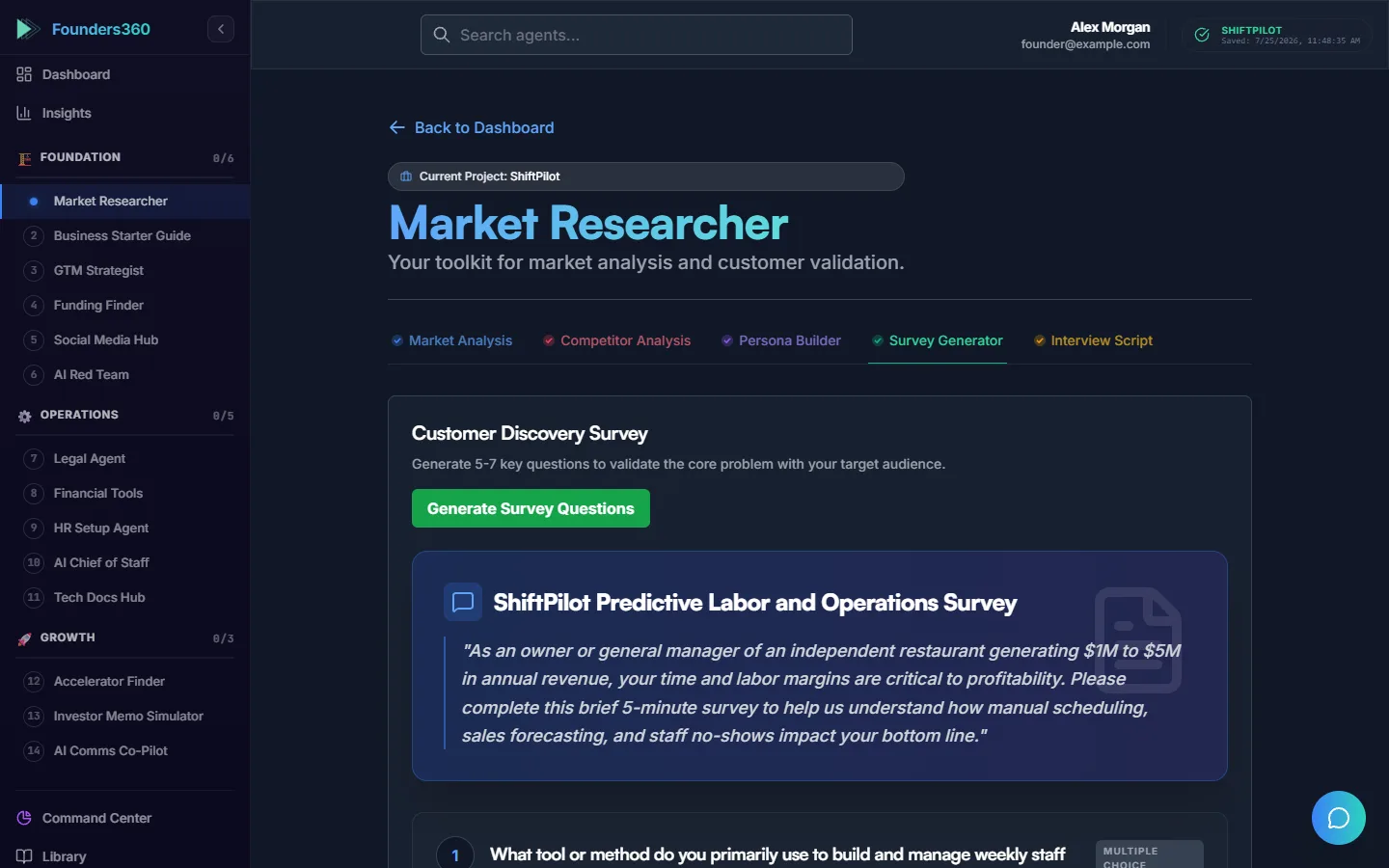
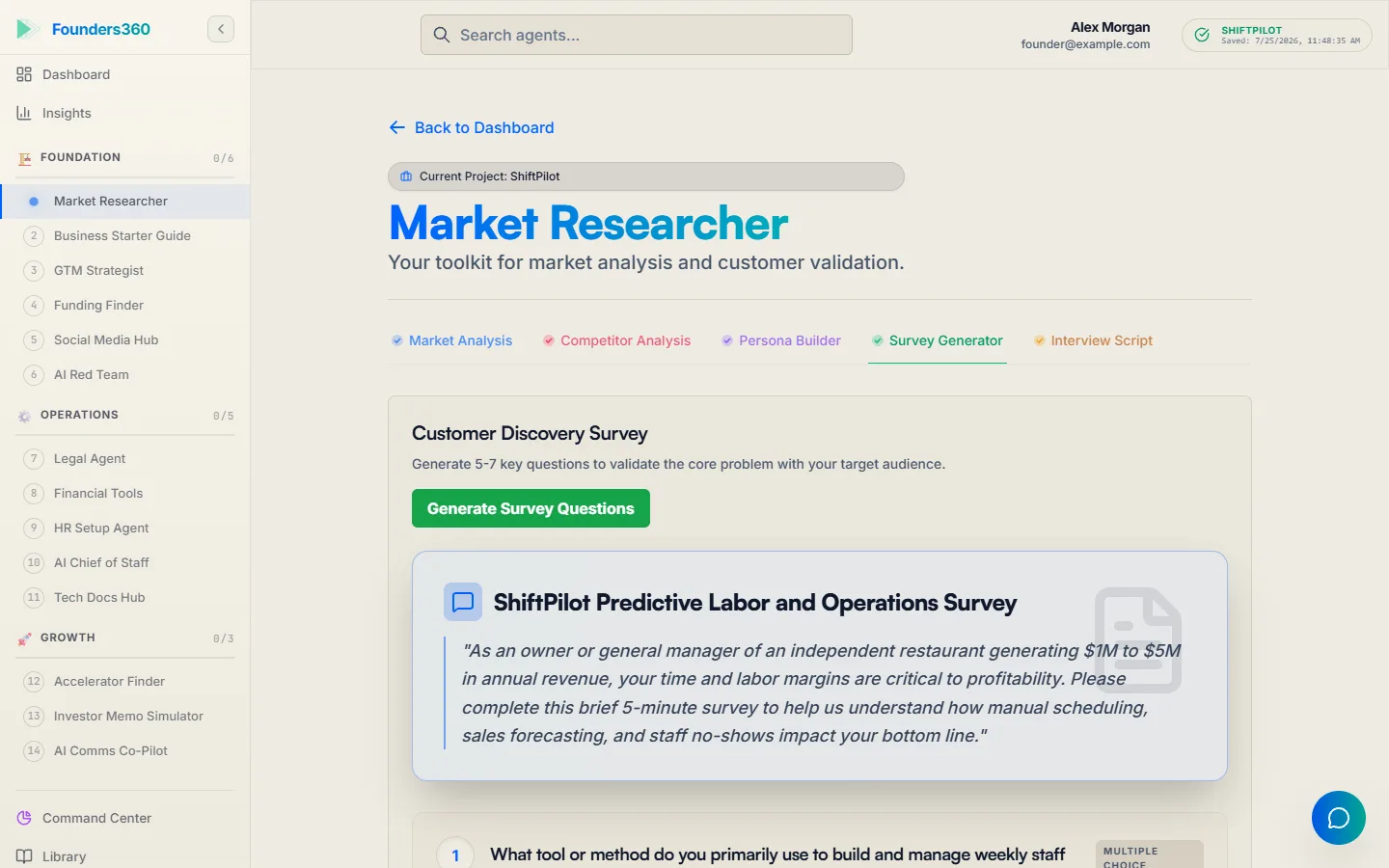
The market slide should come from research you did earlier, not from a number invented the night before the meeting. In Founders360, the Market Researcher agent sizes the market first and writes the result into Shared Context, the per-company memory every agent reads. When the Funding Finder later builds the deck, it reads the total addressable, serviceable and obtainable figures from that store and places them on slide five without being told. On our fictional test company, ShiftPilot (an AI scheduling idea for restaurants; it does not exist), the Market Researcher walked the market from a $2.8 billion total down to a $212.6 million serviceable market and a $4.3 million obtainable slice, and those three numbers are what the deck carried.
Roughly two thirds of all Shared Context facts in production were written by the Market Researcher, which tells you how much later work rests on that first sizing. A founder who sizes the market once and reuses it on the deck, the memo and the financial model has one consistent story. A founder who re-estimates it each time has three different numbers and an investor who noticed.
How to score your own pitch deck before an investor does
Score the deck against the twelve questions in the table above, one point per slide for a clear answer and zero for a vague one, and treat anything under nine as not ready. Founders skip this because they know what they meant on each slide. An investor only knows what the slide says.
When the Funding Finder built a 12-slide deck for ShiftPilot, it scored its own work 72 out of 100 and named the revenue slide as the weak one. That is the useful kind of feedback, a number and a named slide, because it tells you where to spend the next hour. A deck that scores itself 95 tells you nothing.
For a harsher second opinion, the Skeptical VC is a free, no-login AI investor that interrogates the pitch and ends with a blunt verdict naming the weakness on each slide. Run the deck through it before the first real meeting. Our guide to the hardest investor questions and how to answer them walks through the answers.
Common pitch deck structure mistakes at pre-seed
Each of these comes up in nearly every first deck we see, and each is cheap to fix once named.
- Twenty-five slides in the main flow. Move everything past twelve into an appendix.
- A top-down market slide. "One percent of a trillion-dollar market" is the phrase that ends meetings. Count customers and multiply.
- A traction slide with no dates. "500 users" means nothing without knowing whether they arrived last week or over two years.
- Financials that do not match the ask. If the model shows you need $800,000 to reach the milestone and the ask says $500,000, one of the two slides is wrong.
- A missing ask. Decks that end on the team slide leave the investor guessing what you want. State the number.
What to do this week
Build the deck in the order the table gives, and write the market-size arithmetic before anything else, because everything downstream depends on it. On day six, score each slide against its one question and fix the ones that fail. On day seven, run it through the Skeptical VC or a founder friend who has raised, and write down every question the deck did not already answer. Those questions are your appendix.
Frequently Asked Questions
How many slides should a pitch deck have?
Ten to twelve in the main flow. The twelve-slide structure above covers every question an investor expects answered; a pre-seed company with no revenue can merge the financials into the ask and land at eleven. Anything more belongs in an appendix.
Do I need a financials slide at pre-seed?
You need a projection with visible assumptions, even if it is short. Investors at pre-seed do not expect the numbers to be accurate; they expect the assumptions to be reasonable and the arithmetic to be consistent with the amount you are asking for. A three-year view of revenue, costs, headcount and cash on one slide is enough.
What order should the pitch deck slides go in?
Title, problem, solution, why now, market size, product, business model, traction, competition, team, financials, ask. The order moves from the argument (slides one to four) to the evidence (five to eight) to the close (nine to twelve). The most common defensible change is putting traction earlier when it is exceptional.
Does the pitch deck structure change for a B2B versus a consumer startup?
The twelve questions stay the same; the evidence changes. A B2B deck leans on signed pilots, contract values and sales cycle length. A consumer deck leans on retention, engagement and acquisition cost. The market-size slide is bottom-up in both cases.
Tags
Related Articles
Co-Founder Agreement and Vesting: What First-Time Founders Must Put in Writing
A co-founder agreement with a vesting schedule is the document that decides who owns what when a founder leaves. Sign it before the first line of code, the first customer, or the first cheque, because every one of those makes the conversation harder.
8 min readGuidesUnit Economics for Early-Stage Startups: CAC, LTV and Payback Before You Have Revenue
Unit economics for an early-stage startup are three numbers per customer: what one costs to acquire, what one is worth over their life, and how many months until the first pays back the second. Before revenue you build them from stated assumptions, label them as such, and replace each one with a measurement as soon as you have it.
9 min readGuidesTechnical Documentation for Startups: What to Write Before You Hire Your First Engineer
Technical documentation for startups is five documents written before the first engineer starts: a product requirements document, a data model, an architecture decision log, an API contract and a runbook. Everything else can wait.
8 min readReady to Build Smarter?
Join thousands of solopreneurs using AI agents to scale their businesses.
Get Started Free