
The Hardest Investor Questions and How to Answer Them
The hardest investor questions test whether you know your market, your incumbent, your risks and your numbers better than the person asking. Each one has a weak answer that ends the meeting and a strong answer you can rehearse in advance.
By Founders360 Team
The hardest investor questions are the ones that test whether you know your market, your incumbent, your risks and your numbers better than the person asking. Each has a weak answer that ends the meeting and a strong answer that can be rehearsed before you walk in. This playbook covers the six questions that catch pre-seed founders most often, why investors ask them, and how to build the answer from evidence you already have.
Investors ask hard questions because the answers are the only part of the meeting the deck cannot script. A founder who has already argued the weak points with themselves answers calmly with a number. A founder who hears the question for the first time in the room improvises, and improvisation is what the investor remembers. The table below gives the six questions, the weak answer investors hear most, and the shape of a strong one.
| Question | Weak answer | Strong answer | |---|---|---| | Why will the incumbent not build this? | "They are too slow." | Names the incumbent's constraint and one customer who left over it | | How did you get that market size? | "It is a trillion-dollar market." | Shows the bottom-up count and the price per customer | | Why now? | "AI makes it possible." | Names one specific change with a date | | What is the biggest risk? | "Execution." | Names the risk, the early signal, and the response | | What does this raise get you? | "Eighteen months of runway." | A milestone, a number and a date | | What have you learned from the data? | Quotes the headline number | Says what was checked before trusting it |
"Why will the incumbent not just build this?"
Answer this by naming the incumbent's constraint, not by calling them slow. Every incumbent could build your feature in a quarter. The question is why they will not, and the honest answers are structural: it would cannibalise a revenue line, it conflicts with their pricing model, or it serves a segment they have chosen to ignore.
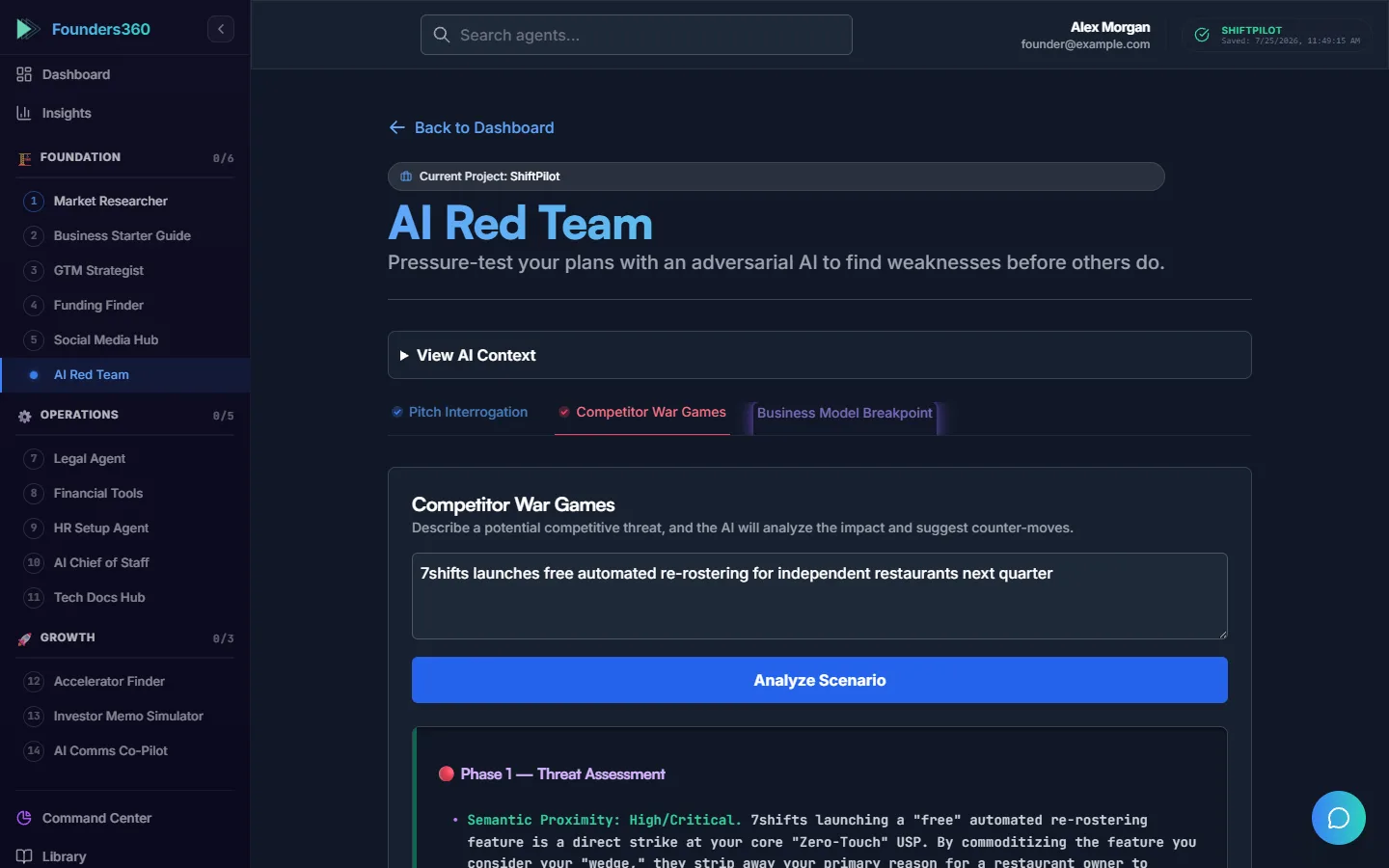
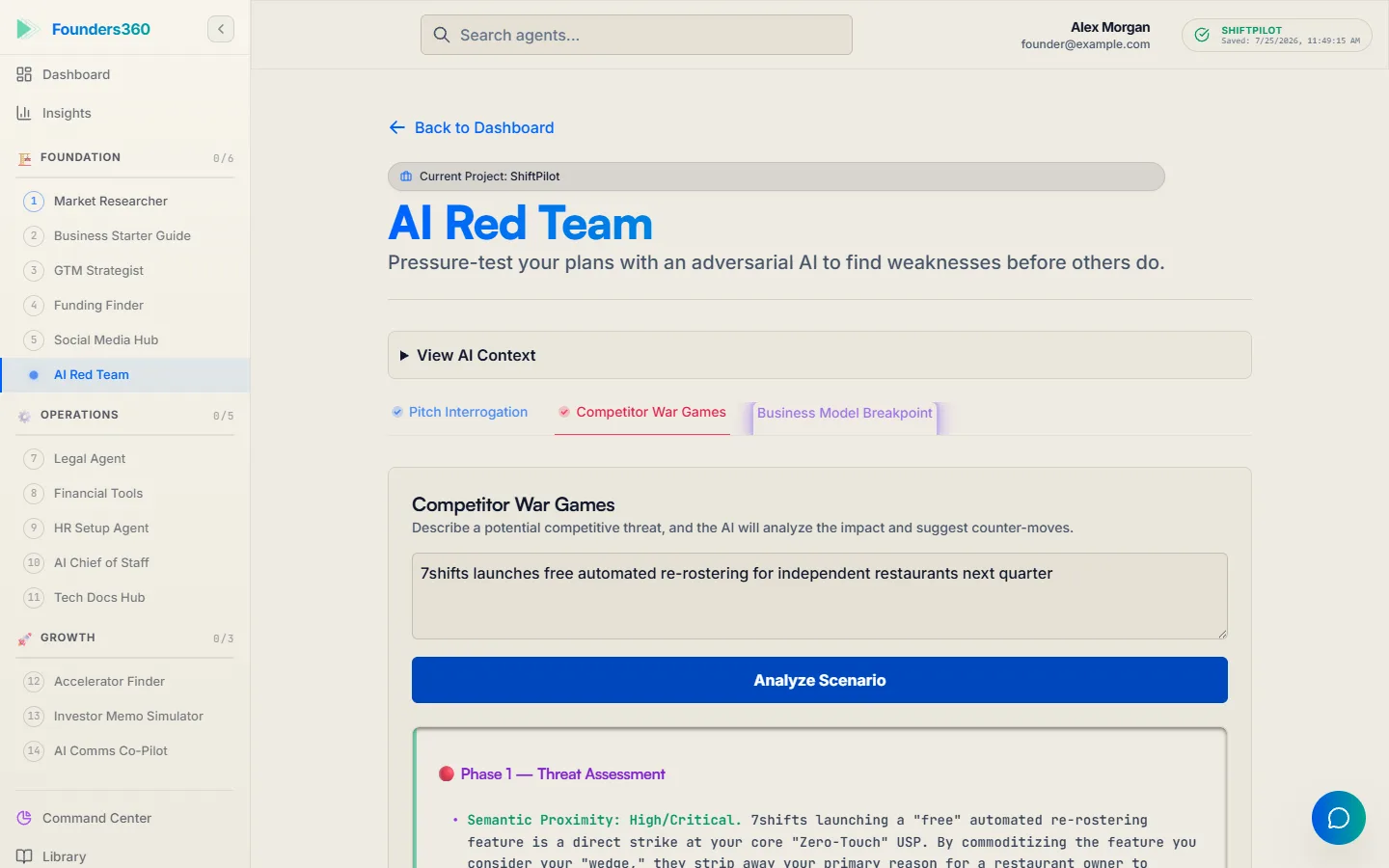
We watched our own AI raise this question before any investor did. On a fictional test company, ShiftPilot (an AI scheduling idea for restaurants; it does not exist), the AI Red Team's first question named a real incumbent and asked what stops customers clicking that incumbent's auto-fill button. That is the question in its sharpest form: the incumbent already has the customer, the data and a button. Your answer has to explain why the customer clicks yours instead. Our piece on why your AI co-founder should argue with you covers why hearing this from software before a meeting is worth the discomfort.
The strongest version of the answer carries one customer story: a named segment that tried the incumbent's version, what it failed to do for them, and what they do today instead.
"How did you get to that market size?"
Answer with the arithmetic: the number of customers who match your problem, multiplied by what each pays per year, and the share of those you can reach with your product and distribution. An investor who asks this question is not asking for the total; they are asking whether you counted or guessed.
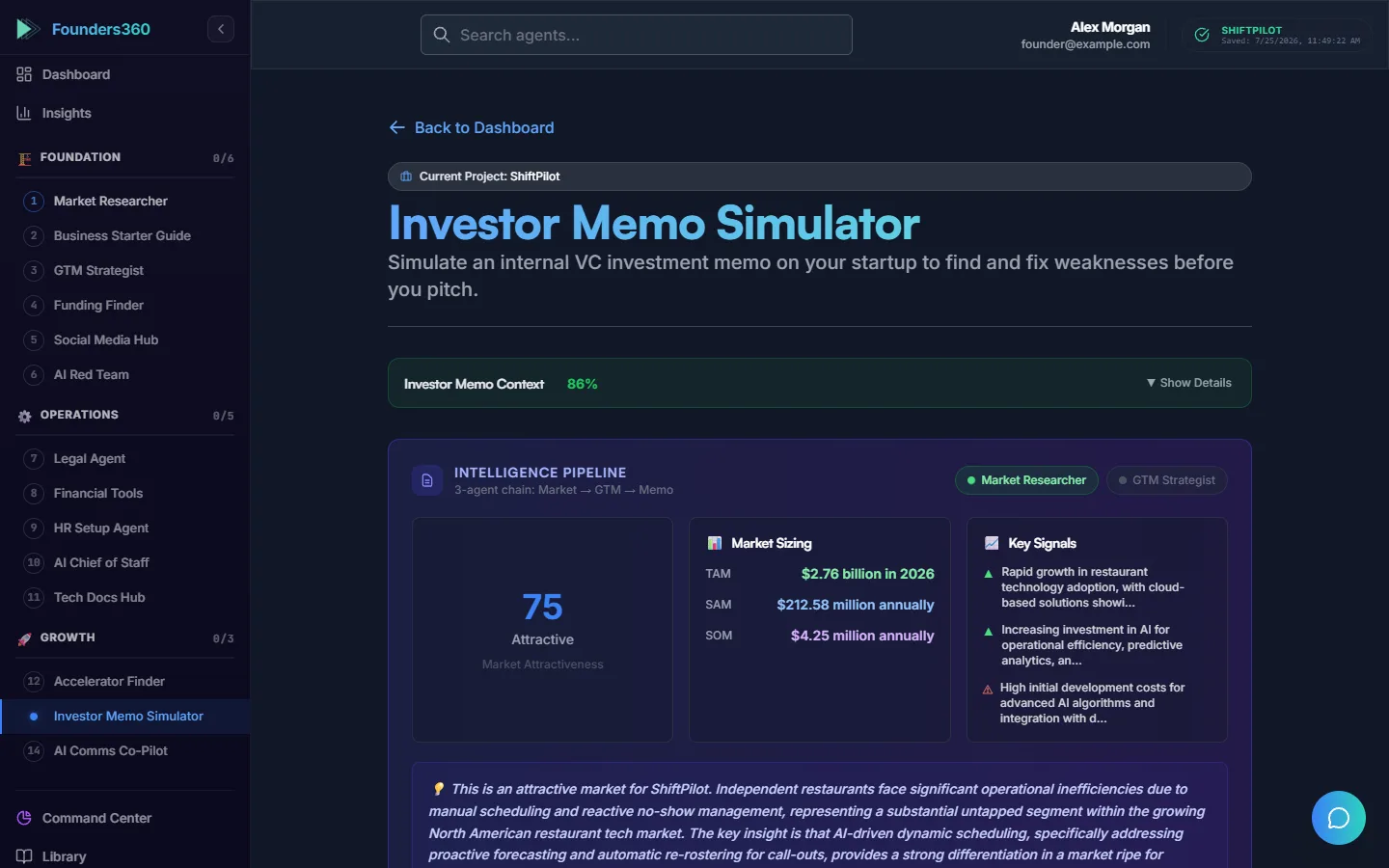
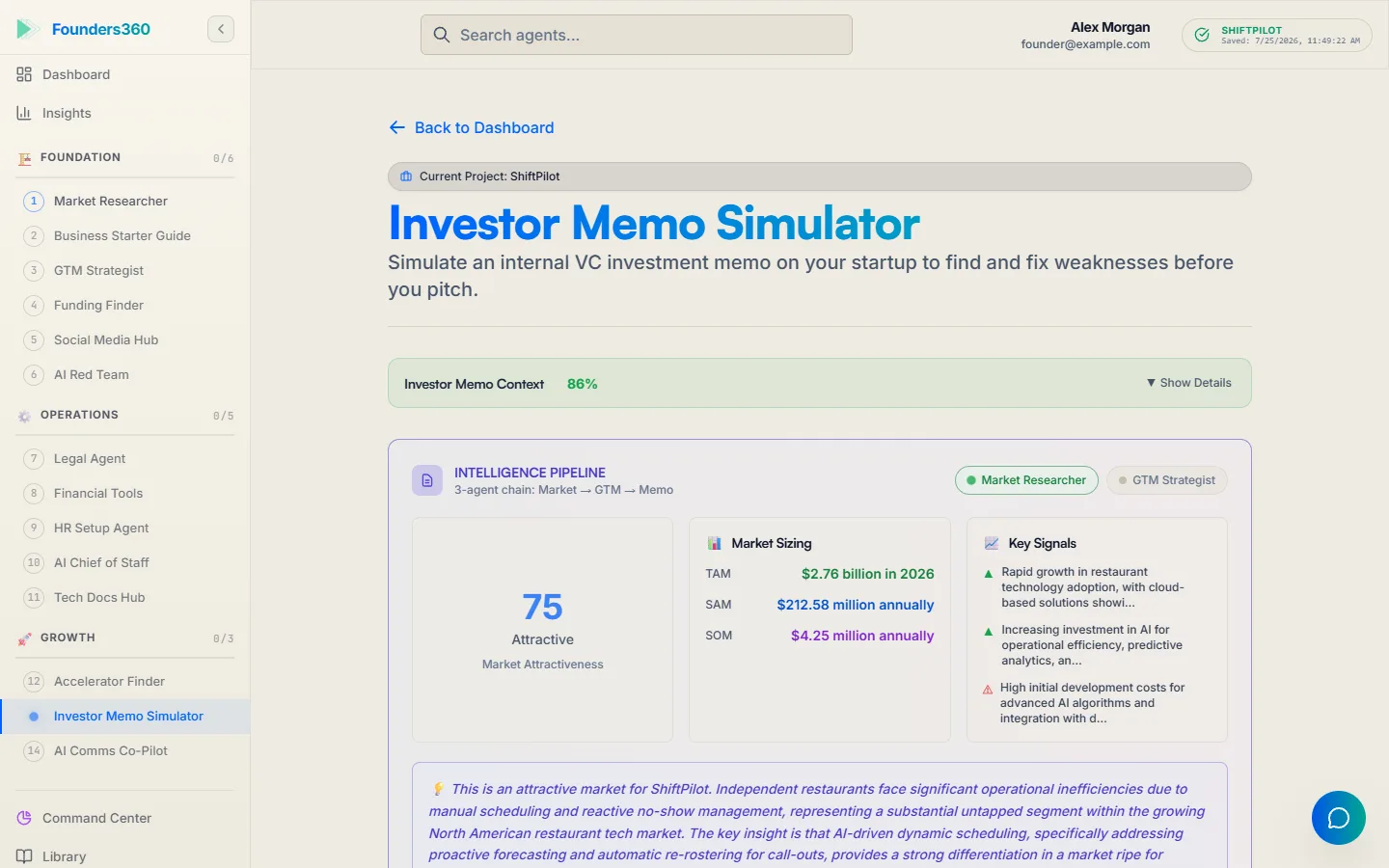
A top-down figure invites the follow-up that ends the meeting: "and what share of that is really yours?" A bottom-up figure answers it before it is asked. On ShiftPilot, the Market Researcher walked the market from a $2.8 billion total addressable market down to a $212.6 million serviceable market and a $4.3 million obtainable slice, with the assumptions behind each step written into Shared Context, the per-company memory every later agent reads. When the Funding Finder later built the deck, it placed those three numbers on the market slide without being told, so the number in the room matched the number in the deck. Our guide to pitch deck structure covers what each of the twelve slides should carry.
Keep the working with you. A founder who can pull up the customer count and the price assumption on request has answered a second question nobody asked: whether the rest of the numbers were built the same way.
"Why has nobody done this before, and why now?"
Answer with one specific change and a date. A regulation took effect, an input cost fell below a threshold, a platform opened an interface, a behaviour shifted and stayed shifted. "AI makes it possible" is not an answer in 2026, because it is true of every deck the investor read this week.
The second half of the question is the one to take seriously. If nobody has done this before, either the change is genuinely recent or the problem is not worth solving, and the investor wants proof it is the former. Name the companies that tried it under the old conditions and what stopped them.
"What is the biggest risk, and what happens when this does not work?"
Answer with a named risk, the early signal that it is happening, and what you would do in response. "Execution" is the weak answer because it is true of every company and therefore says nothing. A strong answer sounds like: "The biggest risk is that restaurant owners will not pay for scheduling separately from their point-of-sale system. The signal is a trial-to-paid rate under ten percent by month four. If we see that, we sell through the point-of-sale vendors instead of direct."
Investors are looking for a founder who has already decided what the first warning sign looks like, because that founder will act on it in month four rather than month twelve. Our playbook on stress-testing a startup pitch before investor meetings walks through how to find your own top three risks before someone else does.
"How much are you raising, and what does it get you?"
Answer with a milestone, a number and a date: "$500,000 on a SAFE to reach 40 paying restaurants and $30,000 in monthly recurring revenue within 14 months." Runway is a consequence of the raise, not the purpose of it, and "eighteen months of runway" tells the investor nothing about what exists at the end of those months.
Expect the follow-up on terms, and know which term matters. We ran our own deal-term simulator on a pre-seed round and moved the valuation cap from $8 million to $12 million. Founder ownership moved from 75.29 percent to 75.88 percent: half a point. At the higher cap the 20 percent discount governed instead, so the term founders fight hardest over mattered most only in the scenario where the company did badly. Option pool size and raise amount moved ownership far more. A founder who can say that in the room understands the deal better than the term sheet template does. The full working is in what a SAFE cap actually costs you in dilution.
"What have you learned from your data so far?"
Answer by saying what you checked before you trusted the number, because the investor has seen many founders quote a headline figure that did not survive a second look. The question is about judgement, not about the figure.
We learned this the expensive way. Our public lead chatbot captured zero leads in its first seven weeks, and the obvious reading was that visitors were not interested. The real cause was a bug: every conversation that called a tool failed on the very next turn, and pricing questions always called a tool. The highest-intent question a visitor could ask was the broken path the whole time. The number was measuring the bug, not the funnel. The lesson we now apply to every metric, and the one worth saying out loud to an investor, is to re-baseline before drawing a conclusion from a number.
A founder who says "our activation rate is 40 percent, and here is how we ruled out the two things that could have inflated it" has answered a harder question than the one asked. That figure is illustrative.
How to rehearse the answers before the meeting
Rehearse against something that argues back. Reading your own deck does not surface the questions above, because you already know what you meant on every slide. A founder friend who has raised will surface some of them; an adversarial tool will surface them every time.
The Skeptical VC is a free, no-login AI investor that interrogates the pitch and ends with a blunt verdict naming the weakness it found and the agent that fixes it. Run it before the first real meeting and write down every question it asked that your deck did not already answer. For the written version, the Investor Memo Simulator in Founders360 drafts the memo an investor would write about your company after the meeting, reading the market sizing, the competitive facts and the financial assumptions already in Shared Context. Because it is written from the investor's side of the table, it names the same gaps the investor would.
What to do this week
Write your answers to the six questions above in one page, one paragraph each, with a number in every paragraph. Then run the pitch through the Skeptical VC and compare its questions with your page. Every question it asked that your page did not cover is a paragraph to add before Friday. You will not read from the page in the meeting, but you will have written it, and that is what the investor hears.
Frequently Asked Questions
What is the hardest question investors ask?
The incumbent question: why the biggest existing player does not simply build your feature. It is hardest because the honest answer requires knowing the incumbent's business model well enough to name the constraint that stops them, and most founders know their own product far better than the incumbent's.
Should I admit I do not know the answer to an investor question?
Yes, and follow it with how you will find out and by when. A confident guess that gets checked afterwards costs more than an honest gap. "I do not know the churn figure yet; we will have three months of cohort data by the end of the quarter" is a stronger answer than an invented percentage.
How do I answer the market size question without real data?
Count customers bottom-up from public sources and show the arithmetic. State how many businesses match your problem, what each would pay per year, and what share you can reach with your distribution. Label every assumption as an assumption. Investors accept an honest estimate with visible working far more readily than a large number with none.
How many questions should I prepare for before an investor meeting?
Prepare written answers to the six in this playbook, then run the pitch through an adversarial reviewer and add every question it raises that you had not covered. The six here are the ones that end meetings most often.
Tags
Related Articles
The Weekly Operating Cadence for Early-Stage Founders
The weekly operating cadence for early-stage founders is a Monday plan with one metric and three outcomes, protected build and customer blocks from Tuesday to Thursday, a written Friday review, and a monthly layer that checks runway and runs a pre-mortem.
9 min readPlaybooksHow to Run a Startup Pre-Mortem Before You Build
A startup pre-mortem is a 90-minute session that assumes the company has already failed eighteen months from now and asks everyone to write down why. Ranked by likelihood, cost and how late you would notice, the causes become the tests you run before writing code.
9 min readPlaybooksRejected by Y Combinator? What to Do in the Next 90 Days
A Y Combinator rejection is a data point about fit on one day, not a verdict on the company. This 90-day playbook covers what the rejection does and does not tell you, how to stress-test the pitch against an adversary, how to build the traction the application lacked, and how to line up other funding.
8 min readReady to Build Smarter?
Join thousands of solopreneurs using AI agents to scale their businesses.
Get Started Free