
How to Write an Executive Summary for Investors (With Template)
To write an executive summary for investors, fit your problem, solution, market, traction, model, competition, team and ask on one page that a stranger can read in two minutes. This guide gives the order, a fill-in template and an illustrative example.
By Founders360 Team
To write an executive summary for investors, put the nine things an investor needs on a single page, in a fixed order: the problem, your solution, the market, traction, your business model, competition, the team, the ask and how you will use the money. Lead with the sharpest fact you have, keep it to one page, and write it so a stranger can decide in two minutes whether to reply.
What is an executive summary for investors, and what is it for?
An executive summary is a one-page document that sells the next conversation, not the investment. It is the page an investor can forward to a partner, read on a phone between meetings, or open before deciding whether your deck deserves attention.
It is not a short business plan and it is not your deck pasted into prose. Its job is narrow: make a busy reader understand what you do, why it could be large, and what you want, fast enough that replying is easy. Attach it to a warm or cold introduction (see how to cold email investors) or send it ahead of a first call.
What goes in an executive summary, and in what order?
We recommend this order: problem, solution, market, traction, business model, competition, team, then the ask. The order matters because each block answers the question the previous one raises.
- Headline. One sentence that says what the company does and for whom. If it needs a second sentence, rewrite it.
- Problem. Who has the problem, how often, and what it costs them in money, time or risk. Use the customer's words.
- Solution. What you built and why it works better than the current alternative. Describe the outcome before the technology.
- Market. Who buys, how many of them exist, and the logic behind your number. A bottom-up market size (customers you can reach multiplied by what each pays) is more believable than a percentage of a large industry. Our TAM, SAM and SOM calculator guide walks through it.
- Traction. The proof: revenue, paying customers, pilots, waitlist, retention, growth rate. Give numbers with dates. If you have none, show the strongest evidence of demand you do have, labelled honestly.
- Business model. How you make money, who pays, and roughly how much per customer.
- Competition. The real alternatives, including doing nothing, and the one reason customers pick you.
- Team. The two or three people who matter and the specific reason each is the right person to build this.
- Ask and use of funds. How much you are raising, on what instrument, and what the money buys. A use of funds line should tie to milestones: "18 months of runway to reach 50 paying accounts" beats a pie chart of percentages.
What does an executive summary template look like?
Copy this template, replace the brackets, and delete any line you cannot support with a fact.
[Company name]: [One sentence: what you do, for whom, with what result.]
Problem. [Customer type] struggle with [problem], which costs them [amount or time] each [period]. Today they [current alternative], which fails because [reason].
Solution. [Product] lets them [outcome] in [timeframe]. Unlike [alternative], it [key difference].
Market. About [number] [customer type] in [region], each worth [annual value], gives a reachable market of [amount]. We start with [first segment].
Traction. As of [month, year]: [metric], [metric], [metric]. Growth: [rate] over [period].
Business model. We charge [who] [amount and unit]. Gross margin: [percent, or estimate]. Payback: [period].
Competition. [Competitor A] and [Competitor B] serve [segment] but [gap]. We win on [one reason].
Team. [Name], [relevant background]. [Name], [relevant background].
Ask. Raising [amount] via [instrument] to reach [milestone] in [months]. Use of funds: [item and share], [item and share], [item and share].
Contact. [Name, email, link to deck or demo.]
What does a good executive summary look like? An illustrative example
The example below is illustrative: the company, numbers and people are invented to show the format, and nothing here describes a real business.
RouteLedger (illustrative): Bookkeeping software for independent trucking owner-operators that turns fuel receipts and load confirmations into tax-ready books automatically.
Problem. Owner-operators lose about five hours a week to paperwork and often miss deductions because receipts live in glove boxes and phone photos.
Solution. Drivers photograph a receipt; RouteLedger categorises it, matches it to the load and produces quarterly tax summaries.
Market. Roughly 300,000 owner-operators in the target region at 600 dollars a year each gives a reachable market of 180 million dollars. We begin with the 20,000 who run three or more loads a week.
Traction. As of October 2026: 140 paying drivers, 12 percent month over month growth for four months, 94 percent monthly retention.
Business model. 49 dollars per driver per month, roughly 80 percent gross margin, payback under three months.
Competition. General bookkeeping apps ignore load matching; fleet software targets large carriers. We win on setup time of under ten minutes.
Team. A former dispatcher (six years, 40 drivers) and an engineer who built payments software.
Ask. Raising 750,000 dollars on a SAFE to reach 1,000 paying drivers in 18 months. Use of funds: engineering 50 percent, driver acquisition 35 percent, operations 15 percent.
If you are building the longer written version of this argument, see our investor memo template guide, and for the slide version see the pitch deck structure guide.

How long should it be, and how should it be formatted?
Our recommendation is one page, roughly 300 to 450 words, with the headline and traction visible without scrolling. Use short labelled blocks rather than paragraphs of prose, because investor attention is brief: a DocSend study of more than 200 pitch decks, reported by TechCrunch, found investors spent an average of 3 minutes and 44 seconds on a deck.
Format it as a PDF with a clean layout, one typeface, and a link to your deck or demo near the top. Put your contact details at the bottom. Name the file with your company name, for example "RouteLedger Executive Summary", so it is findable in an inbox a month later.
What mistakes make investors stop reading?
The mistakes that most undercut a summary are burying the point, inflating the market, hiding the ask and leaving out dates. Each one makes a reader doubt the rest.
- Starting with the company history. Investors want the problem and the result first. Your origin story belongs in the call.
- A top-down market claim. "One percent of a 50 billion dollar market" suggests you have not talked to customers.
- Traction without dates or definitions. "Growing fast" is not a metric. Say what grew, by how much and over which period.
- No ask. A summary that never says how much you are raising forces the reader to guess, and most will not.
- Ignoring competition. "We have no competitors" signals you have not looked. Name the alternatives, including a spreadsheet.
Before you send it, test the page: ask someone outside your industry to read it for two minutes and tell you what the company does, who pays and what you want. If they cannot, rewrite the headline and the problem.
How Founders360 helps you draft and test your summary
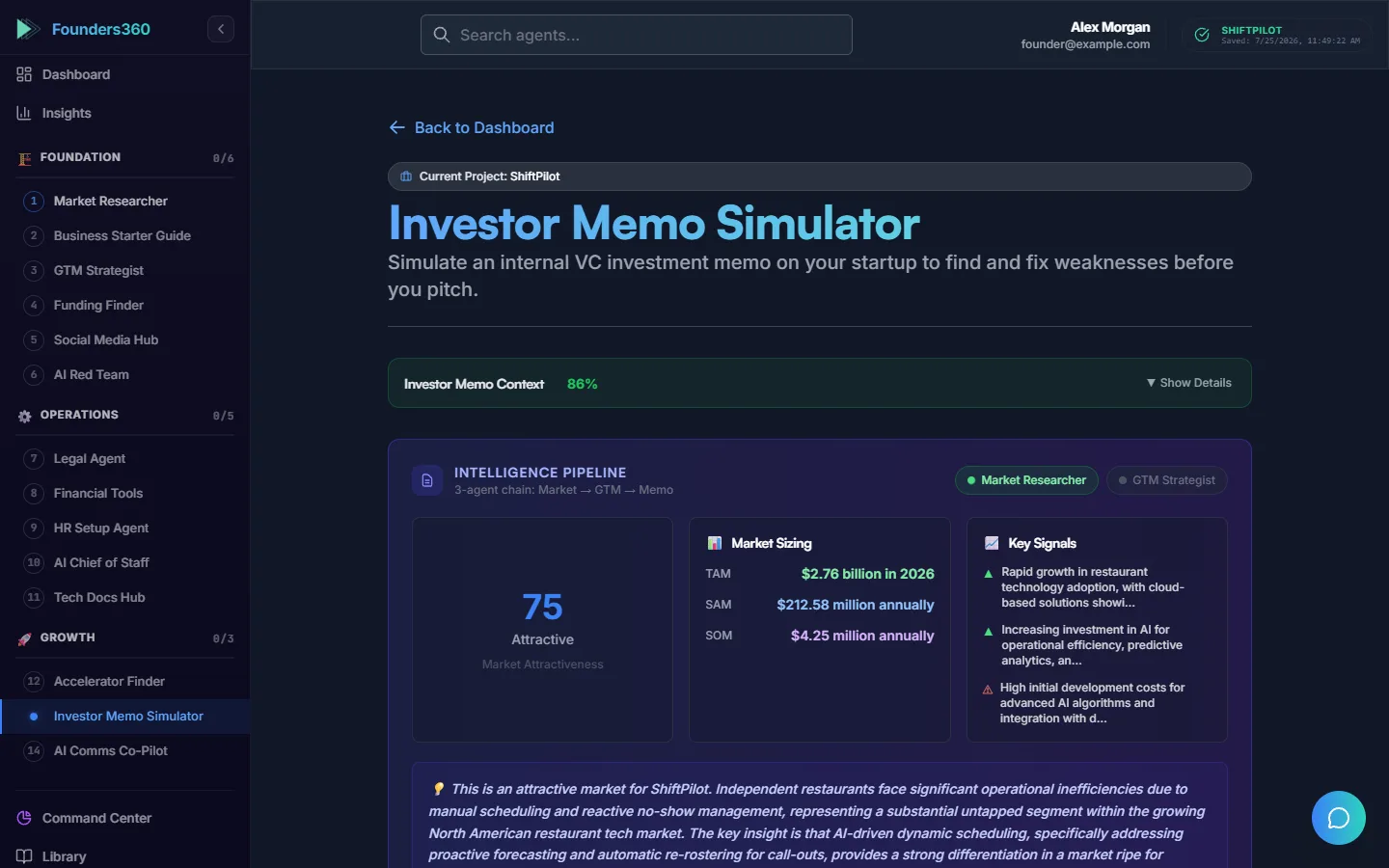
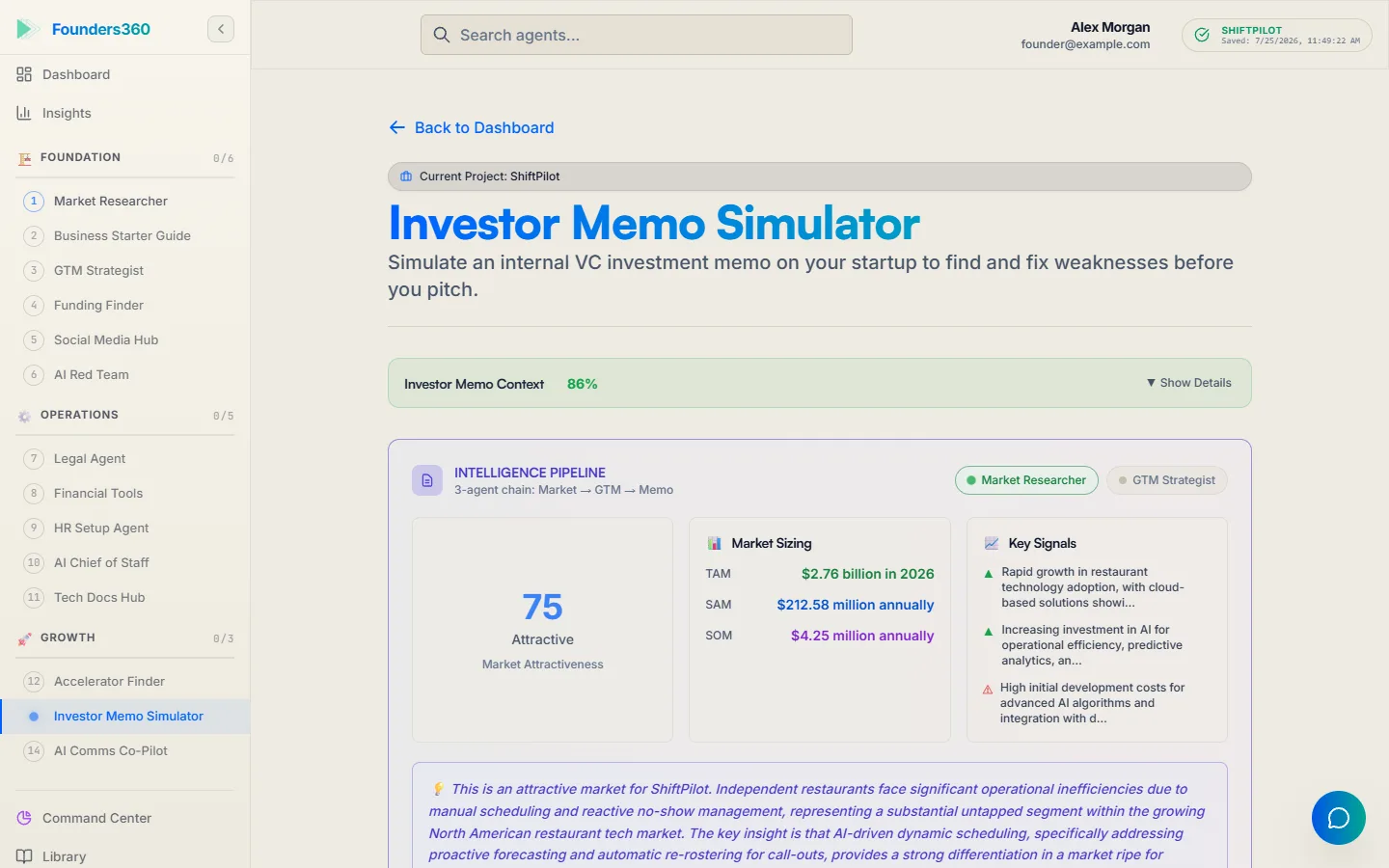
The facts on your page (market size, competitors, traction, ask) should match everywhere you state them. In Founders360, the Investor Memo Simulator and the Market Researcher both draw on Shared Context, the company memory every agent reads from, so your market figure and positioning stay consistent between the memo, the deck and the one-pager. You can also run your pitch through the free Skeptical VC pitch grill to find the weak lines before an investor does.
Try it free at https://www.founders360.world
Frequently Asked Questions
What is the difference between an executive summary and a pitch deck?
A pitch deck is a short visual presentation, often around 10 slides at seed stage, used in a meeting. An executive summary is a one-page written document used to earn that meeting. They cover the same ground, but the summary is shorter, text based and designed to be read without you in the room.
How long should an executive summary for investors be?
We recommend one page, or roughly 300 to 450 words. If you cannot fit the argument on one page, the argument is not yet sharp enough. Cut the weakest block rather than shrinking the font.
Should an executive summary include financial projections?
We suggest not in detail. Include traction, unit economics and your raise and use of funds. Full projections belong in a model you share on request, because a forecast on page one invites debate about assumptions before the investor understands the business.
What if I have no traction yet?
Show the strongest evidence of demand you do have: customer interviews, signed letters of intent, a waitlist, a prototype test. Label it accurately, and be specific about what you will prove with the money you are raising.
Tags
Related Articles
Term Sheet Explained: The Clauses Founders Must Understand Before Signing
A term sheet explained simply is a short, mostly non-binding offer that fixes the price and the control terms of a venture round. Most clauses are standard; a handful of economic and control terms decide who really wins.
7 min readFundraisingSAFE vs Convertible Note: Which Should Your Startup Use?
In a SAFE vs convertible note choice, the SAFE is simpler because it is not debt and has no interest or maturity date, while a note is a loan that converts into equity. This guide compares the terms side by side and shows when each one fits.
7 min readFundraisingStartup Funding Stages Explained: Pre-Seed, Seed, Series A and Beyond
The startup funding stages are pre-seed, seed, Series A, Series B and later, and each one buys a specific kind of proof. This guide covers what each stage is for, what investors expect, 2026 round sizes from named reports, and how to tell which stage you are at.
7 min readReady to Build Smarter?
Join thousands of solopreneurs using AI agents to scale their businesses.
Get Started Free