
Term Sheet Explained: The Clauses Founders Must Understand Before Signing
A term sheet explained simply is a short, mostly non-binding offer that fixes the price and the control terms of a venture round. Most clauses are standard; a handful of economic and control terms decide who really wins.
By Founders360 Team
A term sheet explained in one sentence is a short document in which an investor proposes the price and the main rights for a funding round, and which is mostly non-binding except for a few clauses such as exclusivity and confidentiality. A small number of its terms carry almost all of the consequence. Some are economic (they decide how much you keep) and some are control terms (they decide who can decide).
What is a term sheet, and what is actually binding?
A term sheet is a summary of the deal, written before the expensive legal documents. It lets lawyers draft the real agreements without redoing the negotiation.
Most of it is non-binding. The usual binding parts are confidentiality, the costs clause, and the no-shop (also called exclusivity), which stops you from soliciting or negotiating with other investors for a fixed window. Your leverage drops once you sign it, so negotiate the important terms first.
The reference point for US venture deals is the model documents published by the National Venture Capital Association (NVCA). The NVCA describes them as industry-embraced model documents for venture capital financings, meant to establish norms and avoid bias toward either the investor or the company, and says each is intended as a starting point only. Several of its financing documents were updated between October 2025 and June 2026 (as of October 2026). Treat the NVCA form as the working definition of "standard", and treat any term that departs from it as a question to ask.
Which economic terms decide how much you keep?
Valuation, the option pool, the liquidation preference and anti-dilution decide your outcome, and the headline valuation is the least informative of them.
Valuation and the option pool shuffle. The pre-money valuation sets the price per share. The trap is the option pool shuffle: the investor asks that a new employee option pool be created before the round closes, so the pool dilutes only existing holders. Here is an illustrative example. An investor offers $2 million at an $8 million pre-money valuation, so the post-money is $10 million and the investor owns 20 percent. If the term sheet also requires an unallocated pool equal to 10 percent of the post-money, that pool is worth $1 million and sits inside the pre-money. Your effective pre-money is $7 million, not $8 million. Ask for the pool to be sized to your real hiring plan for the next 18 months. For help setting the headline number, see how to value a pre-revenue startup.
Liquidation preference. This clause decides who is paid first when the company is sold. The standard is 1x non-participating: the investor gets the greater of its money back or its percentage of the proceeds. Participating preferred lets the investor take its money back and also share in what remains. In the illustrative round above, suppose the company sells for $5 million. With 1x non-participating, the investor takes its $2 million (more than its 20 percent share of $5 million, which is $1 million), and everyone else shares $3 million. With participating preferred, the investor takes $2 million plus 20 percent of the remaining $3 million, so $2.6 million. Market data shows what is normal: Cooley's Q4 2025 venture financing report found that 98 percent of its deals had a 1x preference and 96 percent used nonparticipating preferred stock. That covers 221 financings handled by one law firm, so it is a signal, not a census.
Anti-dilution. If you later sell shares at a lower price (a down round), anti-dilution protection adjusts the investor's conversion price. The market standard is broad-based weighted average, which softens the adjustment by counting all outstanding shares and options. Full ratchet resets the investor's price to the new lower price regardless of how few shares are sold. If the price falls from $1.00 to $0.50, a full ratchet doubles the number of common shares the investor converts into. Full ratchet is a red flag in an early round; ask for broad-based weighted average.
Redemption and pay-to-play. Both are uncommon: in the same Cooley report, redemption appeared in 1.8 percent of deals and pay-to-play (investors must keep funding or lose rights) in 6.3 percent. If either shows up in a first term sheet, ask why.
Which control terms decide who can decide?
Board composition, protective provisions, pro rata rights, drag-along and the no-shop decide who has the final word, and they matter more the longer you stay with the company.
Board seats. A balanced early board is commonly an odd number, with founders and investors each holding seats and an independent seat that both sides accept. Giving up board control in a first round is a red flag.
Protective provisions. These are the actions the company cannot take without approval from the preferred holders, even if the board agrees. Typical items include changing the charter, creating a senior class of stock, selling the company, redeeming shares, and taking on debt above a threshold. A short, specific list is standard. A long list that includes ordinary operating decisions, such as the annual budget or hiring a named executive, hands the investor a veto over daily management.
Pro rata rights. These let an investor buy its share of future rounds to keep its ownership percentage. They are common, but they can crowd out a new lead investor, so know who holds them. For how SAFEs interact with this, see what a SAFE valuation cap actually costs you in dilution.
Drag-along. A drag-along lets a specified majority force the remaining holders to join a sale of the company. It is standard and useful, because buyers want clean ownership. Check who must approve the sale: if only the preferred holders decide, you can be dragged into a sale at a price you reject.
No-shop. Shorter is better. Ask for a defined end date of a few weeks, and refuse a no-shop that renews automatically.
How do you tell a standard term from a red flag?
A clause is a red flag when it is rare in the market data, favours one side heavily, or has no stated reason. Compare each term with the NVCA form:
| Term | Usually standard | Push back or walk | |---|---|---| | Liquidation preference | 1x non-participating | Participating, or above 1x | | Anti-dilution | Broad-based weighted average | Full ratchet | | Board | Balanced, with an independent seat | Investor-controlled board in a first round | | Protective provisions | Short, specific list | Operating decisions under veto | | No-shop | Short, with a fixed end date | Long or auto-renewing |
Ask the investor to explain any term you do not recognise, and send the term sheet to a startup lawyer before you sign the no-shop, not after. Pressure test your own side of the table too: investors will ask hard questions, and the hardest investor questions and how to answer them is a good rehearsal.

How can you prepare before the term sheet arrives?
Decide your target dilution and walk-away terms before an offer exists. Write down the ownership you want to hold after this round, size your option pool from real roles, and decide which two terms you will not trade.
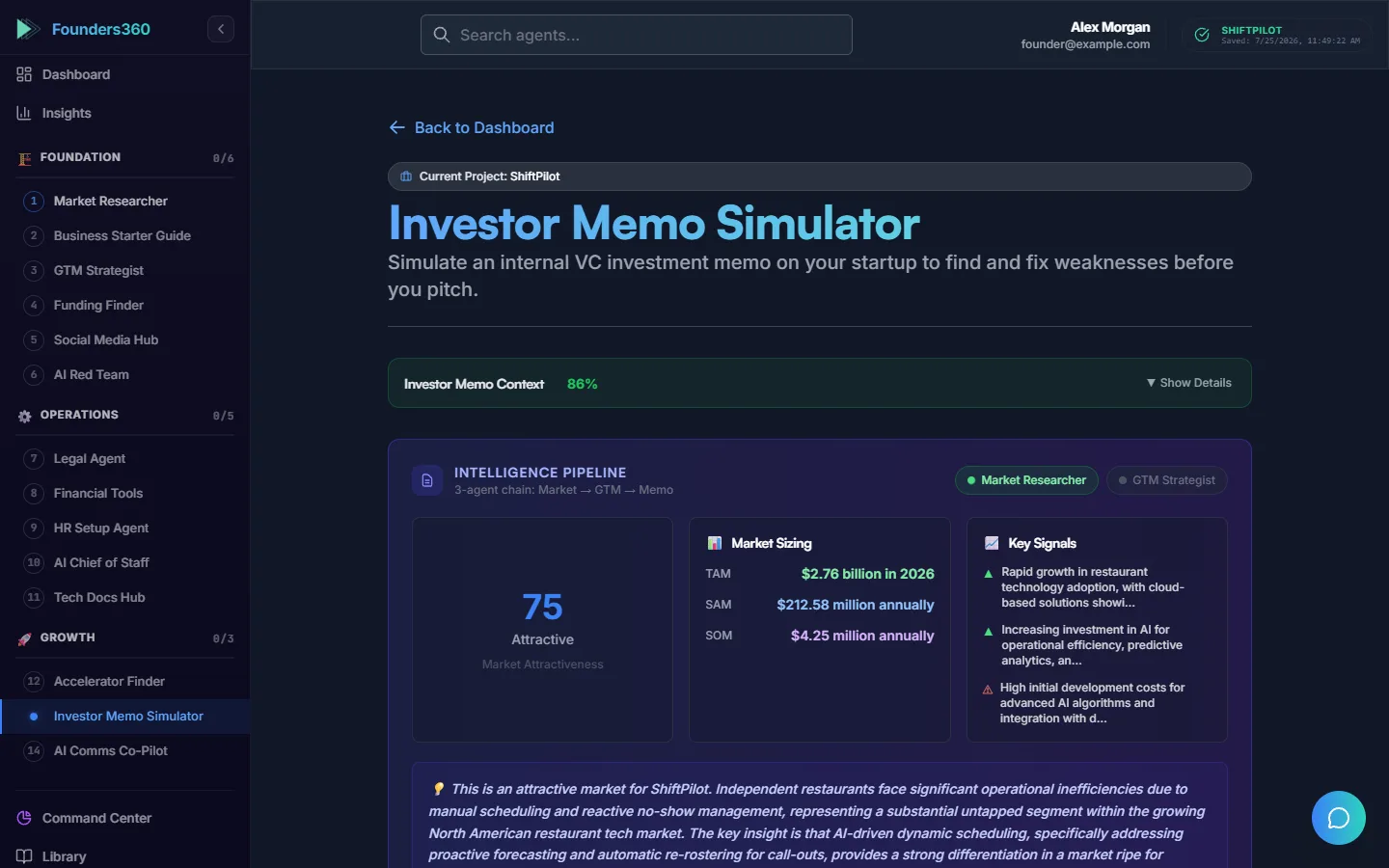
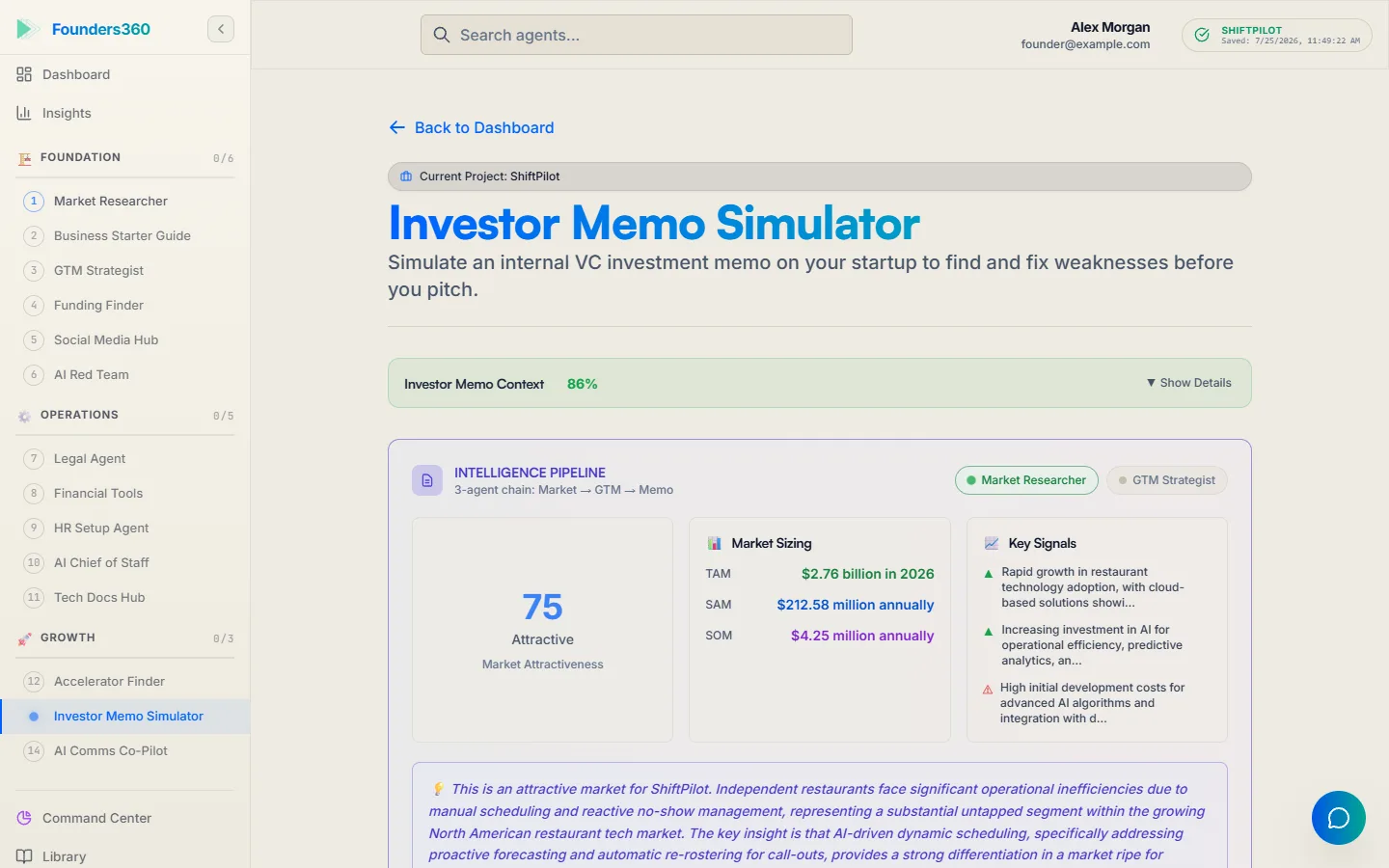
It also helps to read the round the way an investor does. The Investor Memo Simulator in the Founders360 suite looks at a round from the investor's side, which is useful practice for the conversation about price and structure. It does not replace a lawyer. For stage context, read the pre-seed fundraising guide, and rehearse the conversation in the free Skeptical VC pitch grill.
Try the Founders360 agents free at https://www.founders360.world.
Frequently Asked Questions
Is a term sheet legally binding?
Mostly no. The valuation, rights and structure are a statement of intent, and either side can walk away before the final documents are signed. The binding parts are usually confidentiality, costs and the no-shop.
What is the most important clause in a term sheet?
No single clause wins every deal, but liquidation preference, the option pool and board control together decide most outcomes.
What is a normal liquidation preference?
A 1x non-participating preference is the norm. Cooley reported that 98 percent of its Q4 2025 deals used a 1x preference and 96 percent used nonparticipating preferred stock.
What is the difference between broad-based weighted average and full ratchet?
Both protect an investor in a down round. Broad-based weighted average adjusts the conversion price in proportion to the size of the new, cheaper issuance across all shares outstanding. Full ratchet resets the price to the new low price no matter how small the round, which is far more dilutive to founders.
Do I need a lawyer to review a term sheet?
Yes, before you sign the no-shop. The term sheet becomes the template for the financing documents, so errors are much cheaper to fix at this stage.
Tags
Related Articles
SAFE vs Convertible Note: Which Should Your Startup Use?
In a SAFE vs convertible note choice, the SAFE is simpler because it is not debt and has no interest or maturity date, while a note is a loan that converts into equity. This guide compares the terms side by side and shows when each one fits.
7 min readFundraisingHow to Write an Executive Summary for Investors (With Template)
To write an executive summary for investors, fit your problem, solution, market, traction, model, competition, team and ask on one page that a stranger can read in two minutes. This guide gives the order, a fill-in template and an illustrative example.
7 min readFundraisingStartup Funding Stages Explained: Pre-Seed, Seed, Series A and Beyond
The startup funding stages are pre-seed, seed, Series A, Series B and later, and each one buys a specific kind of proof. This guide covers what each stage is for, what investors expect, 2026 round sizes from named reports, and how to tell which stage you are at.
7 min readReady to Build Smarter?
Join thousands of solopreneurs using AI agents to scale their businesses.
Get Started Free