
How to Cold Email Investors (and When a Warm Intro Is the Only Way)
Cold emailing investors works when the email is short, specific to that investor's thesis, and carries one number that proves traction. It fails when it is a mass mailing with a deck attached. Here is the template, the cadence, and the cases where only a warm intro will do.
By Founders360 Team
Knowing how to cold email investors comes down to three things: pick investors whose stated thesis already matches your company, write five lines that carry one proof number, and follow up exactly twice. A cold email done that way gets read. A cold email that opens with your life story and attaches a fourteen-slide deck gets archived, and the same investor is now harder to reach through a warm intro later.
We write this as the team behind Funding Finder, the most-used agent on Founders360 by external founders (about 36 percent of all runs). The first question most founders ask after the agent matches them to investors is whether they may simply write to those people. You may. The rest of this article is about doing it so the email is worth reading.
When cold emailing investors works and when it does not
Cold email works at pre-seed and seed for investors who publicly say they read cold inbound, and it works badly everywhere else. Many angels, micro-funds and solo GPs state on their site or profile that they read every email. That is a standing invitation, and a founder who writes a good one is competing with a small number of good ones, because most cold emails are bad.
It does not work with large multi-stage funds, where inbound is triaged by an associate whose job is to say no, and it does not work outside the investor's stated stage, sector or geography. An email to a Series B healthcare fund about a pre-revenue consumer app is a wasted send that trains the recipient to skip your name.
The honest hit rate is low. Treat a five to ten percent reply rate on a well-targeted list as a good outcome, and make cold email one channel of several. Our pre-seed fundraising guide for 2026 covers the other channels, including grants and accelerators, that do not depend on a stranger opening an email.
How to find the right investors to cold email
Build a list of twenty to forty investors whose last five deals look like you, not a list of two hundred names. The quality of the list decides the reply rate before a word is written. For each name you want the fund's stage, cheque size, sector focus, two recent investments and the partner who led them, because the email will reference at least one of those.
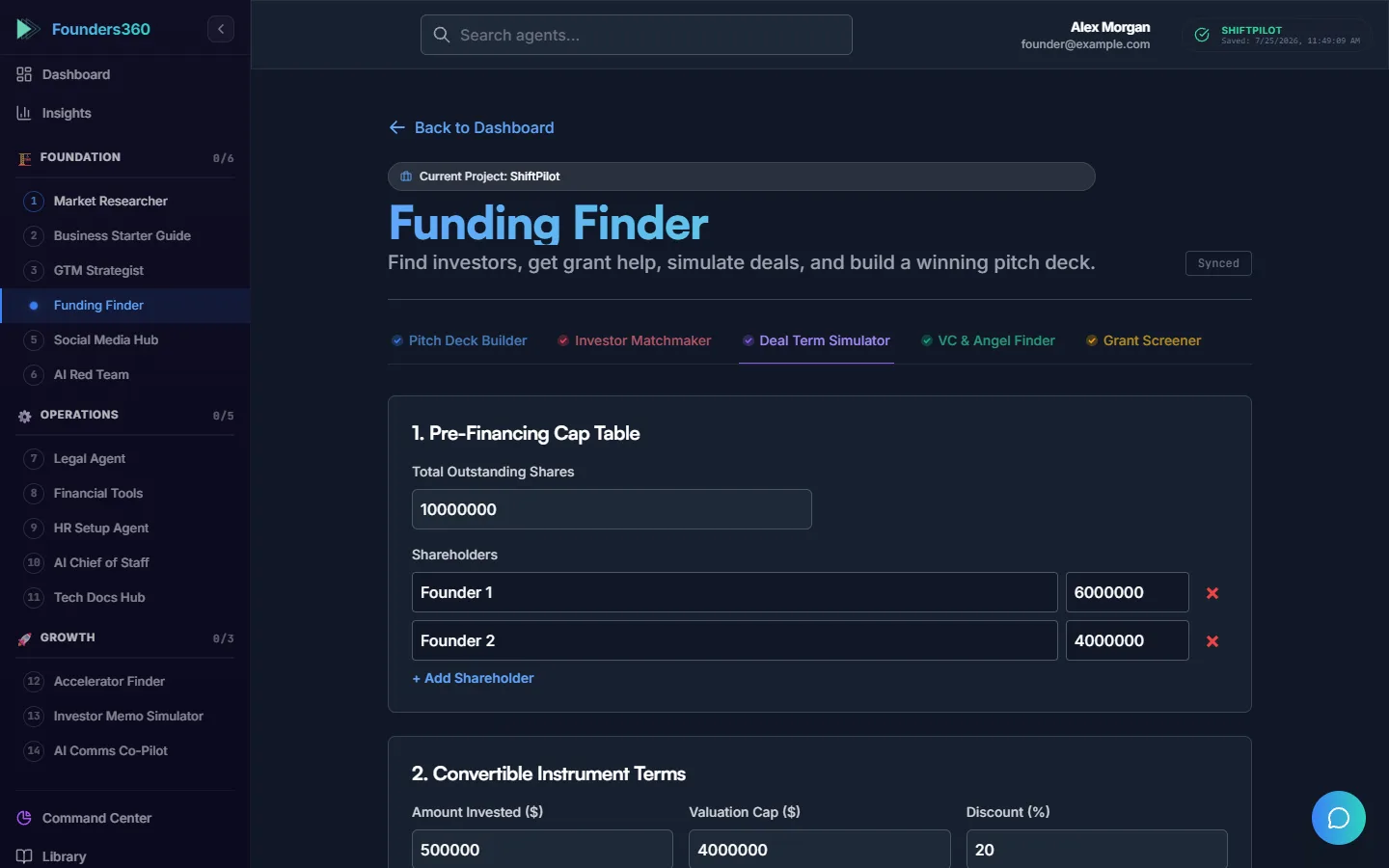
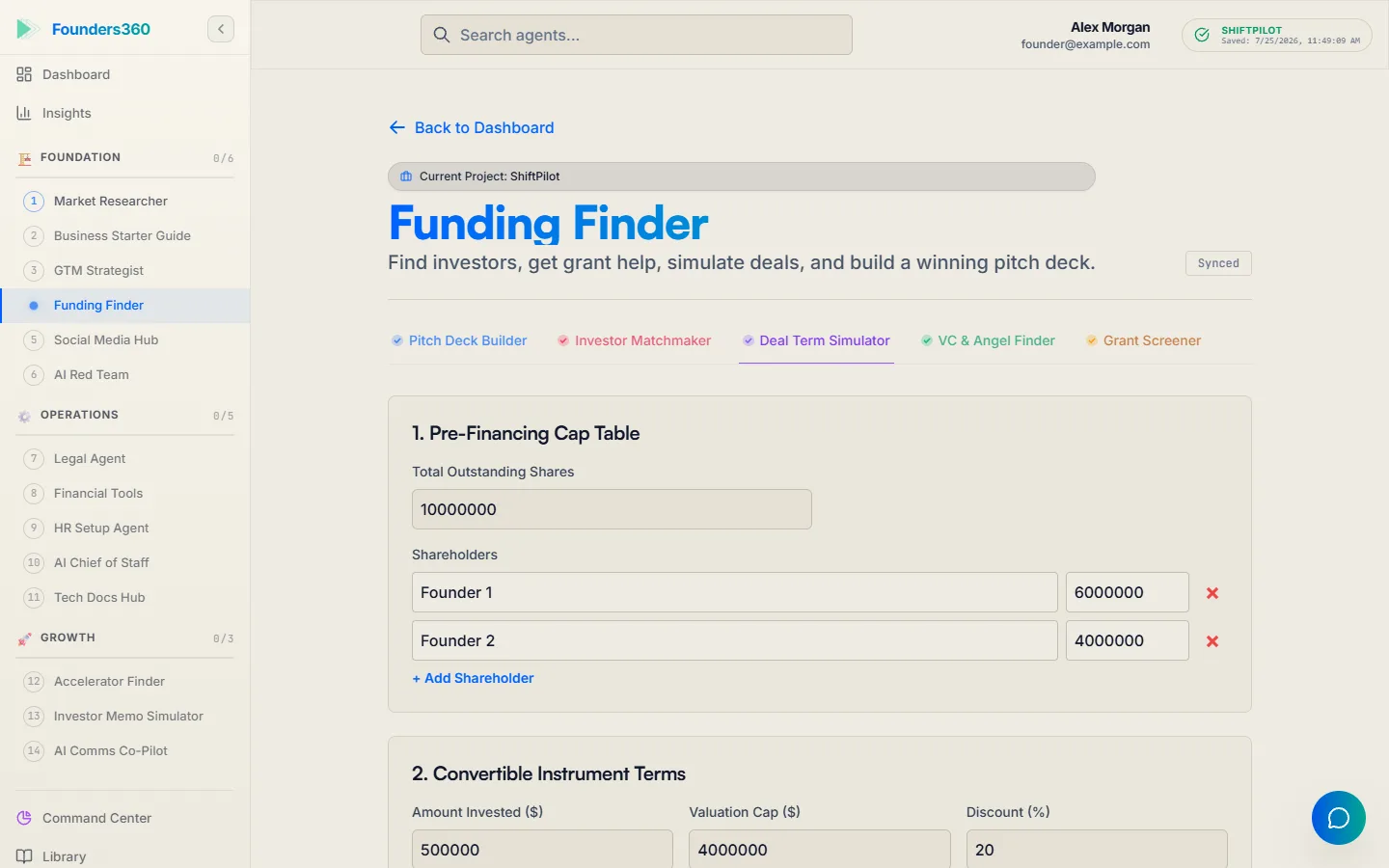
On Founders360 the Funding Finder does this matching against the company profile in Shared Context. The Market Researcher has usually already written the market size and the competitor set there, and the Funding Finder reads both, so the investor list it produces is filtered by the same facts that appear on the deck. What the agent writes back is a structured list: investor, stage fit, thesis match, and the one line in your story most likely to interest that partner. That last field is the seed of the cold email.
Verify every entry before sending. Funds change thesis and partners move. One bounce is noise; a run of them tells the receiving mail server that you are a bulk sender, and that reputation follows your domain.
The cold email structure investors actually read
Five lines, under 120 words, with one number in the second line. The structure below is what we see work. Placeholders are in square brackets and every figure is illustrative.
Subject: [Company]: [one-line what you do] ([traction number])

Hi [First name],

[Why this investor: one sentence naming a deal or a thesis post of theirs.]

[Company] does [what, for whom] and has [one proof number: revenue, users, pilots, growth rate] since [date].

We are raising [$X] on a [SAFE/priced] round to [one goal], with [$Y] committed.

Would a 20-minute call in the next two weeks make sense? Deck: [link, not attachment].

[Name], [Title]
[Phone] | [LinkedIn]
Each line has one job: prove you chose them on purpose, prove the company exists and moves, state the ask with momentum, make the next step trivial. There is no founding story and no feature list, because the reply you want is "send me more," not "I have read everything."
The deck is a link, never an attachment. Attachments trip spam filters, cannot be updated after sending, and give the investor a reason to skip the email itself. A link to a short deck or a pre-seed data room lets you see whether it was opened.
Subject lines and first sentences that get opened
The subject line states what the company does and the one number; the first sentence states why this investor. "Acme: scheduling software for restaurant groups (14 paying locations)" tells a partner in eight words whether to keep reading. "Quick question" and "Exciting opportunity" tell them nothing and read as mass mail.
The first sentence is where most cold emails fail, because founders write about themselves when the investor is scanning for evidence that the email was written for them. "You led the seed in [portfolio company] and wrote that vertical workflow tools win on data, so I thought this was worth two minutes" is specific, checkable and short. If you cannot write that sentence for a given investor, they should not be on the list.
Keep the tone flat and confident. No exclamation marks, no "I hope this finds you well," no apology for writing. The Comms Co-Pilot on Founders360 drafts outreach from the facts in Shared Context, so the traction number and the round terms in the email match the deck, but the "why you" sentence is the founder's job because the agent does not know why you admire that partner.
The follow-up cadence for a cold email to an investor
Follow up twice, at five and twelve business days, then stop. A first email that goes unanswered is not a no; partners travel, triage in batches and read on phones. A short follow-up that adds one new fact (a new customer, a new commitment to the round, a new milestone) gives them a reason to reply that the first email did not.
The second follow-up is the last, and it should say so plainly: "I will not chase again, but if the stage or sector is wrong for you I would value a one-line pointer to someone it fits." That line gets replies from people who were never going to invest, and a pointer from a partner who passed is a warm intro in all but name.
Three or more follow-ups turns a cold email into harassment and closes the door on a later warm intro. Log every send and reply against the investor's name so a later round starts from what was already said.
When a warm intro is the only way in
A warm intro is the only realistic path to top-decile multi-stage funds, to any partner who says they do not read cold inbound, and to investors who already passed on you cold. For those three cases, cold email is not a lower-probability route; it is a zero-probability route that also costs you the intro.
The best warm intro is the double opt-in. Ask the connector to check with the investor first, send the connector a three-line blurb they can forward unedited, and let the investor say yes before your name reaches their inbox. An intro made without asking the investor first is a cold email wearing a friend's signature, and partners can tell.
The cheapest way to manufacture warm intros is the monthly update. An investor who passed but agreed to receive your investor update email has watched twelve months of numbers by the time you raise again, and the founders of their portfolio companies are the connectors most likely to say yes to a double opt-in. Cold email is how you build that list; warm intros are how you spend it.
Cold email mistakes that close doors
The most expensive mistake is sending to everyone at once. A blast of two hundred identical emails produces a handful of replies and a domain reputation that lowers delivery on every email you send afterward, including the ones to customers.
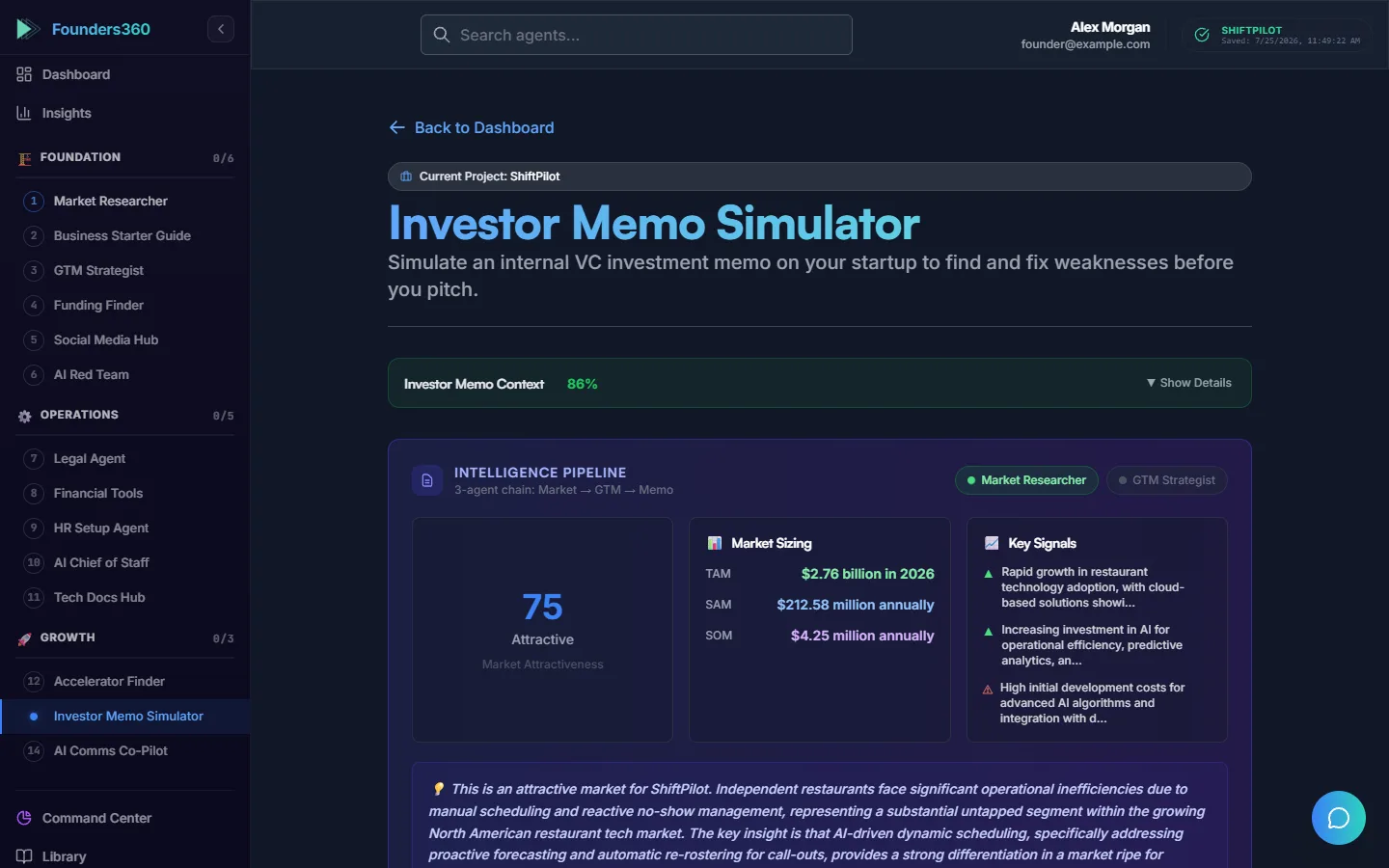
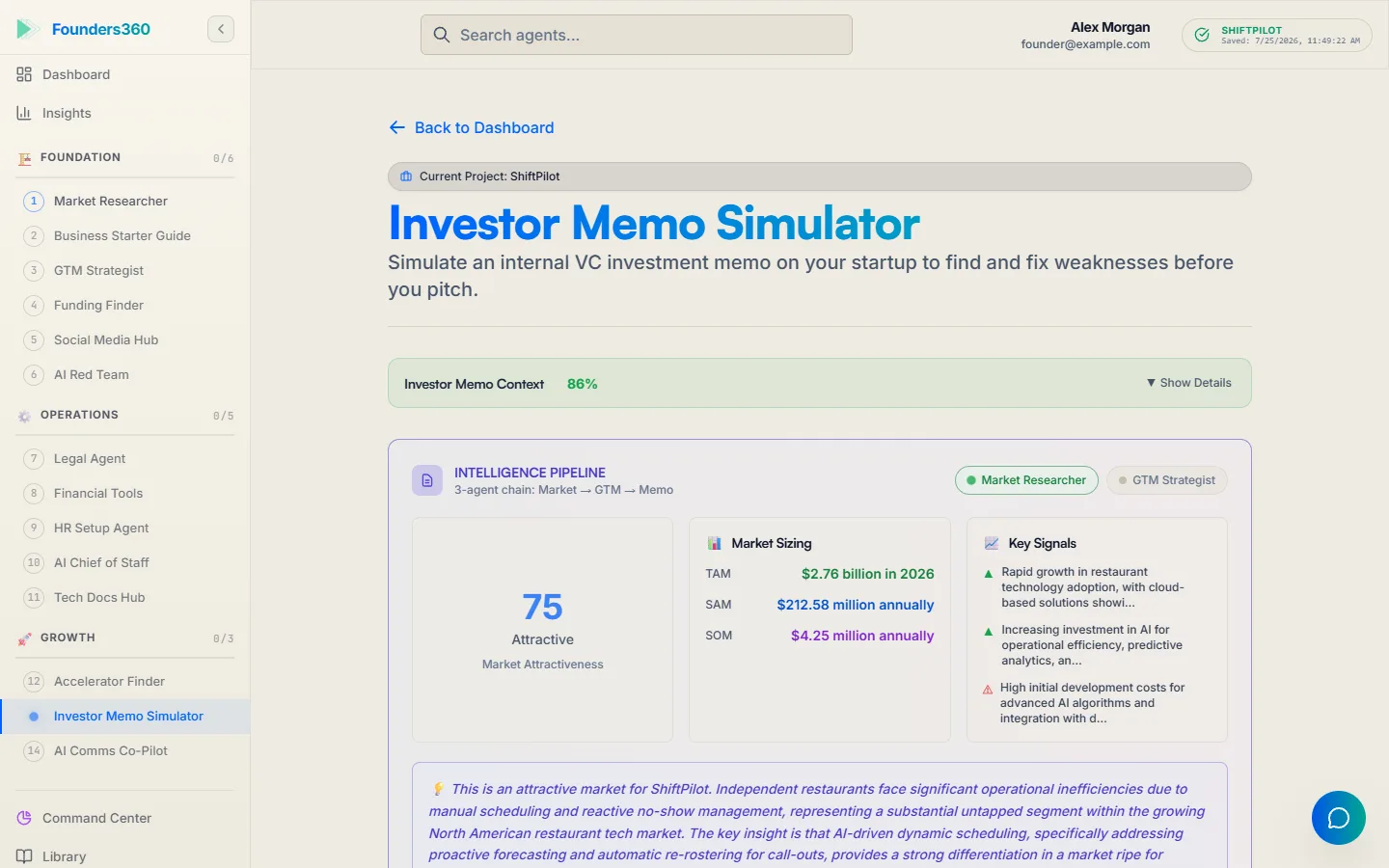
The second is sending before the pitch can survive a hard question. A partner who replies will ask the obvious thing (why now, why you, what stops the incumbent), and a founder who has not rehearsed it wastes the one reply the cold channel produced. Our free Skeptical VC exists for this: paste the pitch and it interrogates it with no login, ending with a verdict that names the weakness. The guide to stress-testing a pitch before investor meetings covers the same rehearsal in more depth.
The third we learned ourselves, in our own outbound program. Our cold email to institutions runs on a separate cron service with its own settings, and we once set the "require human approval" flag on the API service instead. It looked like it worked. The cron sent an email to a program director who was supposed to be reviewed first, and there is no unsend. The lesson for a founder is the same: nothing leaves your outbox to an investor unless a human has read that exact email, with that exact name, and the tooling that sends it is the tooling you checked.
Frequently Asked Questions
Do investors actually read cold emails?
Some do, and they say so. Many angels, micro-funds and solo general partners state publicly that they read every inbound email, and a specific, short email to one of them gets a real read. Large multi-stage funds route cold inbound to an associate and rarely act on it, so target the first group and use warm intros for the second.
How long should a cold email to an investor be?
Under 120 words and five lines: why this investor, what the company does with one proof number, the round and what is committed, the ask for a short call, and a link to the deck. Anything longer is skimmed on a phone and archived.
Should I attach my pitch deck to a cold email?
No. Send a link. Attachments trip spam filters, cannot be updated after sending, and give the reader a reason to skip the email body. A link lets you change the deck later and see whether it was opened.
How many times should I follow up with an investor?
Twice, at roughly five and twelve business days, each adding one new fact. State in the second follow-up that it is the last and ask for a one-line pointer if the fit is wrong. A third chase closes the door on a later warm intro.
What reply rate should I expect from cold emailing investors?
Roughly one reply in ten to twenty from a well-targeted list of investors whose recent deals resemble your company. That figure is illustrative, not a benchmark; a list built from thesis fit outperforms a longer generic one every time.
This week: build a list of twenty investors whose last five deals look like your company, write the "why you" sentence for each one, and send the five where that sentence came easiest. Log the sends, set the two follow-up dates, and put the rest of the list into your monthly update.
Tags
Related Articles
The Weekly Operating Cadence for Early-Stage Founders
The weekly operating cadence for early-stage founders is a Monday plan with one metric and three outcomes, protected build and customer blocks from Tuesday to Thursday, a written Friday review, and a monthly layer that checks runway and runs a pre-mortem.
9 min readPlaybooksHow to Run a Startup Pre-Mortem Before You Build
A startup pre-mortem is a 90-minute session that assumes the company has already failed eighteen months from now and asks everyone to write down why. Ranked by likelihood, cost and how late you would notice, the causes become the tests you run before writing code.
9 min readPlaybooksRejected by Y Combinator? What to Do in the Next 90 Days
A Y Combinator rejection is a data point about fit on one day, not a verdict on the company. This 90-day playbook covers what the rejection does and does not tell you, how to stress-test the pitch against an adversary, how to build the traction the application lacked, and how to line up other funding.
8 min readReady to Build Smarter?
Join thousands of solopreneurs using AI agents to scale their businesses.
Get Started Free