
SAFE vs Convertible Note: Which Should Your Startup Use?
In a SAFE vs convertible note choice, the SAFE is simpler because it is not debt and has no interest or maturity date, while a note is a loan that converts into equity. This guide compares the terms side by side and shows when each one fits.
By Founders360 Team
In a SAFE vs convertible note decision, a SAFE is usually the simpler and cheaper choice for a US startup raising a small early round, because it is not debt and has no interest or maturity date. A convertible note is a loan that converts into shares later, so it carries interest and a deadline. Both delay the price of your company until a priced round, which is why early investors use them.
What is the difference between a SAFE and a convertible note?
The core difference is that a convertible note is debt and a SAFE is not. A convertible note is a short-term loan with a principal amount, an interest rate and a maturity date, which J.P. Morgan describes as a debt instrument that usually converts into equity in a future financing round. A SAFE (Simple Agreement for Future Equity) is a short contract an investor signs to fund your company now in return for stock rights later. Y Combinator states that it has "no interest and no maturity date."
Both instruments exist for the same reason: a pre-seed company is hard to value, so the investor and founder agree to settle the price when a priced round arrives.
SAFE vs convertible note side by side
The table below covers the terms that matter most, based on Y Combinator's SAFE documents and J.P. Morgan's note guide (as of October 2026).
| Term | SAFE | Convertible note | |---|---|---| | Is it debt? | No, it is a contract for future equity | Yes, it is a loan | | Interest | None | Accrues, usually folded into conversion | | Maturity date | None | Yes, commonly 12 to 24 months | | Repayment risk | No repayment obligation | Real obligation if it does not convert | | Valuation cap | Optional | Optional | | Discount | Optional, commonly 10 to 20 percent | Optional | | MFN option | Yes, a version with no cap or discount | Possible through a clause | | Legal cost and speed | Standard form, low | Moderate, more negotiation |
The interest rate on a note is set by negotiation and tends to follow the wider rate environment, so confirm the going rate with counsel rather than relying on a rule of thumb.
How do caps, discounts and MFN work?
A valuation cap is the highest company valuation at which the instrument converts, so early money gets a better price than later money. A discount gives the early investor a lower price than new investors pay: a 20 percent discount means the investor pays $0.80 where the new round pays $1.00. An MFN (most favored nation) SAFE has no cap or discount and instead takes the cap or discount of a SAFE the company issues later.
Y Combinator's standard SAFE forms offer a cap or a discount, not both, plus the MFN version with neither. A convertible note can carry both, and then the investor normally converts at whichever price is lower.
For a full treatment of what a cap does to your ownership at different valuations, read what a SAFE valuation cap actually costs you in dilution.
Pre-money vs post-money SAFE
A post-money SAFE sets the cap after counting all SAFE money raised, so each investor can compute their ownership exactly: investment divided by cap. Y Combinator has used the post-money version since 2018. Its own example is $500,000 on a $6.7 million post-money cap, which is about 7.5 percent. A pre-money SAFE measures the cap before the SAFE money, so every new SAFE dilutes the earlier ones in a way that is harder to predict.
For founders, the post-money SAFE makes the cost of each SAFE visible immediately. The new option pool added in the priced round is not counted in the post-money cap, so it dilutes founders and SAFE holders alike. If you sign several SAFEs, keep a running total of the percentages.

A worked conversion example (illustrative)
This example is illustrative, not a real deal, and it ignores option pools, other holders and legal nuances. Suppose founders hold 10,000,000 shares. An investor puts in $500,000 through either a post-money SAFE with a $5 million cap, or a note with a $5 million pre-money cap and 5 percent simple interest. A priced round then arrives 18 months later at $1.00 per share.
- SAFE: $500,000 divided by a $5 million post-money cap is 10 percent. The SAFE converts into about 1,111,111 shares, which is exactly 10 percent of the 11,111,111 total, at roughly $0.45 per share.
- Note: 18 months of simple interest at 5 percent adds $37,500, so $537,500 converts. At the cap price of $0.50 (the $5 million cap divided by 10,000,000 shares), that is 1,075,000 shares, or about 9.7 percent of 11,075,000.
In both cases the cap beats the $1.00 round price, so the investor converts at the lower price. The results land close together, but the note needed interest math that keeps growing if the round slips. If no round had come before the maturity date, only the note would have forced a conversation about repayment or an extension.
When should you use a SAFE and when a convertible note?
Use a SAFE when you are a US-incorporated company raising a small pre-seed or seed round from investors who accept the standard form. It is faster, cheaper and carries no repayment risk. Use a convertible note when an investor requires debt terms, when local law or practice in your country favors notes, or when the investor wants interest and a maturity date as protection.
Where you are incorporated matters. Y Combinator's online tool to send a SAFE supports only US-incorporated companies. It also publishes SAFE forms for companies formed in Canada, the Cayman Islands and Singapore, and says to consult a lawyer licensed in the relevant country before using them. Outside those places, expect to work with a local lawyer on either instrument.
Investor preference also decides it: some investors want a note's interest, others accept only the familiar Y Combinator SAFE. If you are still working out who to approach, see how to find angel investors, and for the wider picture of who funds you at this stage, the pre-seed fundraising guide for 2026. If you have not formed the company yet, start with how to incorporate a startup without a lawyer, since your jurisdiction shapes the choice.
Model your cap table before you sign
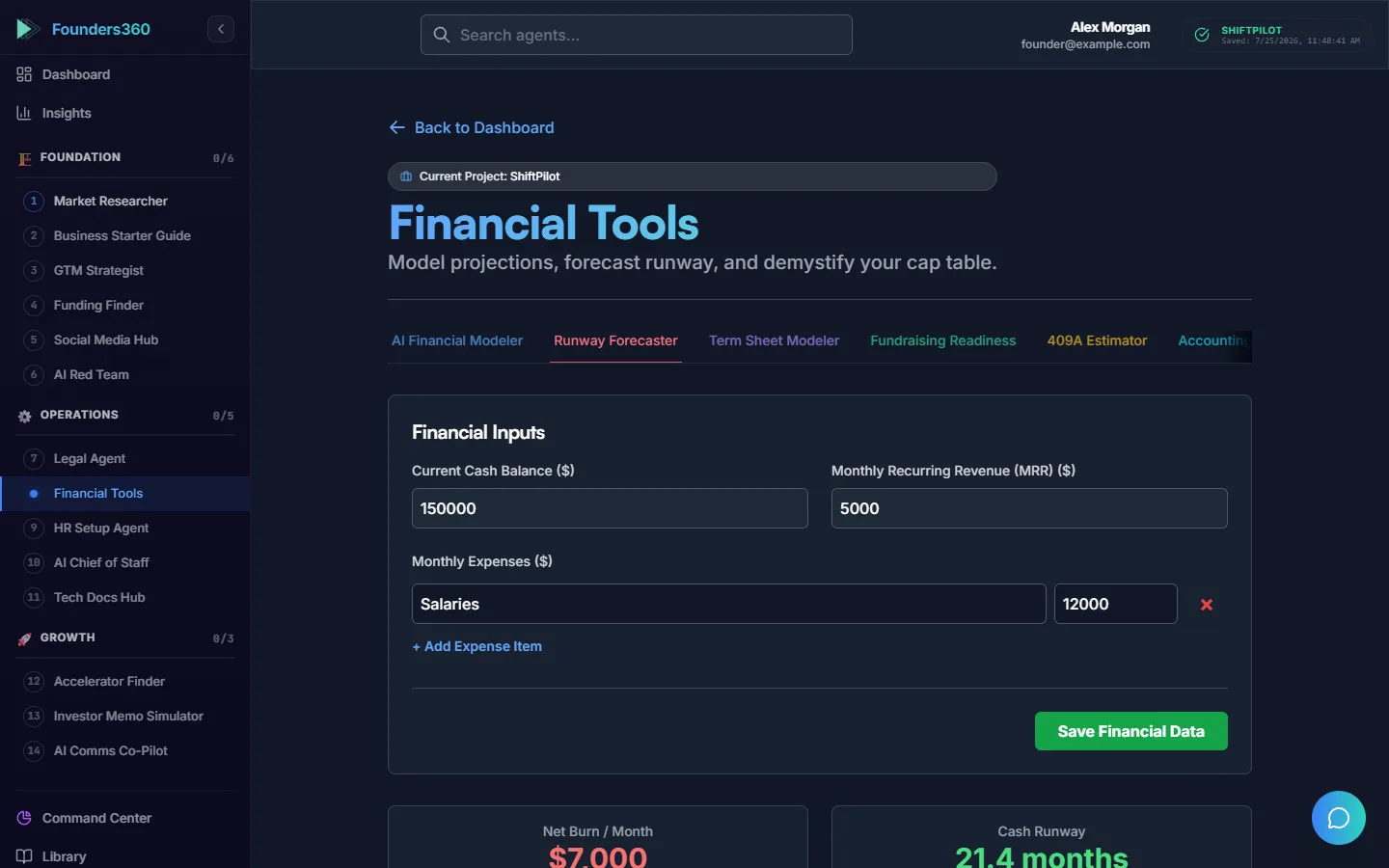
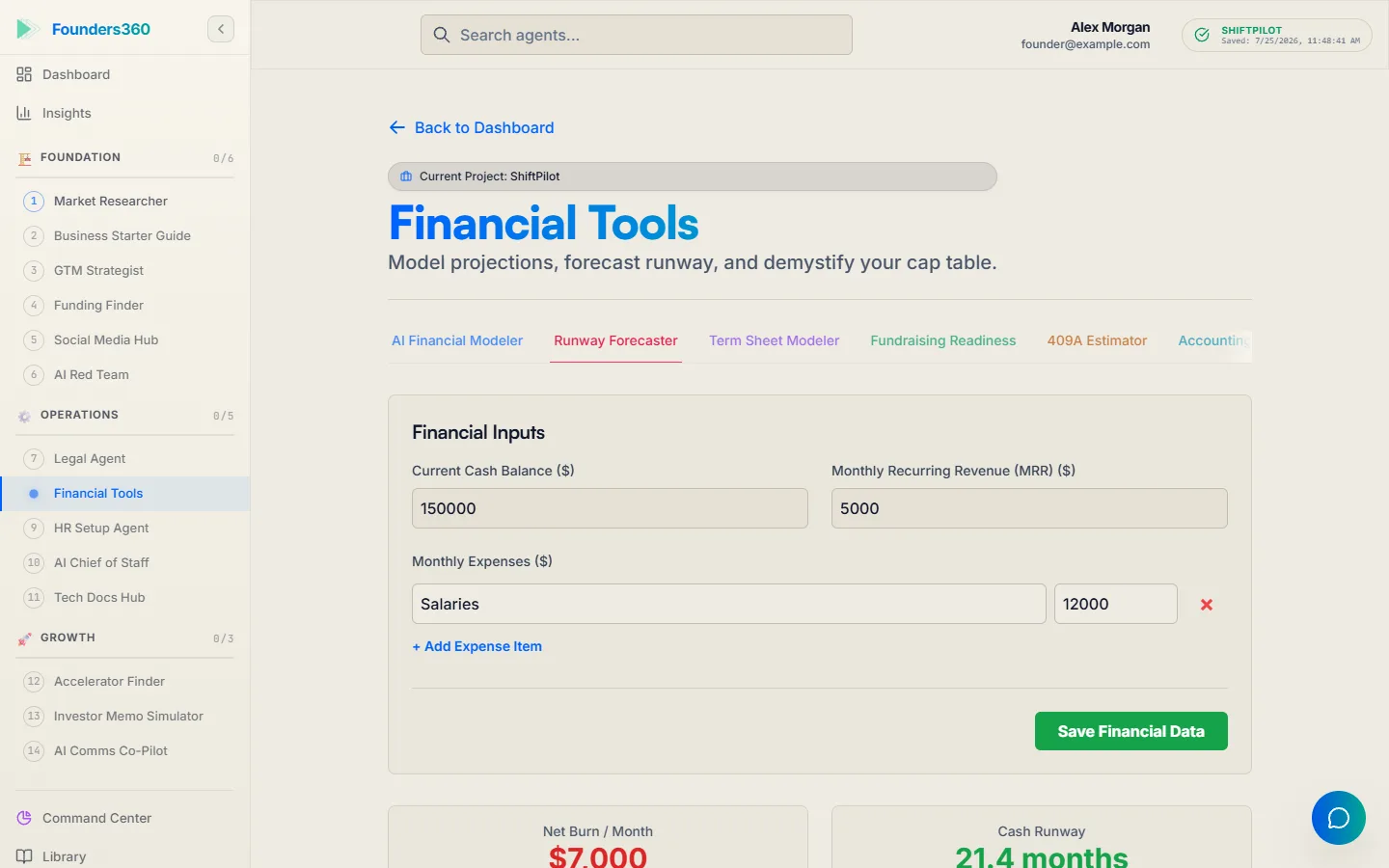
Whichever instrument you choose, the real risk is signing several of them without seeing the combined dilution. Before the first signature, write down each instrument, its cap and discount, and what the founders own after a priced round at a few plausible valuations. The guide to financial modeling for pre-revenue startups shows how to build the numbers that sit behind this. The Financial Tools agent in Founders360 can help you model the company finances that feed the same conversation, and because it shares one company memory with the other agents, the figures carry into your fundraising work. You can try it free at https://www.founders360.world.
Frequently Asked Questions
Is a SAFE better than a convertible note?
For most US founders raising a small early round, yes, because a SAFE has no interest, no maturity date and no repayment obligation, and the standard form is quick to sign. A note can still be the better fit when an investor insists on debt terms or when your local legal setting favors notes.
Is a SAFE debt?
No. Y Combinator states that a SAFE is not debt: it has no interest and no maturity date, so it does not accrue or come due. It becomes stock only when it converts, usually at a priced round.
What happens if a convertible note reaches its maturity date?
If no qualifying financing has happened, the founder and investor typically negotiate repayment, an extension or conversion, based on the note terms. Repayment is a real obligation in principle, which is the main risk a SAFE avoids.
What is the difference between a pre-money and post-money SAFE?
A post-money SAFE counts all SAFE money raised when setting the cap, so ownership equals the investment divided by the cap. A pre-money cap measures value before the SAFE money, which makes later dilution harder to predict. Y Combinator has used the post-money version since 2018.
Can I use a SAFE if my company is not in the US?
Possibly. Y Combinator publishes SAFE forms for Canada, the Cayman Islands and Singapore, but says to consult a lawyer licensed in that country. Its online tool supports only US-incorporated companies. This article is general information, not legal advice.
Tags
Related Articles
Term Sheet Explained: The Clauses Founders Must Understand Before Signing
A term sheet explained simply is a short, mostly non-binding offer that fixes the price and the control terms of a venture round. Most clauses are standard; a handful of economic and control terms decide who really wins.
7 min readFundraisingHow to Write an Executive Summary for Investors (With Template)
To write an executive summary for investors, fit your problem, solution, market, traction, model, competition, team and ask on one page that a stranger can read in two minutes. This guide gives the order, a fill-in template and an illustrative example.
7 min readFundraisingStartup Funding Stages Explained: Pre-Seed, Seed, Series A and Beyond
The startup funding stages are pre-seed, seed, Series A, Series B and later, and each one buys a specific kind of proof. This guide covers what each stage is for, what investors expect, 2026 round sizes from named reports, and how to tell which stage you are at.
7 min readReady to Build Smarter?
Join thousands of solopreneurs using AI agents to scale their businesses.
Get Started Free