
Startup Funding Stages Explained: Pre-Seed, Seed, Series A and Beyond
The startup funding stages are pre-seed, seed, Series A, Series B and later, and each one buys a specific kind of proof. This guide covers what each stage is for, what investors expect, 2026 round sizes from named reports, and how to tell which stage you are at.
By Founders360 Team
The startup funding stages are pre-seed, seed, Series A, Series B and later growth rounds, and each stage exists to fund one specific kind of proof: that the problem is real, that people will buy, that the model repeats, and then that it scales. You are at the stage that matches the proof you already hold, not the stage whose round size you would like to raise.
What are the startup funding stages in order?
The usual order is pre-seed, seed, Series A, Series B, Series C and beyond, with each round answering one question that the previous round left open.
- Pre-seed: Is this problem worth solving, and are you the team to do it?
- Seed: Will real customers pay, and do they come back?
- Series A: Can the model repeat predictably?
- Series B and later: Can the company scale without breaking?
The labels are conventions, not legal categories. A company can skip a stage, raise two seeds, or stay bootstrapped for years. Nothing in law says you must raise a Series A. The stages are a shared vocabulary that investors use to decide whether a company fits their fund, so learning the vocabulary saves you from pitching the wrong people.
What is pre-seed funding, and what do investors expect?
Pre-seed funding is the first outside money, raised on a team, a clear problem and early evidence, usually before meaningful revenue. Investors here are mostly angels, small funds, accelerators and friends and family, and they are betting on you more than on metrics.
Expect to show a defined customer, a handful of discovery conversations, a prototype or early pilot, and a credible plan for what the money buys over the next 12 to 18 months. The typical instrument is a SAFE or convertible note, because both let you raise without agreeing a price for the company yet. For a deeper walkthrough, see the pre-seed fundraising guide, and for the mechanics of the cap, read what a SAFE valuation cap costs you in dilution.
What is a seed round, and what traction do you need?
A seed round funds the search for repeatable demand: you have a product in use, and you need money to learn which customers pay, why they stay and how to reach more of them. Seed investors are specialist seed funds, angels and some larger funds, and they expect evidence of use, not only a plan.
What counts as evidence depends on the business. For software it often means paying customers, early recurring revenue or strong retention among a small group. For other models it may be repeat orders or signed pilots. Seed money is sometimes raised on SAFEs and sometimes as priced equity, so read the terms before assuming either. If you are unsure where to find the people who write these cheques, the guide to finding angel investors lays out the routes.
What is a Series A, and what do investors look for?
A Series A is the first large institutional round, typically priced equity led by a venture fund, and it exists to scale something that already works. Investors want proof of a repeatable engine: revenue, growth, retention and a clear picture of how new money turns into more revenue.
There is no single revenue number that unlocks a Series A. In an investor discussion published in the PitchBook-NVCA Q1 2026 Venture Monitor, Graham Brown of Lerer Hippeau warns against treating $3 million in revenue as a ticket to a Series A, because the rate of progress and your position in your category matter as much. Amy Wu Martin of Menlo Ventures adds that the quality of growth counts: customers who cannot operate without the product are a stronger signal than early revenue alone. Treat any benchmark as a signal of a moving bar, not a rule.
How much do startups raise at each stage in 2026?
As of October 2026, the most recent stage-level data I could open covers United States deals in Q1 2026, and the figures differ by source and definition, so read them as ranges.
| Stage | Median round size | Median valuation | Source | |---|---|---|---| | Seed | $3.0 million | $18.4 million pre-money | PitchBook-NVCA Q1 2026 Venture Monitor | | Series A | $19.6 million | $62 million pre-money | PitchBook-NVCA Q1 2026 Venture Monitor |
The PitchBook-NVCA report also notes that half of early-stage deals now exceed $10 million, and that the Series A median sits well below the $39.6 million average because a few very large rounds pull the average up. J.P. Morgan's H1 2026 Startup Insights shows the same $3.0 million median seed deal for Q1 2026. Carta publishes different figures because it measures software companies on its own cap table platform: its July 2026 benchmark, covering the prior six months, shows a median seed of $4.1 million raised at a $24.3 million valuation and a median Series A of $14.4 million raised at an $80 million valuation.
Pre-seed has no single median in these reports. Carta's State of Pre-Seed Q1 2026 counts about 3,000 United States startups on its platform raising pre-seed money in the quarter, and finds rounds under $1 million becoming more common.

The practical lesson: a median is the middle of a wide spread, and AI companies lift the numbers. A non-AI founder in a smaller market should expect to sit below these medians, and that is normal. Figures for Series B and later are outside what I verified, so check the PitchBook-NVCA report directly for those.
How do you know which funding stage you are at?
You are at the stage whose proof you can already show, so match your evidence to the question each stage answers.
- No customers yet, only a thesis and a prototype: pre-seed.
- Customers in use, revenue starting, retention unproven: late pre-seed or seed.
- Repeatable acquisition and retention, and growth you can explain: Series A territory.
- A working engine and a need for capital to scale it: Series B and later.
Two traps are common. The first is raising a stage ahead of your proof because a median looks attractive; investors will check the metrics and the round stalls. The second is raising more than you can justify, which sets a valuation you must grow into. Before you set a price, it helps to know how investors value a pre-revenue startup. Also consider whether equity is the right tool at all: grants, loans and revenue-based financing may fit, as the guide to non-dilutive funding explains. To test your pitch before real investors see it, the free Skeptical VC pitch grill is a fast way to find weak spots.
How can Founders360 help you match investors to your stage?
The Funding Finder agent in Founders360 helps you shortlist investors that fit your stage, so you spend outreach time on funds that actually write cheques at your size. It works from your company details held in Shared Context, which the other agents also use, so a market size found by the Market Researcher can carry into your funding work.
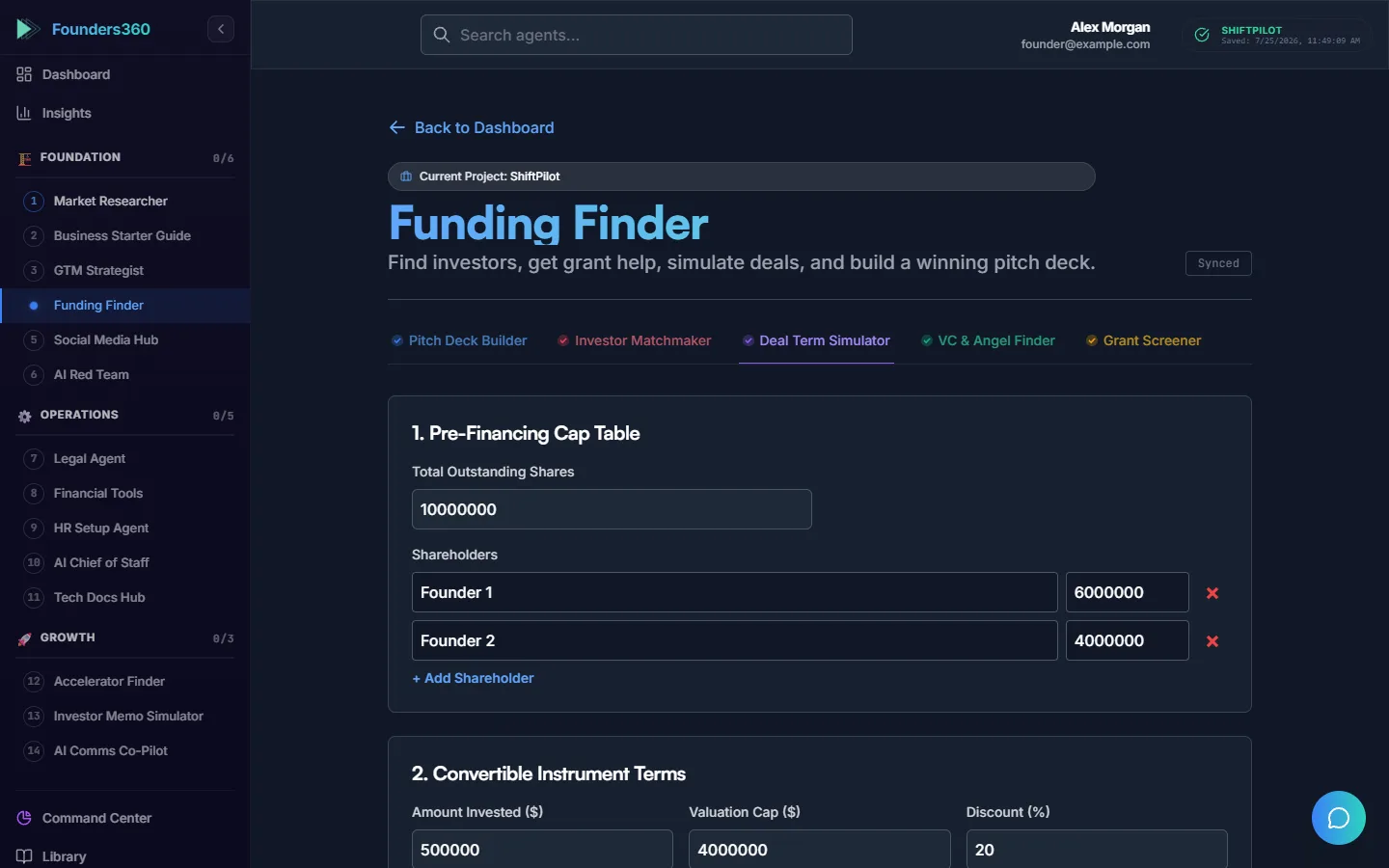
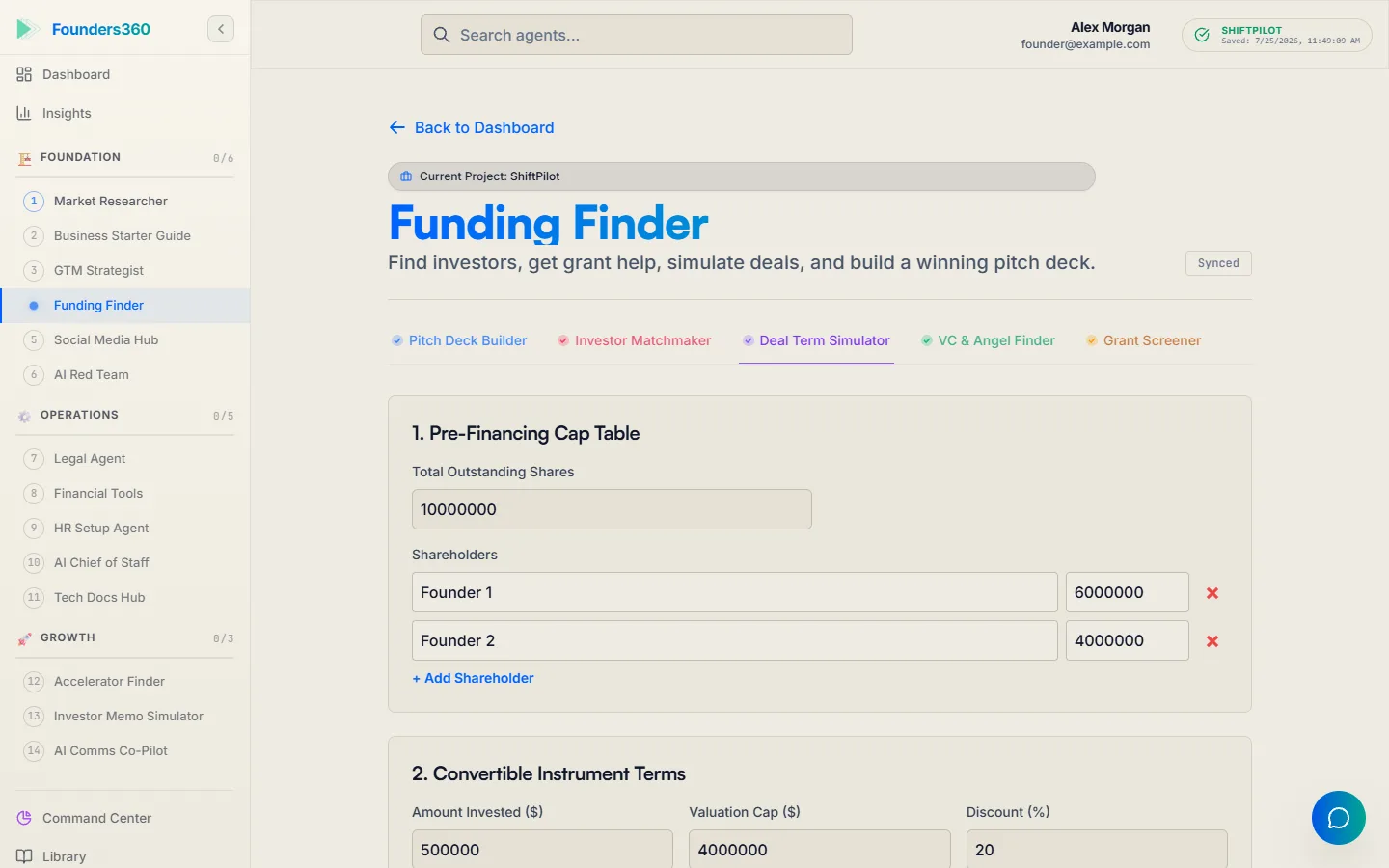
Use it as a starting list, then verify each investor yourself before you reach out. You can try it free at https://www.founders360.world.
Frequently Asked Questions
What are the stages of startup funding?
The main stages are pre-seed, seed, Series A, Series B and later rounds. Each funds a different proof: the problem, early demand, a repeatable model, and then scale.
How much do startups raise at seed in 2026?
In the United States, the median seed round was $3.0 million in Q1 2026 at a median pre-money valuation of $18.4 million, according to the PitchBook-NVCA Venture Monitor. Carta data for software companies runs higher: a median of $4.1 million raised at a $24.3 million valuation in the six months to July 2026.
What is the difference between pre-seed and seed?
Pre-seed funds the earliest work, often before revenue, and relies on the team and early evidence. Seed funds the search for repeatable demand and usually expects customers in use. The line is blurry, and some investors treat them as one stage.
Do I need to raise every funding stage?
No. The stages are conventions, not requirements. Many companies skip stages, raise smaller amounts, use non-dilutive funding, or grow on revenue without raising venture capital.
Is a SAFE the same as seed funding?
No. A SAFE is an instrument, not a stage. It is common at pre-seed and sometimes used at seed, while priced equity is the usual instrument at Series A.
Tags
Related Articles
Term Sheet Explained: The Clauses Founders Must Understand Before Signing
A term sheet explained simply is a short, mostly non-binding offer that fixes the price and the control terms of a venture round. Most clauses are standard; a handful of economic and control terms decide who really wins.
7 min readFundraisingSAFE vs Convertible Note: Which Should Your Startup Use?
In a SAFE vs convertible note choice, the SAFE is simpler because it is not debt and has no interest or maturity date, while a note is a loan that converts into equity. This guide compares the terms side by side and shows when each one fits.
7 min readFundraisingHow to Write an Executive Summary for Investors (With Template)
To write an executive summary for investors, fit your problem, solution, market, traction, model, competition, team and ask on one page that a stranger can read in two minutes. This guide gives the order, a fill-in template and an illustrative example.
7 min readReady to Build Smarter?
Join thousands of solopreneurs using AI agents to scale their businesses.
Get Started Free