
Break-Even Analysis for Startups: How to Calculate Your Break-Even Point
Your break-even point is the amount you must sell before revenue covers all of your costs. This guide gives the formula, a step-by-step worked example with illustrative numbers, and shows how changes in price, cost and target profit move the result, so you can set realistic sales goals.
By Jay Kambo
Your break-even point is the amount you must sell, in units or in revenue, before your income covers all of your costs. Below it you lose money, and above it you make a profit. You can calculate it with three numbers: your fixed costs, your price and your variable cost per unit. This guide gives the formula, walks through a worked example with illustrative numbers, and shows what changes the result.
What is a break-even point and why does it matter for a startup?
A break-even point is the level of sales at which your profit is exactly zero, and it tells you the minimum you must achieve to survive. One more sale beyond it creates profit. One fewer creates a loss.
Founders use it in four ways. It turns a vague goal such as "we need to grow" into a number, such as "we need 400 customers a month". It tests whether a pricing idea can ever work. It shows how much a new hire or tool raises the bar. And it gives investors a clear view that you understand your costs.
It is not a forecast of what you will sell. It is the line you must cross. Whether you can cross it depends on your market, which is why break-even works best alongside a realistic projection. Our guide to financial projections for startups with no revenue shows how to build one.
What numbers do you need to calculate break-even?
You need three numbers: total fixed costs per period, the selling price per unit and the variable cost per unit. Everything else comes from those.
- Fixed costs are costs that stay the same whether you sell one unit or a thousand, within a normal range. Examples are rent, salaries, insurance, software subscriptions and accounting fees. Choose a period, usually one month.
- Variable costs rise with every sale. Examples are materials, payment processing fees, shipping, hosting that scales with usage, and sales commissions.
- Price is what a customer pays for one unit. A unit can be one product, one subscription month or one hour of service.
Some costs are mixed. A salary is fixed, but overtime is variable. When unsure, ask whether the cost would fall to nearly zero if you made no sales this month. If yes, it is probably variable. If no, it is fixed.
Gather these figures from your real records where you can. Clean books make this easier. Our guide to runway and burn rate shows how to pull out your monthly costs.
What is the break-even formula?
Break-even units equal fixed costs divided by the contribution margin per unit, where contribution margin is price minus variable cost. Contribution margin is simply what each sale leaves over after its own direct costs, available to pay your fixed costs.
The formulas are:
- Contribution margin per unit = price - variable cost per unit
- Break-even units = fixed costs / contribution margin per unit
- Contribution margin ratio = contribution margin per unit / price
- Break-even revenue = fixed costs / contribution margin ratio
Break-even revenue is also break-even units multiplied by the price. Both routes give the same answer, so use whichever suits your business. A company that sells many products at different prices usually uses the revenue version.
How do you calculate break-even step by step? A worked illustrative example
Divide your fixed costs by what each sale contributes after its own direct costs. Here is a worked example. All numbers are illustrative and invented for teaching. They are not data from a real company.
Imagine a small startup that sells a software subscription:
- Price: 50 dollars per customer per month
- Variable cost per customer: 20 dollars (hosting, payment fees and support)
- Fixed costs: 12,000 dollars per month (salaries, tools and rent)
Step 1: Find the contribution margin per unit. 50 minus 20 equals 30 dollars. Each customer contributes 30 dollars toward fixed costs.
Step 2: Divide fixed costs by the contribution margin. 12,000 divided by 30 equals 400. The break-even point is 400 paying customers per month.
Step 3: Convert to revenue. 400 customers multiplied by 50 dollars equals 20,000 dollars in monthly revenue.
Step 4: Check with the ratio. The contribution margin ratio is 30 divided by 50, which is 0.6, or 60 percent. Fixed costs of 12,000 divided by 0.6 equals 20,000 dollars. The two methods agree.
Step 5: Prove it. With 400 customers, revenue is 20,000 dollars, variable costs are 8,000 dollars and fixed costs are 12,000 dollars. Total costs are 20,000 dollars, so profit is zero.

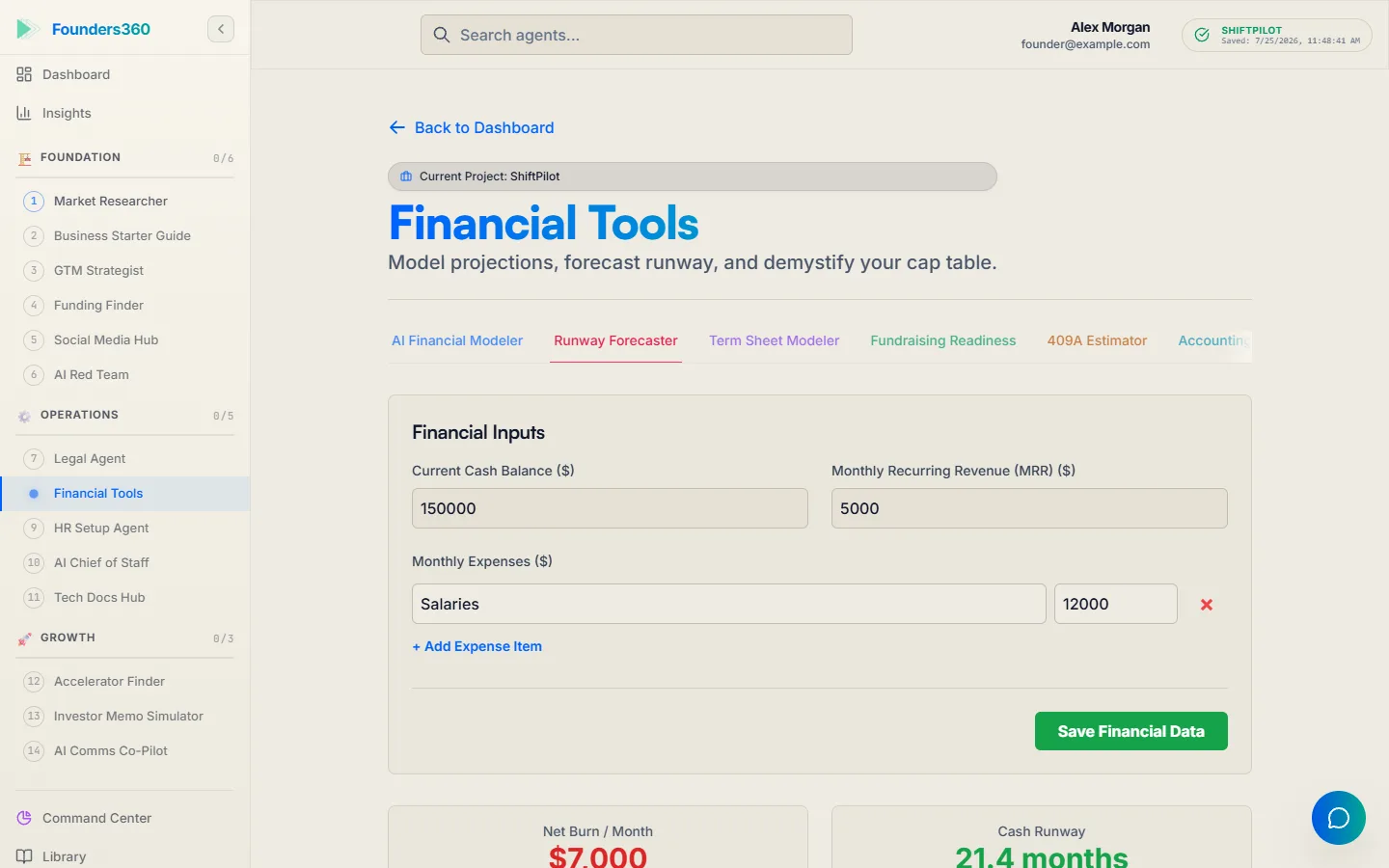
If you want to test numbers like these in a larger model, the Founders360 Financial agent is one place to start, but a simple spreadsheet is enough for break-even.
How do price, cost and profit targets change the break-even point?
Raising price or cutting variable cost lowers your break-even point, and raising fixed costs lifts it. You can test each lever by changing one number in the formula. These examples use the same illustrative startup.
- Price rises to 60 dollars. Contribution margin becomes 40. Break-even is 12,000 divided by 40, which equals 300 customers. A 20 percent price rise cut the target by 25 percent.
- Variable cost falls to 15 dollars. Contribution margin becomes 35. Break-even is about 343 customers (12,000 divided by 35 is 342.9, so round up to 343).
- Fixed costs rise to 15,000 dollars after a new hire. Break-even becomes 15,000 divided by 30, which equals 500 customers. One hire raised the bar by 100 customers.
Always round up to the next whole unit, because you cannot sell part of a customer.
To target a profit, add it to fixed costs. If the startup wants 6,000 dollars of profit a month, it needs (12,000 plus 6,000) divided by 30, which equals 600 customers. This is sometimes called the target profit sales volume.
Pricing changes can also change how many people buy, so a higher price is not automatically better. Treat these results as a map of what must be true, then test the price with real customers.
What is margin of safety and how long until you break even?
Margin of safety is how far your actual or expected sales sit above break-even, shown as a percentage of sales. It tells you how much sales can fall before you start losing money.
Using the illustrative startup: if it expects 500 customers and break-even is 400, the margin of safety is (500 minus 400) divided by 500, which equals 20 percent. Sales can drop by one fifth before the company makes a loss.
Break-even also has a time dimension. If you start from zero, add 25 new customers a month and lose none, you need 16 months to reach 400. If your cash runs out before then, the plan fails even though the formula works. Compare the months to break-even with your runway. Our unit economics guide explains how the contribution margin links to customer acquisition cost and payback.


What mistakes make a break-even analysis wrong?
Most errors come from missing costs, mixing up fixed and variable costs, or assuming one price for every customer. Check these before you trust your result.
- Leaving out your own pay. If founders take no salary now, a true break-even should include what you will need to pay yourselves.
- Forgetting payment fees, refunds and taxes, which reduce the contribution from each sale.
- Treating step costs as fixed. A support person, a larger server or a new office may be needed after a certain volume, and each raises the fixed costs.
- Ignoring discounts. Use the average price actually paid, not the list price.
- Using revenue instead of cash. If customers pay late, you may reach break-even on paper and still run short of cash.
- Assuming it stays still. Recalculate when your costs, prices or product mix change, and at least every quarter.
For companies with several products, calculate a blended contribution margin using the expected mix. Break-even is a planning tool, not a promise. Our roundup of AI business plan generators lists tools that can help build the wider model around it.
Frequently Asked Questions
What is the break-even formula?
Break-even units equal fixed costs divided by contribution margin per unit, and contribution margin per unit equals price minus variable cost per unit. For revenue, divide fixed costs by the contribution margin ratio, which is the contribution margin divided by the price.
What counts as a fixed cost and a variable cost?
Fixed costs stay roughly the same whatever you sell, such as rent, salaries, insurance and software subscriptions. Variable costs rise with each sale, such as materials, shipping, payment fees and commissions. When unsure, ask whether the cost would drop to nearly zero if you sold nothing this month.
How do I include a profit target in break-even analysis?
Add the profit you want to your fixed costs, then divide the total by the contribution margin per unit. In the illustrative example, fixed costs of 12,000 dollars plus a target profit of 6,000 dollars, divided by 30 dollars per unit, gives 600 units.
Is break-even the same as being cash positive?
Not always. Break-even is where profit is zero, and profit begins above it. Cash can differ, because paying suppliers before customers pay you can leave you short of cash even when your sales exceed break-even. Track both profit and cash.
How often should I recalculate break-even?
Recalculate whenever prices, costs or your product mix change, such as after a new hire, a price rise or a new supplier. At minimum, review it every quarter and before any fundraising conversation.
Tags
Related Articles
Privacy Policy and Terms of Service for Startups: What Each One Must Cover
A privacy policy tells people what data you collect and why, while terms of service set the rules for using your product. This guide explains what each document should cover for a startup website or app, and the basics of GDPR, CCPA and PIPEDA.
9 min readGuidesCompetitor Analysis for Startups: How to Do One, With a Template
A competitor analysis lists who your customers could choose instead of you, records what each offers, charges and does badly, and shows where you can win. This guide gives a seven-step method, a template table to copy, and advice on where to find reliable information.
8 min readGuidesBookkeeping Basics for Startup Founders: Accounts, Records and Cash vs Accrual
Bookkeeping is the habit of recording every dollar that comes in and goes out of your company so you can pay taxes, report to investors and make decisions. This guide covers separate accounts, a simple chart of accounts, cash versus accrual, a monthly routine and record retention periods.
9 min readReady to Build Smarter?
Join thousands of solopreneurs using AI agents to scale their businesses.
Get Started Free