
Privacy Policy and Terms of Service for Startups: What Each One Must Cover
A privacy policy tells people what data you collect and why, while terms of service set the rules for using your product. This guide explains what each document should cover for a startup website or app, and the basics of GDPR, CCPA and PIPEDA.
By Jay Kambo
A privacy policy explains what personal data your startup collects and why, and terms of service explain the rules for using your product. If your website or app collects even an email address, you need both, and the privacy rules of the places where your users live decide much of what the privacy policy must say. This is general information, not legal advice, so have a lawyer review the final documents.
What is the difference between a privacy policy and terms of service?
A privacy policy is about your users' data, and terms of service are about the relationship between you and your users. They answer different questions, so a startup needs two separate documents.
The privacy policy answers: what information do you collect, what do you do with it, who do you share it with, and what can people do about it? Privacy laws in many places require this document, and they say what it must contain.
Terms of service (also called terms and conditions or terms of use) answer: what may people do with your product, what may they not do, what happens if something goes wrong, and who is responsible? These are a contract between you and the user. Few laws list the exact words, so you decide the content, but it should protect both sides and match how your product really works.
Keep them on separate pages, linked in your footer and at sign up. Our overview of startup legal documents and their cost shows where these two fit among the other documents a new company needs.
Do you really need a privacy policy if you are small?
Yes, if you collect personal information from people, and most websites do. Personal information is wider than most founders expect.
The Office of the Privacy Commissioner of Canada describes personal information under PIPEDA as "any factual or subjective information, recorded or not, about an identifiable individual", according to its PIPEDA summary. An email address on a newsletter form, a name on a contact form and a customer account all fit.
Each law has its own scope, and some depend on where your users are, not where your company sits. The next three sections cover the main laws.
When does GDPR apply to a startup outside Europe?
GDPR can apply to you even if your company is outside Europe, when you offer goods or services to people in the European Union or monitor their behavior there. Article 3 of the regulation states that it covers processing of personal data of people who are in the Union by a controller or processor outside it when the processing relates to offering goods or services to them, whether or not they pay, or to monitoring their behavior in the Union. You can read it in the text of Article 3.
The regulation sets out what you must tell people when you collect their data. According to Article 13, the information includes:
- Who you are and how to contact you.
- Why you process the data and on what legal ground.
- Who receives the data, and whether it is sent to another country.
- How long you keep it.
- The rights people have: access, correction, erasure, restriction, objection and portability.
- That consent can be withdrawn at any time, where you rely on consent.
- The right to complain to a supervisory authority.
- Whether automated decision-making, including profiling, takes place.
Article 83 allows fines for the most serious infringements of up to 20 million euros or, for a company, up to 4 percent of total worldwide annual turnover of the preceding financial year, whichever is higher. The lower tier is up to 10 million euros or 2 percent. Those numbers are ceilings, not typical outcomes.
UK founders should also read the ICO guidance on UK GDPR, and UAE founders should check the data protection rules that apply in their emirate or free zone.
What does CCPA require for businesses that serve Californians?
CCPA applies only to larger or data-focused businesses, but if you meet its thresholds you need specific wording in your privacy policy. The California Attorney General's CCPA page says it applies to for-profit businesses that do business in California and meet any one of these:
- Gross annual revenue over $25 million, a figure the California Privacy Protection Agency raised to $26,625,000 from January 1, 2025.
- Buying, selling or sharing the personal information of 100,000 or more California residents or households.
- Earning 50 percent or more of annual revenue from selling California residents' personal information.
Many early startups fall below all three, but a fast-growing app can pass the 100,000 mark. The same page says that if CCPA applies, your privacy policy must describe consumers' rights to know, delete, opt out of sale or sharing, correct, limit use of sensitive information and not be discriminated against, and explain how to exercise them. It must also include a "Do Not Sell or Share" link if you sell or share personal information.
The page adds that requests to know, delete or correct must be answered within 45 calendar days, which can be extended by another 45 days with notice.
What does PIPEDA require in Canada?
PIPEDA requires private-sector organizations to follow 10 fair information principles, and the first things to build into your policy are consent and openness. The OPC summary names the principles: accountability, identifying purposes, consent, limiting collection, limiting use, disclosure and retention, accuracy, safeguards, openness, individual access and challenging compliance.
The same page says PIPEDA applies to private-sector organizations across Canada that collect, use or disclose personal information. Organizations covered by a substantially similar provincial law are generally exempt within that province, and it names Alberta, British Columbia and Quebec as having such laws. Businesses that move personal information across provincial or national borders are covered regardless of location.
On consent, the OPC's guidance says consent is meaningful only when it is reasonable to expect your customers will understand the nature, purpose and consequences of what they agree to. It asks organizations to explain what data is collected, who receives it, why it is used and what harms could follow. It also says people can withdraw consent, and that new consent is advisable when you make significant changes such as new purposes.
What should a startup privacy policy cover?
Cover what you actually collect, why, who gets it, how long you keep it and how people can use their rights. Combining the three laws above, a good startup policy answers these points in plain words:
- Who you are. Company name and a working contact email.
- What you collect. Account details, payment details handled by a payment provider, usage data, cookies and anything users type into your product.
- Why you collect it. One clear purpose per type of data.
- Who receives it. Name the types of service providers, such as hosting, email, analytics, payments and any AI provider that processes user input.
- Where it goes. Say if data is transferred to other countries.
- How long you keep it. A period or the rule you use to decide.
- People's rights. How to ask for access, correction or deletion, and how to withdraw consent.
- Children. If under-13s could use your product, note that the US children's privacy rule, COPPA, applies to services directed to children under 13 and to operators who know they collect data from them, according to the FTC.
- Changes. How you will tell people when the policy changes.
The policy must be true. List your real tools first, then write. A short honest policy beats one that names the wrong tools.
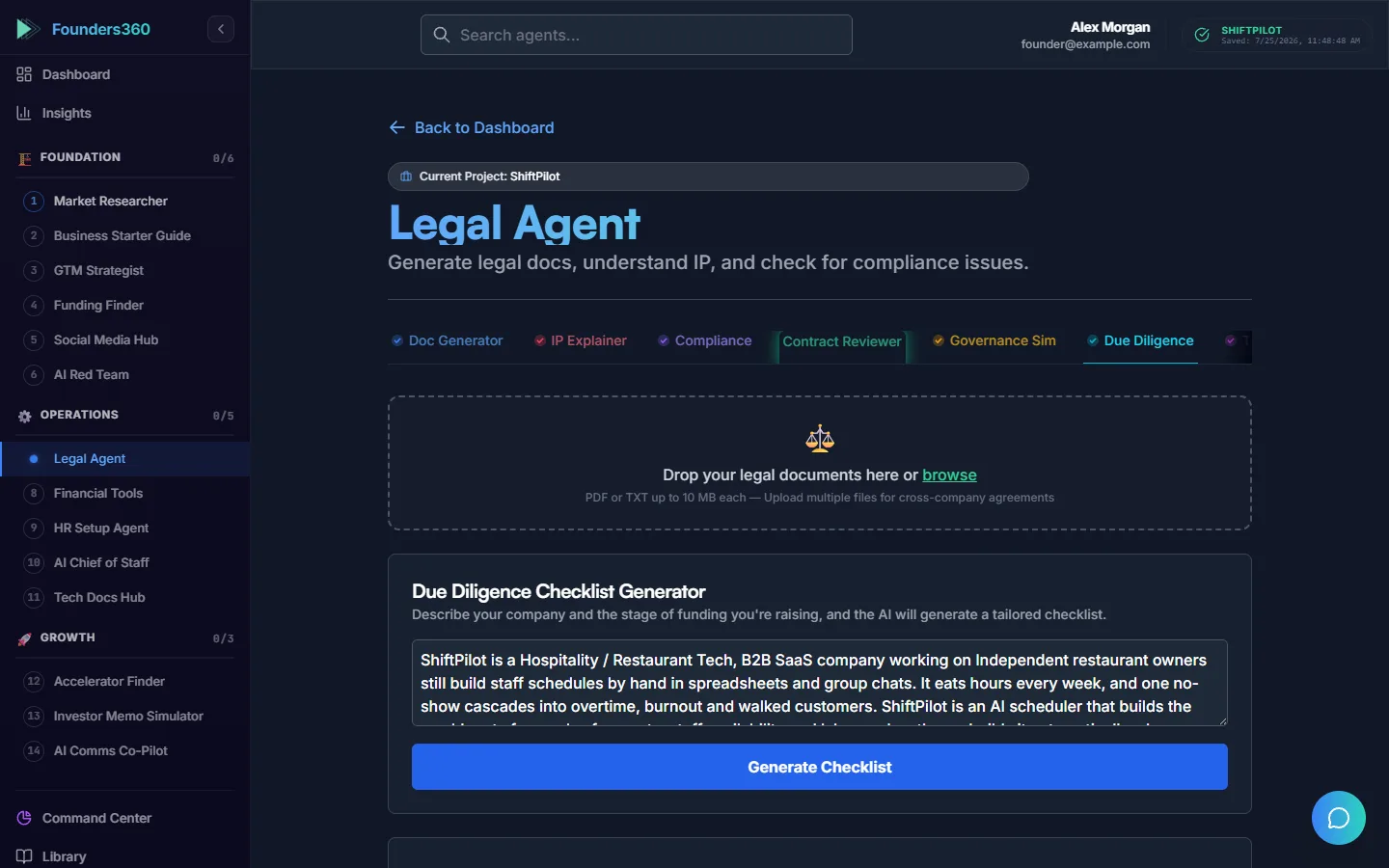
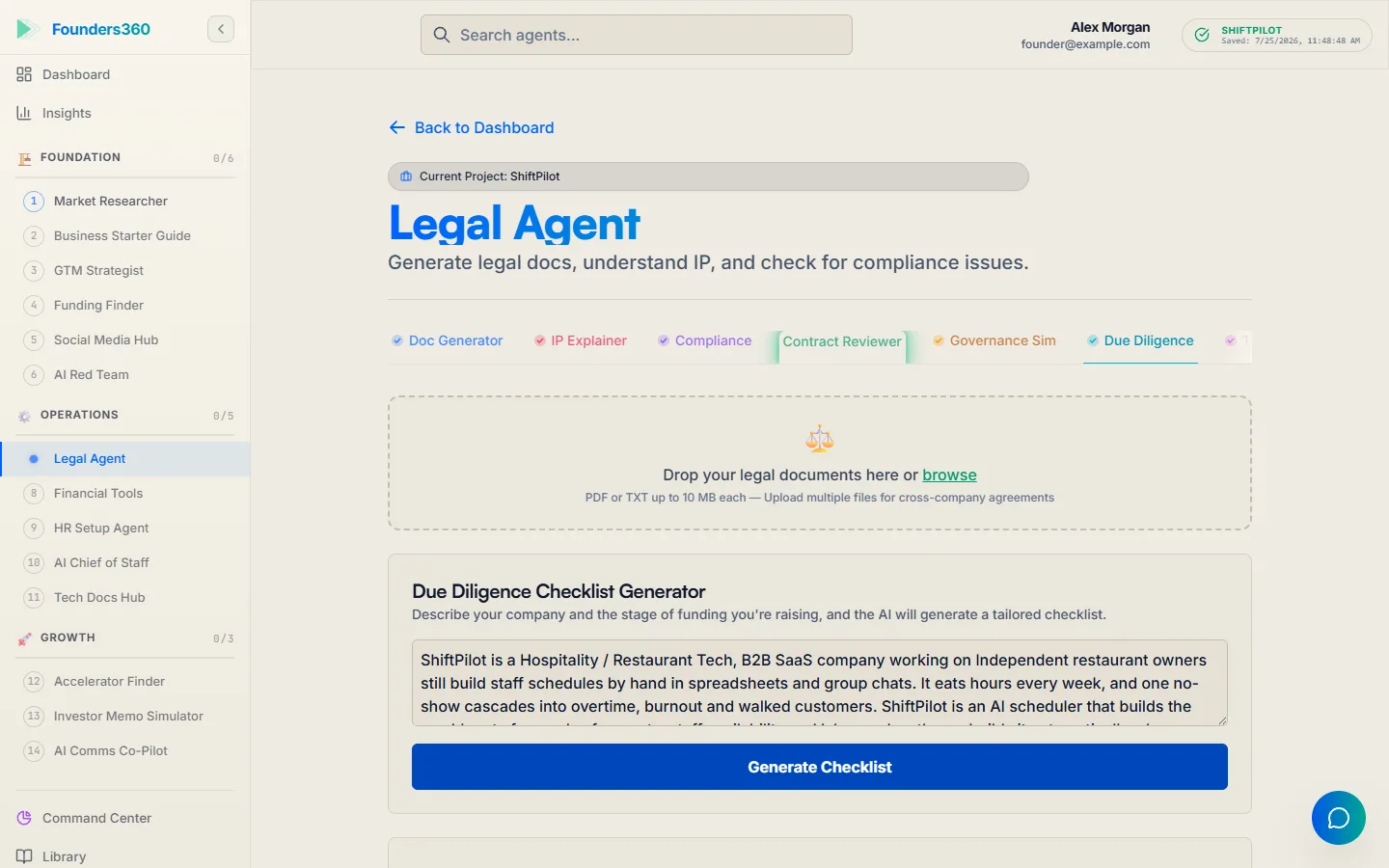
A drafting aid can save time. The Founders360 Legal Agent is one option, and our list of AI legal tools for startups compares other options. Whatever you use, treat the draft as a starting point and have a lawyer check it, as we explain in our note on human review of AI output.
What should startup terms of service cover?
Your terms should cover who may use the product, what is allowed, what you promise, what you do not promise, and how disputes are handled. Unlike a privacy policy, there is no single law that lists the clauses, so match them to your business.
Common sections include:
- Who can use it. Minimum age and whether business use is allowed.
- Accounts. Users keep passwords safe and give accurate information.
- Acceptable use. What users must not do, such as break the law or attack the service.
- Payment and cancellation. If you charge, how billing, renewals, refunds and cancellation work. Make this match what your checkout says.
- Ownership. You keep your software and brand, and users keep their own content, with a license for you to run the service for them.
- Disclaimers and limits. What you do not guarantee and how far your liability goes. The rules on what a limit can cover differ by country, so this is a section a lawyer should review.
- Disputes and governing law. Which country's or state's law applies, and how disagreements are handled.
Terms only help if users can find and accept them, so use a clear checkbox or sign-up line with links, and record which version each user accepted.
How do you keep your legal pages up to date?
Review them whenever you add a tool that touches personal data, enter a new country or change your pricing, and at least once a year. A policy goes stale the day you add a new analytics tool, a new payment provider or a new AI feature.
A short routine helps:
- Keep a simple list of every service that receives user data.
- Review the list each quarter and update the policy to match.
- Tell users about significant changes, since the OPC guidance advises new consent for new purposes.
If you are setting up your company at the same time, see how to incorporate a startup without a lawyer for the order of the early legal steps.
Keeping your launch list in one place makes the quarterly review easier to remember.
Frequently Asked Questions
Do I need both a privacy policy and terms of service?
Yes, in almost every case. The privacy policy covers personal data and is required by privacy laws in many places, while terms of service set the rules of use and protect you in a dispute. They do different jobs, so one document cannot replace the other.
Can I copy another company's privacy policy?
You should not. Your policy must describe your own data practices, and a copied one will list tools and purposes that are not yours. Use another policy only as a reference for structure, then write your own from a list of what you really collect.
Does GDPR apply if my startup is not in Europe?
It can. The regulation applies to processing of data of people in the EU when you offer them goods or services or monitor their behavior there, even if your company is outside the EU, according to Article 3. If you target or accept European users, plan for it.
Does CCPA apply to my early startup?
Only if you do business in California and meet one of its thresholds: gross annual revenue over $26,625,000 (adjusted from $25 million in 2025), handling the personal information of 100,000 or more California residents or households, or earning 50 percent or more of revenue from selling that information, per the California Attorney General and the CPPA. Many early startups are below all three, but check as you grow.
What does PIPEDA mean for a small business in Canada?
It requires private-sector organizations that collect, use or disclose personal information to follow 10 fair information principles, including consent, limited collection and openness. Provincial laws in Alberta, British Columbia and Quebec may apply instead within those provinces, according to the OPC.
Tags
Related Articles
Break-Even Analysis for Startups: How to Calculate Your Break-Even Point
Your break-even point is the amount you must sell before revenue covers all of your costs. This guide gives the formula, a step-by-step worked example with illustrative numbers, and shows how changes in price, cost and target profit move the result, so you can set realistic sales goals.
7 min readGuidesCompetitor Analysis for Startups: How to Do One, With a Template
A competitor analysis lists who your customers could choose instead of you, records what each offers, charges and does badly, and shows where you can win. This guide gives a seven-step method, a template table to copy, and advice on where to find reliable information.
8 min readGuidesBookkeeping Basics for Startup Founders: Accounts, Records and Cash vs Accrual
Bookkeeping is the habit of recording every dollar that comes in and goes out of your company so you can pay taxes, report to investors and make decisions. This guide covers separate accounts, a simple chart of accounts, cash versus accrual, a monthly routine and record retention periods.
9 min readReady to Build Smarter?
Join thousands of solopreneurs using AI agents to scale their businesses.
Get Started Free