
Non-Dilutive Funding for Startups: Grants, Loans and Revenue-Based Financing Compared
Non-dilutive funding for startups is capital you raise without selling equity. This guide compares grants, loans, revenue-based financing, venture debt and customer funding so you can pick what fits your stage.
By Founders360 Team
Non-dilutive funding for startups is money you raise without giving up any ownership: grants, loans, revenue-based financing, venture debt, competition prizes and customer prepayments all qualify. It beats equity when you can predict how you will use and repay the money, or when a program funds exactly the work you were going to do anyway. This guide compares each type, what it asks of you, and where it quietly costs more than it looks.
Every program fact below was checked against an official source in October 2026. Confirm current terms before you apply.
What is non-dilutive funding, and when does it beat equity?
Non-dilutive funding is capital that does not add shares to your cap table, so your ownership percentage stays where it is. It beats equity in three situations: your milestone is technical and a public program pays for it, your revenue is steady enough to service debt, or a customer will pay before you build.
Non-dilutive money is not free, though. Grants cost time and paperwork. Loans cost cash flow and sometimes personal liability. Revenue-based financing takes a slice of every month.
What are the main types of non-dilutive funding?
There are five practical types: government grants and R&D programs, startup and small-business loans, revenue-based financing, venture debt, and customer or competition money. They differ most on what you must already have, such as technology, revenue or an equity round.
The table below summarises them. It carries no dollar figures on purpose, because limits vary by program and change often.
| Type | Best for | Typical requirements | Cost and trade-off | |---|---|---|---| | Government grants and R&D programs | Technical startups with a defined research goal | Registered small business, a research plan, often a long application | No equity taken, but slow, competitive and tied to approved work | | Small-business loans | Founders with a plan and some track record | Credit history, often a personal guarantee, sometimes revenue history | Fixed repayments regardless of how the business does | | Revenue-based financing | Companies with steady recurring revenue | Real, predictable monthly revenue | Percentage of revenue until a cap is repaid, which strains margins | | Venture debt | Startups that recently closed an equity round | Institutional investor backing | Interest plus often warrants, and covenants to respect | | Competitions, stipends, customer prepayments | Pre-revenue or early-revenue teams | A strong story, a working pilot, a customer with a problem | Small or uneven, but the cheapest money you can find |
How do government grants and R&D programs work?
Government programs fund specific technical work and take no ownership. They suit startups building something hard, and they reward patience, because the application is slow and the competition is real.
United States. The Small Business Innovation Research (SBIR) and Small Business Technology Transfer (STTR) programs, described on sbir.gov as America's Seed Fund, give federal agency funding to American small businesses developing technology. The site calls the awards "equity free" and "non-dilutive." As of April 2026, sbir.gov lists the standard award ceiling without SBA approval at up to $323,090 for Phase I and up to $2,153,927 for Phase II, with higher awards needing a waiver. Each agency runs its own solicitations, so you apply to a published topic.
Canada. The National Research Council's Industrial Research Assistance Program (IRAP) provides funding for research and development of technology-driven products and services. According to the NRC, your business must be incorporated, for-profit and operating in Canada with up to 500 full-time-equivalent employees. It does not support sole proprietorships, partnerships, cooperatives, ULCs or LLCs. Funding typically comes only after an advisory stage, and the NRC states plainly that it is not guaranteed.
Canada's second route is the Scientific Research and Experimental Development (SR&ED) tax incentive, which you claim through your income tax return as a deduction or an investment tax credit. Per the Canada Revenue Agency, qualifying Canadian-controlled private corporations can receive a 35% enhanced credit that is fully refundable on current expenditures, up to an expenditure limit of $6 million for tax years beginning on or after December 16, 2024. Because it is a tax claim, you are paid after you spend.
United Kingdom. Innovate UK runs competitive grants for innovative businesses. We have not verified its current open competitions for this article, so check its site directly.
The trade-off across all of these: the money follows the program's goals, not yours. If a grant pulls you toward research your customers do not need, it is a distraction with a paycheck attached. For a broader list with deadlines, see our guide to grants for early-stage startups in 2026.
Are startup and small-business loans a good idea?
Loans are a good idea when you have a predictable way to repay and a specific use for the money. They are a poor idea as a substitute for finding product-market fit, because the repayment schedule does not care whether you found it.
United States. The U.S. Small Business Administration says microloans go up to $50,000, with an average of about $13,000 and repayment terms up to seven years. Nonprofit intermediary lenders make the credit decisions. Funds can go to working capital, inventory, supplies, furniture, fixtures, machinery and equipment, but not to paying existing debts or buying real estate. The SBA 7(a) program goes much larger, with a maximum loan of $5 million, but the SBA says it does not lend directly: it guarantees loans made by participating lenders, and you apply through a local lender.
Canada. The Business Development Bank of Canada (BDC) lists a start-up financing product of up to $150,000 and a small business loan of up to $350,000. Its general guidance is that financing suits businesses with at least 12 months of revenue and at least $100,000 in annual sales, and newer businesses are referred to partners. BDC also offers a loan for tech companies at any growth stage that does not require giving up shares.
Read any personal guarantee clause before you sign: it turns a company problem into a household problem.
How does revenue-based financing work, and who is it for?
In revenue-based financing, a provider advances you cash and you repay it as a fixed percentage of monthly revenue until you have paid back an agreed total. When revenue is high you repay faster, and when it dips you repay slower. No shares change hands.
It suits companies with recurring revenue that is already steady, such as subscription software, because the provider is underwriting your revenue, not your idea.
It does not suit pre-revenue companies, because there is nothing to take a percentage of. It also fits poorly if your gross margins are thin: a slice of revenue taken before you pay costs can leave you short on cash exactly when you want to grow. Always convert the offer into a total repayment amount and compare it with what the same cash would cost as a loan.
It is a private market with no official terms, so we quote no rates or caps. Ask any provider for the full repayment total in writing.
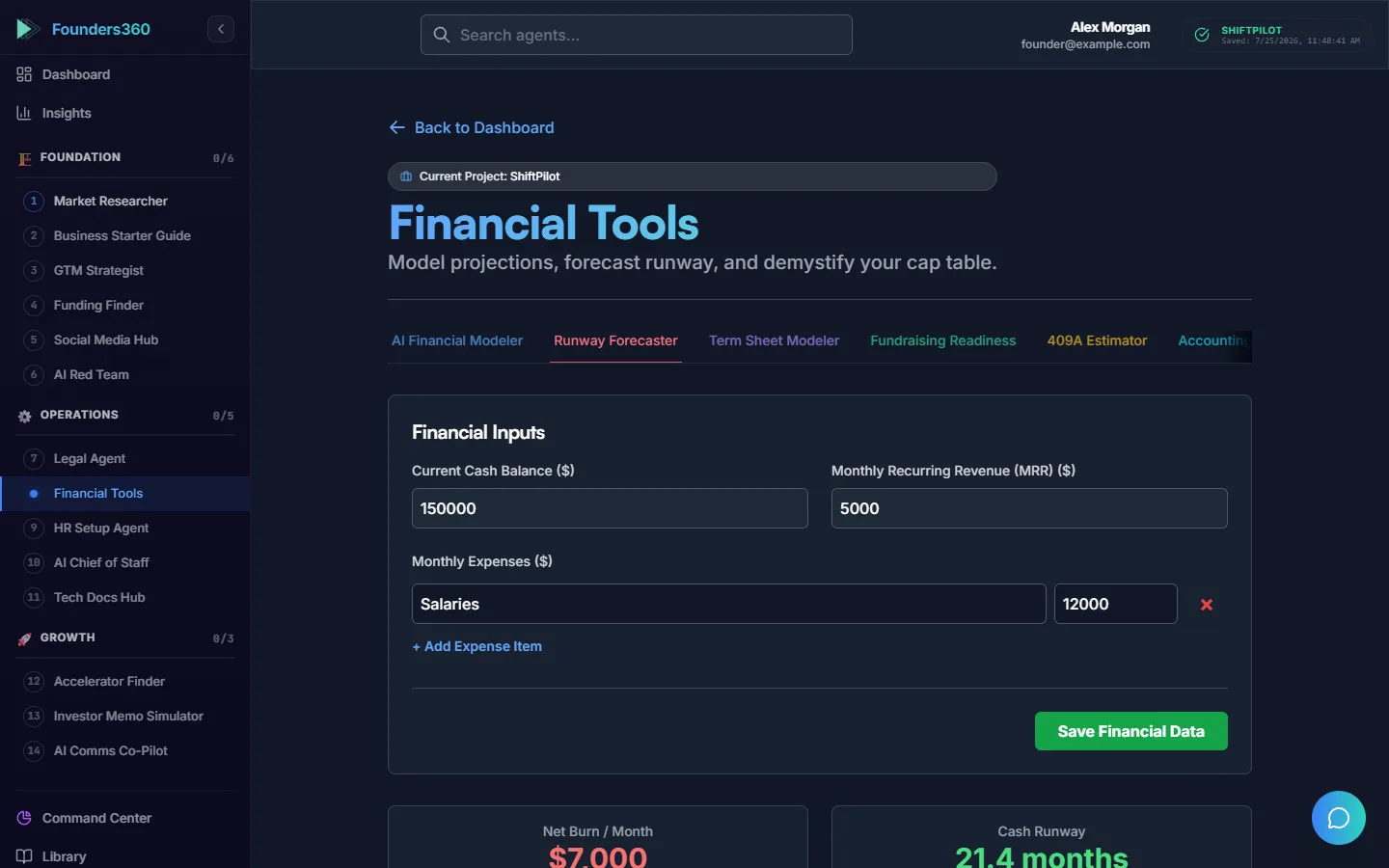
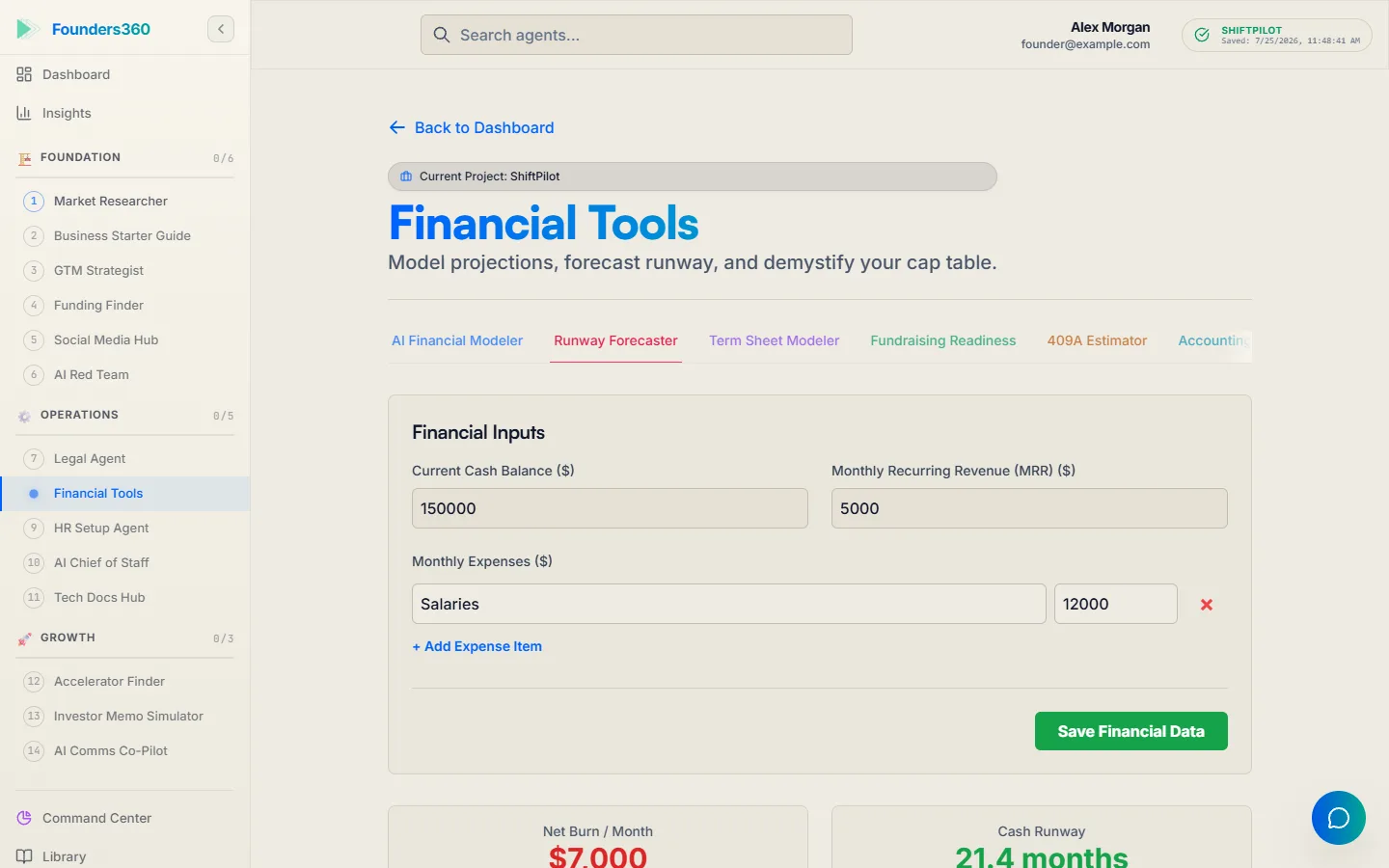
Model what repayment does to your cash first. Our guide to runway and burn rate shows how to test whether a fixed monthly drag still leaves you enough months of runway.
What is venture debt, and when should you consider it?
Venture debt is a loan from a specialist lender to a startup that already has venture backing. You should consider it only after an equity round, when it can extend your runway between rounds without selling more shares.
Lenders in this space generally lend against the strength of your investors and your cash position, not against assets. Terms commonly include interest, a request for warrants (a right to buy a small amount of equity later) and covenants, which are conditions you must keep meeting. Because warrants and covenants vary by lender, we do not quote typical numbers.
Venture debt must be repaid whether or not your next round closes. For most pre-seed founders this is not an option yet. If you are planning that first round, start with our pre-seed fundraising guide.
Can competitions, accelerators and customers fund your startup?
Yes, and for many founders these are the best first dollars. Pitch competitions and accelerator stipends are small and uneven, but they come with no repayment and often with introductions. Customer prepayments and paid pilots are better still, because they prove demand while they fund you.
A paid pilot forces a real conversation about price. If a customer will not pay anything for one, you have learned something no grant application would tell you. Annual prepay discounts, deposits and design-partner agreements are versions of the same idea: the customer is your lender, repaid in product.
Many accelerators take equity, so check terms before counting the money as non-dilutive. Our guide to choosing a startup accelerator covers what to compare.
How do you pick the right non-dilutive source?
Pick by your stage and by what you can prove, then match the money to the milestone. Pre-revenue technical teams should look at grants and competitions. Teams with steady revenue can consider loans or revenue-based financing. Teams with a fresh equity round can consider venture debt. Everyone should try customer money first.
Ask four questions of any offer: what must I do to get it, what must I repay and when, what do I give up besides shares, and how many months until the cash arrives. Grants often fail the last one.
Funding Finder screens grants and investors using your company context, so the list reflects your stage, location and sector instead of a generic directory. The Business Starter Guide, one of the four agents that are free forever, helps you set up the company foundation that most applications ask about first, such as your structure and plan.
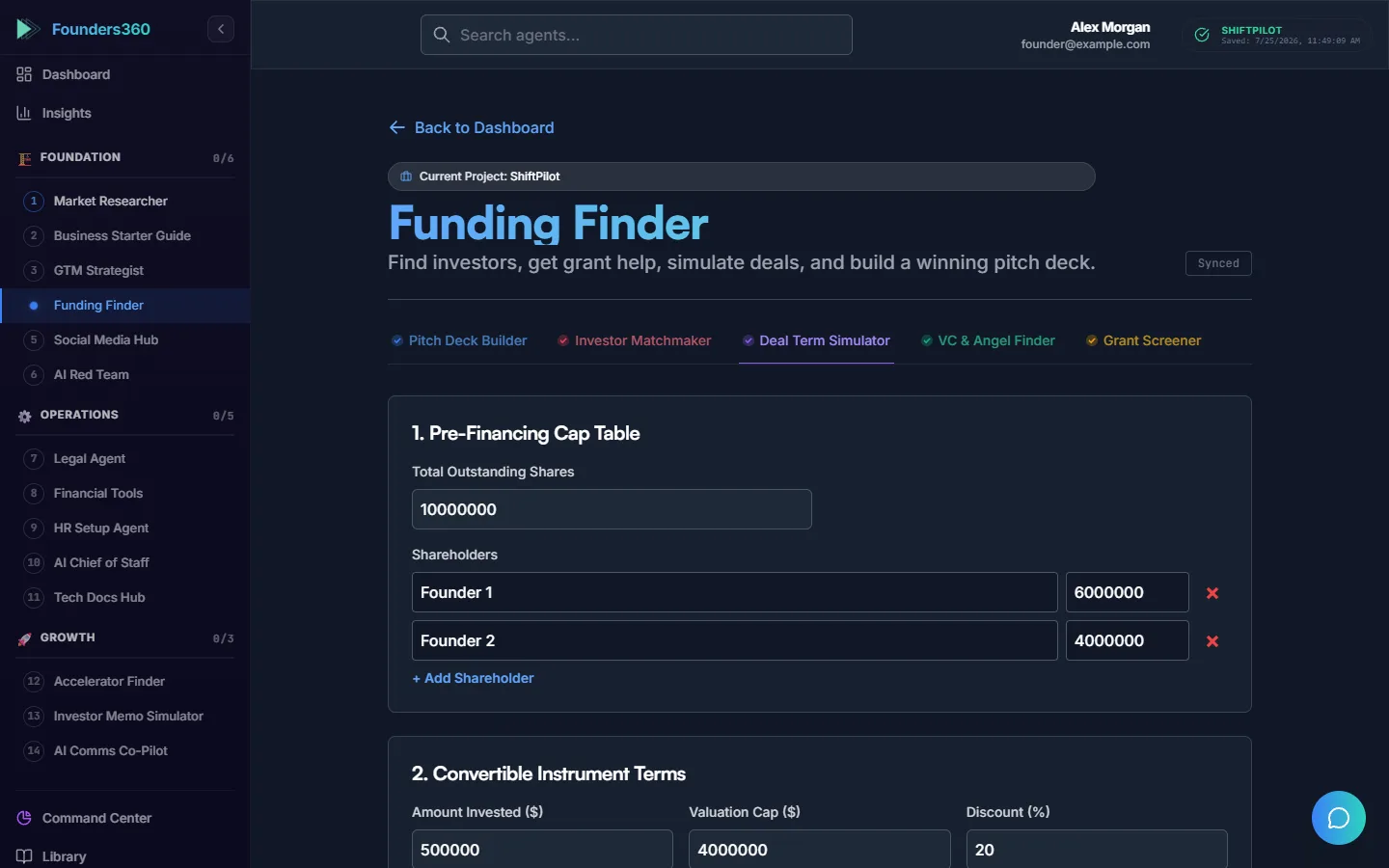
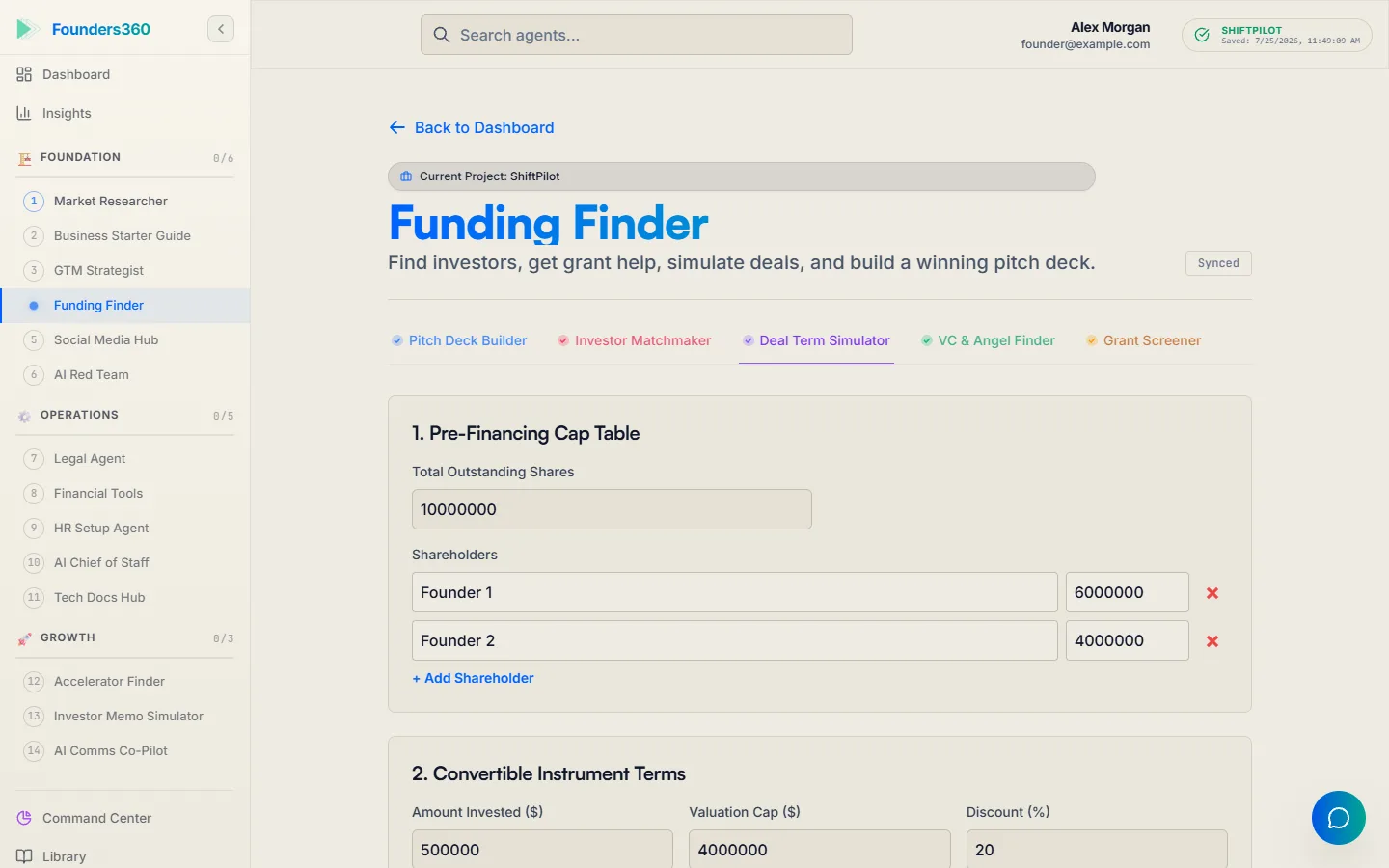
If you are still deciding whether to raise outside money at all, read our bootstrapping versus venture capital framework first. Non-dilutive money often lets you stay in the bootstrapping lane for longer.
Frequently Asked Questions
What is non-dilutive funding?
Non-dilutive funding is money you raise without issuing shares, so your ownership percentage does not change. Examples include government grants, loans, revenue-based financing, venture debt, competition prizes and customer prepayments.
Is non-dilutive funding better than equity?
It is better when you can carry the cost it brings, such as paperwork for a grant or repayments for a loan. It is worse when the cost, such as a fixed monthly payment, would threaten your survival. Many founders use both over time.
Do SBIR and STTR awards take equity?
No. According to sbir.gov, the awards are equity free and non-dilutive. As of April 2026, the site lists standard ceilings of up to $323,090 for Phase I and up to $2,153,927 for Phase II, with higher amounts needing a waiver.
Can a pre-revenue startup get revenue-based financing?
Generally not, because repayment is a percentage of revenue and the provider underwrites your revenue. It fits companies with steady recurring revenue. Pre-revenue teams usually look to grants, competitions and customer pilots first.
Where can I find non-dilutive funding that fits my startup?
Start with the official program sites, such as sbir.gov in the United States and the NRC and Canada Revenue Agency pages in Canada. Funding Finder in Founders360 also screens grants and investors from your company context, and it is part of a free-to-start product.
Tags
Related Articles
Term Sheet Explained: The Clauses Founders Must Understand Before Signing
A term sheet explained simply is a short, mostly non-binding offer that fixes the price and the control terms of a venture round. Most clauses are standard; a handful of economic and control terms decide who really wins.
7 min readFundraisingSAFE vs Convertible Note: Which Should Your Startup Use?
In a SAFE vs convertible note choice, the SAFE is simpler because it is not debt and has no interest or maturity date, while a note is a loan that converts into equity. This guide compares the terms side by side and shows when each one fits.
7 min readFundraisingHow to Write an Executive Summary for Investors (With Template)
To write an executive summary for investors, fit your problem, solution, market, traction, model, competition, team and ask on one page that a stranger can read in two minutes. This guide gives the order, a fill-in template and an illustrative example.
7 min readReady to Build Smarter?
Join thousands of solopreneurs using AI agents to scale their businesses.
Get Started Free