
Competitor Analysis for Startups: How to Do One, With a Template
A competitor analysis lists who your customers could choose instead of you, records what each offers, charges and does badly, and shows where you can win. This guide gives a seven-step method, a template table to copy, and advice on where to find reliable information.
By Jay Kambo
A competitor analysis is a short, written comparison of the businesses your customers could choose instead of you, covering what they offer, what they charge, who they serve and where they fall short. Done well, it takes a few days, fits in one table, and tells you where you can win. This guide gives you a seven-step method and a template table to copy for your own competitor analysis.
What is a competitor analysis and why do startups need one?
A competitor analysis is a structured look at the alternatives your customers have, so you can decide where to compete and where to stay away. It is not a hunt for a rival to copy, and it is not a reason to give up if you find that others exist. Competitors are often a sign that the problem is real.
The US Small Business Administration lists what a business should find out about competitors in its guide to market research and competitive analysis. The list includes competitors by product line and market segment, their market share, their strengths and weaknesses, your window of opportunity to enter the market, the barriers that could stop you, and indirect or secondary competitors who could affect your success. The SBA also suggests looking at what successful competitors do, why it works, and whether you could do it better.
For a startup, the main payoff is focus. You learn which customers are well served and which are not, what buyers already pay, and which claims are crowded. That feeds directly into your pricing, your message and your choice of first customer. Our guide to writing a startup positioning statement shows how to turn the findings into a sentence customers remember.
Who counts as a competitor?
A competitor is anything your customer could use instead of you, not only companies that sell a similar product. Stripe's guide to market positioning defines direct competitors as those that "offer products or services similar to yours," and indirect competitors as those that "satisfy the same customer needs but in different ways."
Think of three groups:
- Direct competitors. Businesses that sell nearly the same thing to the same customer. A local bakery has other bakeries as direct competitors.
- Indirect competitors. Businesses that meet the same need another way. The same bakery competes with a supermarket aisle and with a customer baking at home.
- The status quo. Doing nothing, using a spreadsheet, asking a friend, or hiring a freelancer. For many new products the real rival is the status quo, and it is free.
The SBA page also points out that you should consider other industries competing for the same market and the threat of new competitors. When you build your list, include local, national and global players where they matter to your customer. Start with five to eight names. A longer list is usually a sign you have not yet defined your customer.
How do I do a competitor analysis step by step?
Follow seven steps: list, gather, compare, assess, map, find gaps and set a review date. The steps below adapt the guidance in Stripe's guide and the SBA page for a small team with little time.
- List direct and indirect competitors. Write down every name, including the status quo, in one column of a table.
- Review their offers. Stripe suggests examining features, marketing, sales tactics, pricing and distribution channels. Visit their sites, sign up for free trials, and read their help pages.
- Assess strengths and weaknesses. Stripe recommends running a strengths, weaknesses, opportunities and threats review for each main competitor. For a small team, a plain list of what they do well and what they do poorly is enough. Our guide to the AI SWOT analysis generator covers the longer version.
- Map how each is positioned. Note the value each competitor claims and how customers see them. The words on their homepage show the claim, and reviews show the perception.
- Look for gaps. Which customers, jobs or price points are poorly served? A gap is a customer group that complains, or a need nobody mentions.
- Decide where you will compete. Choose one or two points of difference that matter to your first customer, and be honest about the areas where you will not compete yet.
- Track changes. Stripe advises monitoring competitors' launches, campaigns, price changes and expansion. Set a date every quarter to update the table.
Keep the work in proportion. A first competitor analysis should take a few days, not a month. You will update it as you learn from customers.
What is a good competitor analysis template?
A good template is a table with one row per competitor and the same columns for each, so you can compare them at a glance. Copy the table below into a spreadsheet and fill it in. The rows are placeholders, not real companies.
| Competitor | Type (direct, indirect, status quo) | Who they serve | Main offer | Price and model (date checked) | Strengths | Weaknesses | How they position themselves | Our opening | |---|---|---|---|---|---|---|---|---| | Competitor A | Direct | Small teams | Core product | Monthly per user, checked on a date | Well known, simple setup | Few reports, slow support | Easy for everyone | Specialised reports for one industry | | Competitor B | Direct | Larger firms | Full suite | Annual contract, checked on a date | Many features | Complex, expensive | Everything in one place | Faster setup for small firms | | Spreadsheet | Status quo | Anyone | Manual tracking | Free | Familiar | Errors, no reminders | Not applicable | Automatic reminders | | Competitor C | Indirect | Freelancers | Adjacent tool | One-off fee, checked on a date | Cheap | Does only part of the job | Simple and cheap | Complete job in one place |
Add columns that matter to your business, such as the countries they serve, the channels they sell through, or how long they have operated. Remove columns you will not fill in. An unfinished column of guesses is worse than no column.
Always write the date next to prices and claims. Competitor prices and plans change often, and a table without dates quickly becomes untrustworthy.
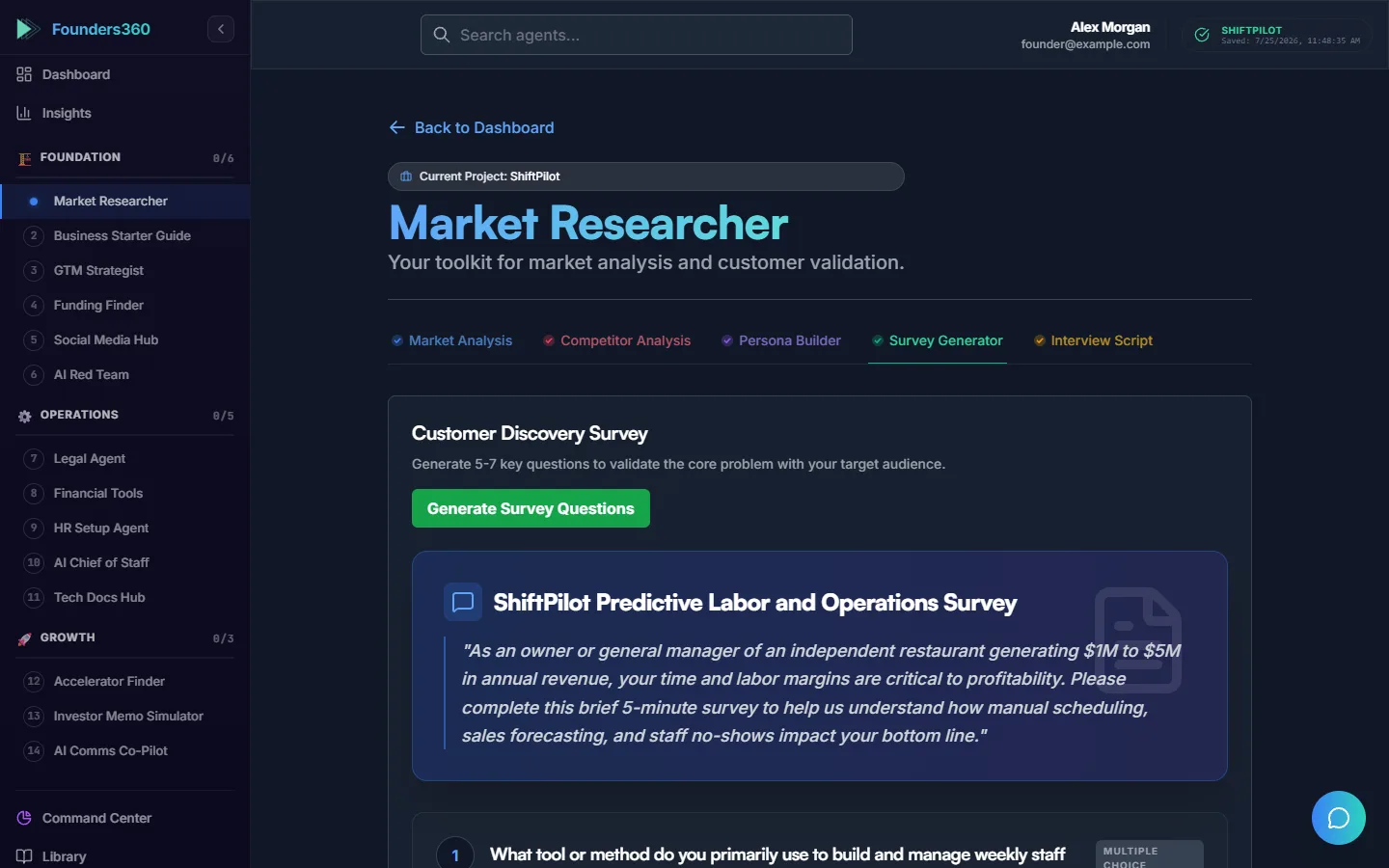
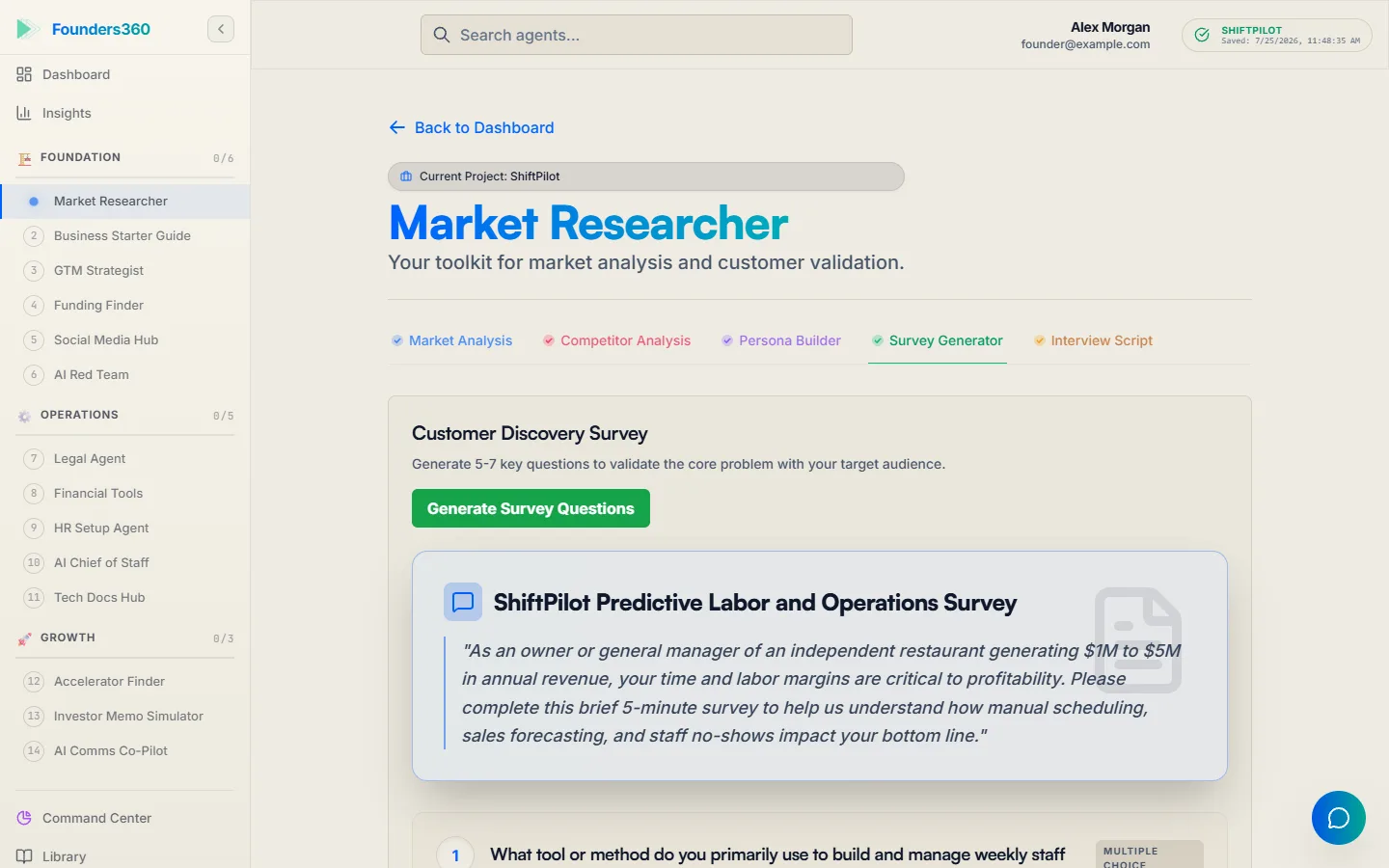
The Founders360 Market Researcher agent can support general market research while you fill in the template, though you should still check each claim against the competitor pages themselves.
Where can I find reliable information about competitors?
Start with what competitors publish, then add what their customers say, then add what industry sources report. Stripe suggests drawing on industry reports, customer reviews, social channels, public financial records and news coverage.
Useful places:
- Their own website and pricing page. Save screenshots with the date.
- Product trials and demos. Use the product as a customer would and note where you get stuck.
- Customer reviews. Look for repeated complaints, since they point to gaps. The SBA suggests asking customers where they might go instead of your business, which is a direct way to learn who the alternatives are.
- Job postings. They show what a competitor plans to build or sell.
- Official records and public filings. Registered businesses and public companies publish accounts in many countries, though what is available differs between the US, Canada, the UK and the UAE.
- Your own conversations. Ask every prospect what they use today and why they chose it. This is often the best source, and it is free.
For a wider overview of how AI can speed up research, see our complete guide to AI market research and the list of the best AI market research tools for startups. AI can help you collect and summarise, but check the facts that matter, since a summary can be wrong or out of date.
How do I turn the analysis into decisions?
Use the table to choose your first customer, your main point of difference and your price range. An analysis that stays in a spreadsheet changes nothing.
Ask four questions of your completed table:
- Which customer group has the most complaints about the current options? That group is a candidate for your first customers.
- Which strength do all competitors share? That is the price of entry, and you will need to match it.
- Which weakness appears in more than one competitor? That is your best opening.
- Where do prices cluster? Your price should sit inside the range or above it for a clear reason.
Write one sentence for each answer and put them into your positioning, your pricing and your sales calls. Then test the claims with customers. An opening that looks good in a table can fail if customers do not care about it, which is why real conversations matter more than research.
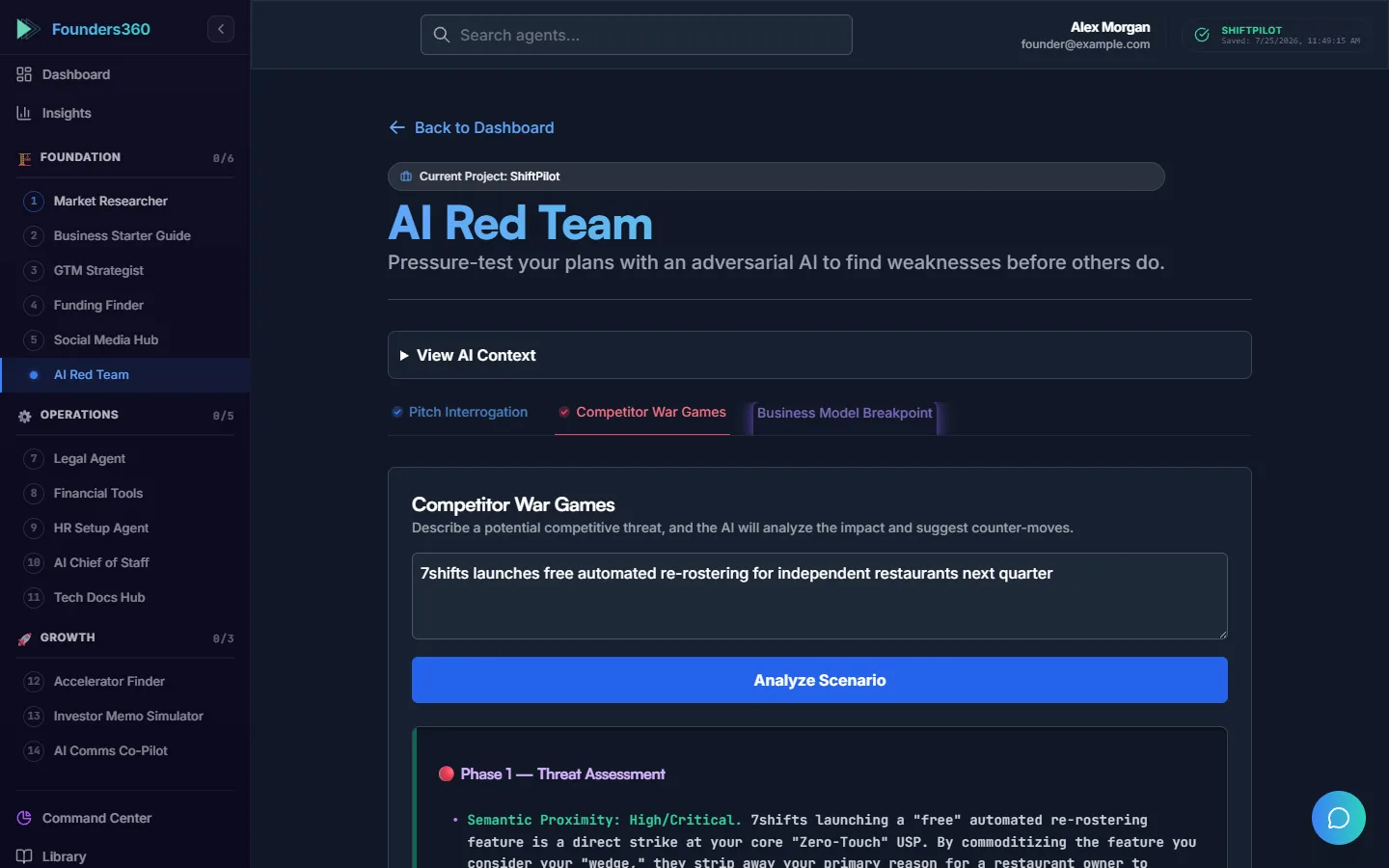
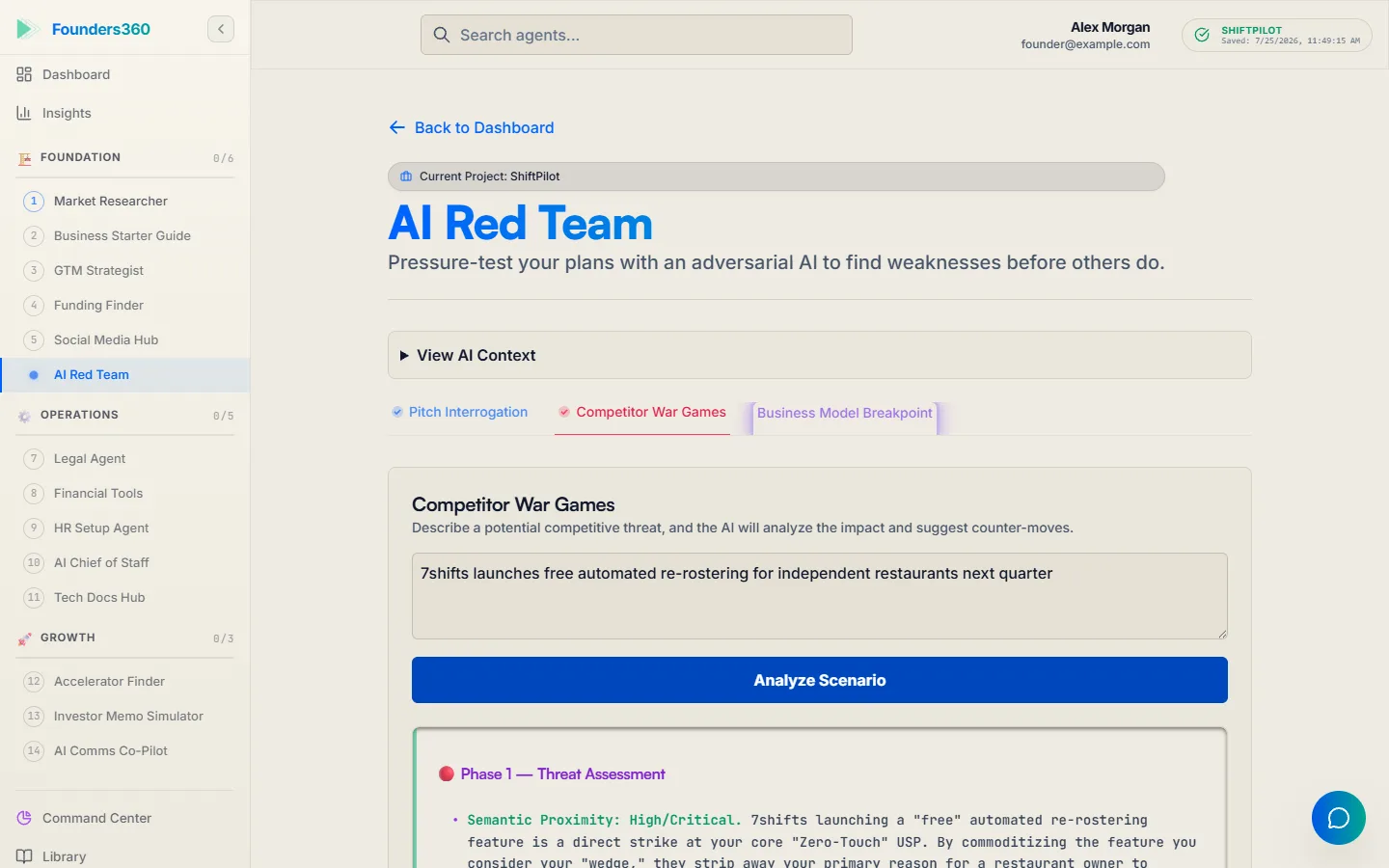
Stress-test your conclusions too. The Founders360 AI Red Team agent is built for stress-testing ideas, which can help you find holes before an investor or a buyer does. Ask yourself, too, who customers would use instead of you.
What mistakes should I avoid in a competitor analysis?
The biggest mistakes are ignoring the status quo, copying competitors and never updating the work. Watch for these.
- Saying you have no competitors. It usually signals a gap in research. If nothing else exists, ask why customers have not solved the problem, and what they do instead.
- Counting features instead of results. A longer feature list does not mean a better outcome for the customer.
- Copying. A rival may have different costs, customers and goals. Match what customers expect, then differ where it helps them.
- Relying on one source. A homepage shows what a company wants you to believe, not what customers experience. Cross-check with reviews and your own calls.
- Forgetting dates. Plans and prices change. An undated table gets stale without anyone noticing.
- Fear. A large competitor is not the end. Large firms often ignore small segments, which is where a startup can start.
Frequently Asked Questions
How many competitors should I analyse?
Five to eight is enough for a first pass: a few direct competitors, one or two indirect ones and the status quo. A longer list usually means your customer definition is too broad.
What is the difference between a competitor analysis and a SWOT analysis?
A competitor analysis compares several businesses on a range of factors, while a SWOT analysis looks at strengths, weaknesses, opportunities and threats for one business. Stripe suggests using a SWOT review for each main competitor as one step within the wider analysis.
How often should I update my competitor analysis?
Review it at least once a quarter, and sooner if a competitor launches something, changes prices or raises money. Date every entry so you can see what is current.
What if I find that someone already does exactly what I plan to do?
It is useful news. It shows demand exists. Look at who they serve badly, what customers complain about and where they are expensive or slow, then decide whether you can serve a narrower group better or differently.
Can I do a competitor analysis for free?
Yes. Most of the information is public: websites, free trials, reviews, job postings and conversations with customers. Paid tools can save time, but they are not required for a first analysis.
Tags
Related Articles
Privacy Policy and Terms of Service for Startups: What Each One Must Cover
A privacy policy tells people what data you collect and why, while terms of service set the rules for using your product. This guide explains what each document should cover for a startup website or app, and the basics of GDPR, CCPA and PIPEDA.
9 min readGuidesBreak-Even Analysis for Startups: How to Calculate Your Break-Even Point
Your break-even point is the amount you must sell before revenue covers all of your costs. This guide gives the formula, a step-by-step worked example with illustrative numbers, and shows how changes in price, cost and target profit move the result, so you can set realistic sales goals.
7 min readGuidesBookkeeping Basics for Startup Founders: Accounts, Records and Cash vs Accrual
Bookkeeping is the habit of recording every dollar that comes in and goes out of your company so you can pay taxes, report to investors and make decisions. This guide covers separate accounts, a simple chart of accounts, cash versus accrual, a monthly routine and record retention periods.
9 min readReady to Build Smarter?
Join thousands of solopreneurs using AI agents to scale their businesses.
Get Started Free