
Startup KPIs to Track at the Early Stage (and the Ones to Ignore)
An early-stage startup should track one main metric that shows the value it delivers, plus three to five supporting numbers such as revenue, customers, churn, cash runway and the cost of winning a customer. This guide explains each one, how to calculate it, and which numbers to ignore for now.
By Jay Kambo
An early-stage startup or small business should track one main metric that shows how much value it delivers to customers, plus a short list of supporting numbers: revenue, customer count, customer retention, cash runway and the cost of winning a customer. That is usually enough. Tracking dozens of numbers makes it harder to see what matters. This guide explains which KPIs to track at the early stage, how to calculate each, and which numbers you can safely ignore for now.
What is a KPI and why should a startup track a few?
A KPI, or key performance indicator, is a number that shows whether a part of your business is healthy. Y Combinator partner Adora Cheung describes KPIs as "a set of quantitative metrics that indicate how healthy your business is doing," in her talk summarised in Y Combinator's Startup School recap.
The same recap makes a point that matters for a small team: tracking many numbers is fine, but optimising many at once is not. The speaker advises against trying to optimize too many metrics at once. A founder with two customers and a tight budget has limited time, so every number you track should lead to a decision you can make this week.
A good early KPI has three features. It is simple enough to explain in one sentence, it can be measured the same way every time, and it changes when you take an action. A vanity number, such as total website visits with no link to sales, fails the third test, because it rises and falls without telling you what to do.
What is the one main metric I should pick?
Pick the single number that best shows how much value customers get from your product, and be willing to bet the company on it. The YC recap says to pick only one primary metric, the one you would be willing to bet the whole company on, and that it should show how much value you deliver. It calls revenue "always the best metric," and says the primary metric should be a lagging indicator of success, meaning it reflects results that have already happened.
For many small businesses the main metric is revenue or monthly recurring revenue. For a service business it might be paid projects completed per month. For a product still looking for users, it might be the number of customers who use it every week, which is weaker than revenue but still useful when sales have not started.
Write the metric down, with a one-line definition and the exact way you will calculate it, so you and your co-founders count the same thing. If you later find that the metric does not reflect real value, change it, and record why you changed it.
Which supporting metrics should I track?
Pair the main metric with three to five supporting numbers. The YC recap recommends selecting "a set of three to five other metrics" to go with your primary one. For most early-stage startups, a good set looks like this.
| Metric | What it tells you | Simple way to calculate it | |---|---|---| | Revenue or monthly recurring revenue | Whether people pay | Sum of monthly-normalised subscription amounts, or total sales in the month | | Customer count | Whether the base is growing | Number of paying customers at month end | | Churn | Whether customers stay | Customers lost in a period divided by customers at the start | | Cash runway | How long you can keep going | Cash in the bank divided by monthly net cash loss | | Customer acquisition cost | What it costs to win a customer | Sales and marketing spend divided by new customers won |
Add a sixth, such as pipeline of qualified leads, only if you will act on it. The next sections explain the less obvious ones.

How do I measure monthly recurring revenue?
Monthly recurring revenue, or MRR, is the predictable revenue you earn each month from subscriptions, counted as a monthly amount. Stripe's help article on calculating MRR explains it as summing "the monthly-normalized amounts of all active subscriptions." Its example is that an annual subscription for 1,200 dollars counts as 100 dollars toward MRR.
Use MRR only if you sell subscriptions or retainers. If you sell one-off projects or products, track monthly revenue and the number of orders instead, and note how much of next month sales you can already see. Mixing one-off fees into MRR makes the number look steadier than it is.
Watch growth as well as the total. A simple monthly growth rate is this month revenue divided by last month revenue, minus one, shown as a percentage. In the early months the percentage swings widely because the base is small, so look at the trend over several months and not at a single jump.
What is churn, and why does it matter?
Churn is the share of customers, or of revenue, you lose over a period, and it tells you whether people keep finding value. Stripe defines subscriber churn in its Billing help article on churn rate: it occurs "when a subscriber goes from non-zero Monthly Recurring Revenue (MRR) to zero MRR." In plain words, a customer who used to pay and now pays nothing has churned.
A simple version for a small business: customers you lost in the month divided by customers you had at the start of the month. If you began with 20 customers and lost one, churn for the month was 5 percent. That example is illustrative, and your own number will depend on your business. Stripe uses a slightly different denominator in its Billing reports, counting active subscribers as of 30 days ago plus any new subscribers in those 30 days, so pick one method and keep it consistent.
Churn matters because it caps your growth. If you lose customers as fast as you win them, spending more on marketing just fills a leaking bucket. When churn is high, speak to the customers who left. Ask what they used before, what they do now, and what would have made them stay. Our guide to measuring product-market fit explains how to read retention and feedback together.
How do I track cash runway and burn?
Runway is the number of months your cash will last at your current rate of spending, and it is the one number that can end the company. Calculate it by dividing the cash in the bank by your monthly net burn, where net burn is what you spend minus what you earn.
If you have 30,000 in the bank and lose 5,000 a month, you have six months of runway (illustrative figures). Update the number every month and look at it alongside any money you expect to receive and any large payment you must make. Founders who watch runway early have time to cut costs, raise money or change course, while those who check late are left with no choices.
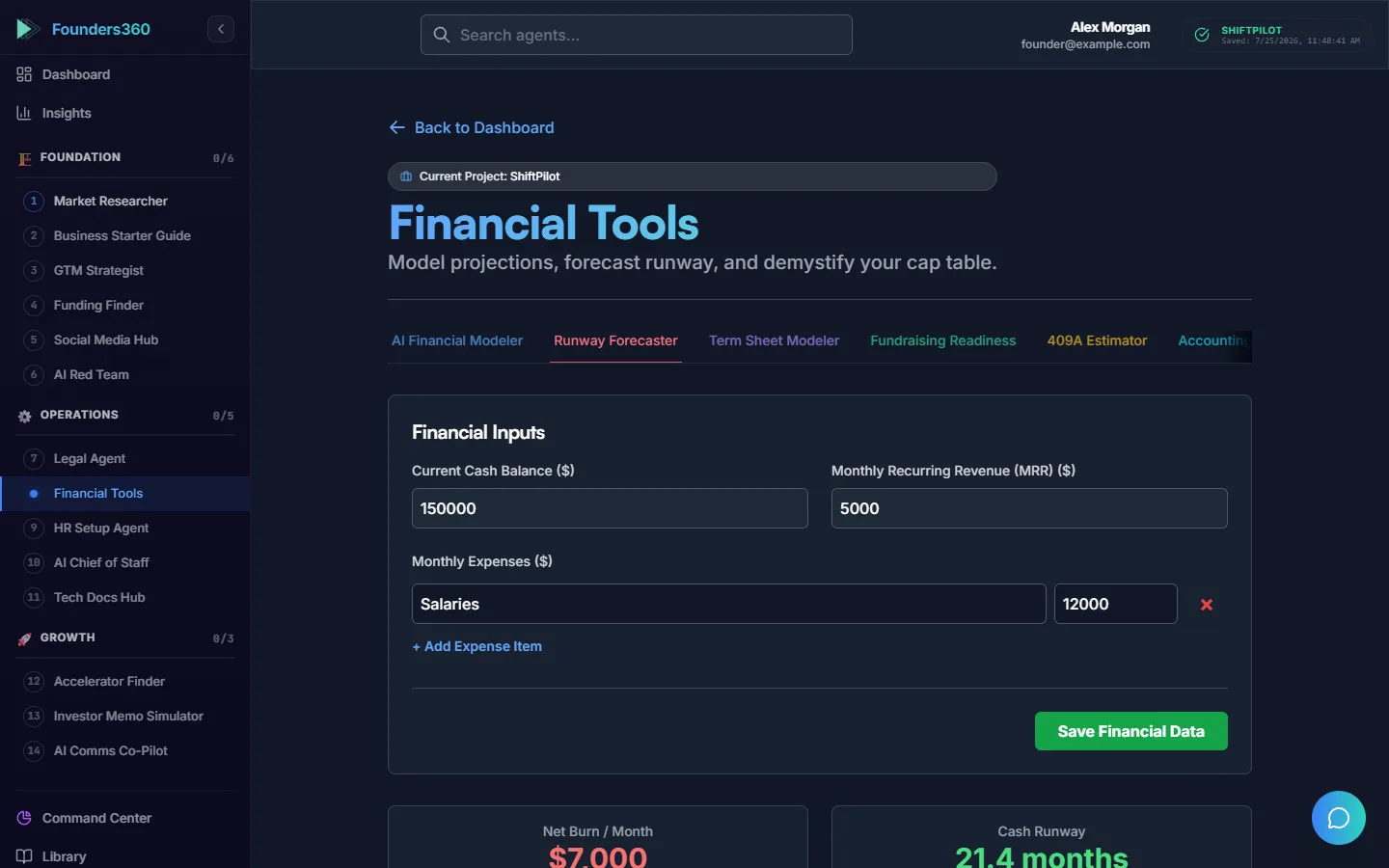
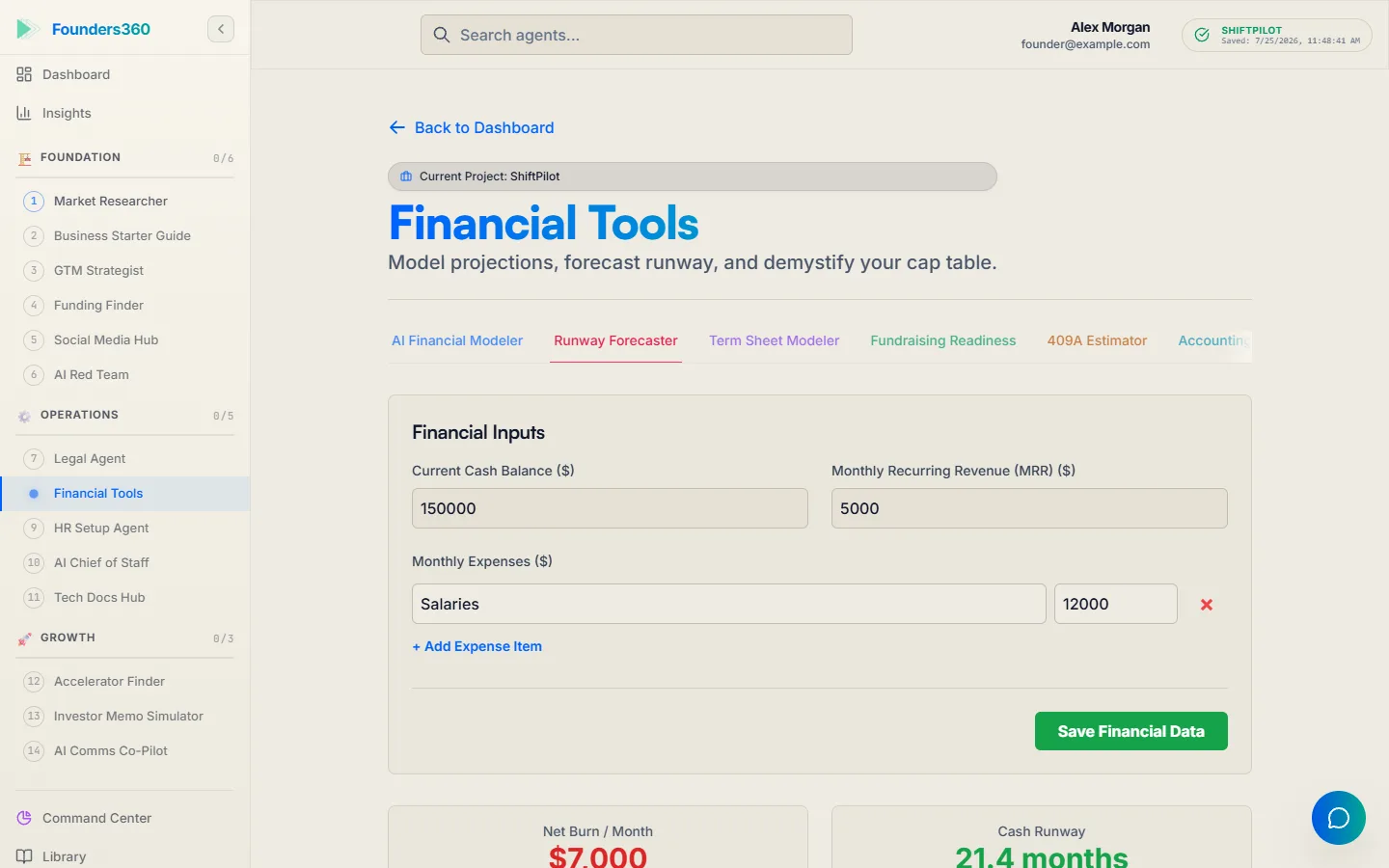
Our guide to startup runway and burn rate covers the calculation in more detail, including gross and net burn. If you want to see how a price, a customer count and your costs affect runway, build a simple model in a spreadsheet. The Founders360 Financial Tools agent is another option for general financial planning.
How do I know what a customer costs and what a customer is worth?
Compare what you spend to win a customer with the profit you make from that customer over time. Customer acquisition cost, or CAC, is your sales and marketing spend in a period divided by the number of new customers you won in that period. Include everything: advertising, tools, commissions and the value of your own time if you spend it on selling.
Customer lifetime value is the profit you expect from a customer before they leave. To keep it simple, multiply the average monthly profit from a customer by the average number of months they stay. With few customers the estimate is rough, so use it as a guide and not a promise.
If a customer costs more to win than they will ever bring in, you have a problem that more sales will make worse. If a customer brings in much more than they cost, you have room to spend more on growth. Our guide to unit economics for early-stage startups explains how to calculate and read these two numbers together.
How often should I review my startup KPIs, and which numbers can I ignore?
Review them weekly, with a short routine that ends in a decision. Set a fixed time, open the same sheet or dashboard, and look at the main metric and your supporting numbers. Write one line on what changed, one line on why you think it changed, and one action for next week.
Keep the review short, 20 to 30 minutes is enough for a small team. Our guide to a weekly operating cadence for early-stage founders shows how to build this into your week, including what to do on the days between reviews.
Ignore any number that does not lead to a decision this month. Common distractions in the early stage include:
- Total sign-ups with no activity data. They flatter you but do not show whether anyone uses the product.
- Social media followers. They are not customers unless you can link them to sales.
- Page views. They show attention, not purchases.
- Complex ratios before you have data. A lifetime value calculation based on two customers is a guess.
- Competitor numbers you cannot verify. Rumours about rivals do not belong on your dashboard.
You do not need to ignore these numbers forever. Just do not let them take over your weekly review. As you grow, add metrics that match your stage, and drop those you no longer use.
Keep a simple record of past numbers so you can see the trend. Where you use a tool for this, check the figures at least once against your bank account and your invoices, because a dashboard is only as good as the data behind it.
Frequently Asked Questions
What are the most important KPIs for an early-stage startup?
Pick one main metric that shows the value you deliver, usually revenue, and add three to five supporting numbers. A good starting set is revenue, customer count, churn, cash runway and customer acquisition cost.
How many KPIs should a startup track?
Fewer than you think. One primary metric plus three to five supporting metrics, as suggested in the Y Combinator Startup School material, is enough for most early teams. Tracking more is fine, but optimising many at once is not.
What is the difference between a KPI and a metric?
A metric is any number you can measure. A KPI is a metric you have chosen because it shows how a key part of the business is doing and leads to action. Every KPI is a metric, but most metrics are not KPIs.
What KPIs should a pre-revenue startup track?
Track evidence that people want what you are building: the number of customer interviews done, how many people describe the problem in the same way, sign-ups from your target group, and how many of them use the product again. Move to revenue metrics as soon as someone pays.
Should a small service business use the same KPIs as a software startup?
The ideas carry over, but the details change. A service business may track paid projects, average project value, repeat customers and the share of time spent on paid work. Use MRR only if you have retainers or subscriptions.
Tags
Related Articles
Email Marketing for Startups: Your First 1,000 Subscribers
A startup can reach its first 1,000 email subscribers by offering one useful thing, asking for permission clearly, and sending something worth opening. This guide covers where subscribers come from, what to send, and the CAN-SPAM, CASL and UK PECR consent basics.
9 min readGrowthSEO for Startups: A Practical First 90 Days Plan
SEO for a new startup is mostly a sequence of small, boring jobs done in the right order. This 90-day plan follows Google's own Search Central guidance: make the site findable, pick a few real questions, write helpful pages, tidy titles and links, and measure patiently.
9 min readGrowthHow to Measure Product-Market Fit: Signals, Surveys and Metrics
To measure product market fit, combine one survey (the share of users who would be very disappointed to lose your product) with a retention curve that flattens and organic growth you did not pay for. This guide shows each signal and a one-month scorecard.
7 min readReady to Build Smarter?
Join thousands of solopreneurs using AI agents to scale their businesses.
Get Started Free